Skip to content
cardamomnectar
Facebook X Instagram Pinterest TikTok
  • IntroductionExpand
    • Fennel Seeds: Nature’s Remedy for Better Digestion andWha Wellness
    • Cinnamon Spice: The Unmatched Guide to Its Benefits, Risks, and Culinary Uses
    • Cumin: Health Benefits, Culinary Uses, Essential Oils & More
  • How To GrowExpand
    • Fennel Bulb: The Ultimate & Nutritious Guide to Growing, Cooking, and Delicious Recipes
  • Substitutes
  • Cardamom Powder
  • Cardamom Tea
  • Blog
cardamomnectar
Cardamom Plant (Elettaria cardamomum): Anatomy, Flowers, Pods, Seeds | Elaichi Identification Guide
🌿 Comprehensive Botanical Guide

Cardamom Plant (Elaichi):
Morphology, Origin, Uses & Life Cycle

A deep dive into the cardamom plant — its anatomy, where it comes from, how every part is used, its unique adaptations, and how to identify it.

Olivia Turner, Spice Researcher and Food Writer OT
✍️ Written by
Olivia Turner
Spice Researcher & Food Writer
Dr. Michael Bennett, Botanist and Plant Scientist MB
🔬 Reviewed by
Dr. Michael Bennett
Botanist & Plant Scientist
✓ Fact Checked 📅 Updated March 2026 ⏱️ 12 min read
⚡ Quick Answer

What is the cardamom plant? Elettaria cardamomum is a perennial tropical herb in the ginger family, native to the Western Ghats of Kerala, India. It grows 6–15 ft tall from a spreading rhizome, produces white-purple flowers at ground level, and bears the aromatic green seed pods used worldwide as a spice. It lives 10–15 years and is also called elaichi (الائچی).

📋 In This Guide

  • Plant Overview & Classification
  • Is Cardamom a Tree or Plant?
  • Botanical Morphology & Anatomy
  • Labeled Diagram & Species Comparison
  • Flower, Pod & Plant With Fruit
  • Origin & Global Distribution
  • Uses of Every Plant Part
  • Life Cycle & Growth Stages
  • How to Identify Cardamom
  • Natural Habitat & Ecology
  • Frequently Asked Questions

Plant Overview & Botanical Classification

⚡ Cardamom Plant — Quick Facts (Identification Reference)
Scientific nameElettaria cardamomum Maton
Plant habitClumping perennial herb; pseudostems non-woody
HeightTypically 1.8–4.5 m (6–15 ft); varies with habitat
Leaf shapeLanceolate, 40–60 cm long; pinnate venation; glossy adaxial surface
Flower colorWhite/pale cream petals + violet-purple streaked labellum (orchid-like)
Flower locationGround level on prostrate panicles — separate from leafy pseudostems
Fruit typeTrigonal capsule (3-sided), green, 1–2 cm long
Seeds per capsule15–20 dark brown aromatic seeds (5–7 per locule × 3 locules)
Key aroma compounds1,8-Cineole (25–45%) + α-Terpinyl acetate (20–36%)
Native regionWestern Ghats, southern India + Sri Lanka
Plant lifespan10–15 years; peak production years 4–8
FamilyZingiberaceae (same as ginger, turmeric, galangal)
Cardamom Plant at a Glance

The cardamom plant (Elettaria cardamomum Maton) is a herbaceous perennial in the order Zingiberales, family Zingiberaceae — the same family as ginger, turmeric, and galangal. It is the sole species in the genus Elettaria, native to the moist tropical rainforests of the Western Ghats of southern India (Kerala, Karnataka, Tamil Nadu) and Sri Lanka. Its dried seed pods — technically three-sided capsules each containing 15–20 aromatic seeds — constitute one of the most expensive spices in the world, surpassed in price only by saffron and vanilla.

🔬
Scientific Name
Elettaria cardamomum
👨‍👩‍👧
Family
Zingiberaceae
🌿
Common Names
Cardamom, Elaichi, Green Cardamom
📏
Height
Typically 6–15 ft; varies with habitat
📍
Native Region
Western Ghats, India & Sri Lanka
⏳
Lifespan
10 – 15 years
🌡️
Ideal Temp
65–95°F (18–35°C)
🏆
Rank Among Spices
3rd most expensive worldwide

The plant is colloquially called the “Queen of Spices” — a title that reflects not just its price, but its extraordinary aromatic complexity. Its flavor profile is simultaneously sweet, spicy, floral, and citrus-like, driven by volatile compounds including 1,8-cineole (eucalyptol), terpinyl acetate, limonene, and linalool.

Plant height is typically reported as 1.8–4.5 m (6–15 ft), though this range reflects considerable environmental variation. In its native Western Ghats forests under optimal canopy shade and humidity, mature plants frequently exceed 3 m. In drier, more exposed conditions — or when grown in containers — the same species may reach only 1.5–2 m. Height is therefore a function of habitat, not a fixed species characteristic.

Is Cardamom a Tree or a Plant? — The Clear Answer

❌ Not a Tree
Cardamom is NOT a tree

A tree has a permanent woody trunk that persists for years. Cardamom has pseudostems — non-woody, soft structures made of rolled leaf sheaths. They die back after 2–3 years and are replaced. No true woody trunk ever forms.

✅ It Is a Herb
Cardamom is a perennial herb

Botanically, it is a clumping perennial herb — tall (up to 4.5 m / 15 ft) but entirely herbaceous. It belongs to the same family as ginger and turmeric, both of which are also herbs, not trees. Its impressive height often misleads people into calling it a “tree.”

📸
Full-height cardamom plant showing pseudostems
Suggested image: Wide shot showing full plant height — label “This is a herb, not a tree”
Alt text: “Full height cardamom plant showing tall non-woody pseudostems — cardamom is a herb not a tree”
📸
Cardamom pseudostem base close-up
Suggested image: Base of plant showing soft pseudostem vs woody tree trunk comparison
Alt text: “Cardamom plant pseudostem base showing non-woody soft structure — green cardamom anatomy”
💡 Why people search “cardamom tree”: The cardamom plant’s height of up to 15 feet — taller than many ornamental trees — naturally leads people to assume it must be a tree. In commercial plantations in Kerala and Guatemala, mature cardamom plants in dense rows can look remarkably tree-like from a distance. But up close, there is no woody trunk — only soft, herbaceous pseudostems.
🟢
This Page Covers
Green Cardamom

Elettaria cardamomum — small trigonal green capsules, sweet floral aroma. Native to Western Ghats, India.

⚫
Different Species
Black Cardamom

Amomum subulatum — large ribbed dark pods, smoky camphor aroma. Native to Eastern Himalayas. Not the same plant.

↑ Back to top

Botanical Morphology — Precise Plant Anatomy

📌 Key Morphological Facts — Quick Scan
  • → Stem: Pseudostem — not a true woody stem
  • → Height: 1.8–4.5 m; varies with habitat
  • → Leaves: Lanceolate, 40–60 cm, pinnate veins
  • → Root: Sympodial rhizome — not harvested as spice
  • → Spread: Clump 1.2–1.8 m wide at maturity
  • → Architecture: 3-tier — roots / ground pods / tall leaves

Understanding cardamom’s morphology at a technical level is key to accurate cardamom plant identification, meaningful comparison with related species, and appreciating the biological architecture behind this remarkable spice plant.

Full cardamom plant showing tall pseudostems with alternate lance-shaped dark green leaves — green cardamom anatomy and plant identification guide
Full plant — tall pseudostems with alternate lanceolate leaves
Close-up of cardamom plant leaf showing glossy dark green adaxial surface, prominent central midrib, and pinnate venation pattern — Elettaria cardamomum leaf anatomy
Leaf — glossy adaxial surface, midrib and pinnate venation visible
Green cardamom seed pods on prostrate panicle stems at soil level showing trigonal capsule shape — elaichi plant fruit anatomy and identification
Trigonal capsules on prostrate ground-level panicle stems
🌱
Root System & Rhizome
Underground horizontal stem · pale cream · 1.5–3 cm wide · aromatic when cut · NOT the spice (unlike ginger)
📸
Cardamom rhizome texture
Close-up of cut rhizome showing pale cream interior
Alt: “Cardamom rhizome cross-section showing pale cream interior and aromatic texture — Elettaria cardamomum root anatomy”
Cardamom has a sympodial rhizome — horizontal, monopodially-branching, fleshy underground stem with distinct nodes and internodes. Pale cream to yellowish, 1.5–3 cm diameter. Highly aromatic when cut (releasing 1,8-cineole). Adventitious fibrous roots emerge from nodes downward.

vs. Ginger: Ginger rhizomes are thicker (3–5 cm), more irregularly branched, tan-beige coloured. Unlike ginger — cardamom rhizomes are not the spice; the pods are.
🌿
Pseudostem — False Stem
Not a true woody stem · rolled leaf sheaths · 1.8–4.5 m tall · soft, herbaceous · lives 2–3 years then replaced
The apparent “trunk” is a pseudostem: overlapping, concentrically rolled leaf sheaths — same architecture as banana (Musa). Non-lignified, entirely herbaceous, pale green with subtle purple at the base. Each pseudostem lives 2–3 years before being replaced by a new sucker from the rhizome.

Critical: Pseudostems bear only foliage leaves. Flowers and pods emerge separately from the rhizome at ground level — never from the pseudostems. This two-tier separation is unique among common culinary spices.
🍃
Leaves — Shape, Venation & Texture
Lanceolate · 40–60 cm long × 5–8 cm wide · glossy above, silky-hairy below · pinnate veins · crush = spicy scent
📸
Leaf venation close-up
Backlit or close-up showing pinnate venation pattern
Alt: “Cardamom leaf close-up showing pinnate venation midrib and glossy adaxial surface — green cardamom anatomy”
Shape: Lanceolate to oblong-lanceolate; apex acuminate, base rounded to cuneate, margins entire.
Dimensions: 40–60 cm × 5–8 cm — aspect ratio ~8:1.
Venation: Pinnate — 1 prominent midrib + 20–30 pairs of secondary veins at 45–60°. Ladder-like under backlight.
Surfaces: Upper = dark green, glabrous, glossy. Lower = paler, fine silky hairs (puberulent).
Petiole: Very short (0.5–1 cm), sessile, merging into the sheathing base.
Fragrance test: Crush a fragment — spicy-sweet scent confirms identity.
📐
Growth Habit & 3-Tier Architecture
Clumping perennial herb · 5–12 pseudostems per clump · 1.2–1.8 m wide · 3 distinct tiers: roots / pods / leaves
Habit: Clumping perennial herb — multiple pseudostems from one shared rhizome mass. Each at a different growth stage simultaneously.
Clump spread: 1.2–1.8 m (4–6 ft) diameter at maturity.

Three-tier architecture:
① Subterranean — rhizome + roots
② Ground tier — prostrate inflorescence / pod panicles (0–30 cm)
③ Aerial tier — tall pseudostems with foliage leaves (up to 4.5 m)

This spatial separation of reproductive organs (flowers, pods) from vegetative organs (leaves) is botanically distinctive.
↑ Back to top

Labeled Botanical Diagram

The diagram below shows the key structural parts of the cardamom plant with labels — a useful reference for identification and understanding how the plant is organized.

🌿 Cardamom Plant — Anatomical Structure

rhizome Rhizome (underground) Fibrous roots Pseudostem Lance-shaped leaf Leaf midrib Flower panicle Flowers Seed pods (fruit) Pod panicle (ground level) approx. 6–8 ft Elettaria cardamomum — Anatomical Overview Green Cardamom Plant

Diagram: Cardamom plant anatomy showing all major structural parts. Flowers and pods grow at ground level on separate panicle stems from the rhizome, not on the tall pseudostems.

Cardamom vs. Related Zingiberaceae Species — Visual Comparison

Cardamom is often confused with ginger and turmeric because all three belong to the Zingiberaceae family. This chart clarifies the key morphological differences:

Feature 🌿 Cardamom 🫚 Ginger 🌿 Turmeric Feature 🌿 Cardamom 🫚 Ginger 🟡 Turmeric Scientific name Elettaria cardamomum Zingiber officinale Curcuma longa Plant height at maturity 1.8–4.5 m (6–15 ft) 0.6–1.2 m (2–4 ft) 0.6–1.0 m (2–3 ft) Leaf shape & size Lanceolate, 40–60 cm Pinnate venation, glossy Narrow lanceolate, 20–30 cm Matte surface Oblong-elliptic, 30–45 cm Large, paddle-shaped Rhizome appearance Pale cream, thin (1.5–3 cm) Aromatic; NOT the spice Tan/beige, knobby (3–5 cm) THE spice (fresh or dried) Bright orange interior (3–4 cm) THE spice (dried & ground) Inflorescence type & location Prostrate panicle at base (separate from pseudostem) Spike on short lateral shoot emerging from rhizome Dense spike on pseudostem or between leaf sheaths Spice part Seed pod (capsule) Rhizome (root) Rhizome (root) Flower color White + purple labellum Yellow + purple lip Pale yellow/white + purple Key identifier Pods at base; very tall plant Knobby tan rhizome; short Bright orange rhizome interior

All three species belong to family Zingiberaceae but differ fundamentally in height, spice source, and inflorescence location.

↑ Back to top

The Cardamom Flower & Pod — In Detail

🔍 At a Glance — Flower & Pod Quick Facts
  • ✦ White/cream petals + purple labellum streaks
  • ✦ Orchid-like, bilaterally symmetrical (zygomorphic)
  • ✦ Bloom at ground level — not on tall pseudostems
  • ✦ Pods: green, 3-sided (trigonal), 1–2 cm long
  • ✦ 15–20 seeds per pod (5–7 per locule × 3 locules)
  • ✦ Flowers + pods on same ground-level panicle stem
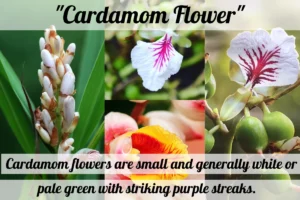
Macro close-up of cardamom flower showing white petals and violet-purple streaked labellum on prostrate panicle stem — green cardamom flower identification
🌸 Cardamom flower — white petals, purple-streaked labellum
📸
Labellum extreme close-up
Needed: Macro shot of labellum (lip petal) showing purple/violet veining pattern clearly
Alt: “Close-up of cardamom flower labellum showing violet purple streaks and veining — cardamom flower anatomy identification”
🔬 Labellum (lip petal) — purple veining detail
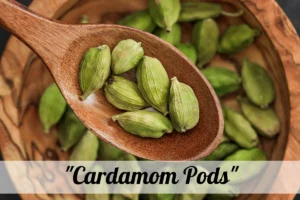
Close-up of mature green cardamom seed pods showing trigonal three-sided capsule shape and longitudinal ridges — Elettaria cardamomum fruit anatomy
🫛 Trigonal green capsules — 3 sides, 15–20 seeds inside
📸
Pod cross-section showing 3 locules + seeds
Needed: Cut-open pod showing 3 internal chambers (locules) with dark seeds visible
Alt: “Cardamom pod cross-section showing three locules with 15–20 dark brown aromatic seeds — cardamom capsule anatomy”
✂️ Pod cross-section — 3 locules, dark seeds inside

Cardamom Plant With Fruit — What It Looks Like

This is one of the most searched visual queries: people want to see a cardamom plant with its fruit (pods) visible. Here is exactly what to look for:

The defining visual of a fruiting cardamom plant

When a cardamom plant is bearing fruit, you will see two completely different zones simultaneously: tall dark-green pseudostems (up to 15 ft) bearing large lance-shaped leaves above ground — and at soil level, low-creeping panicle stems carrying clusters of small, bright green trigonal capsules. The pods are never up on the tall stems. This two-tier visual — tall foliage above, fruits at foot level — is unique among common spice plants and makes the fruiting cardamom plant instantly recognizable.

📸
Cardamom plant with green pods at base
Suggested: Wide shot showing tall leafy pseudostems WITH ground-level green pods visible together in one frame
Alt text: “Cardamom plant with green seed pods growing at ground level on panicle stems while tall pseudostems rise above — cardamom plant with fruit”
🌿 Full plant in fruit-bearing state — pods at base, leaves above
📸
Close-up: green cardamom pods on panicle
Suggested: Macro shot of 4–6 green trigonal pods clustered on a panicle stem, showing 3-sided shape and ridges
Alt text: “Close-up of green cardamom seed pods on prostrate panicle stem showing trigonal three-sided capsule shape — elaichi plant with fruit”
🫛 Close-up: trigonal green capsules on panicle stem at soil level
💡 How to identify a fruiting cardamom plant: Look down, not up. The pods grow at ankle to knee height on trailing stems — separate from the impressive tall foliage above. Green, firm, 3-sided pods = ready to harvest. Yellowish or splitting pods = over-ripe.

The Flower — Full Botanical Anatomy

Inflorescence Type: Prostrate Panicle (Raceme of Cincinni)

Cardamom flowers are white or pale cream with conspicuous violet or purple streaks on the lower lip petal (labellum) — a distinctive, orchid-like appearance that sets them apart from other Zingiberaceae. The inflorescence is a prostrate panicle: a branching cluster on a horizontal creeping peduncle emerging directly from the rhizome at ground level, entirely separate from the tall foliage pseudostems. Botanically, each branch is a cincinnus (modified scorpioid cyme) — a defining characteristic of the genus Elettaria.

Flower FeatureBotanical Detail
Overall appearanceDistinctly orchid-like; delicate, bilaterally symmetrical with a prominent striped lip petal
SymmetryZygomorphic (bilaterally symmetrical) — one plane of symmetry only
Size1.5–2 cm across; 3–4 cm long including the tubular base
Sepals3 fused sepals forming a tubular green calyx, 1–1.2 cm long, split on one side
Petals3 petals: 2 lateral + 1 dorsal (upper); white to pale cream, oblong, 1.5–2 cm
Labellum (lip petal)Broadly obovate; white base with bold violet/purple veining and streaks — the plant’s most visually distinctive feature; acts as pollinator landing platform
Stamen1 fertile stamen (petaloid, anther-bearing); 2 staminodes fused into the labellum
OvaryInferior, trilocular (3-chambered) — each locule develops into one section of the trigonal capsule
FragranceMild, sweet, lightly spiced — same essential oil compounds as the seed, in trace concentration
Bloom seasonMonsoon season — June to September (India); year-round in equatorial Guatemala
Duration per flowerIndividual flowers: 2–3 days. Full panicle bloom: 4–6 weeks (flowers open sequentially)
Edible?Yes — mildly aromatic; used in herbal teas and as garnishes in South Indian cuisine

Pollination Mechanism

Cardamom is primarily cross-pollinated by bees — mainly species of Apis and Trigona. The flower’s architecture is a precisely engineered pollination trap. When a bee lands on the labellum (attracted by its purple nectar guides and scent), it must push past the single fertile stamen to reach the nectary at the flower base. This deposits pollen on the bee’s dorsal surface — and collects pollen from any previous cardamom flower the bee visited.

💡 Self-pollination rate: Despite being hermaphrodite (having both male and female organs in each flower), cardamom has a very low self-pollination rate (~10–15%) because the stigma is positioned above and away from the anther. Cross-pollination by bees is required for economically meaningful pod set — which is why bee populations in cardamom-growing regions are actively protected by farmers.

From Flower to Pod — Development Timeline

StageTimingWhat Happens
Flower budPre-monsoon (April–May)Panicle emerges from rhizome; bracts enclose developing buds
Anthesis (bloom)June–September (monsoon)Flower opens; anthers dehisce (release pollen); bee pollination occurs
Fertilization24–72 hrs after pollinationPollen tube grows down style; ovules fertilized in 3 locules
Fruit setDays 1–14 post-pollinationOvary begins swelling; petals drop; green capsule starts forming
Capsule developmentDays 14–60Trigonal shape established; seeds developing inside 3 locules
Seed maturationDays 60–90Seeds accumulate essential oils; characteristic aroma intensifies
Harvest windowDays 90–110Pods green and firm; must be harvested before capsule dehisces (splits)
Dehiscence (if unharvested)Day 110+Capsule splits along 3 sutures; seeds dispersed; aroma rapidly lost

Green vs. Black Cardamom — Capsule Comparison

Although both are called “cardamom” and belong to Zingiberaceae, green and black cardamom are distinct species with fundamentally different capsule morphology:

FeatureGreen Cardamom (Elettaria cardamomum)Black Cardamom (Amomum subulatum)
Capsule sizeSmall: 1–2 cm longLarge: 2–4 cm long
Capsule shapeTrigonal (3-sided), smooth-ridged; triangular in cross-sectionOvoid to ellipsoid, deeply ribbed/wrinkled
Capsule colorBright green (fresh); pale tan when driedDark brown to black; smoky-looking surface
Seeds per capsule15–20 dark brown aromatic seeds in 3 rows (5–7 per locule)20–50 smaller seeds in 3 locules
Aroma profileSweet, floral, citrus-spiced (cineole + terpinyl acetate dominant)Smoky, camphor-like, menthol-earthy (camphor + cineole dominant)
Drying methodShade-dried or cured at low heat to preserve green colorSmoke-dried over open fire — gives the characteristic smoky note
Culinary useDesserts, tea, coffee, whole spice blends, perfumerySavory dishes, biryanis, meat rubs — rarely in sweets
Native regionWestern Ghats, South India & Sri LankaEastern Himalayas (Nepal, NE India, Bhutan)
Capsule Anatomy in Plain Terms

The cardamom capsule is three-sided (triangular in cross-section) with three shallow ridges running lengthwise. Inside, it is divided into three chambers (locules), each containing 5–7 small, dark brown aromatic seeds — giving a total of 15–20 seeds per capsule. The seeds, not the capsule wall, hold the essential oils. When the capsule is opened or cracked, the scent released comes almost entirely from the seed testa (outer seed coat), where the volatile oil glands are concentrated.

🫛

Why are pods trigonal? The three-sided shape corresponds to the three internal chambers (locules). Each locule develops from one of the three fused carpels of the original flower’s inferior ovary — a direct architectural link from flower to fruit anatomy.

🧪

The aroma secret: The pod’s skin (pericarp) acts as a protective shell for volatile essential oils inside. Whole pods retain aroma 12–18 months; ground cardamom loses potency within 60–90 days — because grinding ruptures the oil cells and exposes them to oxidation.

🌿

Pods vs. seeds: The pericarp (pod wall) contains negligible essential oil. Nearly all aromatic compounds are concentrated in the seeds’ testa (seed coat) and endosperm. The pod’s sole biological function is protective storage of the seeds.

Phytochemical Profile — The Aromatic Compounds

The distinctive aroma of cardamom is produced by a complex mixture of volatile compounds in the seed’s essential oil. Gas chromatography-mass spectrometry (GC-MS) analysis of Elettaria cardamomum seed oil identifies the following major constituents:

CompoundConcentrationAroma NoteRole in the Plant
1,8-Cineole (Eucalyptol)25–45% of essential oilCool, camphor-like, eucalyptusPrimary antimicrobial defense; deters herbivores; key flavor compound
α-Terpinyl acetate20–36%Fruity, floral, slightly citrusPollinator attractant; contributes characteristic “cardamom” note
Linalool1–6%Floral, lavender-likePart of pollinator signaling; softens the aromatic profile
Linalool acetate1–4%Fruity, fresh, floralSynergist with linalool in floral scent profile
Sabinene2–8%Spicy, woody, pepperySecondary defense compound; adds spice depth
β-Pinene1–4%Fresh, piney, resinousPart of terpene backbone; contributes to green freshness
Limonene1–4%Bright citrus, orangeAntifungal defense; adds citrus brightness
Borneoltrace–2%Camphor-like, cool, herbalMinor antimicrobial; present in trace amounts
🔬 Why does origin affect aroma? The ratio of 1,8-cineole to α-terpinyl acetate varies significantly by growing region and cultivar. Indian Malabar cardamom tends toward higher terpinyl acetate (more floral, “sweet”), while Guatemalan varieties often show higher cineole (more camphor-cool). This is why trained spice buyers can identify cardamom origin by smell alone — and why Indian cardamom commands a price premium in specialty markets.
↑ Back to top

Origin, Natural Habitat & Global Distribution

Where Cardamom Comes From

Cardamom is native to the Western Ghats mountain range of southern India (Kerala, Karnataka, Tamil Nadu) and Sri Lanka. These two regions together constitute the plant’s original wild range. The Western Ghats forests — specifically the moist evergreen and semi-evergreen zones — represent the primary center of origin, while Sri Lanka’s humid highland forests represent a secondary native distribution. The Kerala highlands are historically known as the “Cardamom Hills” (Elamalai in Malayalam).

📸
Cardamom in Kerala forest / natural habitat
Suggested: Cardamom plants growing under forest canopy in Kerala’s Western Ghats or plantation
Alt text: “Cardamom plant growing in Kerala Western Ghats rainforest natural habitat — where does cardamom come from”
🇮🇳 Cardamom in its native Kerala forest habitat
📸
Cardamom plantation / commercial farming
Suggested: Rows of cardamom in a plantation (Kerala or Guatemala)
Alt text: “Green cardamom plants in commercial plantation Kerala India showing where cardamom grows”
🌿 Commercial cardamom plantation — Kerala or Guatemala

Natural Habitat Conditions

In the wild, cardamom grows as a forest understory plant — thriving in the semi-shade beneath taller trees at elevations of 600–1,500 meters above sea level. Its native environment is characterized by:

Habitat FactorNative Condition
Elevation600–1,500 m (2,000–5,000 ft) above sea level
Rainfall1,500–4,000 mm per year — heavy monsoon rains with a dry season
Temperature10–35°C (50–95°F) — no frost, warm year-round
LightDappled forest shade — 30–50% canopy cover
SoilRich, humus-laden, well-draining laterite forest soils; slightly acidic (pH 5–6.5)
Humidity70–90% relative humidity year-round
Forest typeMoist tropical and semi-evergreen forest

Historical Spread — How Cardamom Traveled the World

Cardamom has one of the richest trade histories of any spice. Its journey from Kerala’s forests to global kitchens spans more than 3,000 years:

~1000 BCE
Ancient India — Vedic & Ayurvedic Records

Cardamom is mentioned in ancient Sanskrit texts including the Charaka Samhita (Ayurvedic medical compendium) as a digestive aid and breath freshener. It was traded along overland routes from Kerala to the Indian subcontinent’s northern regions.

~700 BCE
Ancient Babylon & Egypt

Cardamom appears in Babylonian records and was reportedly used in Egyptian perfumery. It traveled via Arabian Sea maritime routes from India to the Persian Gulf and onwards to the Mediterranean world.

~300 BCE
Greece & Rome

Greek botanist Theophrastus described cardamom in his botanical writings. Romans used it as a digestive spice, a perfume ingredient, and a mouth freshener. It was imported at high cost via the Spice Route.

8th–13th century CE
Arab World — The Golden Age of Spice Trade

Arab merchants controlled the cardamom trade through the Middle Ages, bringing it into Persian, Moroccan, and Ottoman cuisines. It became an essential ingredient in Arabic coffee (qahwa) — a tradition that persists to this day.

15th–16th century
Portuguese & European Contact

Portuguese explorer Vasco da Gama’s arrival in Kerala (1498) opened direct European access to cardamom at its source, breaking Arab monopoly on the spice trade. European demand surged, and cardamom became a luxury commodity across the continent.

Late 1800s
Guatemala — New World Cultivation Begins

German coffee planter Oscar Majus Klöffer introduced cardamom cultivation to Guatemala in the 1880s. Guatemala’s high-altitude cloud forests proved ideal, and the country eventually overtook India as the world’s largest producer.

Today
Global Cultivation

Cardamom is now cultivated in Guatemala, India, Sri Lanka, Uganda, Tanzania, Nepal, and Papua New Guinea. Guatemala produces ~70% of global supply. India retains the highest quality reputation for its Malabar and Mysore varieties.

Where Cardamom Grows Today

  • 🇮🇳
    Native Homeland
    Kerala, Karnataka & Tamil Nadu, India

    The original and highest-quality source. Kerala’s Idukki district is the heart of Indian cardamom production. The Malabar variety (small, intensely aromatic) is prized worldwide. India produces the “Alleppey Green” and “Mysore” varieties — both benchmark grades.

  • 🇬🇹
    World’s #1 Producer
    Guatemala (Alta Verapaz highlands)

    Guatemala produces approximately 30,000–35,000 metric tons annually — around 70% of global supply. The high-altitude cloud forests of Alta Verapaz closely mirror Kerala’s natural conditions. Most Guatemalan cardamom is exported to Saudi Arabia, UAE, and other Middle Eastern markets for use in qahwa coffee.

  • 🇱🇰
    Major Producer
    Sri Lanka

    Sri Lanka has cultivated cardamom for centuries in its central highland districts (Kandy, Matale, Nuwara Eliya). Sri Lankan cardamom is known for its bold aroma. The country also grows black cardamom in some regions.

  • 🇺🇬
    Significant Producer
    Uganda & Tanzania

    East African cardamom cultivation has grown significantly since the 1990s. Uganda’s highland regions in the west and southwest provide suitable conditions. Production is still smaller than Asian sources but growing steadily to meet export demand.

  • 🇳🇵
    Producer
    Nepal & Bhutan

    Nepal is the world’s largest producer of black cardamom (Amomum subulatum), grown in the eastern Himalayan foothills. Some green cardamom is also cultivated in lower-altitude humid regions bordering India.

  • 🇵🇰
    Limited Cultivation
    Pakistan — Khyber Pakhtunkhwa

    Small-scale cardamom cultivation is possible in the humid highland valleys of KPK province. The main challenge is Pakistan’s dry summers and low humidity in most regions. The cooler, wetter mountain areas present the best potential.

↑ Back to top

Uses of Every Part of the Cardamom Plant

Cardamom is one of the most completely utilized spice plants in the world. Almost every part — from the seeds to the leaves to the flowers — has culinary, medicinal, or aromatic applications.

🫛
Seed Pods
The Primary Spice

Whole pods are used in biryanis, rice dishes, curries, and spice blends (garam masala). They impart a subtle aroma without releasing full seed intensity. Pods are also chewed whole as a natural breath freshener after meals — a tradition across South Asia and the Middle East.

🌑
Seeds (Inside Pod)
Culinary & Medicinal Powerhouse

Ground seeds go into chai tea, coffee (qahwa), desserts, pastries, and spice rubs. Medicinally, seeds are used in Ayurveda and Unani medicine as digestive aids, carminatives, and anti-nausea remedies. The essential oil from seeds is used in perfumery, soap, and food flavoring industries.

🌸
Flowers
Edible & Aromatic

Fresh cardamom flowers are edible — lightly aromatic with a mild version of the seed’s flavor. Used in herbal teas, as garnishes on desserts and drinks, and in some traditional South Indian preparations. The flowers are rarely seen in markets but are used locally near growing regions.

🍃
Leaves
Wrapping & Flavoring

Large cardamom leaves are used as natural food wrappers in South Indian cooking — similar to banana leaves. Rice, fish, and desserts are wrapped and steamed in cardamom leaves, imparting a subtle, grassy-spiced flavor. In some tribal traditions, dried leaves are used in craft and weaving.

🌱
Rhizome
Traditional Medicine

In Ayurvedic and folk medicine traditions of Kerala and Karnataka, the rhizome is used in poultices and decoctions for treating skin conditions and joint inflammation. It contains some of the same aromatic compounds as the seeds, albeit in lower concentration.

💧
Essential Oil
Aromatherapy & Perfumery

Steam-distilled from the seeds, cardamom essential oil is used in high-end perfumes, cosmetics, and aromatherapy. Its warm, spiced-citrus scent is a popular base or heart note in oriental fragrances. It is also used as a flavoring agent in liqueurs and confectionery at the industrial scale.

Interesting Facts About Cardamom Plant Uses

☕

Arabic Coffee (Qahwa): Across the Arabian Peninsula, cardamom pods are added whole to coffee during brewing. The tradition is so strong that Saudi Arabia and UAE import the majority of Guatemala’s cardamom crop — and the plant is virtually the “national spice” of several Gulf countries.

🍬

Natural Breath Freshener: Long before commercial mints, cardamom pods were chewed after meals across South Asia to freshen breath and aid digestion. The antimicrobial properties of cineole help reduce oral bacteria — this tradition has a solid scientific basis.

🧴

Perfume Industry: Cardamom essential oil appears in more than 300 commercial fragrances, including iconic names like Dior Fahrenheit and Guerlain Shalimar. Its warm, spiced-citrus note makes it a prized heart or base element in oriental and woody perfume families.

↑ Back to top

Life Cycle & Unique Botanical Adaptations

The Cardamom Life Cycle — Visual Stages

🌱 Germination 3–6 weeks Seeds sprout; warm + humid 🌿 Seedling Months 2–8 First true leaves; needs shade 🌾 Vegetative Year 1–2 Pseudostems grow; rhizome expands 🌸 First Flower Year 2–3 White-purple flowers; bee pollination 🫛 Peak Yield Years 4–8 Max pods; 2–3 kg per plant/year PEAK 🍂 Decline Years 9–15 Yield drops; divide rhizome to propagate Total productive lifespan: 10–15 years
📸
Cardamom seedling / young plant
Suggested: Young cardamom seedling with 2–3 leaves, in nursery or soil
Alt text: “Young cardamom plant seedling showing early growth stage — cardamom plant growth stages”
Stage 2: Cardamom seedling — months 2–8
📸
Mature cardamom plant in Kerala / plantation
Suggested: Mature plant in natural Kerala forest habitat or plantation row
Alt text: “Mature cardamom plant in Kerala forest showing peak production stage with green pods — cardamom plant life cycle”
Stage 5: Peak production — Years 4–8
StageDurationWhat Happens
Seed germination3–6 weeksSeeds sprout in warm, humid conditions. Germination rate is highest (60–80%) with fresh seeds soaked 12–24 hrs before sowing.
Seedling stageMonths 2–8First true leaves emerge. The seedling is delicate and sensitive to direct sun, drought, and cold. Shade is critical at this stage.
Vegetative growthYear 1–2Pseudostems elongate rapidly in warmth. Rhizome expands laterally. Plant focuses energy on foliage, not reproduction.
First floweringYear 2–3 (seed) / Year 1–2 (rhizome)Low-growing panicle stems emerge from the rhizome base. Flowers appear during monsoon season, lasting 4–6 weeks.
Pod maturation60–90 days after floweringFertilized flowers develop into green seed pods. Each pod matures independently — multiple harvests per season are common.
Peak productionYears 4–8Plant produces maximum pods — typically 2–3 kg per plant per year in good conditions. Rhizome has fully expanded.
Decline phaseYears 9–15Pod yield gradually decreases. Older pseudostems die back more frequently. Rhizome divisions can be taken to start new vigorous plants.
End of productive lifeYear 10–15+Plant’s yield is no longer economically viable. Farmers replant using rhizome divisions from the healthiest mother plants.

Unique Botanical Adaptations

🌑
Deep Shade Tolerance

Cardamom evolved as a forest understory plant beneath the dense canopies of Kerala’s Western Ghats. It has adapted to thrive in 30–50% light conditions where most crop plants would fail. This shade tolerance is not just a preference — direct harsh sun actually reduces pod quality and can scorch the leaves. The chloroplasts in cardamom leaves are optimized for low-light photosynthesis.

🌧️
Monsoon-Synced Flowering

Cardamom has evolved to time its flowering precisely with the onset of monsoon rains. The increased humidity, cooler temperatures, and higher soil moisture of the monsoon season trigger flowering. This synchronizes pollinator activity (bees are most active post-monsoon) with flower availability — a finely tuned ecological relationship developed over thousands of years.

🌱
Sympodial Rhizome — Immortal Root

The rhizome growth pattern means the plant is effectively immortal through clonal propagation. Even if all visible pseudostems die from disease or cold damage, a healthy rhizome can regenerate the entire plant. This adaptation evolved as a survival mechanism in unpredictable forest environments where individual shoots might be damaged by falling trees or flooding.

🫛
Ground-Level Fruiting

The fact that pods grow at ground level (not on the tall stems) is a key adaptation. Low-hanging pods are accessible to ground-level pollinators and seed dispersers — and are protected from wind damage that would affect pods on tall stems. This unusual trait (tall stems, ground-level fruit) also makes harvesting by hand far easier for farmers.

🔬 Botanical Curiosity: The cardamom plant’s annual flowering cycle is triggered not just by temperature but by photoperiod (day length) and moisture levels. In regions with irregular rainfall, farmers in Kerala traditionally planted cardamom under the shade of specific trees — silver oak (Grevillea robusta) — because that combination of shade and natural mulch from fallen leaves most closely mimicked the original forest floor conditions.
↑ Back to top

How to Identify the Cardamom Plant

Whether you’re in a market, a garden, or a forest trail, here’s how to confidently identify a cardamom plant:

What to Look ForWhat You’ll SeeConfidence Level
Leaf shapeLong, narrow, lance-shaped. Dark glossy green above, pale below. Up to 60 cm long.⭐⭐⭐ High
Leaf fragranceCrush a small piece — releases mild spicy-sweet cardamom scent instantly.⭐⭐⭐⭐ Very High
Growth habitDense upright clumps of multiple pseudostems from a single base. 6–15 ft tall.⭐⭐⭐ High
Pod locationSmall green trigonal (3-sided) pods at the base of the plant on low trailing stems.⭐⭐⭐⭐ Definitive
Pod fragranceCrack a pod — intensely sweet, citrus-spiced scent. Unmistakable if you’ve smelled cardamom before.⭐⭐⭐⭐ Definitive
Flower locationSmall white-purple flowers at ground level during monsoon — same panicle stems as the pods.⭐⭐⭐⭐ Definitive (seasonal)
RhizomePale cream, fleshy, horizontal underground stem visible if you scratch soil at plant base. Spicy when cut.⭐⭐⭐ High
What does a healthy cardamom plant look like?

A healthy cardamom plant has deep green, upright, glossy leaves free from brown spots, yellowing, or wilting. The pseudostems should stand firm, not drooping. At the base, look for firm green pods and small flowers on clean trailing panicle stems. The rhizome at soil level should be cream-colored and firm — never mushy or dark. In a pot, healthy soil should smell earthy, not sour or rotten.

↑ Back to top

Natural Habitat & Ecological Profile

The cardamom plant’s physiology, flowering phenology, and morphology are all direct products of the ecological conditions in its native Western Ghats and Sri Lankan forests. The parameters below describe the plant’s natural habitat — the environment in which the species evolved — not prescriptions for cultivation.

Ecological ParameterNative Forest ConditionsBotanical Significance
Temperature range10–35°C (50–95°F); no frostThe species lacks frost-hardening mechanisms — a product of its frost-free montane tropical origin
Light regime30–50% canopy openness (dappled shade)Understory evolution; leaf chloroplasts optimized for low-light photosynthesis efficiency
Annual rainfall1,500–4,000 mm; seasonal monsoon patternMonsoon onset directly triggers the plant’s flowering phenology via soil moisture and humidity cues
Relative humidity70–90% year-roundPrevents desiccation of the puberulent (fine-hairy) abaxial leaf surface; supports pollinator activity
Soil typeLaterite forest soils; humus-rich; pH 5–6.5Adapted to high-organic, acidic substrate with excellent drainage — waterlogging is not tolerated
Altitude600–1,500 m above sea levelCooler montane temperatures moderate heat stress; elevated UV promotes secondary metabolite (essential oil) synthesis
Forest canopy typeMoist tropical semi-evergreen forestSeasonal variation in canopy density provides photoperiodic cues that regulate annual growth and flowering cycles
🔬 Ecological note: The cardamom plant’s phenological cycle (the timing of growth, flowering, and fruiting) is tightly coupled to the South Asian monsoon. Flowering is triggered by a combination of increasing photoperiod (day length), rising temperature, and the first monsoon rains — a multi-factor environmental cue system that evolved over millions of years in the Western Ghats ecosystem.
🌱
Practical Application
How to Grow Cardamom at Home — Seed to Harvest

Translate this ecological knowledge into practical growing — soil prep, pots, garden beds, fertilizing, seasonal care, and harvest.

→

Explore Further — Related Plant Science Topics

📖

What Is Cardamom?Complete introduction to cardamom as a spice — history, types, and culinary identity of Elettaria cardamomum.

🧬

Cardamom Chemical Profile & Health BenefitsHow cineole, terpinyl acetate, and other phytochemicals in cardamom translate into documented health effects.

⚗️

Cardamom Substitutes — Zingiberaceae RelativesExplore how related Zingiberaceae species — ginger, galangal, grains of paradise — compare botanically and aromatically to cardamom.

↑ Back to top

Frequently Asked Questions

How many seeds are in a cardamom pod? +
Each cardamom pod (capsule) contains 15–20 small dark brown seeds. The pod has 3 internal chambers (locules), each holding 5–7 seeds arranged in a row. The seeds contain the essential oils — primarily 1,8-cineole (25–45%) and α-terpinyl acetate (20–36%) — that give cardamom its distinctive sweet, spiced-citrus aroma.
How do you identify a cardamom plant? +
Key identifiers: (1) Tall clumping pseudostems 6–15 ft with dark green lanceolate leaves. (2) Crush a leaf — immediate spicy-sweet scent confirms identity. (3) Look at the base — small green 3-sided (trigonal) pods on trailing panicle stems at ground level. (4) Crack a pod — 15–20 dark seeds with an intense citrus-spice fragrance. Flowers (white with purple labellum streaks) also appear at ground level during monsoon season.
What does a healthy cardamom plant look like? +
A healthy cardamom plant has deep green, glossy lance-shaped leaves standing upright on firm pseudostems. Leaves should be free of brown spots, yellowing, or drooping. At the base, healthy panicle stems bear firm green pods and small white-purple flowers. The rhizome at soil level should be cream-colored and firm — never mushy or dark-colored. In a pot, the soil should smell earthy, not sour or rotten, indicating good drainage and no root rot.
How do you identify cardamom pods? +
Cardamom pods are small (1–2 cm), distinctly three-sided (trigonal), and smooth-skinned — green at peak harvest. They grow on low trailing panicle stems at the base of the plant, not on the tall leafy stalks. Each pod has 3 internal chambers containing 5–7 dark brown seeds each (15–20 seeds total). The definitive test: crack a pod open — the intensely sweet, spiced-citrus fragrance is instantly recognizable and unmistakable.
How big can a cardamom plant grow? +
In its natural forest habitat, cardamom can reach 15 feet (4.5 meters) tall. In home gardens it typically grows 6–10 feet. In a 12–14 inch pot it usually stays 4–6 feet. The plant grows in dense clumps — a single established plant may spread 4–6 feet wide as its rhizome expands. Each pseudostem (leaf-bearing stalk) lives 2–3 years before the rhizome replaces it with new shoots.
What is the cardamom plant? +
The cardamom plant (Elettaria cardamomum) is a perennial tropical herb in the ginger family (Zingiberaceae), native to the Western Ghats forests of Kerala, southern India. Growing 6–15 feet tall from a spreading underground rhizome, it produces aromatic green seed pods — one of the world’s most prized spices — and has a productive lifespan of 10–15 years. It is called elaichi (الائچی) in Urdu and Hindi.
Where does cardamom come from originally? +
Cardamom is native to the moist evergreen forests of Kerala, Karnataka, and Tamil Nadu in southern India — specifically the Western Ghats mountain range. The Kerala highlands are historically called the “Cardamom Hills.” The spice has been traded for over 3,000 years, traveling from India to Babylon, Egypt, Greece, Rome, the Arab world, and eventually to the Americas (Guatemala). Today Guatemala is the world’s largest producer, followed by India and Sri Lanka.
What are cardamom flowers used for? +
Cardamom flowers are edible and mildly aromatic. In parts of South India and Sri Lanka, fresh flowers are used floating in herbal teas, as delicate garnishes on desserts and beverages, and occasionally in traditional preparations. They carry the same aromatic compounds as the seeds (cineole, terpinyl acetate) but in a much milder, more floral form. They are rarely found in markets — only accessible near growing regions or from home-grown plants.
What are the uses of cardamom leaves? +
Cardamom leaves are used primarily as natural food wrappers in South Indian cooking — fish, rice, and sweets are wrapped and steamed in the large leaves, which impart a subtle, grassy-spiced flavor. In some tribal traditions in Kerala and Karnataka, dried cardamom leaves are incorporated into handicrafts and weaving. The leaves are also used in some Ayurvedic preparations, though they contain far less essential oil than the seeds.
What is the lifespan of a cardamom plant? +
A cardamom plant lives and produces pods for 10–15 years under good conditions, though the rhizome can survive even longer. Individual pseudostems (the tall leafy stalks) each live 2–3 years before dying back and being replaced by new shoots from the rhizome. Peak pod production falls between years 4–8. After year 10, yield gradually declines but rhizome divisions can be taken to propagate new, vigorous young plants.
Is cardamom a flower, seed, or fruit? +
Cardamom is technically a fruit — the green pod is the plant’s fruit (a capsule). Inside the pod are the seeds (15–20 per pod), which are the primary aromatic spice. The plant also produces beautiful flowers (white with purple streaks) that precede the pods. So depending on context: the spice is a seed, it comes in a fruit (pod), and the plant also produces edible flowers. All three terms can be accurate depending on which part is being referenced.

📚 Sources & References

Botanical information on this page is consistent with the following authoritative sources:

  • → Kew Gardens — Plants of the World Online (POWO): Elettaria cardamomum (L.) Maton — powo.science.kew.org
  • → Encyclopædia Britannica: Cardamom — britannica.com/plant/cardamom
  • → USDA GRIN Taxonomy: Elettaria cardamomum — National Germplasm Resources Laboratory
  • → Ravindran, P.N. & Madhusoodanan, K.J. (2002): Cardamom: The Genus Elettaria. Taylor & Francis — standard botanical reference for Zingiberaceae morphology

🌿 Cardamom Plant — Complete Quick Reference

  • Scientific name: Elettaria cardamomum
  • Family: Zingiberaceae (Ginger family)
  • Common names: Cardamom, Elaichi, Queen of Spices
  • Height: Typically 6–15 ft; varies with habitat
  • Stem type: Pseudostem (non-woody, not a true stem)
  • Root system: Sympodial horizontal rhizome
  • Leaf shape: Lanceolate, dark green, 40–60 cm; pinnate venation
  • Flower: White + violet/purple labellum; orchid-like; at ground level
  • Fruit type: Capsule (trigonal / 3-sided), green, 1–2 cm
  • Seeds per capsule: 15–20 aromatic dark brown seeds
  • Main aroma compounds: 1,8-Cineole + α-Terpinyl acetate
  • Native region: Western Ghats, India & Sri Lanka
  • World’s #1 producer: Guatemala
  • Historical trade: 3,000+ years via Spice Routes
  • Bloom season: Monsoon (June–September)
  • First harvest: 2–3 years (seed) / 1–2 years (rhizome)
  • Peak production: Years 4–8
  • Plant lifespan: 10–15 years
  • Key adaptation: Forest understory shade tolerance
  • Inflorescence: Prostrate panicle, separate from pseudostems
Olivia Turner
Written by
Olivia Turner
Gardening & Spice Plant Specialist
Dr Michael Bennett
Reviewed by
Dr Michael Bennett
Nutrition Researcher

Recent Posts

  • Interesting Cardamom Health Benefits, Nutritions, Daily Dosage & Precautions
  • Cardamom Milk Recipe, Nutrition, Benefits for Men & Women
  • Is Cardamom Used In Soda?
  • How To Grow Cardamom at Home: Amazing and Complete Guide from Seed to Harvest
  • Is Cardamom Good For Periods?
Thank You For Choosing Us

“Step into the world of cardamom with Cardamom Nectar! Our blog is your go-to source for everything you need to know about this aromatic spice. From handy tips to mouthwatering recipes, trust us to guide you on your flavorful journey!”

Quick Links
  • Privacy Policy
  • contact Us
  • FAQs
  • cardamom types
  • Health Benifits
Happy to Follow Us
Facebook Youtube Instagram X-twitter

copyright© 2025 Cardamomnector All Right Reserved

×

Log In

Forgot Password?

Not registered yet? Create an Account

Scroll to top
  • Introduction
    • Fennel Seeds: Nature’s Remedy for Better Digestion andWha Wellness
    • Cinnamon Spice: The Unmatched Guide to Its Benefits, Risks, and Culinary Uses
    • Cumin: Health Benefits, Culinary Uses, Essential Oils & More
  • How To Grow
    • Fennel Bulb: The Ultimate & Nutritious Guide to Growing, Cooking, and Delicious Recipes
  • Substitutes
  • Cardamom Powder
  • Cardamom Tea
  • Blog
Search