What Is Cardamom (Elaichi)?
The world’s most complete guide to cardamom: definition, all types, cooking techniques, nutrition, health benefits, Ayurveda, 5,000-year history, buying guide, storage, side effects, economic significance, and plant diseases.
 MB
MBCardamom is a tropical spice made from the aromatic seed pods of plants in the Zingiberaceae (ginger) family — primarily Elettaria cardamomum (green cardamom). Native to the Western Ghats of southern India, it is called Elaichi in Hindi and Urdu. Known as the “Queen of Spices,” cardamom is the world’s third most expensive spice after saffron and vanilla, prized for its complex sweet-floral-spicy aroma and used in cooking, medicine, and perfumery for over 5,000 years.
- Botanical source: dried seed pods of Elettaria cardamomum (green cardamom) or Amomum subulatum (black cardamom), family Zingiberaceae.
- Hindi/Urdu name: Elaichi — Chhoti Elaichi (green/small) and Badi Elaichi (black/large) are the same word family, not the same spice.
- Native origin: Western Ghats rainforests of Kerala, India, and Sri Lanka.
- Top producer today: Guatemala, supplying roughly 50–70% of global cardamom.
- Price rank: third most expensive spice in the world by weight, after saffron and vanilla.
- Key aroma compounds: 1,8-cineole (eucalyptol) and α-terpinyl acetate.
- Documented use: over 5,000 years, first recorded in Ayurvedic texts as ela.
What Is Cardamom? — Formal Definition
Cardamom (pronunciation: /ˈkɑːrdəməm/) is an aromatic spice consisting of the dried trigonal seed pods and seeds of herbaceous perennial plants in the genera Elettaria and Amomum, family Zingiberaceae. The pods are small, three-sided capsules containing 15–20 dark aromatic seeds holding volatile oils — primarily 1,8-cineole (eucalyptol) and α-terpinyl acetate — which give cardamom its characteristic warm, floral, mentholated aroma.
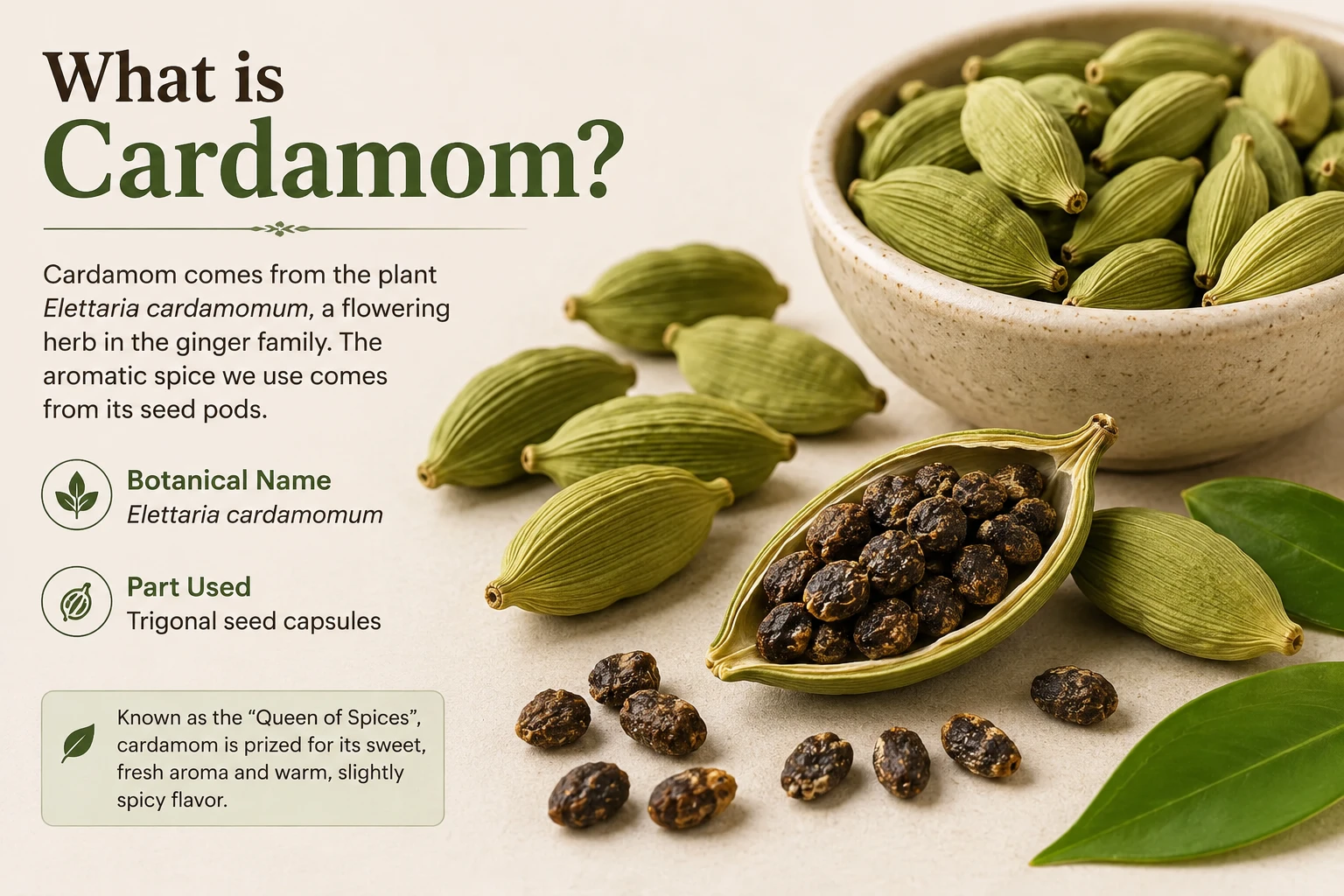
Cardamom is called the “Queen of Spices” — reflecting both its extraordinary fragrance and its premium price ranking alongside saffron and vanilla. In everyday use, “cardamom” without further qualification always means green cardamom (Elettaria cardamomum).
Scientific Classification
| Level | Green Cardamom | Black Cardamom |
|---|---|---|
| Family | Zingiberaceae | Zingiberaceae |
| Genus | Elettaria | Amomum |
| Species | E. cardamomum | A. subulatum |
| Hindi name | Chhoti Elaichi (छोटी इलायची) | Badi Elaichi (बड़ी इलायची) |
| Sanskrit | Ela (एला) — oldest recorded name | |
Etymology — What Does the Word Cardamom Mean?
The word derives from Latin cardamōmum → Greek kardámōmon — a compound of kárdamon (“cress”) + ámōmon (an ancient Indian spice). The Dravidian root also flows through Tamil elakkai → Kannada yalakki → Hindi elaichi. The name carries the imprint of South Indian agriculture, Arab trade routes, and Greek-Roman commerce simultaneously.
Types of Cardamom — How Many Kinds Exist?
There are three commercially recognised types plus several regional species. Green and black cardamom are different plant species with completely different flavours — they are not interchangeable.
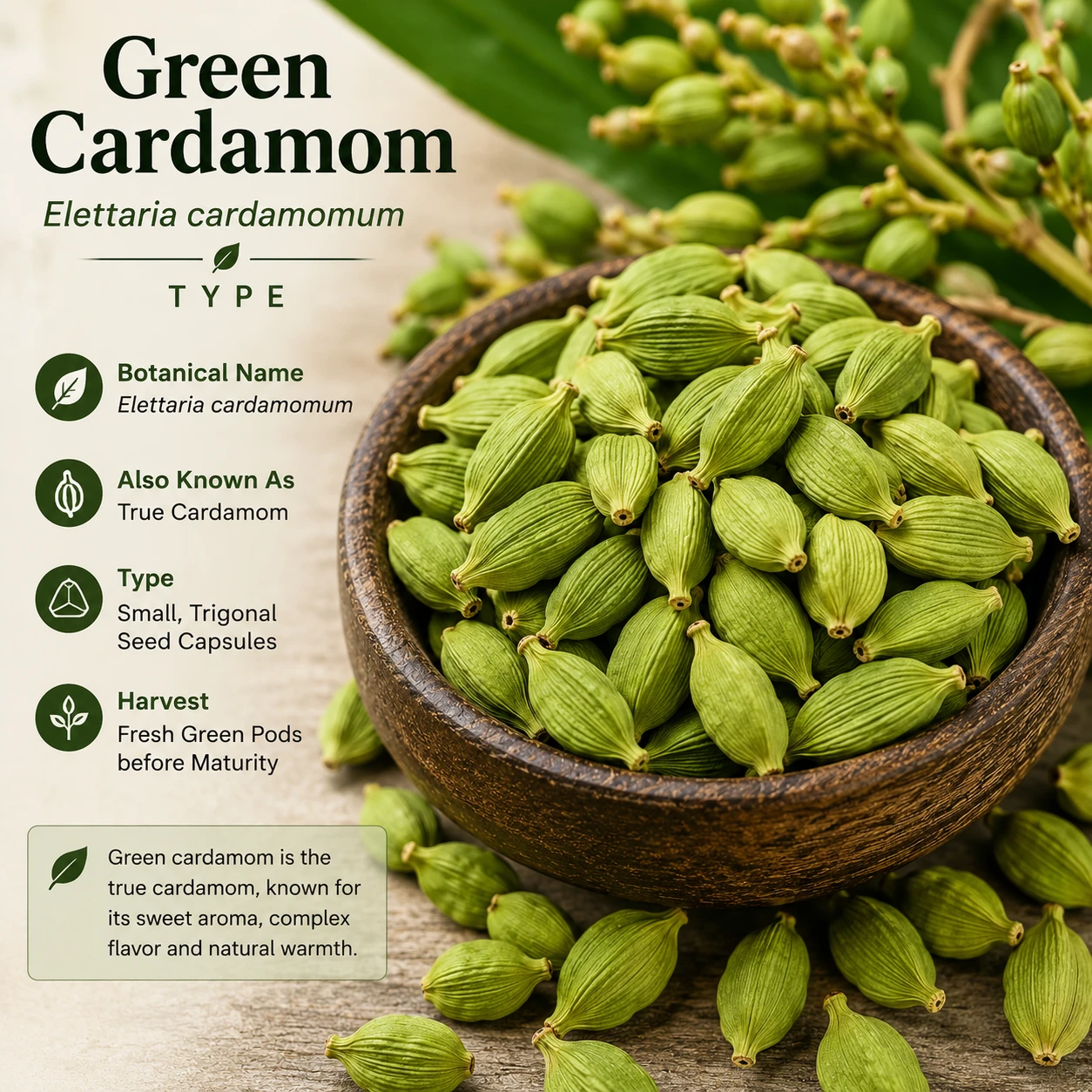

Most prized variety. Small pale-green trigonal pods, 15–20 dark seeds. Sweet, floral, mildly citrusy with eucalyptus undertones.
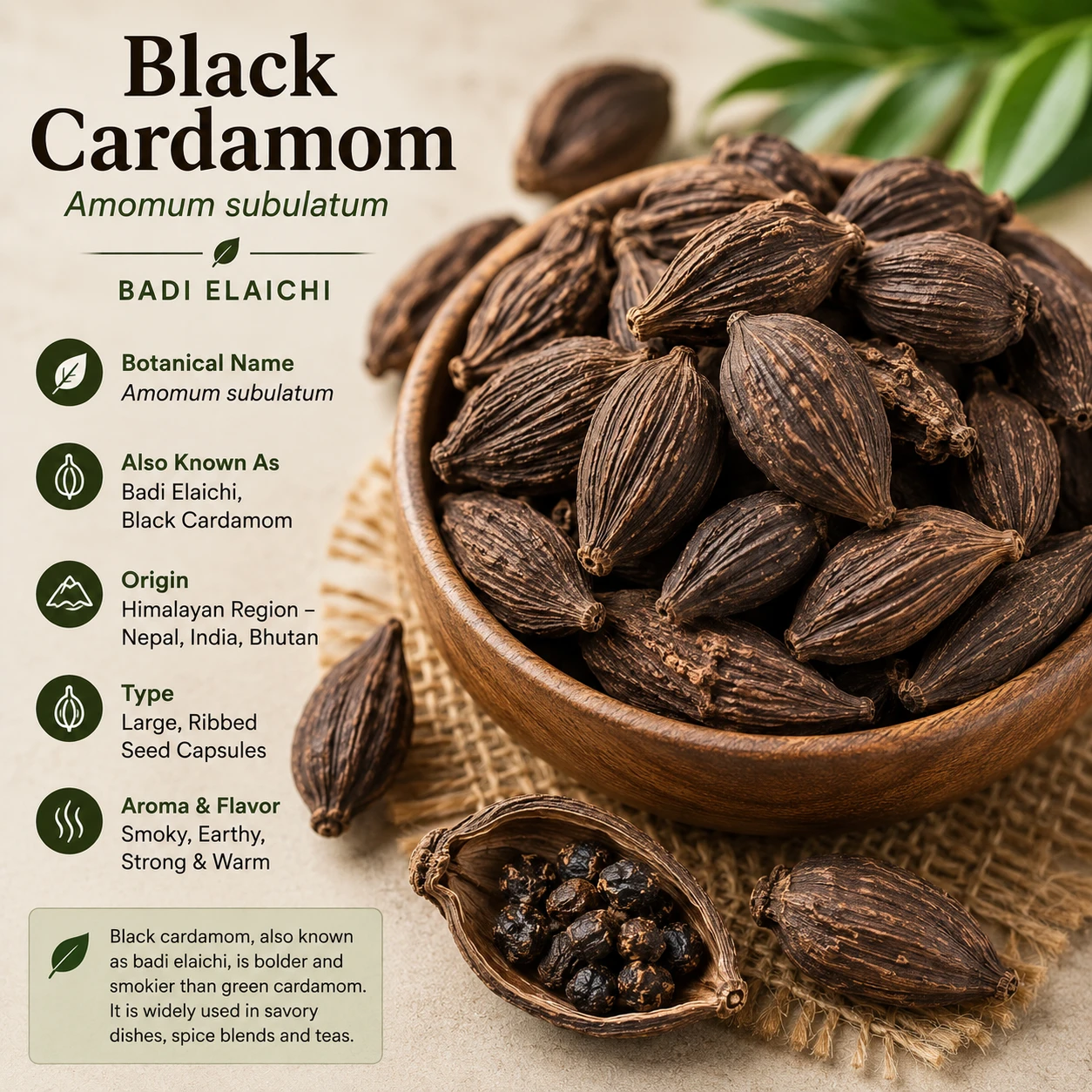
Tea & CoffeeDessertsChaiBakingDifferent species. Large ribbed dark-brown pods dried over fire — smoky, earthy, camphor-like aroma. Savory dishes only.
BiryaniNihariGaram MasalaGreen cardamom bleached with sulfur dioxide. Same plant species, but milder aroma — bleaching reduces volatile oil content.
Scandinavian BakingPale DessertsOther Cardamom Species
| Variety | Scientific Name | Origin | Main Use |
|---|---|---|---|
| Round / Java Cardamom | Amomum compactum | Indonesia, Malaysia | Southeast Asian spice blends, rice dishes |
| Ethiopian Cardamom (Korarima) | Aframomum corrorima | Ethiopia | Berbere blend, Ethiopian coffee (buna) |
| Siam Cardamom | Wurfbainia vera | Thailand, Vietnam | Thai and Vietnamese cooking |
| Tsao-ko | Amomum tsao-ko | China (Yunnan) | Sichuan cuisine, braised meats |
🔑 Key rule: When a recipe says “cardamom” it always means green cardamom. Never substitute black for green — they come from different species with completely opposite flavour profiles. See our full Green vs Black Cardamom comparison → for a side-by-side breakdown.
🔄 Out of black cardamom? Read our Black Cardamom vs Star Anise guide → to see when star anise works as a substitute and when it doesn’t.
What Does Cardamom Taste Like?
Green cardamom has a warm, sweet, floral, and mildly spicy flavour with notes of eucalyptus, mint, and citrus — simultaneously warm and cool on the palate. This dual effect comes from its two primary compounds: 1,8-cineole (cool, mentholated) and α-terpinyl acetate (warm, sweet, floral). Black cardamom tastes smoky, earthy, and camphor-like.
| Compound | % in Green Cardamom Oil | Flavour Note |
|---|---|---|
| 1,8-Cineole (Eucalyptol) | ~40–45% | Cool, mentholated, eucalyptus-like |
| α-Terpinyl acetate | ~28–35% | Warm, sweet, floral, fruity |
| Linalool | ~3–5% | Floral, lavender-like |
| Sabinene | ~2–4% | Spicy, woody, citrus nuance |
| Limonene | ~2–3% | Bright citrus note |
Cardamom Pods vs Ground vs Seeds — Which to Use?
One of the most common cardamom questions is whether to buy whole pods, loose seeds, or pre-ground powder. Each form has a distinct best use — choosing wrong significantly affects the flavour of your dish.
Drop whole into biryanis, stews, rice, or teas. Remove before serving. Pods slowly release aroma without overpowering. Longest shelf life (12 months).
Crack pods, extract seeds, grind with mortar & pestle just before use. Maximum freshness. Essential for spice blends, garam masala, baking. Use within weeks.
Convenient but loses potency within 3–6 months after opening. Use 1/4 tsp ground = 3–4 pods. Buy small quantities, replace often. Never pre-ground for garam masala.
Pro tip: Whole pods protect the seeds from oxidation. The volatile oils that give cardamom its aroma degrade rapidly once ground. For baking and spice blends, always grind fresh seeds yourself — pre-ground powder is a last resort, not a preference.
🔍 Deciding between pods and seeds for a specific recipe? See our full Cardamom Pods vs Seeds guide → for a complete decision framework. If you’re buying pre-ground, read our Cardamom Powder guide → for brands, uses, and freshness tests.
Conversion Chart: Pods to Ground
| Whole Pods | Seeds (approximate) | Ground Cardamom | Use case |
|---|---|---|---|
| 1 pod | ~12–15 seeds | ⅛ tsp (0.25g) | Single cup of tea |
| 3 pods | ~36–45 seeds | ¼ tsp (0.75g) | Chai for 2, small dessert |
| 6 pods | ~72–90 seeds | ½ tsp (1.5g) | Most baking recipes |
| 10 pods | ~120–150 seeds | ¾–1 tsp (2.5g) | Rice dishes, curries |
| 12 pods | ~144–180 seeds | 1 tsp (3g) | Full spice blend, garam masala |
How to Use Cardamom — Step-by-Step Techniques
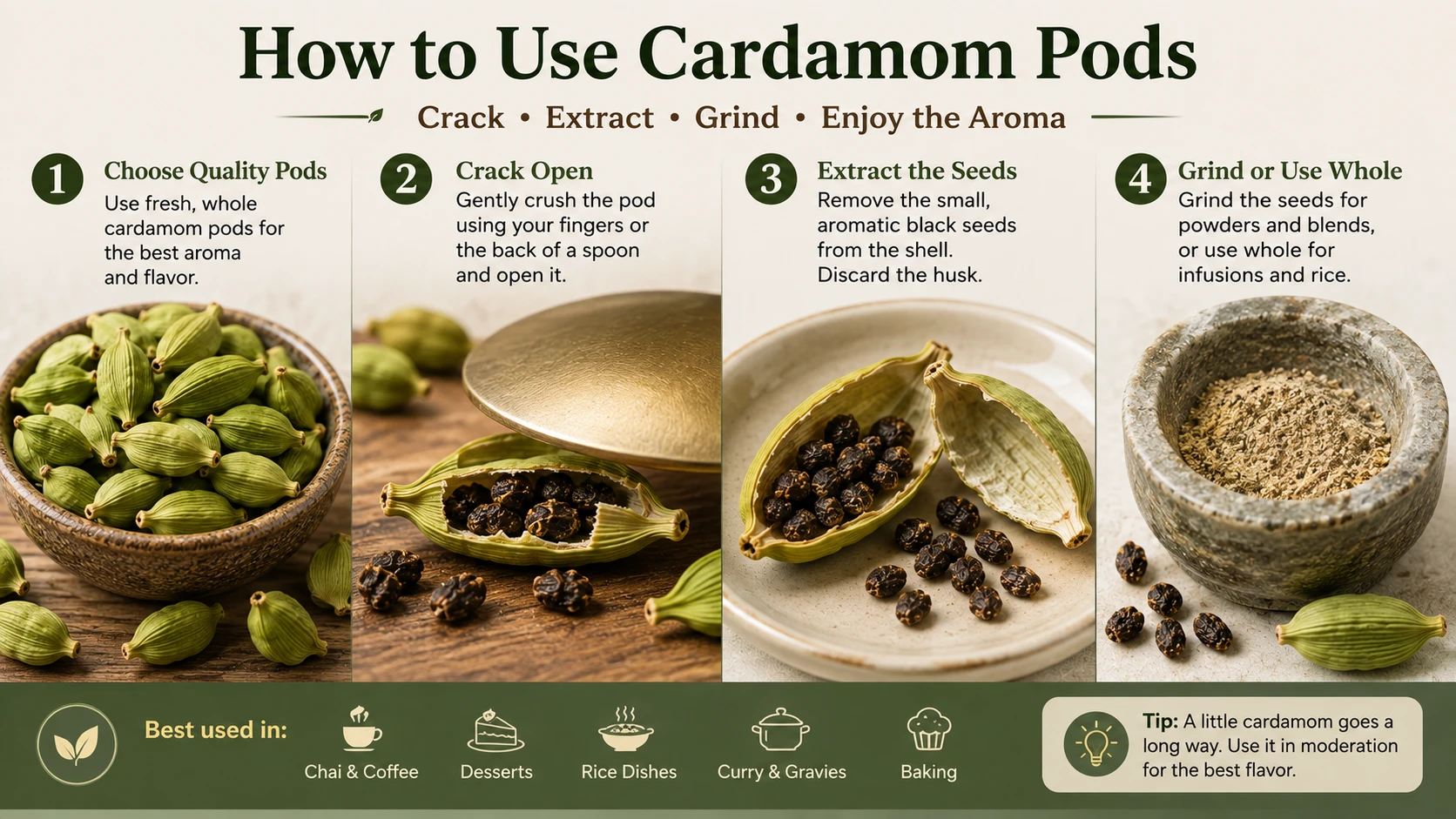
Press the flat of a knife or rolling pin firmly on the pod until it splits open. This releases the aromatic compounds immediately.
Peel away the papery husk and collect the dark brown seeds inside. Discard the husk — it has minimal flavour and is fibrous.
Heat a dry pan over medium heat. Add seeds for 30–45 seconds until fragrant. Shake constantly — they burn quickly. This unlocks volatile oils.
Use a mortar and pestle or spice grinder. Grind seeds to a fine powder. Use immediately — ground cardamom oxidises rapidly.
For savory dishes: add whole or cracked pods to hot oil or ghee at the start of cooking. The heat transfers the aromatic oils directly into the oil, flavouring the whole dish.
For teas and coffee: drop 2–3 cracked pods into boiling water or milk. Simmer 3–5 minutes. For cold infusions: steep cracked pods in cold water overnight in the fridge.
What Is Cardamom Used For?
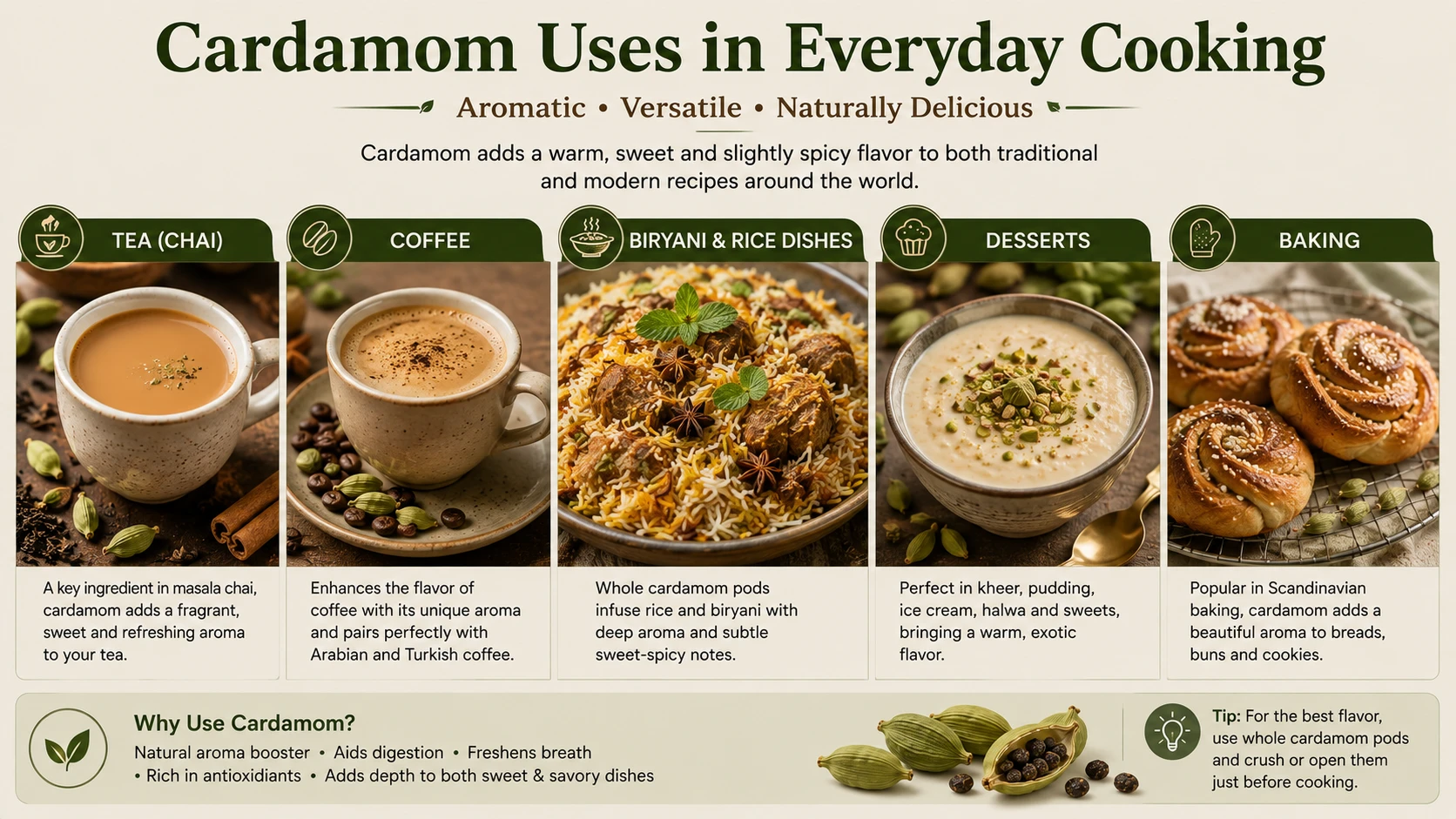
Essential in South Asian chai, Middle Eastern qahwa (Arabic cardamom coffee), and Turkish kahve. One of the most widely used spices in hot beverages globally.
Key ingredient in biryani, garam masala, pulao, haleem, nihari, and tagine. Adds aromatic depth to meat and rice dishes across South Asian and Middle Eastern cuisines.
Widely used in Scandinavian cardamom buns (kardemummabullar), Indian mithai, Middle Eastern pastries, and spiced cakes. Pairs beautifully with cinnamon and ginger.
Ayurveda has used cardamom for 5,000 years to aid digestion, freshen breath, reduce nausea, and support respiratory health. Modern studies confirm digestive and antioxidant benefits.
Present in over 300 commercial perfumes and fragrances worldwide. A valuable middle note in Oriental, spicy, and woody fragrance families. See our Cardamom Essential Oil guide →
Chewing cardamom pods after meals is a centuries-old practice across South Asia and the Middle East. The compound 1,8-cineole acts as a natural antimicrobial against oral bacteria.
Cardamom in World Cuisines
| Region | How Used | Key Dishes |
|---|---|---|
| South Asia (India, Pakistan) | Pods in rice; ground in masalas; in tea | Biryani, chai, kheer, garam masala |
| Middle East (Gulf states) | Ground into Arabic coffee (qahwa); in rice and meat | Qahwa, kabsa, mandi, luqaimat |
| Scandinavia | Ground into baked goods; white cardamom preferred | Kardemummabullar (cardamom buns), Danish pastries |
| Ethiopia | Korarima in coffee ceremony and berbere spice | Buna (Ethiopian coffee), injera accompaniments |
| Southeast Asia | Round cardamom (Amomum compactum) in blends | Rendang, laksa, nasi briyani |
Cardamom Nutrition Facts — USDA Data
Cardamom is used in small culinary quantities (1–3 pods per serving) but is nutritionally dense. The following data is per 1 teaspoon (2g) ground cardamom, based on USDA FoodData Central.
📌 Note: While cardamom’s macro-nutrients are modest (used in small amounts), its phytochemical content — antioxidants, terpenoids, flavonoids — delivers the health benefits documented in clinical research. The essential oil compounds are the key.
Cardamom Health Benefits — Key Research Findings
Cardamom has been used medicinally for over 5,000 years. Modern clinical research confirms several of its traditional applications. Below is a summary — for the full evidence-based guide with 15+ documented benefits, see our complete health benefits article →
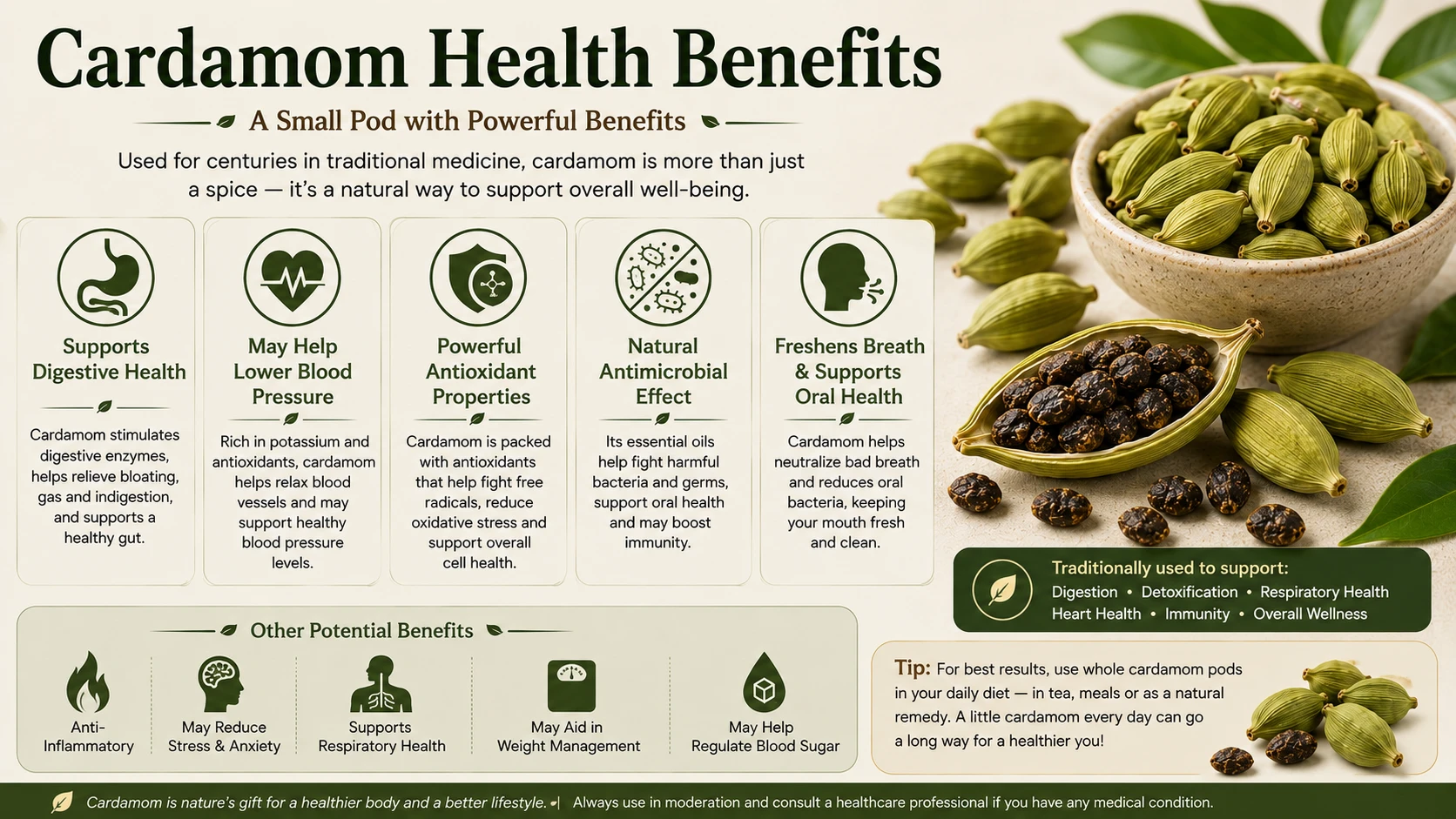
Stimulates digestive enzyme secretion, reduces bloating and gas. A 2009 study confirmed carminative and antispasmodic effects. Chewing 1–2 pods post-meal is a traditional Ayurvedic practice.
A 2019 randomised trial found 12 weeks of cardamom supplementation (3g/day) significantly lowered systolic blood pressure in pre-hypertensive patients. Rich in potassium (heart-regulating mineral).
1,8-cineole and flavonoids scavenge free radicals. Studies confirm cardamom reduces inflammatory markers (CRP, IL-6) comparable to NSAIDs in animal models.
1,8-cineole has documented antibacterial action against Streptococcus mutans (cavity bacteria) and Candida albicans (oral thrush). Multiple studies confirm breath-freshening efficacy.
Aromatherapy research shows cardamom essential oil reduces cortisol levels and promotes relaxation. Caffeine-free cardamom tea before bed is a traditional remedy for insomnia.
A 2024 meta-analysis (Zhang et al., Nutrition) found cardamom supplementation improved fasting blood glucose, triglycerides, and LDL cholesterol in metabolic syndrome patients.
History of Cardamom — A 5,000-Year Journey
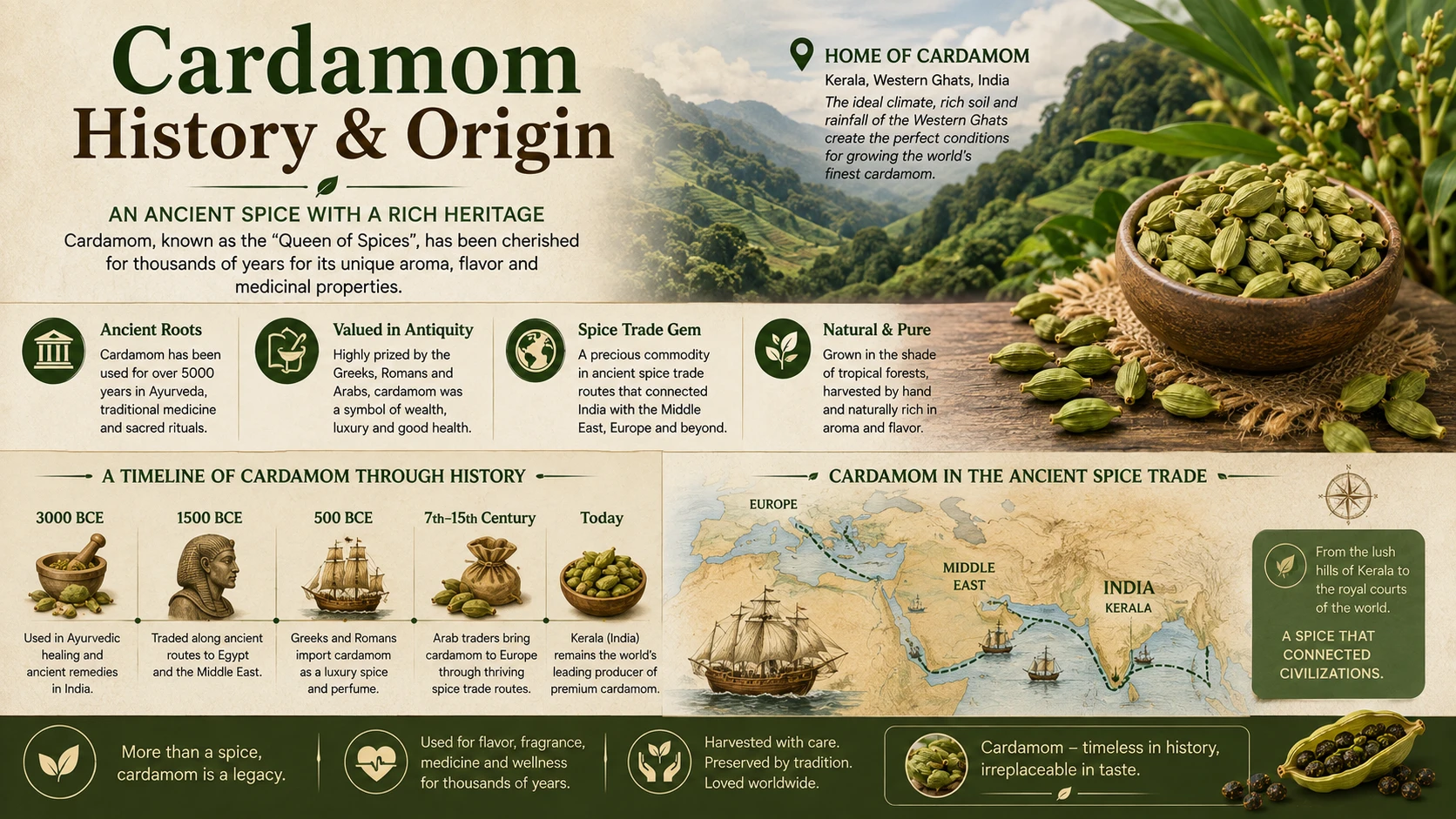
Cardamom (Sanskrit: ela) appears in Vedic texts and the Charaka Samhita. Ayurvedic physicians prescribed it for digestion, respiratory conditions, and detoxification. Cultivated in Kerala’s Western Ghats rainforests.
Egyptians prized cardamom for temple incense, perfumes traded along the Red Sea, and reportedly in mummy preparation. Egyptian texts reference it for tooth-cleaning and breath freshening.
The father of botany described cardamom as kardámōmon. Greek physicians imported it via Arab traders for medicinal use — marking the beginning of its formal Western documentation.
Arab traders carried Kerala cardamom by dhow across the Arabian Sea to the Persian Gulf, Mediterranean, and East Africa. The Arabic name habbahan / hail (هيل) became embedded in Middle Eastern culture during this period.
Norse traders encountered cardamom during expeditions to Constantinople. They brought it to Scandinavia where it became permanently embedded in Nordic baking — explaining why Sweden remains one of the highest per-capita cardamom consumers today.
German coffee planters introduced cardamom to Guatemala’s Alta Verapaz highlands in the early 20th century. The climate proved ideal — by the 1980s, Guatemala accounted for over 60% of global exports, primarily supplying Middle Eastern demand.
Cardamom in Ayurveda — 5,000 Years of Traditional Use
Ela (small/green) and Sthula Ela (large/black cardamom). Referenced in Vedas as early as 1000 BCE.
Sweet (madhura) and pungent (katu) — a rare combination that makes it balancing across multiple body types.
Cooling (shita virya) — despite its warming flavour, cardamom has a cooling post-digestive effect on the body.
Balances Vata and Kapha doshas; may increase Pitta in excess. Recommended for digestive and respiratory conditions.
Trikatu (with ginger and black pepper), Triphala combinations, and dedicated formulas like Ela Churna for digestion.
Nausea, hiccups, excessive thirst, bad breath, urinary disorders, heart palpitations, cough, and as a general tonic (rasayana).
Cardamom in Arab Traditional Medicine
Arab physicians in the 9th–12th centuries CE — particularly Ibn Sina (Avicenna) in his Canon of Medicine — prescribed cardamom as a digestive stimulant, aphrodisiac, and treatment for urinary complaints. This influenced its adoption into Persian and Ottoman medicine and explains its continued medicinal use across the Middle East today, where it is added to coffee not only for flavour but for its perceived digestive and energising properties.
Cultural & Spiritual Significance
Beyond medicine, cardamom carries deep cultural and spiritual significance across its growing regions. In India, cardamom pods are offered in temples dedicated to Goddess Lakshmi, symbolising prosperity. In Kerala, the spice is integral to sadya (ritual feast) preparations. In Arab cultures, serving qahwa (cardamom coffee) to guests is a sacred act of hospitality — refusing it is considered offensive in Bedouin tradition. The spice also appears in Arabian Nights literature and in ancient Egyptian papyri as a perfume and ritual incense ingredient.
What Is Cardamom Called in Different Languages?
Because cardamom has been traded globally for millennia, it carries names in dozens of languages. Many users in South Asia search in Hindi/Urdu as “elaichi” — both names refer to the exact same spice.
💡 Is elaichi and cardamom the same thing? Yes, completely. “Cardamom” is the English name; “elaichi” is Hindi/Urdu. Both refer to Elettaria cardamomum. Chhoti elaichi = green cardamom (small). Badi elaichi = black cardamom (large).
Where Does Cardamom Come From?

Cardamom is native to the tropical rainforests of Kerala’s Western Ghats in southern India, and also Sri Lanka. These cloud-forest environments — high rainfall, 600–1,500m elevation, rich loamy soils, dappled shade — are the plant’s natural habitat.
Why Is Cardamom (Elaichi) So Expensive?
Cardamom is expensive because every pod is harvested entirely by hand, the plant takes 2–3 years before first yield, pods ripen at different times requiring 3–4 harvests per season, and cultivation is limited to specific tropical highland microclimates at 600–1,500m elevation.
| # | Factor | Impact |
|---|---|---|
| 1 | 100% hand-harvested | No mechanisation possible — each pod picked individually |
| 2 | 2–3 year establishment | No revenue for years after planting |
| 3 | Multiple harvests per season | Pods ripen unevenly — same plants visited 3–4 times per season |
| 4 | Narrow growing zone | Only thrives at 600–1,500m in specific humid tropical belt |
| 5 | Low yield per hectare | ~200–300 kg dry pods per hectare in good conditions |
| 6 | High post-harvest labour | Cleaning, grading, and curing are all manual processes |
💡 Current price: Green cardamom trades at approximately $9–13/kg at Vandanmedu auction (Kerala) as of March 2026. See our live cardamom price tracker →
Economic Importance of Cardamom — Significance in the Spice Industry

Cardamom’s Significance in the Global Spice Trade
Cardamom occupies a unique position in the global spice economy. Unlike many spices partially replaced by synthetic flavouring alternatives, cardamom’s complex volatile oil profile cannot be replicated synthetically — sustaining high demand for the genuine article. The Middle East is the world’s largest importer, with Saudi Arabia, UAE, and Kuwait collectively importing over 30,000 MT annually. Cardamom is integral to Arabic qahwa coffee culture, a central social ritual throughout Gulf states, giving it a demand floor resistant to economic fluctuations.
Guatemala’s Cardamom Economy
Guatemala’s transformation into the world’s largest cardamom producer represents one of agriculture’s most remarkable crop-adoption stories. Concentrated in the Alta Verapaz and Huehuetenango highlands, cardamom cultivation supports approximately 100,000–150,000 smallholder farming families and generates over $1 billion USD annually — making it Guatemala’s most valuable agricultural export after coffee.
| Country | Role | Annual Volume | Key Markets |
|---|---|---|---|
| Guatemala | World #1 producer & exporter | 50,000–80,000 MT | Saudi Arabia, UAE, India |
| India | #2 producer; premium grade | 15,000–25,000 MT | Middle East, Europe, USA |
| Nepal | #1 black cardamom producer | 5,000–8,000 MT | India (primary consumer) |
| Saudi Arabia | Largest single importer | ~32,000 MT imported | Domestic qahwa consumption |
How to Buy and Store Cardamom — Complete Guide

How to Buy Fresh Cardamom — What to Look For
- Vibrant, uniform pale to medium green colour (not yellow or brown)
- Pods feel heavy and plump for their size — seeds inside are full
- Snap test: pod cracks crisply when bent — dry pods crumble
- Intense, immediate aroma when you scratch the surface
- Seeds rattle slightly when you shake the pod
- Buy from stores with high turnover — spice shops, South Asian grocers
- Yellow, brown, or bleached pods (unless buying white cardamom intentionally)
- Pods that feel lightweight or shrivelled — seeds have dried out
- No aroma when scratched — volatile oils have evaporated
- Cracked or split pods sitting in supermarket bulk bins
- Pre-ground cardamom in large packages (loses potency fast)
- Powdery residue inside the bag (indicates age and moisture)
Cardamom Grades — Understanding Quality Levels
| Grade | Name | Characteristics | Best For | Price |
|---|---|---|---|---|
| Premium | Malabar Green (AGEB) | Bold, plump pods; deep green; highest oil content; Kerala origin | Chai, fine baking, gifting | $12–15/kg |
| Premium | Mysore Bold | Extra-large pods; intense aroma; Karnataka origin | Arabic coffee, premium blends | $13–16/kg |
| Standard | Guatemala Green | Slightly paler; milder flavour; good value | Everyday cooking, bulk purchase | $7–9/kg |
| Standard | Black Cardamom | Large dark pods; smoky; Nepal/India origin | Biryani, savory dishes only | $18–22/kg |
How to Store Cardamom — Shelf Life Guide
Airtight glass jar. Dark, cool pantry. Away from heat and moisture.
Airtight tin or jar. No exposure to air — oxidises quickly once extracted.
Buy small quantities. Replace every 3 months for full potency.
Freeze in airtight bag. Thaw at room temperature before use. Excellent for bulk buying.
Cardamom Side Effects — Who Should Be Cautious?
Normal culinary use is considered safe. However, large medicinal doses may stimulate uterine contractions. Pregnant women should avoid cardamom supplements and limit intake to cooking amounts only. Consult your doctor.
Cardamom may interact with anticoagulants (blood thinners like warfarin) and aspirin. Its mild blood-thinning properties at high doses could enhance effects. Inform your doctor if taking these medications.
People with gallstones should be cautious — cardamom may trigger spasms in bile ducts in sensitive individuals. Avoid large amounts if diagnosed with cholelithiasis.
Though rare, cardamom allergies exist — particularly in people with allergies to other Zingiberaceae plants (ginger, turmeric). Symptoms include contact dermatitis, mouth tingling, or breathing difficulty.
Cardamom may lower blood glucose levels. Diabetics on medication should monitor carefully — it could enhance the effect of glucose-lowering drugs. A benefit in metabolic syndrome but requires monitoring in medicated patients.
Culinary use: unlimited (1–6 pods/day is normal). Supplemental/medicinal: studies use 1.5–3g ground cardamom per day. Anything above 3g/day without medical supervision is not recommended.
Common Cardamom Plant Diseases and Pests
Cardamom cultivation faces significant threats from diseases and insects that can cause yield losses of up to 80%. Understanding these threats is essential for farmers, agricultural researchers, and students studying the crop’s economics.
Most devastating cardamom disease. Spreads through aphids (Pentalonia nigronervosa). Causes mosaic yellowing and stunted growth. Can destroy 80%+ of yield. No cure — infected plants must be removed.
Affects the underground rhizome, causing soft rot and plant collapse. Promoted by waterlogged soils. Treated with copper-based fungicides and drainage improvement.
Brown necrotic lesions on leaves spreading inward from tips. Severe infections defoliate the plant. Managed with copper oxychloride sprays and reducing leaf moisture.
Primary vector for Katte virus. Colonies on pseudostem and leaf undersides. Viral transmission is the greater threat. Controlled with neem oil and systemic insecticides.
Tiny insects (1–2mm) attacking flower buds and developing pods, causing scarring and premature drop. Can reduce yields by 25–50%. Managed with spinosad-based insecticides.
Microscopic roundworms infecting roots, forming characteristic galls. Infected plants show stunted growth and yellowing. Managed with soil solarisation and neem cake application.
📌 For a complete guide to cardamom plant care and growing, see our Complete Cardamom Growing Guide →
Cardamom — Frequently Asked Questions
- 1Kew Gardens POWO — Elettaria cardamomum. powo.science.kew.org
- 2Encyclopaedia Britannica — Cardamom. britannica.com
- 3Ravindran P.N. & Madhusoodanan K.J. (2002). Cardamom: The Genus Elettaria. Taylor & Francis, London.
- 4USDA GRIN Taxonomy — Elettaria cardamomum. grin.usda.gov
- 5Spice Board of India — Cardamom Production & Export Statistics 2025. spiceboard.gov.in
- 6Wikipedia — Cardamom. en.wikipedia.org/wiki/Cardamom
 ER
EREmily Rhodes is a culinary writer specialising in spices, herbal teas, and plant-based ingredients. She writes extensively about spice history, cultural uses, and evidence-based health applications for CardamomNectar.
View full profile → MB
MBDr. Bennett holds a Ph.D. in Nutritional Sciences from the University of Michigan, specialising in Zingiberaceae phytochemistry. He reviews all botanical and health claims on CardamomNectar against peer-reviewed primary literature.
View full profile →