Garam Masala Recipe with Black Cardamom
Authentic Punjabi-Pakistani garam masala — 12 whole spices, dry-toasted in sequence, freshly ground. Black cardamom is the anchor spice that gives this blend its depth. Ready in 15 minutes and better than any store-bought version.


What is Garam Masala?
Garam masala is a dry-toasted and freshly ground blend of warming whole spices from North Indian and Pakistani cuisine. “Garam” means warming (Ayurvedic — spices that elevate body temperature) and “masala” means spice mixture. It typically includes black cardamom, green cardamom, cinnamon, cloves, cumin, coriander, black pepper, nutmeg, and mace. It is used as a finishing spice — added at the end of cooking to preserve its volatile aromatics.
Why Black Cardamom is the Anchor Spice
Open any jar of commercial garam masala and smell it. It will be aromatic — cumin-forward, slightly sweet from cinnamon. What it almost certainly will not have is the deep, smoky, camphor-forward base note that defines traditional Punjabi and Pakistani garam masala. That note comes from black cardamom (badi elaichi). Most commercial manufacturers omit it — it is more expensive, less familiar to Western markets, and harder to source at scale. The result is a functional but shallow spice blend.
Black cardamom’s volatile camphor and cineole compounds are heat-stable. When garam masala is added to a hot dish at the end of cooking, the black cardamom note is the last to fade and the most persistent in the finished dish. It provides a resinous, wood-smoke quality that rounds and grounds the bright top notes of green cardamom, nutmeg, and mace. Without it, garam masala tastes complete but one-dimensional. For a deeper look at the chemical differences, see our green vs black cardamom guide.
This recipe yields Punjabi-Pakistani style garam masala — deeper, more robust than light South Indian versions. The two-stage toasting sequence matters: large dense spices like black cardamom and cinnamon need a head start before smaller seeds are added. This is the most-skipped technique in garam masala recipes online. Use this blend in dal makhani, mutton biryani, and every slow-cooked dish you make.
↑ Back to top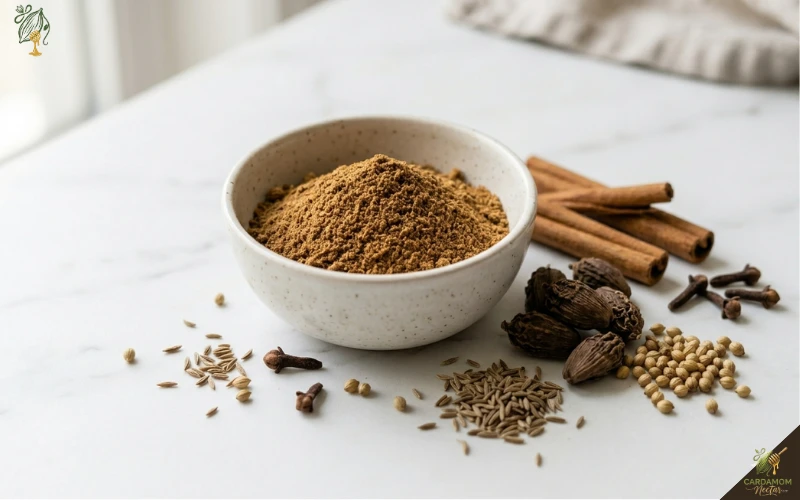
Authentic Punjabi-Pakistani whole spice blend — 12 spices, toasted in sequence, freshly ground. The smoky black cardamom anchor that no store-bought blend has.
Ingredients
Yields approx. 6 tablespoons · Urdu/Hindi names included
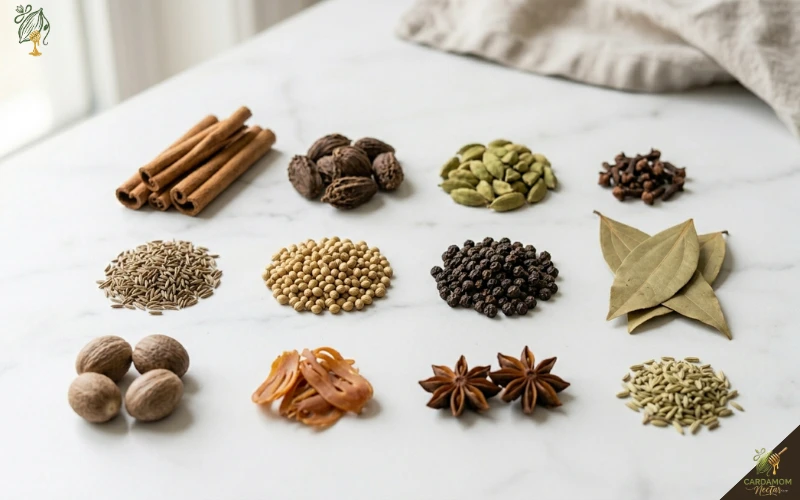
What Each Spice Does in Garam Masala
Understanding each spice’s role lets you adjust the blend for specific dishes — more cumin for meat, more green cardamom for rice dishes, less cloves for a milder blend.
| Spice | Flavour Role | Function | Essential? |
|---|---|---|---|
| Black CardamomBadi Elaichi | Deep smoky camphor base — wood-smoke, resinous, mentholated | Anchor / Base | High |
| Coriander SeedsDhaniya | Mild citrus-earthy body — largest volume, tones down pungency of others | Base / Volume | Essential |
| Cumin SeedsZeera | Earthy nutty warmth with slight bitterness — savory foundation | Base / Warmth | Essential |
| Black PeppercornsKali Mirch | Piperine-driven heat and sharpness — not chilli heat, warming heat | Heat | Essential |
| Green CardamomChhoti Elaichi | Citrus-floral sweetness — the bright top note that balances heavy base | Top Note | Essential |
| Cinnamon / CassiaDar Cheeni | Warm sweetness and body — rounds and mellows the peppery edge | Sweetness | Essential |
| ClovesLaung | Intense pungent punch — adds complexity but overwhelms if over-used | Punctuation | High |
| MaceJavitri | Delicate floral-nutmeg aroma — more nuanced and sweeter than nutmeg | Floral Depth | High |
| NutmegJaiphal | Warm sweet complexity — added after grinding; toasting destroys it | Finish | High |
| Fennel SeedsSaunf | Mild anise-sweetness — supports green cardamom, adds aromatic layer | Support | Moderate |
| Star AniseBaadyan | Sweet anise fragrance — deepens the blend without adding heat | Support | Moderate |
| Bay LeavesTej Patta | Subtle herbal background — hard to identify alone, adds complexity | Background | Moderate |
Select the spice you don’t have — get exact substitution guidance.
Substitute: 1 extra tsp green cardamom seeds + ¼ tsp smoked paprika added after grinding — not during toasting.
Impact: The blend will be lighter and more floral — closer to a South Indian profile. The camphor-smoke note will be absent. Still excellent, just different. Source it for next batch →
Substitute: Add a small extra scraping of nutmeg — use ⅓ nutmeg total instead of ¼. Mace and nutmeg come from the same seed, mace being the outer membrane. They are similar but mace is more delicate and floral.
Impact: Minor — the easiest substitution in this recipe. The blend will be slightly less floral but the nutmeg covers most of the gap.
Substitute: Add ½ tsp extra fennel seeds. Both contribute anise-family sweetness — fennel is milder and will not fully replicate star anise depth but covers the gap without altering the blend significantly.
Impact: Subtle. Star anise is a moderate contributor in garam masala — its absence is less noticeable than missing black cardamom or cinnamon.
Substitute: Use 1 full mace blade instead of ½ to compensate — or simply omit. Nutmeg is a background finish note, not foundational. Do not substitute ground allspice — completely different flavour profile.
Impact: The blend will be slightly less complex in background notes but still excellent and usable in all the same dishes.
Substitute: Add ½ tsp extra fennel seeds for sweetness and 2 extra cloves for aromatic intensity. This will not replicate the citrus-floral note precisely but maintains blend complexity.
Impact: Noticeable — green cardamom is an essential spice. The blend will be earthier and less bright. Green cardamom is available at any South Asian grocery and worth sourcing.
Step-by-Step Instructions
6 steps · 15 minutes total · Electric grinder recommended
-
 1
1Gather, Measure & Prepare All Spices
Measure all whole spices into separate small bowls. For green cardamom: crack pods and extract the black seeds — discard pods or include them (pods add mild body; seeds are more concentrated). For black cardamom: lightly crush each pod flat with the side of a knife to crack it open — this exposes the seeds and accelerates volatile oil release during toasting. Set nutmeg aside separately — it will be grated in after grinding and never toasted.
💡 Why this mattersHaving everything measured before the pan heats prevents rushing during toasting — scorched spices cannot be fixed and the batch must be discarded. Cracking the black cardamom pod is important: the thick outer shell insulates the seeds and slows heat penetration. A cracked pod toasts more evenly and extracts more camphor and cineole into the finished powder. -
2
Toast Large Spices First — Black Cardamom, Cinnamon, Bay, Mace
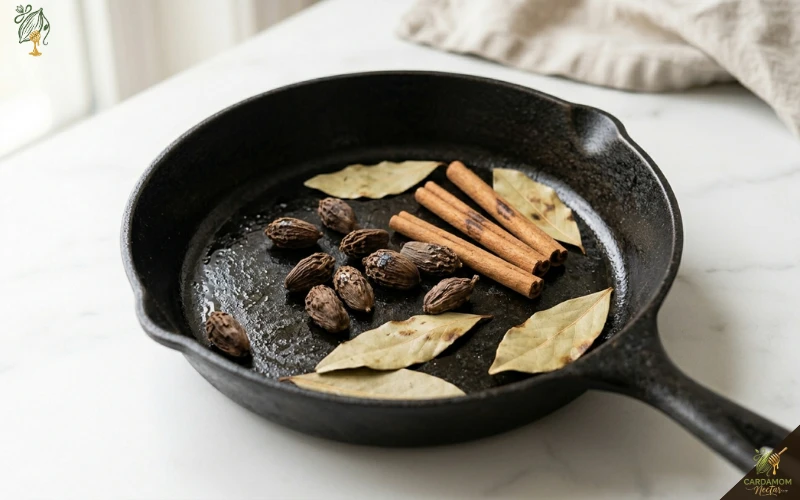
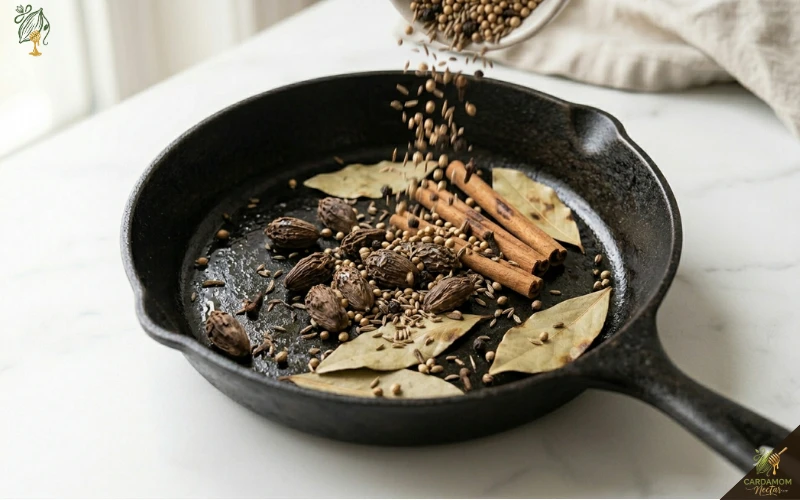
Heat a dry cast iron skillet on medium-low until warm — not smoking. Add the cracked black cardamom pods, cinnamon sticks, bay leaves, and mace blade. Toast for 90–120 seconds, stirring constantly. You will notice the camphor-smoke note of the black cardamom rising clearly — this is the signal that extraction is working. Cinnamon will begin to smell toasted. Bay leaves will become slightly brittle at the edges. Do not allow any spice to blacken.
💡 Why this mattersLarge, dense spices have significantly more mass relative to surface area than small seeds. If all spices are added simultaneously, the small seeds scorch while the large spices are still cold in the centre. A staged approach ensures every spice reaches the correct extraction temperature — hot enough to rupture volatile oil cells, not so hot as to burn them off. -
3
Add Small Seeds — Finish Toasting Together
Add coriander seeds, cumin seeds, black peppercorns, green cardamom seeds, cloves, fennel seeds, and star anise to the pan. Increase stirring speed — small seeds toast fast and can scorch in under 30 seconds if left still. Toast together for 90 seconds, shaking the pan constantly. A strong, complex warm aroma rising from the pan is the signal to stop. Remove pan from heat immediately — do not wait for the aroma to fade.
💡 Why this mattersCloves in particular scorch extremely fast — from perfect to bitter in 15 seconds. Constant movement and pulling from heat the moment aroma peaks is the only way to manage this. Even residual pan heat continues toasting for 10–15 seconds after the flame is off — account for this by removing from heat slightly before you think it is ready. -
4
Cool Completely — Do Not Grind Warm
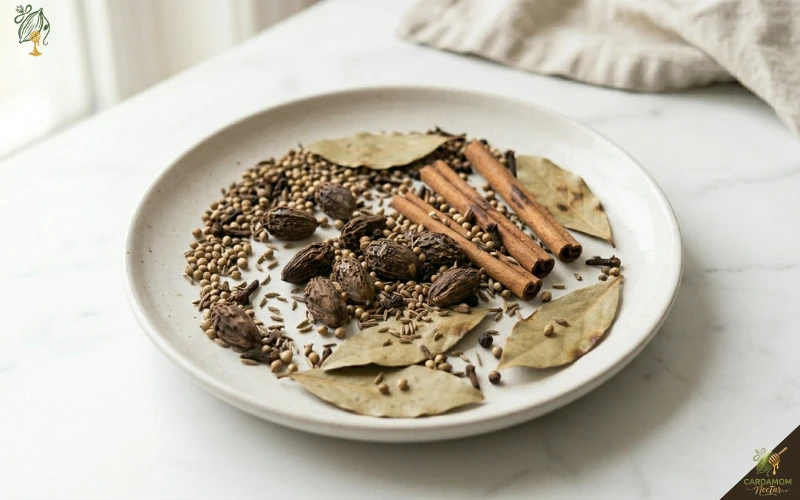
Immediately transfer all toasted spices from the pan onto a wide plate or tray in a single layer — do not pile. Cool at room temperature for 10–15 minutes until no warmth remains when you hold your palm 5cm above the spices. Do not speed this step by refrigerating — the rapid temperature change causes moisture condensation on the spices.
💡 Why this mattersGrinding warm spices creates steam inside the grinder chamber from residual moisture. This steam condenses on volatile aromatic compounds as they are released during grinding, causing them to clump and oxidise faster — measurably reducing shelf life. Cool spices grind finer, more uniformly, and produce a powder with better aroma retention. -
5
Grind to Fine Uniform Powder
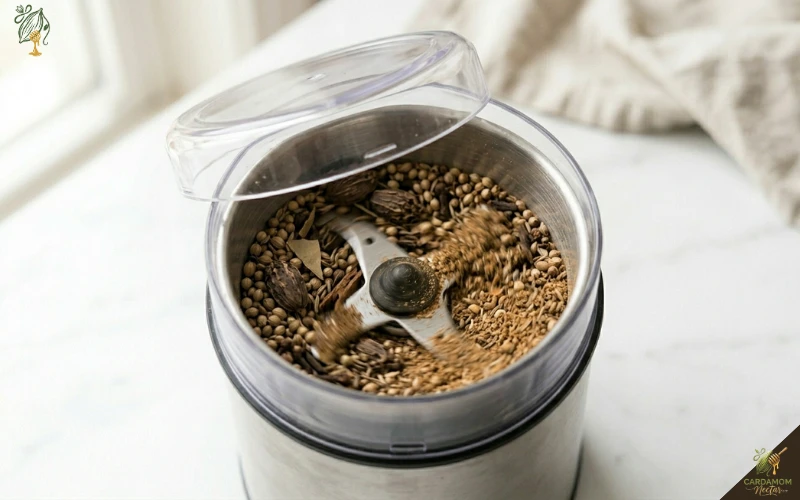
Transfer cooled spices to an electric spice grinder. Grind in 15-second bursts, shaking the grinder between each burst, for 45–60 seconds total until fine and uniform. Test by rubbing a pinch between fingers — no large gritty pieces should remain. For mortar and pestle: grind harder spices (black cardamom seeds, peppercorns, cloves) separately first, then combine with the rest. Sieve through a fine mesh if any large pieces remain.
💡 Why this mattersShort pulse cycles prevent the grinder motor from overheating and prevent spices from clumping against the blades. A continuous 60-second grind on a home spice grinder generates friction heat that drives off volatile compounds from the powder itself. Short pulses produce a finer grind and preserve more aroma in the finished powder. -
6
Add Nutmeg, Store in Airtight Glass
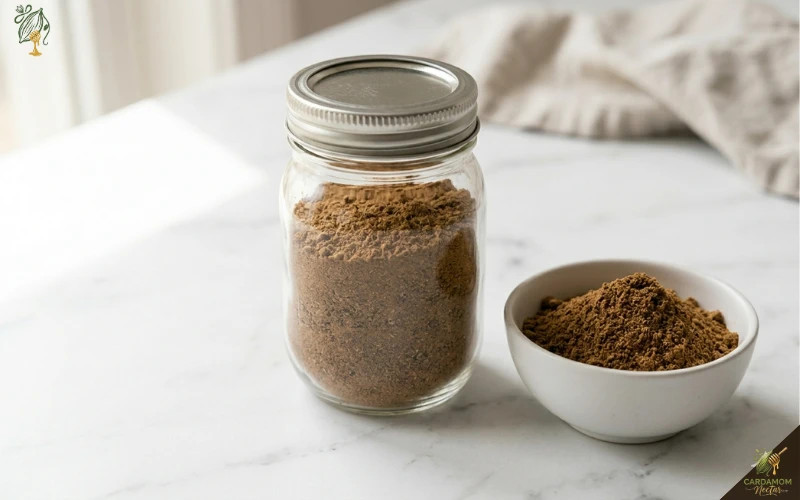
Grate ¼ of a whole nutmeg directly into the ground spice blend using a fine Microplane or grater. Stir thoroughly until fully incorporated. Transfer to a completely dry glass jar with an airtight lid — never use plastic (plastic is gas-permeable and accelerates aroma loss). Label with the date. Store away from direct light, heat, and humidity. Use within 4–6 weeks. If the jar smells faint when opened: make a fresh batch. Whole unground spices last 12–18 months — pre-measure batches and grind monthly.
💡 Why this mattersNutmeg’s most volatile aromatic compounds (myristicin, elemicin) are destroyed by the heat of toasting. This is why nutmeg is added post-grind — the same reason professional kitchens grate nutmeg fresh over finished dishes rather than cooking it in. Glass is impermeable to volatile aromatic compounds; plastic containers allow slow gas permeation that steadily accelerates staleness.
How to Use This Garam Masala
Garam masala is a finishing spice — add in the last 3–5 minutes of cooking to preserve volatile aromatics. These are the amounts and timing for common dishes.
What Makes a Garam Masala Great vs Just Good
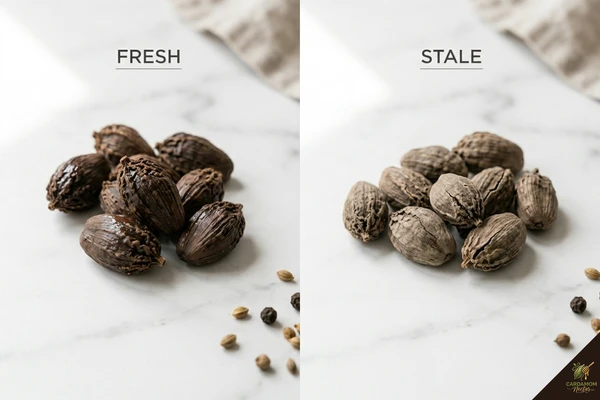
A garam masala from fresh whole spices in imperfect ratios outperforms a precisely proportioned blend from stale pre-ground spices every time. Volatile aromatic compounds degrade from the moment spices are ground. Buy whole spices from South Asian grocers with high turnover — not supermarket aisles where stock may be months old. Smell each spice before adding: if it doesn’t smell distinctly of itself, it has lost potency. See our cardamom buying guide for sourcing details.
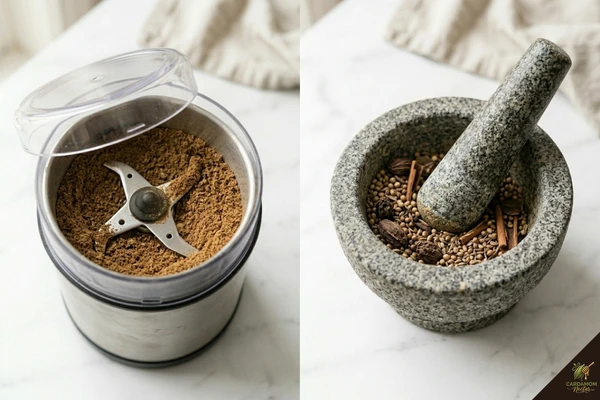
An electric spice grinder produces a finer, more uniform powder and is faster — this is the recommended tool. A mortar and pestle produces a slightly coarser grind with more texture, which some cooks prefer in certain dishes. For the most aromatic result: avoid shared coffee grinders (coffee residue taints spice flavour); clean the grinder between uses by grinding a tablespoon of raw rice, which absorbs oils and odours. Replace the grinder if you notice persistent old-spice smell.
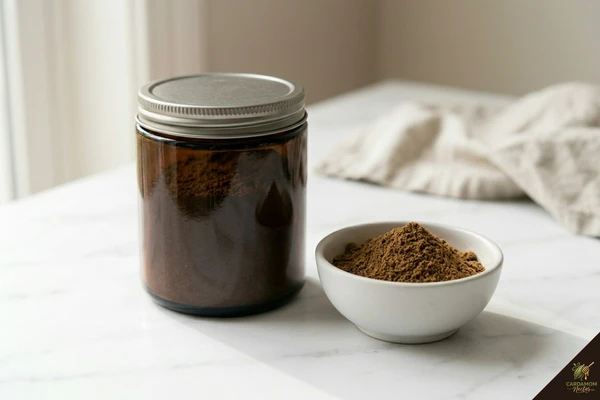
This recipe yields 6 tablespoons — enough for 6–10 dishes. This is intentional. Garam masala loses measurable aroma within 4 weeks of grinding as volatile compounds oxidise and evaporate. Large batches sitting for months are a false economy — you end up using more of a stale blend to achieve the same effect, negating any cost saving. Pre-measure batches of whole spices and seal in small bags — they last 12–18 months. Grind fresh monthly.
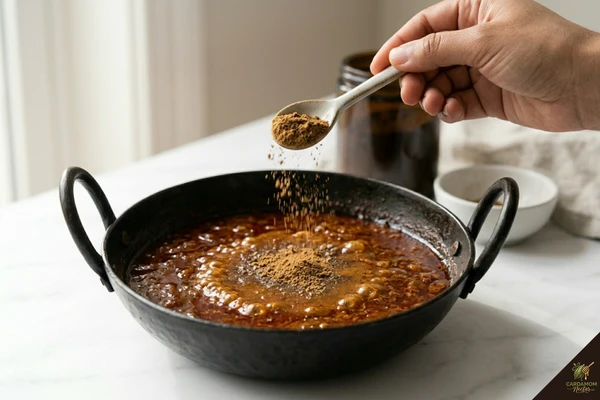
Garam masala is a finishing spice by design. Its volatile aromatic compounds evaporate quickly under sustained heat. Adding at the beginning with onions produces a flat, cooked-out note rather than the bright complex aroma it provides when added late. Add in the final 3–5 minutes, stir once, and cover briefly so aromatics bloom in the trapped steam. Exception: biryani marinade, where cold yogurt protects the aromatics during the marination period.
Difficulty Level & Time Breakdown
This is the most accessible recipe on the site. The only real skill required is heat management — keeping the pan at medium-low and not walking away during the 4-minute toast. New to South Asian cooking? Start here. Understanding garam masala from scratch is the fastest way to understand the flavour foundation of dishes like dal makhani and nihari.
Frequently Asked Questions
Recipes That Use This Garam Masala
All from the Black Cardamom Recipes hub — put your freshly made blend to work.


Emily covers South Asian spice culture, recipe development, and market sourcing. She has visited spice markets in Kerala, Karachi, and Dubai and writes all recipe content on CardamomNectar. Her approach prioritises kitchen science — the why behind technique — and sourcing accuracy grounded in direct market experience.
View Profile →Dr. Bennett reviews all scientific and technical content on CardamomNectar. His expertise in volatile oil composition and spice phytochemistry ensures all data meets peer-reviewed standards. He verified the claims in this article on staged toasting extraction, volatile compound degradation during storage, and the chemical differences between black and green cardamom aromatic profiles.
View Profile →