Green vs Black Cardamom
Two pods. Two completely different spices. One common mistake. This guide tells you exactly which to use, when — and why they cannot replace each other.
Green Cardamom
Floral · Sweet · Eucalyptol-rich
3–8% volatile oil · South India / Guatemala
Black Cardamom
Smoky · Camphor · Earthy
1.5–3% volatile oil · Nepal / Sikkim
💱 Roughly: Green ≈ £16–33 / C$31–63 / A$31–64 per kg · Black ≈ £6–13 / C$11–25 / A$11–26 per kg — approximate, based on mid-2026 exchange rates and fluctuates daily.
- Side-by-Side Comparison · 2 min✓
- Where Cardamom Comes From · 1 min✓
- Volatile Oil Science · 2 min✓
- Harvest & Processing · 2 min✓
- How to Crack Open Each Pod · 1 min✓
- Flavor Profiles · 1 min✓
- Use Case Matcher (Interactive Tool) · 1 min✓
- Cuisine & Recipe Guide · 2 min✓
- Buying Guide · 2 min✓
- Nutrition & Minerals · 1 min✓
- Sustainability · 1 min✓
- Substitution Guide · 2 min✓
- Quick Quiz · 1 min✓
- Common Myths, Busted · 1 min✓
- FAQ · 4 min✓
Walk into any South Asian grocery store and you will find both side by side. Most cooks grab green without thinking. That is not always wrong — but it is often uninformed. Green and black cardamom come from different plant genera, process differently, taste nothing alike, and serve almost entirely separate culinary roles.
This guide gives you the science, the cooking data, and an interactive tool to end the confusion once and for all.
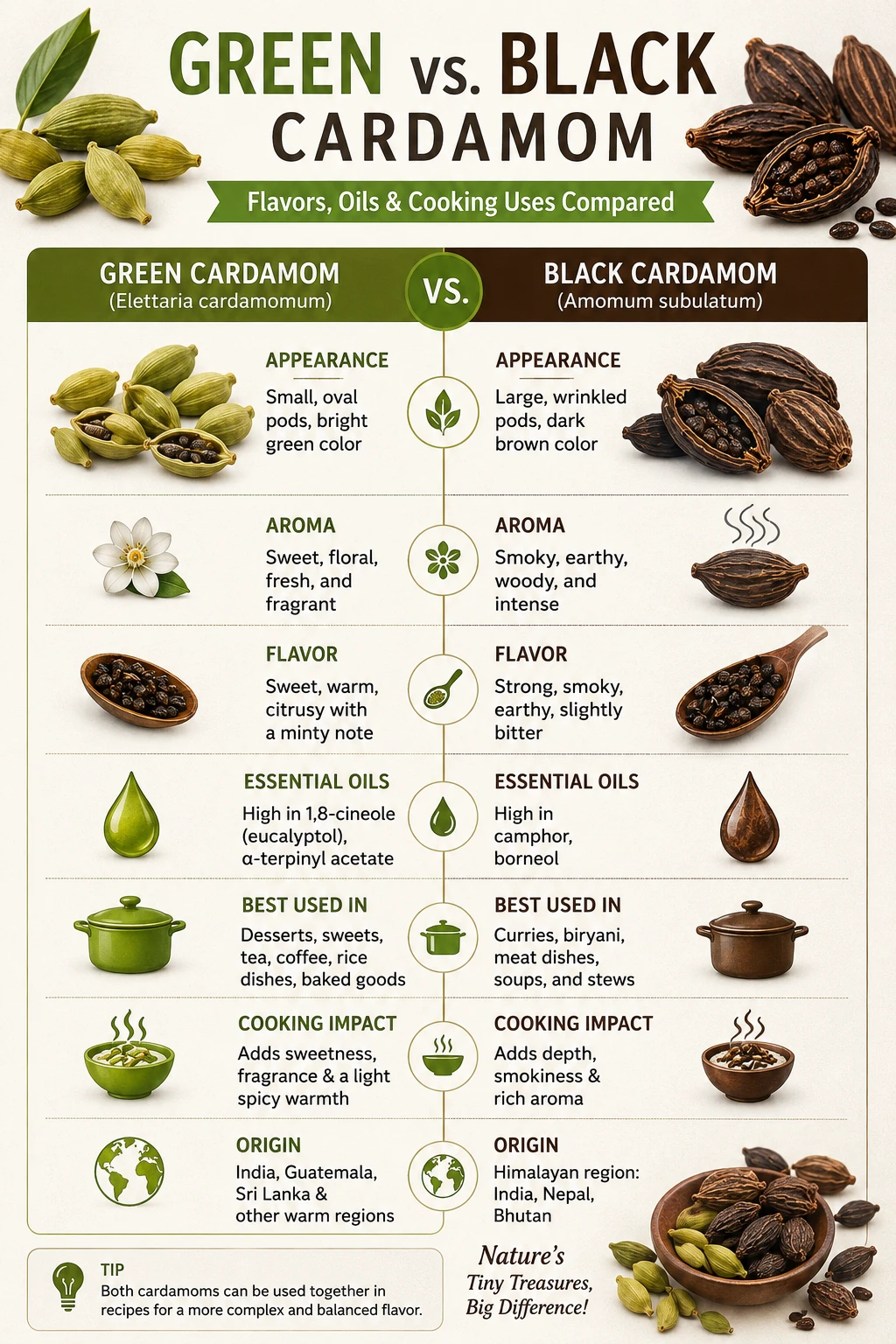
Pin the full green vs black cardamom breakdown — flavor, volatile oils, and cooking uses at a glance — so it’s easy to find next time you’re cooking.
Side-by-Side Comparison
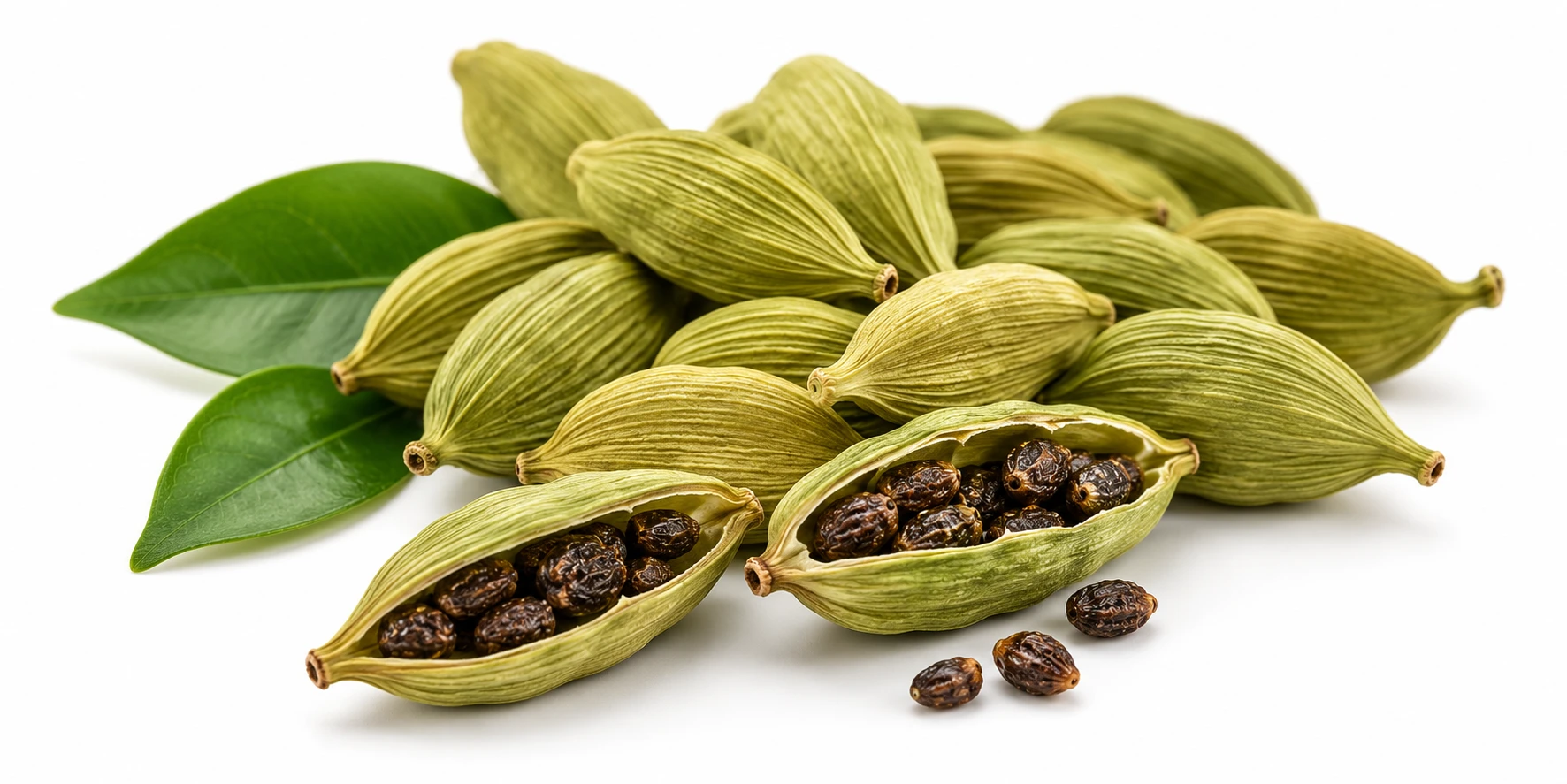
Green Cardamom
Elettaria cardamomum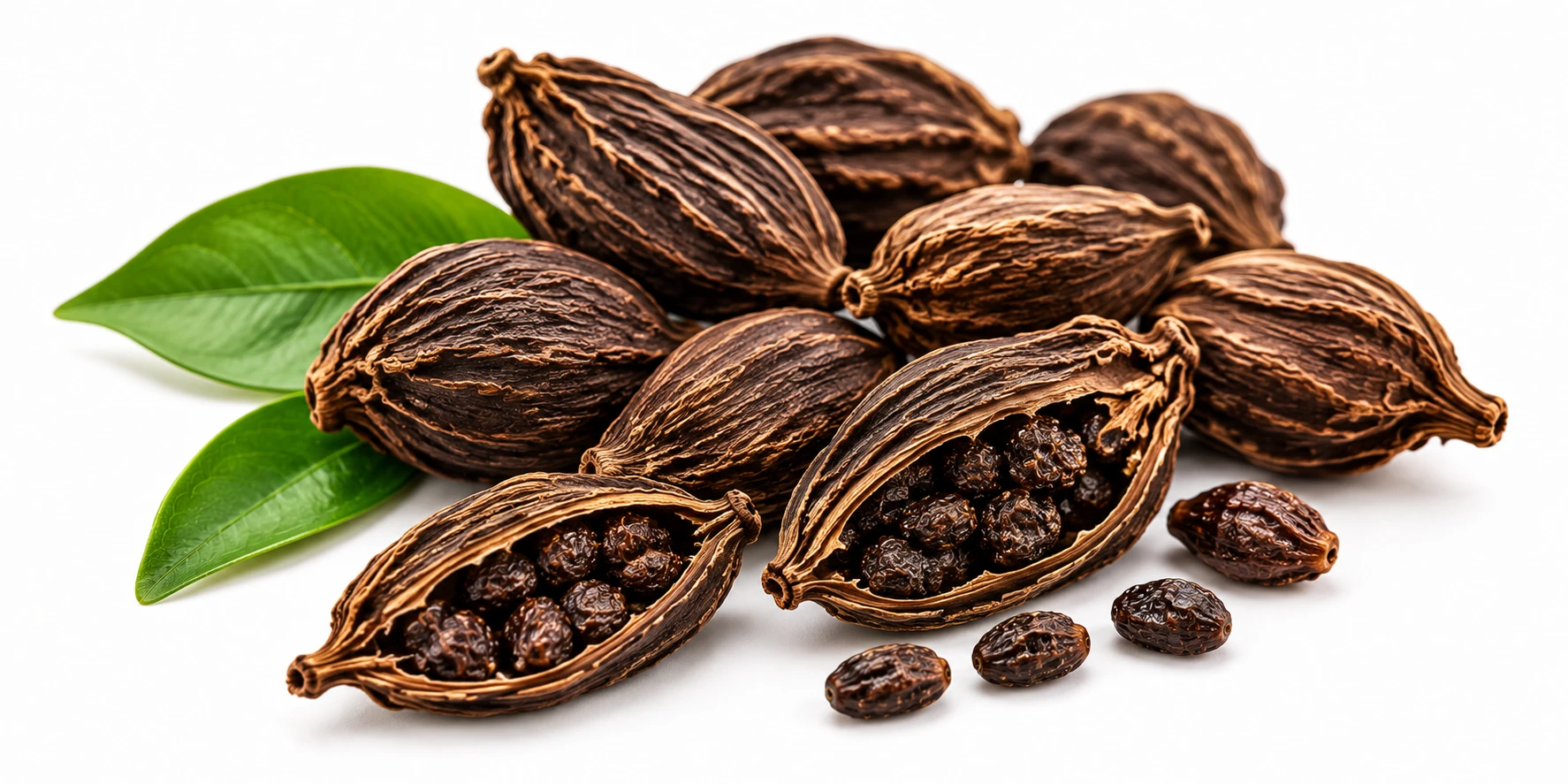
Black Cardamom
Amomum subulatumWhere Cardamom Comes From: A 2,300-Year Journey
Cardamom’s story starts in the wild forests of the Western Ghats in southern India, where Elettaria cardamomum still grows naturally today — the only cardamom that does. Traders carried it along ancient spice routes into Greece more than 2,300 years ago; historians credit Alexander the Great’s campaigns in India with introducing it to the Mediterranean world, where Greek and Roman physicians prized it as a digestive remedy long before it became a kitchen staple.
Black cardamom’s history runs on a separate track entirely. Native to the eastern Himalayan foothills of Nepal, Sikkim, and Bhutan, it developed as a distinct regional spice used in the cooler, meat-heavy cuisines of the mountains — smoke-drying wasn’t a stylistic choice but a practical one, since open-fire curing was the only reliable way to dry pods in the damp Himalayan climate.
Did You Know?
Green cardamom reached Northern Europe via Viking trade routes over 1,000 years ago, which is why it’s still a defining flavor in Scandinavian baking today — Swedish kardemummabullar (cardamom buns) and Finnish pulla both trace back to that same trade history, not to South Asian influence.
The Volatile Oil Science
A spice’s aroma and flavor come from its volatile (essential) oils. Understanding which compounds dominate each cardamom tells you exactly why they taste so different — and which dishes they suit.
Volatile Oil Compound Profile
Bars show approximate % of total volatile oil content. Data from phytochemistry literature.
Harvest & Processing: From Farm to Pod
The oil profiles above don’t come from the plant alone — how each pod is harvested and dried is what locks in (or destroys) those compounds. This is the step most comparison guides skip, and it’s the real reason green and black cardamom end up tasting nothing alike.
| Stage | 🟢 Green Cardamom | 🟤 Black Cardamom |
|---|---|---|
| Harvest window | Hand-picked pod by pod, just before full ripeness, 3–4 times per season | Machine or bulk hand-harvested once mature; less selective |
| Altitude | 600–1,500m (Western Ghats, Guatemalan highlands) | 1,000–2,000m (Eastern Himalayan foothills of Nepal, Sikkim) |
| Drying method | Sun-dried or low-heat shade-dried in curing chambers — preserves delicate volatile oils | Fire-dried over wood or charcoal for 3–5 days — this smoke exposure is what creates the guaiol and phenolic compounds responsible for its signature smokiness |
| Drying duration | 4–7 days, temperature-controlled | Longer, open-fire process; less controlled, more variation batch to batch |
| Post-harvest handling | Graded and sorted by pod size (AGEB/AGB/AGS) immediately after drying | Typically sorted by size and color; less standardized international grading exists |
Did You Know?
Black cardamom isn’t one uniform crop — Sikkim and Nepal grow named cultivars like Ramsey, Golsey, Sawney, and Varlangey, each with slightly different pod size and disease resistance, plus newer high-yield varieties bred specifically for the region. It’s closer to how coffee has Arabica sub-varieties than most home cooks realize.

“People assume the smoke in black cardamom is added later, like a spice rub. It isn’t — it’s baked into the pod’s chemistry during those 3 to 5 days over open fire. That’s a one-way chemical change, which is why no amount of toasting green cardamom in a dry pan will ever get you there.”
— Dr. Michael Bennett, Plant Scientist & Food Scientist
Did You Know?
Cardamom is the third most expensive spice in the world by weight, right after saffron and vanilla — and green cardamom’s labor-intensive hand-harvesting is the main reason why.
How to Crack Open Each Pod
Both pods hide their flavor inside — but they don’t open the same way. A green pod’s thin husk splits with a light pinch; a black pod’s tough, fibrous husk needs real pressure from the flat of a knife or a mortar and pestle, and for most savory dishes the whole bruised black pod goes into the oil rather than being cracked apart for its seeds.
🫛 For the full step-by-step technique for both types — with photos for each stage — see our How to Crack Cardamom Pods guide →
Flavor Profile Comparison
Flavor has multiple dimensions beyond just “spicy” or “sweet.” Toggle between the two to see how each cardamom scores across key sensory attributes.
Use Case Matcher
Not sure which to use in your recipe? Tap your dish type and get an instant recommendation based on flavor science.
🔍 Which Cardamom Should I Use?
Select your dish or drink below — the tool will recommend the right variety and explain why.
Cuisine & Recipe Reference Guide
A practical reference covering the most common dishes and cuisines that use cardamom — with clarity on which variety is correct.
| Dish / Cuisine | Use | Notes |
|---|---|---|
| Masala Chai | 🟢 Green | 2–3 pods, cracked. Green’s eucalyptol pairs perfectly with ginger and milk. |
| Chicken Biryani | ⚖️ Both | Green in marinade; black in whole spice tempering for smoky base. |
| Mutton Rogan Josh | 🟤 Black | Black’s camphor-smoke cuts lamb fat beautifully. Do not use green. |
| Kheer / Rice Pudding | 🟢 Green | Ground green pods only. Black will make it taste medicinal. |
| Arabic Qahwa Coffee | 🟢 Green | Essential. 1 tsp ground green per 2 cups coffee. Traditional recipe. |
| Dal Makhani | 🟤 Black | 1–2 whole black pods in the slow-cooked base. Adds depth without sweetness. |
| Swedish Cardamom Buns | 🟢 Green | Only green works here. Nordic baking relies on the floral-sweet profile. |
| Garam Masala | ⚖️ Both | Traditional recipes use mostly green; some regional blends add small black. |
| Pho / Vietnamese Broth | 🟤 Black | Black cardamom is an authentic pho spice — adds smoky depth alongside star anise. |
| Lassi / Sweet Drinks | 🟢 Green | A pinch of ground green. Black in drinks is an acquired taste — not recommended. |
| Nihari | 🟤 Black | Both varieties in the spice blend, but black dominates for its slow-braise performance. |
| Chhena Poda / Indian Sweets | 🟢 Green | Ground green pods only. Black would completely overpower delicate sweet cheese. |
🔢 Need exact pod-to-teaspoon amounts for the dishes above? See our full conversion chart → — it covers both green and black pod counts.
Did You Know?
Black cardamom is an authentic pho spice, not a Western substitution — Vietnamese cooks have simmered it alongside star anise and cinnamon in beef pho broth for generations.
Buying Guide: What to Look For
Quality varies enormously. Here is what separates premium cardamom from inferior stock — for each variety.
📈 Current market conditions: Green cardamom prices are running higher than usual in 2026 due to a Guatemalan production shortfall, with India gaining export share as a result. For live pricing and the full market update, see our Cardamom Price Today tracker →
🔗 Disclosure: The “Shop” links below are Amazon affiliate links. If you buy through them, CardamomNectar may earn a small commission at no extra cost to you. We only link to products we’d genuinely recommend based on the buying criteria in this guide.
How to Spot Fake or Adulterated Cardamom
Because cardamom is expensive relative to most spices, it’s one of the more commonly adulterated ones in bulk and street-market supply chains. A few checks catch most problems before you buy:
- Dyed or artificially blackened pods: Genuine fire-dried black cardamom has a matte, slightly uneven surface. Dye jobs look unnaturally glossy and uniform, and color can transfer onto wet fingers — rub a pod between damp fingertips as a quick test.
- Empty or husk-only pods: Give a handful a gentle shake near your ear. Quality pods rattle faintly with seeds inside; a papery, hollow sound means many pods have lost their seeds or were never fully filled.
- Bulked ground powder: Pre-ground cardamom is the easiest form to adulterate with rice flour, ground pea husks, or other cheap fillers. Buying whole pods and grinding fresh avoids this risk entirely — it’s the single biggest reason experienced cooks avoid pre-ground cardamom.
- Suspiciously low price for “premium” grade: AGEB-grade green cardamom and Sikkim-origin black cardomom command real premiums for a reason. A bargain price on a pod claiming top grade is a signal to check a sample closely — or buy elsewhere.
- No aroma when cracked: This is the most reliable test of all. Real, fresh cardamom of either variety releases a noticeable burst of aroma the instant a pod is cracked open. If you smell little to nothing, the pods are either old, mislabeled, or of poor quality — regardless of appearance.
Nutritional & Mineral Profile
Cardamom is used in small quantities, so it won’t make or break a diet — but the mineral density per gram is genuinely notable, and it differs between the two varieties. Figures below are approximate values per 1 tsp (about 2g) of ground pods.
| Nutrient (per 1 tsp ground) | 🟢 Green Cardamom | 🟤 Black Cardamom |
|---|---|---|
| Calories | ~6 kcal | ~6 kcal |
| Manganese | ~24% DV — among the highest of any common spice | ~10% DV |
| Iron | ~0.3 mg | ~0.4 mg — slightly higher, likely from soil/altitude differences |
| Potassium | ~29 mg | ~27 mg |
| Fiber | ~0.6 g | ~0.7 g (tougher pod fiber) |
| Notable compounds | Eucalyptol — mild antimicrobial and decongestant properties | Camphor and guaiol — traditionally used for respiratory support |
Did You Know?
Manganese is essential for bone formation and metabolism, and just one teaspoon of ground green cardamom provides a meaningful share of the daily value — more per gram than most spices in a typical kitchen cabinet.
📚 What the research says: A systematic review of randomized clinical trials found cardamom consumption linked to reduced inflammatory markers and blood pressure — though green and black cardamom’s differing oil profiles mean the evidence doesn’t automatically transfer between the two. See our full health benefits guide → for the study-by-study breakdown.
A Note on Sensitivity to Strong Aromatics
Black cardamom’s smoky, camphor-forward compounds are noticeably more potent than green cardamom’s lighter oils. People with asthma, other reactive airway conditions, or a general sensitivity to strong smoke and menthol aromas sometimes find whole black cardamom pods — especially when crushed or simmering uncovered — mildly irritating to breathe near. This isn’t a reason to avoid the spice in normal cooking, where it’s diluted into a dish, but if you know you’re sensitive to smoky or menthol aromas, cook with the lid on and ventilate the kitchen. As with any spice consumed in concentrated form, check with a healthcare provider if you have a specific respiratory or cardiac condition and are unsure.
Note: figures are approximate averages compiled from published food-composition data and will vary by origin, freshness, and grinding method. Cardamom is used medicinally in some traditions, but this is not medical advice — speak to a healthcare provider for individual guidance.
Sustainability & Ethical Sourcing
The two spices carry very different environmental footprints, largely because of the processing differences covered above. Worth knowing if sourcing responsibly matters to you.
Substitution Guide
Out of one variety? A direct 1:1 swap will not work — but these substitutions get you close without ruining your dish.
Can I just use the other cardamom instead?
🔄 For non-cardamom substitutes (allspice, star anise, cloves, and full ratio tables for every dish type) see the dedicated Cardamom Substitutes guide → and Black Cardamom Substitutes guide →.
More from the Cardamom Knowledge Silo
This guide is part of our Cardamom Knowledge silo. Explore related articles:
Keep volatile oils fresh for longer. Airtight containers, light exposure, and freshness tests explained.
Out of cardamom? Interactive tool finds the best replacement for any recipe — sweet or savory.
Nihari, dal makhani, pho broth — dishes where black cardamom is the star ingredient.
AGEB vs AGB grades, seeds vs pods vs ground, freshness tests, and where to buy.
Both are smoky and used in savory cooking — but they are very different spices. Full comparison.
Out of black cardamom? Ratio-based swaps for biryani, curries, and slow braises — with a free finder tool.
Is it safe? Which type? How much? Evidence-based guide for expectant mothers.
Step-by-step technique for opening both green and black pods the right way.
Quick Quiz: Test What You’ve Learned
Five questions, thirty seconds. See how much of the green vs black cardamom science actually stuck.
🧠 Green or Black?
Tap the correct answer for each question.
Common Myths, Busted
Fact: They’re different pods from related but distinct plant species, harvested at different altitudes and fire-dried on purpose — not a shelf-life stage of the same spice.
Fact: Pan-toasting adds light roasted notes, but not the guaiol and phenolic compounds that only form during days of open-fire drying — see the Harvest & Processing section above.
Fact: For most South Asian savory dishes, the whole bruised black pod (husk included) goes into the oil for tempering — the husk itself is where much of the smoky flavor lives.
Fact: Price reflects labor-intensive hand-harvesting, not superiority — they serve different culinary roles and neither replaces the other.
Fact: Despite similar-looking ground powder and occasionally overlapping in spice blends, they’re unrelated — cardamom (green or black) is warm and aromatic with floral or smoky notes, while coriander seed is citrusy and mildly nutty. They aren’t interchangeable in most recipes.
Frequently Asked Questions

Emily Rhodes
Emily covers the science and culture of South Asian spices with a focus on practical kitchen application. Her work draws on direct sourcing visits to spice markets in Kerala, Pakistan, and the UAE, combined with analysis of global auction data.
VIEW FULL PROFILE →Dr. Michael Bennett
Dr. Bennett reviews all technical content on CardamomNectar for scientific accuracy, with particular expertise in essential oil composition, volatile compound analysis, and spice phytochemistry. His reviews ensure all data meets peer-reviewed standards.
VIEW FULL PROFILE →