Saudi Arabia & Pakistan — The Two Countries Driving Global Cardamom Demand in 2026
One buys cardamom for its ancient coffee culture. The other for biryani and elaichi chai. Together, they account for the majority of global demand — and both are buying more than ever.
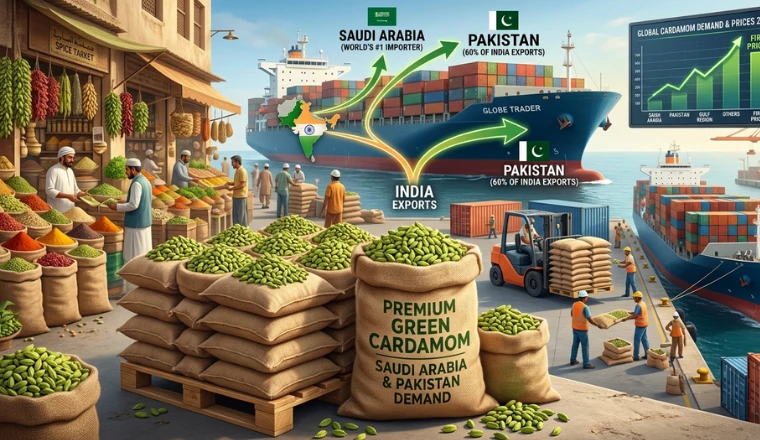
Two countries sit at the heart of global cardamom demand — and neither produces a single pod. Saudi Arabia, the world’s single largest importer, and Pakistan, which absorbs roughly 60% of India’s total cardamom exports, are the twin engines keeping prices firm and supply chains active throughout 2026. Understanding what drives their demand is essential for anyone tracking where cardamom prices are headed next.
2023 data
World’s largest cardamom consumer. Qahwa (Arabic cardamom coffee) is central to Saudi culture and hospitality — driving price-inelastic demand year-round.
absorbed by Pakistan
Imports primarily via India. Demand driven by biryani, elaichi chai, and a rapidly growing packaged spice manufacturing industry.
Saudi Arabia — The World’s #1 Cardamom Buyer
Saudi Arabia holds the single largest share of global whole cardamom imports — 21.54% of total world import value, reaching $131 million in 2023. The kingdom imports cardamom from over 99 countries, with Guatemala and India as its two primary suppliers. This is not a recent trend — Saudi Arabia has led global cardamom imports for decades, rooted in a cultural dependency that no price increase can easily break.
The reason is qahwa — the traditional Arabic cardamom coffee that is central to Saudi hospitality, culture, and daily life. Ground cardamom is brewed with lightly roasted green coffee beans and served in small ceramic cups at every social occasion, from family gatherings to business meetings to weddings. Refusing a cup of qahwa offered by a host is considered disrespectful in Bedouin tradition — making cardamom consumption a cultural obligation rather than a dietary choice.
What Saudi Buyers Look For
Saudi buyers are exceptionally quality-conscious. Indian green cardamom — particularly Malabar and Alleppey grades from Kerala — is especially prized for its intense aroma and high 1,8-cineole content, the volatile oil compound responsible for cardamom’s characteristic warm eucalyptus note. Saudi consumers specifically prefer Indian cardamom for qahwa because of these superior aromatic qualities over cheaper Guatemalan alternatives.
The Saudi Food and Drug Authority (SFDA) enforces strict pesticide residue standards for imported spices. Indian exporters have worked closely with the Spices Board of India to meet SFDA requirements — a significant compliance barrier that limits competition from lower-grade suppliers and keeps premium Kerala cardamom in a strong position in the Saudi market. This quality gate effectively protects Indian exporters from price-based competition.
Pakistan — The Hidden Giant in Cardamom Trade
Pakistan is rarely discussed as a top cardamom importer in mainstream trade data — because most of its cardamom arrives via India, not directly from origin countries. This re-export route through Indian trading hubs obscures Pakistan’s true scale as one of the world’s most significant cardamom consumer markets.
According to trade data, Pakistan is the largest importer of cardamom via India, absorbing roughly 60% of India’s total cardamom exports. When Nepal’s large cardamom exports to India are factored in — with 99% of Nepal’s output going to India first — Pakistan’s indirect demand becomes one of the most powerful price signals in the entire global cardamom supply chain. A slowdown in Pakistani demand would immediately be felt at Kerala auction centres.
Three Reasons Why Pakistan Buys So Much
Biryani & Meat Dishes
Both green and black cardamom are essential ingredients in Pakistani biryani, nihari, haleem, and pulao — dishes consumed daily across the country at all income levels. Pakistan’s population of 240 million means even a modest per-capita usage creates enormous absolute volumes. No substitution for cardamom exists in these dishes without fundamentally changing the flavour profile.
Elaichi Chai Culture
Cardamom tea — elaichi chai — is Pakistan’s national beverage. From roadside dhabas to drawing rooms, cardamom-infused tea is consumed multiple times daily across every income level. Even a small quantity per cup, multiplied across hundreds of millions of cups per day nationwide, creates sustained baseline demand that never weakens regardless of price levels.
Packaged Spice Manufacturing
Pakistan has a rapidly growing packaged spice industry producing garam masala, biryani masala, and chai masala blends for domestic consumption and export to the Pakistani diaspora in the UK, Canada, UAE, and the US. These industrial buyers require consistent cardamom supply in bulk, creating commercial-scale demand on top of already massive household consumption.
The Full Gulf Picture — Beyond Saudi Arabia
Saudi Arabia leads but it does not stand alone. The broader Gulf Cooperation Council — UAE, Kuwait, Qatar, Bahrain, Oman — collectively represents the world’s most concentrated cardamom consumption zone. Together these six nations account for a disproportionate share of global imports relative to their combined population.
| Country | Role in Trade | Primary Use | Import Rank |
|---|---|---|---|
| 🇸🇦 Saudi Arabia | World’s #1 importer | Qahwa (Arabic cardamom coffee) | #1 Global |
| 🇦🇪 UAE | Import + re-export hub | Qahwa, re-export to Asia & Africa | #2 Global |
| 🇰🇼 Kuwait | High per-capita consumer | Qahwa, traditional cooking | #3 Global |
| 🇵🇰 Pakistan | Imports via India | Biryani, elaichi chai, spice blends | Top 6 Global |
| 🇶🇦 Qatar | Significant consumer | Qahwa, hospitality sector | Top 10 Global |
The UAE plays a unique dual role — it is both a large consumer market and a significant re-export hub. Dubai’s famous Spice Souk re-exports cardamom to East Africa, South Asia, and other parts of the Middle East, making UAE trade data a useful barometer for broader regional demand. A sharp rise in UAE import volumes often signals growing end-market demand across multiple downstream countries simultaneously.
What This Means for Cardamom Prices in 2026
The structural demand from Saudi Arabia and Pakistan creates a price floor that is uniquely resistant to correction. Unlike discretionary consumer purchases, cardamom consumption in these markets is woven into daily cultural rituals that do not bend easily to price signals. When Kerala auction averages rose 36% since January 2026, Gulf and Pakistani buyers continued purchasing — absorbing the price increase rather than reducing volumes. This cultural demand inelasticity is the single biggest reason why cardamom prices have stayed elevated through the current season despite healthy supply from Nepal and Guatemala.
For buyers in the UK, US, Canada, and Australia — particularly members of the South Asian and Arab diaspora — understanding this Gulf-Pakistan demand dynamic is essential when deciding whether to stock up now or wait. With both Saudi and Pakistani buying showing no sign of softening, and the pre-monsoon supply tightening continuing at Kerala auction centres, significant price relief is unlikely before the new Kerala harvest arrives in October–November 2026.
Retail buyers in South Asian communities: Current Pakistan retail prices of ₨6,500–₨12,000/kg reflect the same auction-level pressures visible at Vandanmedu and Nedumkandam. There is no structural reason to expect a meaningful price drop in the near term. Buying your regular 3–6 month supply now at current rates is likely more cost-effective than waiting.
Key Takeaways — April 24, 2026
- ✓ Saudi Arabia holds 21.5% of global cardamom imports — the largest share of any single country worldwide
- ✓ Pakistan absorbs ~60% of India’s total cardamom exports — primarily via re-export through Indian trading hubs
- ✓ Qahwa coffee culture creates price-inelastic demand in Saudi Arabia — prices rising does not reduce buying volumes
- ✓ Pakistan’s demand is driven by biryani, elaichi chai, and packaged spice manufacturing — all structurally growing segments
- ✓ Gulf + Pakistan demand is the primary reason 2026 auction prices remain above ₹2,400/kg despite adequate supply
- ✓ Price relief unlikely until October–November 2026 when the new Kerala harvest enters auction markets
📊 Track Prices Daily: Check our dedicated price pages for live Kerala auction rates, Pakistan elaichi wholesale prices, and global market data — updated every trading day before markets open.
Related Reading
Sources: Tridge Global Cardamom Import Data 2026 · Kathmandu Post — Nepal Cardamom Export Report March 2026 · India Spices Board Auction Data April 2026 · CardamomNectar.com Price Tracker · Tendata Global Cardamom Trade Analysis · Volza Saudi Arabia Cardamom Import Intelligence