
Spiced Short Ribs with Black Cardamom
Bone-in beef short ribs braised in red wine with black cardamom bloomed in the beef fat. One Dutch oven. Three hours in the oven. The camphor-smoke depth of black cardamom transforms a standard braise into something restaurant kitchens charge $45 a plate for.


What are Braised Short Ribs?
Braised short ribs are bone-in cuts of beef from the chuck or plate section, slow-cooked in liquid in a covered pot at low temperature until the collagen converts to gelatin and the meat becomes fall-off-the-bone tender. This recipe adds black cardamom — bloomed in the rendered beef fat before the vegetables are added — extracting its camphor and cineole volatile compounds into the fat that then carries them through the entire 3-hour braise. The result is a sauce with a complex, slightly smoky depth no standard braise achieves.
Why Black Cardamom Belongs in Short Ribs
Short rib braises are fundamentally about one thing: depth. You sear to build fond, build a sauce in that fond, braise for three hours, and reduce the braising liquid to a glossy sauce. Every step concentrates flavour. Black cardamom belongs at the beginning of this process — bloomed in the rendered beef fat immediately after searing, its camphor and cineole volatile compounds extract into the fat and then get carried through every subsequent step: into the mirepoix as the vegetables cook, into the red wine as it reduces, and through the full three-hour braise.
The result in the finished dish is a braising sauce with a barely-detectable but unmistakable smoky, resinous background note. Dinner guests will taste it and not be able to identify it. That is the correct level of contribution for black cardamom in a Western-style braise — present but not announcing itself. One pod is enough for two kg of short ribs. Two pods pushes it into identifiably spiced territory, which may be desired but changes the character of the dish. For the science behind why black cardamom’s compounds are so distinctive and heat-stable, see our green vs black cardamom guide.
This recipe is also the ideal make-ahead dinner party dish. Braised short ribs are demonstrably better when made 1–2 days in advance, refrigerated in the braising liquid, and reheated before service. The fat solidifies into a cap that lifts off cleanly, the sauce becomes a thick gelatin overnight that reheats into a silkier sauce than fresh, and the collagen continues distributing through the sauce during the cold rest. More on this in the Expert Tips section. For an alternative application of the same black cardamom + beef method, see our black cardamom BBQ rub.
↑ Back to topEnglish Cut vs Flanken Cut — Which to Buy
The cut you buy determines the cook method. Getting this wrong wastes the entire recipe.
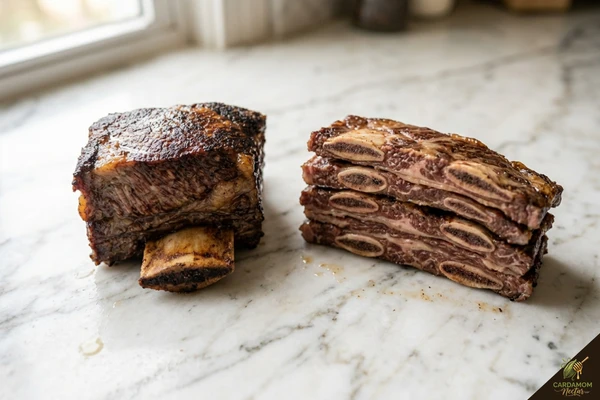
Each piece has a single bone on one side with a thick block of meat — typically 3–4 inches long and 2–3 inches wide. This is the standard short rib you see in restaurants. The large bone and surrounding connective tissue contain high collagen, which converts to gelatin during the 3-hour braise and enriches the sauce. The thick meat block holds its structure during braising rather than falling apart too quickly.
How to order: Ask your butcher for “bone-in short ribs, English cut, 3-inch pieces.” You want 4–6 pieces, approximately 350–450g each.
Flanken-cut ribs are sliced thin (½–¾ inch thick) across multiple bones, producing a strip with 3–4 bone cross-sections visible. This is the cut used in Korean galbi. The thin profile means they cook quickly on high heat — 3–5 minutes per side on a grill. For braising, the thin pieces overcook and disintegrate before the collagen has fully rendered. Do not use flanken cut for this recipe.
Alternative: If you can only find flanken, reduce braise time to 90 minutes and expect a more shredded result.
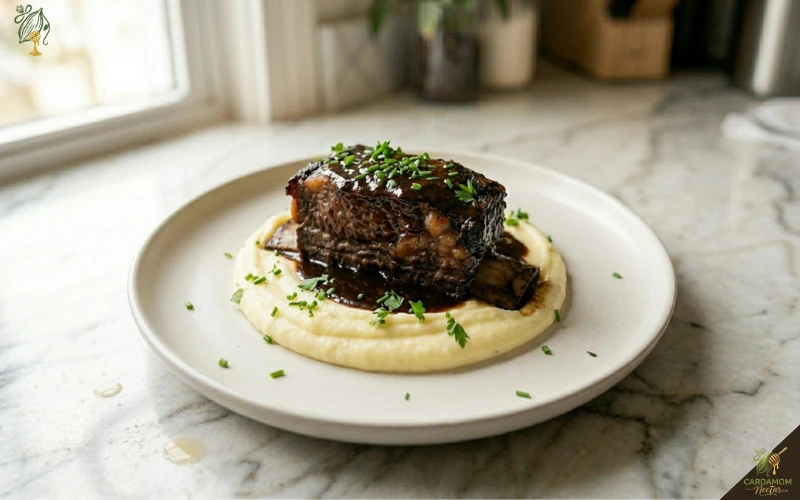
Bone-in short ribs braised in red wine with black cardamom bloomed in beef fat. One pot. Three hours. The smoky camphor depth that restaurant braises have and home recipes don’t explain.
Ingredients
Serves 4 · Scale to 6–8 by increasing ribs and liquid proportionally
Wine Substitutions
If you prefer not to cook with alcohol, these substitutions maintain the acidity and depth red wine provides.
250ml beef stock + 100ml pomegranate juice + 2 tbsp red wine vinegar. The pomegranate provides fruit depth and mild tannins; the vinegar provides acidity.
300ml beef stock + 75ml grape juice + 1.5 tbsp balsamic vinegar. Slightly sweeter profile — reduce balsamic to 1 tbsp if you prefer less sweetness.
375ml extra beef stock + 2 tbsp red wine vinegar. Produces a less complex sauce but still excellent — the black cardamom compensates for some depth.
All alcohol cooks off during the 5-7 minute reduction step — the finished dish is alcohol-free. The wine contributes flavour compounds, not alcohol.
Select what you have — get the closest substitute and impact assessment.
Substitute: Add 3 green cardamom pods (lightly bruised) + ¼ tsp smoked paprika to the fat bloom step instead.
Impact: The braise will be excellent — standard and well-spiced. The camphor-smoke background note will be absent. The green cardamom adds a citrus-floral dimension instead. Source it for next batch →
Substitute: Add ½ tsp fennel seeds to the spice bloom. Fennel provides a milder anise-sweetness without star anise’s intensity.
Impact: Minor — star anise is a supporting spice in this braise. The sauce will be slightly less aromatic in the background but the black cardamom remains the dominant spice note.
Substitute: Use ½ tsp dried thyme added with the stock (not at the beginning — dried thyme at start turns bitter). Or substitute with 2–3 sprigs fresh rosemary for a different but compatible herbal note.
Impact: Minor — thyme adds herbal brightness to the sauce. The braise will be richer and more straightforwardly beefy without it, which many prefer.
Substitute: Use 2 tsp soy sauce + 1 tsp balsamic vinegar. Soy provides the umami-saline quality; balsamic provides the slight sweetness and acidity. Or simply omit and adjust salt at the end.
Impact: Minor. Worcestershire is an umami amplifier — the braise will be slightly less complex in depth but the difference is subtle.
Substitute: Use 3 tbsp finely chopped sun-dried tomatoes cooked into the mirepoix, or 100ml crushed tomatoes (reduce the stock by the same amount to compensate). The caramelisation step is less effective with these alternatives but the tomato umami contribution remains.
Impact: Moderate — tomato paste caramelisation is the glutamate foundation of the sauce. Without it the sauce will be less complex and slightly thinner.
Step-by-Step Instructions
8 steps · 4 hours total · ~30 min active · 3 hr passive braise
-
 1
1Season and Sear Short Ribs — Deep Brown, All Sides
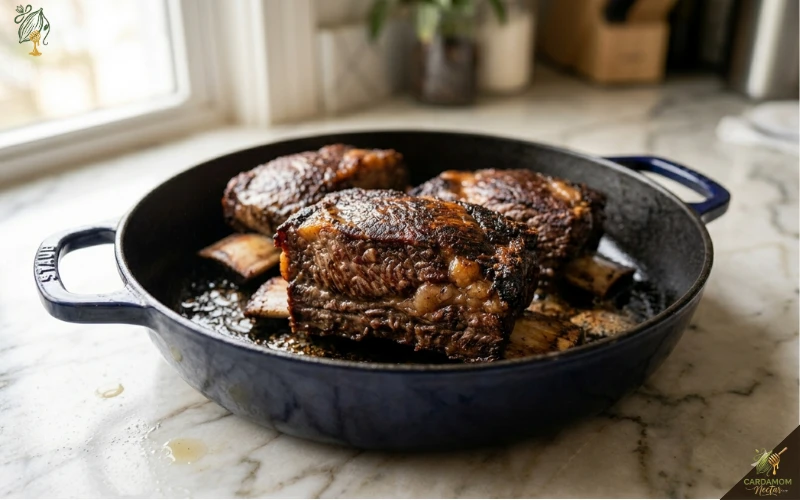
Remove ribs from refrigerator 1 hour before cooking. Pat all surfaces completely dry with paper towels. Season generously with salt and black pepper on all sides including the bone side. Preheat oven to 160°C (325°F). Heat 2 tbsp oil in a large Dutch oven (5-litre+) over high heat until shimmering. Sear ribs in 2 batches — do not crowd. Sear each side 3–4 minutes until deep mahogany brown, including the narrow sides. Remove to a plate. You should have a significant dark fond covering the base of the pot.
💡 Why this mattersThe fond (the dark caramelised residue on the pot base from searing) contains hundreds of Maillard browning compounds that dissolve into the sauce when the wine and stock are added. This is the flavour foundation the entire braise builds on — skimping on sear time or crowding the pan (which causes steaming instead of browning) produces a pale, flat-tasting sauce regardless of how long you braise. Deep mahogany brown is the target, not light tan. -
2
Bloom Black Cardamom in the Beef Fat
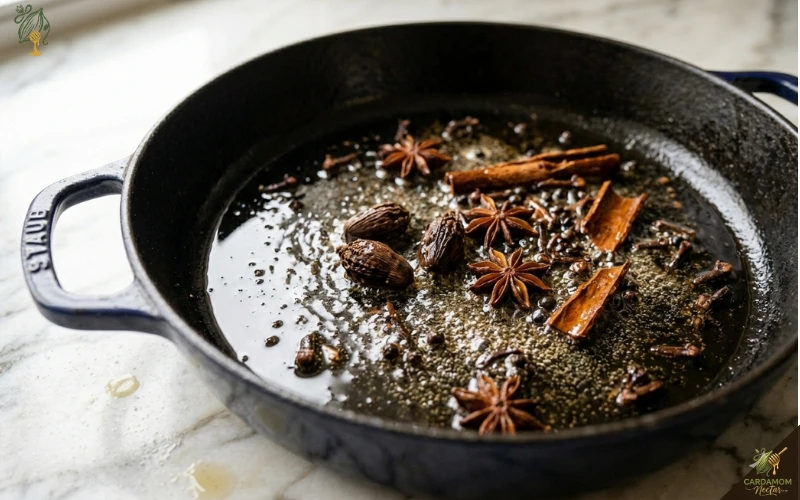
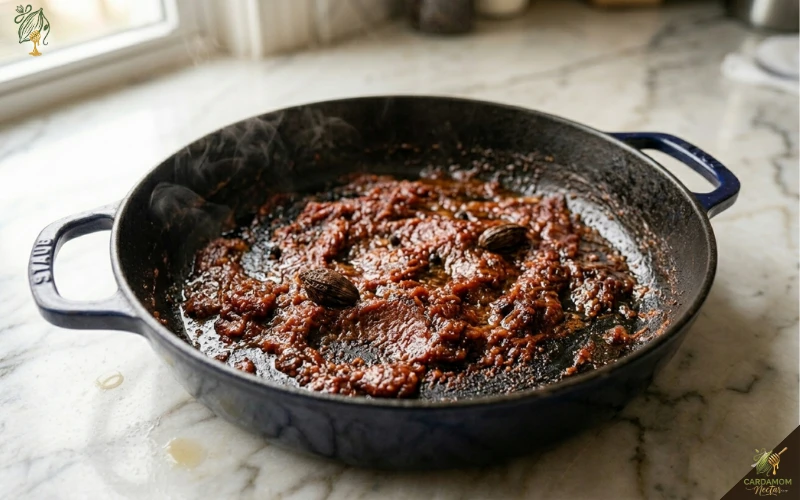
Reduce heat to medium. Leave all the rendered beef fat in the pot — do not drain. Add the lightly crushed black cardamom pods, cinnamon stick, peppercorns, cloves, star anise, and bay leaves directly into the hot beef fat. Let them sizzle and crackle for 60–90 seconds, stirring once. You will smell the distinct camphor-smoke note of the black cardamom rising from the fat — this is the signal that extraction is working and the volatile compounds are entering the oil.
💡 Why this mattersBlack cardamom’s camphor and cineole compounds are fat-soluble — they extract into oil far more effectively than into water. Blooming in the hot beef fat (rather than adding to the stock later) ensures maximum extraction. The fat then carries these compounds through the mirepoix cook, the wine reduction, the stock addition, and the entire 3-hour braise. This single step is what makes this braise taste different from a standard red wine short rib recipe. -
3
Build Mirepoix in the Spiced Fat
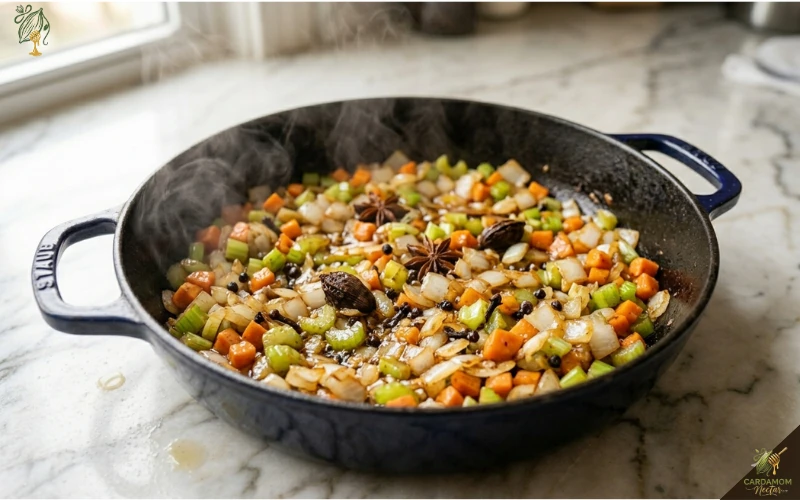
Add diced onion, carrot, celery, and smashed garlic to the spiced fat. Season with a pinch of salt. Cook on medium heat, stirring occasionally, for 8–10 minutes until the vegetables are softened and beginning to colour at the edges — the onions should be translucent and starting to caramelise. Do not rush this step by increasing heat — the vegetables need time to properly soften and sweeten.
💡 Why this mattersThe mirepoix absorbs the spiced fat as it cooks, drawing in the black cardamom’s volatile compounds. The caramelising vegetables also add their own Maillard browning compounds to the sauce base. Properly softened mirepoix dissolves into the braising liquid during the 3-hour cook, thickening and enriching the sauce. Under-cooked mirepoix remains identifiable as vegetable pieces in the finished sauce and contributes less flavour.
-
4
Caramelise Tomato Paste
Push the vegetables to the sides of the pot, clearing a space in the centre. Add the tomato paste to the cleared centre area. Let it cook undisturbed on medium heat for 2–3 minutes until it darkens from bright red to a deep brick-red colour and begins to stick slightly to the base. Stir into the vegetables and cook together for 1 more minute until the paste is evenly incorporated and the whole mixture smells deeply savoury.
💡 Why this mattersTomato paste contains glutamate (MSG naturally), which is the backbone of umami flavour. When the paste caramelises in the hot fat rather than being added to liquid, the Maillard reaction creates additional flavour compounds — the colour change from red to brick-red is the visual signal this has happened. Tomato paste added directly to liquid without this step provides some umami but misses the caramel depth that comes from browning. -
5
Deglaze with Red Wine — Scrape Everything Up
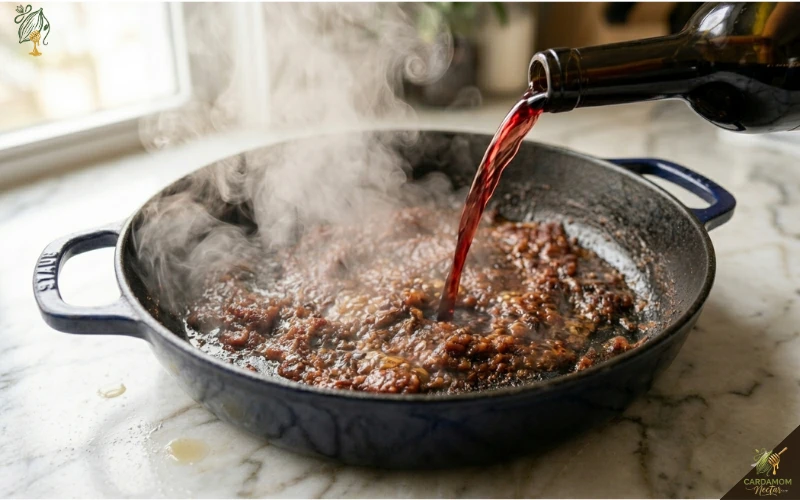
Pour in the 375ml red wine in one go. Use a wooden spoon to vigorously scrape the entire base of the pot — every dark bit of fond must be released into the liquid. Increase heat to high. Bring to a boil and let the wine reduce by approximately half — 5–7 minutes. The liquid should reduce from approximately 375ml to 200ml and the sharp alcohol smell should give way to a richer, concentrated wine aroma. Add Worcestershire and fish sauce if using.
💡 Why this mattersThe fond on the pot base is the most concentrated flavour in the entire recipe — it is the Maillard products from searing two kilos of beef and caramelising vegetables and tomato paste. Every dark particle that remains stuck to the pot is flavour lost. The wine’s acidity dissolves the fond instantly — which is why deglazing must happen immediately while the pot is still hot. Reducing the wine by half removes the raw alcohol and concentrates the fruit compounds. -
6
Add Stock, Nestle Ribs, Cover and Into the Oven
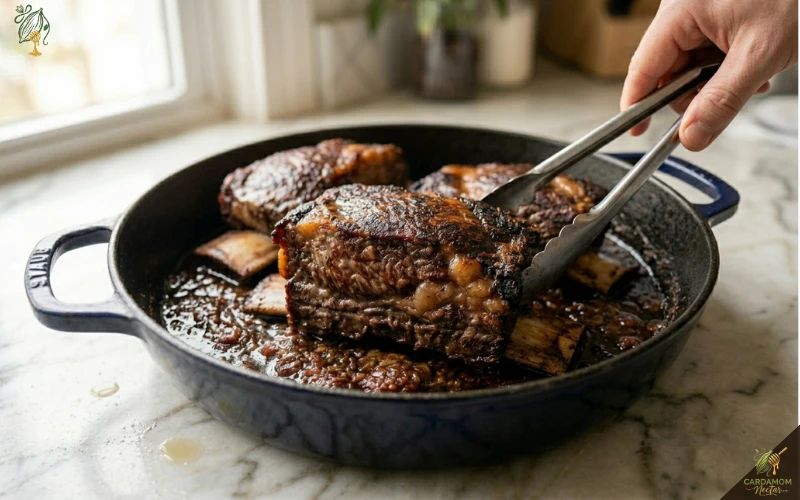
Add the beef stock and bring to a simmer. Taste the braising liquid and adjust salt — it should taste well-seasoned but slightly under-salted since it will reduce and concentrate during the braise. Nestle the seared short ribs back into the pot — meat side down if possible. They should be approximately two-thirds submerged in liquid. Add thyme sprigs tucking them around the ribs. Cover tightly with the lid. Place in the preheated 160°C (325°F) oven.
💡 Why this matters160°C (325°F) is the precise temperature range for collagen-to-gelatin conversion without protein seizing. Too hot (above 175°C/350°F) and the proteins contract and tighten before the collagen has fully rendered — producing tough, stringy ribs. Too low (below 140°C/285°F) and the collagen conversion is too slow to complete in 3 hours. The covered pot traps steam and maintains a moist braising environment throughout.
-
7
Braise 3–3.5 Hours — Do Not Open Early
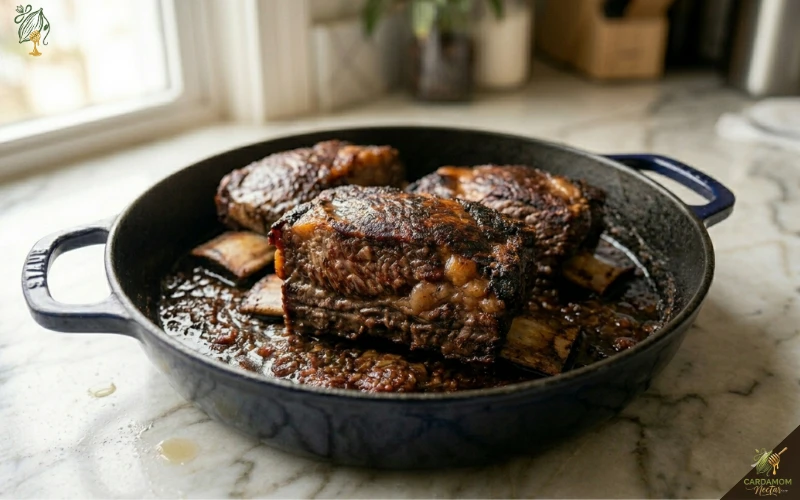
Braise undisturbed in the oven for 3 to 3.5 hours. Do not open the pot during the first 2.5 hours. At 3 hours, check: insert a fork or skewer into the thickest part of the meat — it should slide in with zero resistance and the bones should be loose but the meat should still hold its shape when carefully lifted. If there is any resistance, return to oven for 30 more minutes. Overcooked ribs fall apart in the braising liquid — the target is just past resistance, where the meat yields immediately but still has structure.
💡 Why this mattersCollagen conversion to gelatin in beef short ribs happens in two phases: the first phase (60–90 min) converts easily accessible surface collagen; the second phase (90–180 min) converts deeper collagen in the connective tissue surrounding the muscle fibres. Both phases need to complete for the characteristic fall-off-the-bone texture. Opening the pot during cooking causes temperature drops that interrupt and extend both phases. -
8
Rest Ribs, Reduce Sauce to Gloss
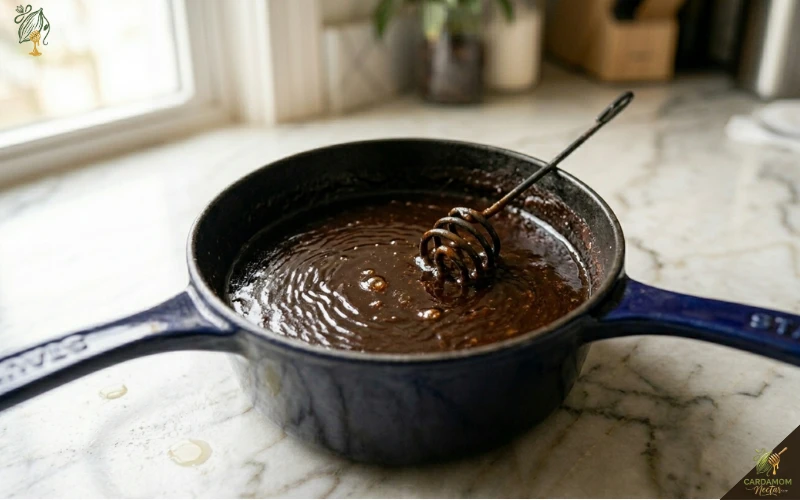
Remove ribs carefully to a warmed plate or baking dish. Cover loosely with foil and rest for 15 minutes. Strain the braising liquid through a fine sieve into a saucepan, pressing the vegetables to extract all liquid. Discard the solids. Skim the fat from the surface (or chill and lift the fat cap if making ahead). Bring the strained liquid to a boil, then reduce to a vigorous simmer for 12–15 minutes until the sauce coats a spoon thickly and has reduced to a glossy, dark consistency. Taste and adjust salt. Return ribs to the sauce or spoon over at plating.
💡 Why this mattersThe braising liquid straight from the pot is too thin for serving — it needs reduction to concentrate both the flavour and the dissolved gelatin into a sauce that coats and clings. The 15-minute rest of the ribs allows the muscle fibres to relax and redistribute juices after the sustained heat of braising. Cutting into rested meat immediately after cooking results in juices running out; rested meat retains them. The fat skimming is visual as well as flavour — a defatted sauce is cleaner and more refined on the plate.
Serving Suggestions
The braising sauce is the centrepiece — choose a base that absorbs it well.
| Base | Prep Note | Sauce Absorption | Rating |
|---|---|---|---|
| Creamy Mashed Potato | Make loose — add extra butter and warm cream. Should pool and spread | Excellent — potato absorbs the sauce as you eat | Classic |
| Creamy Polenta (Grits) | Cook with chicken stock + parmesan + butter. Make loose enough to pour | Excellent — polenta holds sauce in its surface texture | Best Pairing |
| Ricotta Gnocchi | Homemade preferred — pan-sear in butter before plating for texture contrast | Very good — gnocchi absorbs sauce at edges | Elevated |
| Cauliflower Purée | Steam cauliflower + blend with butter + cream + white pepper | Good — lower carb option, similar texture to mash | Low Carb |
| Buttered Egg Noodles | Toss cooked noodles in brown butter and fresh thyme | Good — toss noodles in the sauce for full coating | Comfort |
| Garnish: Gremolata | Mix lemon zest + flat-leaf parsley + 1 small garlic clove, minced | Acidic contrast that cuts the richness of the braise | Recommended |
What Makes Restaurant Short Ribs Different from Home Versions
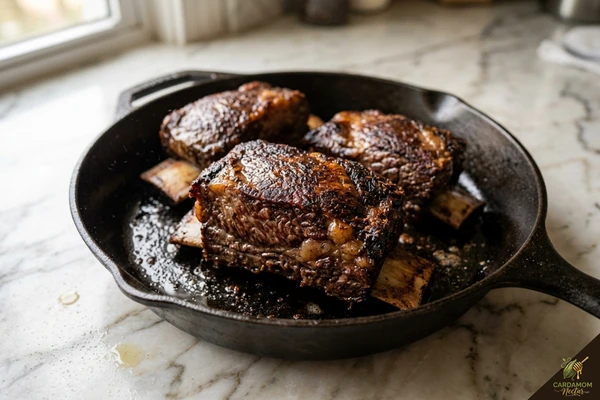
The most common failure in home short rib braises is insufficient searing. A properly seared short rib should be mahogany-dark on all surfaces, including the narrow sides and the bone side. Pale tan searing produces a pale, flat-tasting braising liquid regardless of sauce reduction time. Use your highest heat, ensure the fat is shimmering before the meat goes in, pat the ribs completely dry, and do not touch them for 3–4 minutes — moving them before a proper crust forms causes sticking and tears the sear off the surface.
Braised short ribs are demonstrably better made 1–2 days in advance. After cooking, cool to room temperature, refrigerate in the braising liquid, covered. Overnight, the fat solidifies into a cap that lifts off cleanly (discarding this fat is the secret to a clean, non-greasy final sauce). The dissolved gelatin in the sauce firms into a thick jelly overnight — when reheated, it produces a silkier, more cohesive sauce than same-day service. Reheat covered at 150°C (300°F) for 25–30 minutes or gently on the stovetop. This is standard practice in every restaurant kitchen serving short ribs.
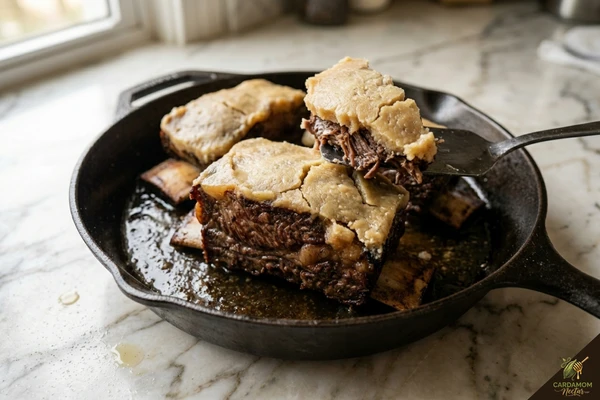
After serving, any remaining braising liquid is a concentrated beef and spice stock with dissolved gelatin and black cardamom compounds — extremely valuable. Freeze in ice cube trays for adding to pan sauces; use as a ramen or soup base; or combine with more beef stock and use as the liquid for our black cardamom bone broth. Do not discard this liquid. It has more flavour per millilitre than anything store-bought.
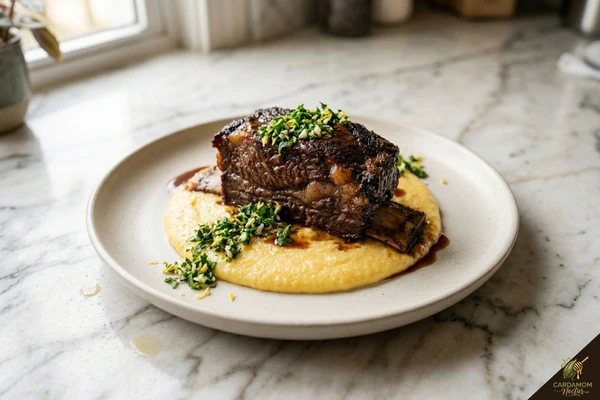
The braising sauce is the centrepiece of this dish. A creamy mashed potato or polenta that pools and spreads beneath the rib allows the sauce to pool around the base — every bite includes both meat and sauce. A stiff mash or firmly set polenta sits under the rib without integrating. Make your base intentionally loose — more cream, more butter, more stock than you think you need. At the table it will look restaurant-quality rather than home-style. Finish with gremolata (lemon zest, flat parsley, garlic) — the acidity cuts through the rich braising sauce and the bright colour contrasts with the dark meat.
Difficulty Level & Time Breakdown
This is ideal for a confident home cook who has made a stew or braise before and wants to step up to restaurant-quality plating. The technique is not complex — sear, build sauce, braise, reduce — but each step must be done correctly for the result to be exceptional. Budget a full afternoon on the day before a dinner party, then simply reheat on the day. The make-ahead approach makes this one of the most manageable impressive dinner party dishes you can make.
Nutrition Information
Per serving (1 rib, approx. 380g with reduced sauce). Does not include mashed potato or polenta base. Values are estimates — actual fat content varies with how thoroughly the fat cap is skimmed.
Frequently Asked Questions
More Black Cardamom Recipes
From the Black Cardamom Recipes hub — same camphor-smoke principle across different dishes.


Emily covers South Asian spice culture, recipe development, and market sourcing. She has visited spice markets in Kerala, Karachi, and Dubai and writes all recipe content on CardamomNectar. Her approach prioritises kitchen science — the why behind technique — and sourcing accuracy grounded in direct market experience.
View Profile →Dr. Bennett reviews all scientific and technical content on CardamomNectar. He verified the claims in this article on black cardamom volatile compound fat-solubility and extraction during the bloom step, collagen-to-gelatin conversion temperature ranges during braising, and the osmotic seasoning mechanism during overnight refrigeration of braised meat.
View Profile →