Fenugreek vs Fennel: 7 Key Differences Every Cook Must Know
They sound similar, sit in the same spice aisle, and their dried seeds can look almost identical — but fenugreek and fennel are completely different plants with opposite flavours. Here’s every difference that actually matters, and which one your recipe needs.


⚡ Quick Answer
No — fenugreek and fennel are not the same. Fenugreek (methi / الحلبة) and fennel (saunf / شمر) are two different plants from two different plant families. Fenugreek is a legume with small, amber, cuboid seeds that taste bitter-maple. Fennel is from the carrot family — longer, greenish, oval seeds with a sweet liquorice flavour. They are not interchangeable in most recipes.
Fenugreek vs Fennel — Facts at a Glance
Quick ReferenceSource: Cardamom Nectar — reviewed by Daniel Carter. Updated August 23, 2026.
Is Fenugreek the Same as Fennel?
No, fenugreek and fennel are not the same spice — they only sound alike. Fenugreek (Trigonella foenum-graecum) is a legume with a bitter, maple-like flavour. Fennel (Foeniculum vulgare) is from the carrot family with a sweet, liquorice-like flavour. They come from unrelated plants, taste nothing alike, and are not interchangeable in recipes. The confusion comes entirely from their similar-sounding English names.
At a Glance — Fenugreek vs Fennel Comparison Table
| Feature | Fenugreek Seeds (Methi) | Fennel Seeds (Saunf) |
|---|---|---|
| Botanical family | Fabaceae (legume / bean family) | Apiaceae (carrot / parsley family) |
| Scientific name | Trigonella foenum-graecum | Foeniculum vulgare |
| Seed shape | Small, cuboid, irregular — 2-4mm | Oval, elongated, ridged — 4-8mm |
| Seed colour | Golden amber to yellowish-brown | Greenish to grayish-brown when dried |
| Taste (raw) | Intensely bitter, pungent | Sweet, anise-like, liquorice |
| Taste (cooked) | Nutty, maple-like, mellow bitter | Sweet, warm, mild anise |
| Aroma | Maple syrup, caramel, earthy | Liquorice, sweet, slightly grassy |
| Arabic name | الحلبة (Hulba / Helba) | الشمر (Shamar / Shumr) |
| Urdu/Hindi name | Methi / Methi Dana (میتھی) | Saunf (سونف) |
| Key health use | Blood sugar, lactation, digestion | Digestion, bloating, hormones |
| Key cuisines | South Asian, Middle Eastern, Ethiopian | Mediterranean, Indian, Chinese, European |
| Can substitute each other? | ❌ No — completely different flavour profiles | |
The 7 Key Differences Between Fenugreek and Fennel
1Botanical Origin — Different Plant Families
This is the most fundamental difference, and it explains why everything else is different. Fenugreek and fennel come from entirely unrelated plant families.
Fabaceae — Legume Family
- Relatives: peas, chickpeas, clover, alfalfa
- Annual herb, grows 30-60cm
- Seeds form inside curved pods
- Native to Mediterranean + South Asia
Apiaceae — Carrot Family
- Relatives: dill, coriander, cumin, parsley
- Perennial herb, grows up to 2 metres
- Seeds are technically dried fruits
- Native to coastal Mediterranean
The genetic distance between fenugreek and fennel is as wide as the distance between peanuts and carrots. They share no significant phytochemical compounds — which is why their flavours, health effects, and culinary functions are completely distinct.
2Appearance — How to Tell Them Apart
Side by side, the seeds are easy to distinguish once you know what to look for:
| Feature | Fenugreek Seeds | Fennel Seeds |
|---|---|---|
| Size | Small — 2-4mm | Larger — 4-8mm |
| Shape | Irregular cuboid / rhomboid, almost square | Oval, elongated, slightly curved |
| Surface | Hard, smooth, with a faint diagonal groove | Ridged lengthwise, 5 visible ribs |
| Colour | Amber to golden-brown (like corn kernels) | Greenish-grey when fresh, grayish-brown when old |
| Texture (raw) | Very hard, almost like a pebble | Lighter, less dense, slightly brittle |
| Smell (jar) | Maple syrup / caramel | Liquorice / sweet anise |
3Taste and Aroma — Completely Different Profiles
This is where the confusion causes the most damage in the kitchen. The two spices taste nothing alike once you go beyond their shared “warm and aromatic” quality.
Fenugreek tastes bitter and pungent when raw — a bitterness that comes from saponins and alkaloids in the seed coat. When toasted or cooked, this bitterness softens into a warm, nutty, maple-caramel sweetness. The aroma is dominated by sotolon — the same compound that gives maple syrup its scent. This is why fenugreek is sometimes used as an artificial maple flavouring in food manufacturing.
Fennel tastes sweet and clean from the first bite — a bright, anise-like liquorice flavour driven by a compound called anethole, which is also responsible for the flavour of anise seeds and star anise. There is no bitterness in fennel. It can be eaten raw in salads, chewed as a mouth freshener, or used to sweeten dishes. In India, roasted fennel seeds (saunf) are served after meals as a digestive and breath freshener.
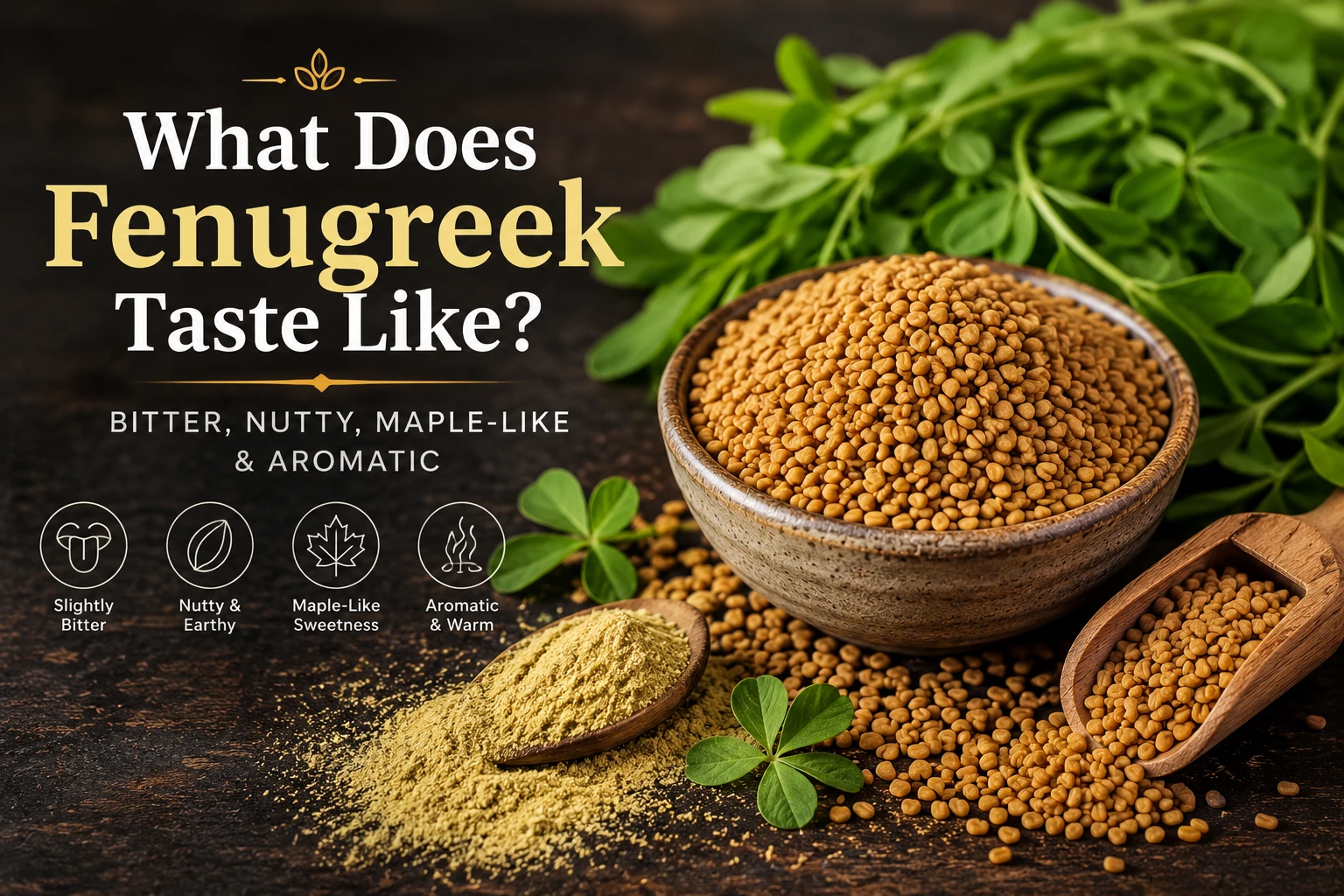
For a deeper breakdown of fenugreek’s flavour profile, see our guide: What Does Fenugreek Taste Like? →
4Culinary Uses — Different Cuisines, Different Roles
| Cuisine | How Fenugreek Is Used | How Fennel Is Used |
|---|---|---|
| Indian | Tempering (tadka), methi leaves in curry, kasuri methi garnish, panch phoron blend | Saunf in mouth fresheners, spice blends, fish curries, chai masala |
| Middle Eastern | Hulba/helba tea (Egypt), hulbeh paste (Yemen), spice blends | Shamar in salads, soups, grilled fish, herbal teas |
| Mediterranean | Rare — occasional use in Greek and Turkish recipes | Central — Italian sausages, focaccia, fish dishes, salads |
| Ethiopian | Berbere spice mix, niter kibbeh butter | Less common |
| European | Mainly supplement / health use | Fennel bulb as vegetable; seeds in sausages and bread |
The clearest rule of thumb: if a recipe is from the Indian subcontinent or the Arab world and calls for a bitter, earthy spice — it wants fenugreek. If it is from Mediterranean Europe and calls for a sweet, anise-flavoured seed — it wants fennel.
5Health Benefits — Overlapping but Not the Same
Both spices have well-documented health benefits, but they act through different compounds and support different body systems:
| Health Area | Fenugreek | Fennel |
|---|---|---|
| Blood sugar | ✅ Strong evidence — galactomannan fibre slows glucose absorption | Minimal effect |
| Lactation (milk supply) | ✅ Most widely studied galactagogue herb | Some evidence, weaker than fenugreek |
| Digestion / bloating | Moderate benefit | ✅ Strong evidence — anethole relieves gas and bloating |
| Hormonal support (women) | ✅ Supports PCOS, menstrual comfort | ✅ Phytoestrogen activity, menopausal support |
| Anti-inflammatory | ✅ Diosgenin and trigonelline | ✅ Anethole and flavonoids |
| Iron content | ✅ Significantly higher iron (33mg/100g) | Lower (6.4mg/100g) |
| Calcium content | 176mg/100g | ✅ Much higher (1196mg/100g) |
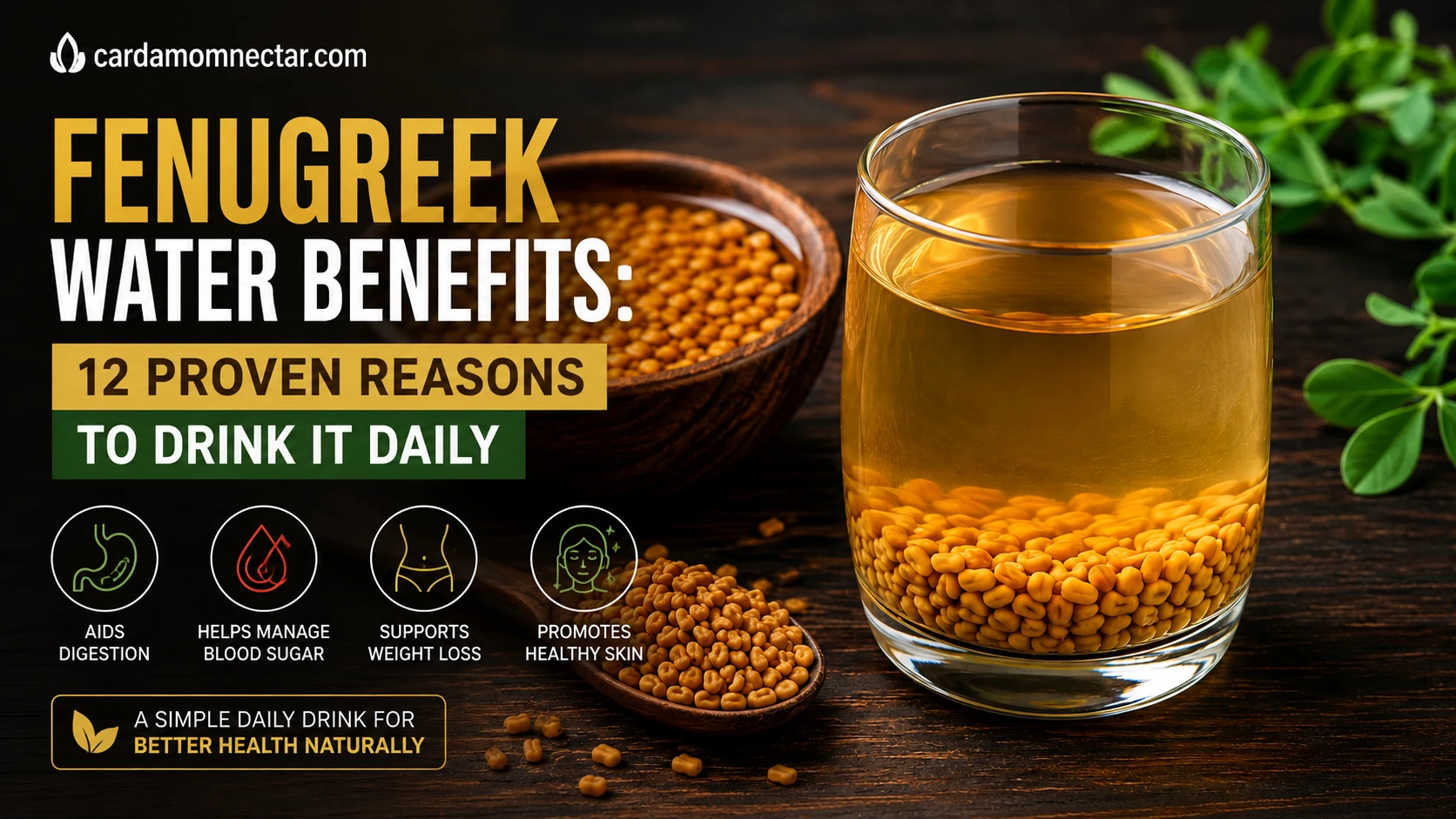
For a detailed look at how fenugreek specifically supports health, see our article on fenugreek water benefits →
Nutrition & Substitution
6Nutritional Comparison (Per 100g)
| Nutrient | Fenugreek Seeds | Fennel Seeds |
|---|---|---|
| Calories | 323 kcal | 345 kcal |
| Protein | 23g | 15.8g |
| Dietary Fibre | 24.6g | 39.8g |
| Iron | 33.5mg | 6.4mg |
| Calcium | 176mg | 1,196mg |
| Potassium | 770mg | 1,694mg |
| Vitamin C | 3mg | 21mg |
| Key compound | Galactomannan, Diosgenin, Trigonelline, Sotolon | Anethole, Limonene, Fenchone |
Source: USDA FoodData Central. Note: Both spices are consumed in small quantities (1-2 tsp per serving), so per-100g comparisons reflect composition, not typical daily intake.
7Can You Substitute One for the Other?
This is the practical question most people come here for — and the honest answer is: almost never, and only in emergencies.
Their flavour profiles are opposite in character. Fenugreek is bitter-maple; fennel is sweet-liquorice. Adding fenugreek to a recipe that needs fennel will make it bitter and medicinal. Adding fennel to a recipe that needs fenugreek will make it sweet and anise-flavoured — completely wrong for Indian or Middle Eastern dishes that rely on fenugreek’s characteristic earthiness.
If you are out of fenugreek and need a substitute: the closest options are yellow mustard seeds (similar bitterness) combined with a tiny amount of maple syrup, or curry powder that already contains fenugreek. See our full Fenugreek Substitute guide → for exact ratios.
If you are out of fennel and need a substitute: anise seeds are the closest match (same compound — anethole), followed by caraway seeds for a milder, drier alternative.
| Need | Best Substitute | Ratio |
|---|---|---|
| Fenugreek substitute | Yellow mustard seeds + pinch maple syrup | 1:1 mustard, few drops syrup |
| Fenugreek substitute (mild) | Curry powder (check it contains fenugreek) | 1.5x the amount |
| Fennel substitute | Anise seeds | 1:1 |
| Fennel substitute (milder) | Caraway seeds or dill seeds | 1:1 |
Fenugreek vs Fennel in South Asian and Arab Cooking
In South Asian and Arab kitchens — where both spices are common — the distinction is well understood and strictly maintained. No Pakistani or Indian cook would confuse methi dana (fenugreek) with saunf (fennel). No Arab cook would confuse الحلبة (hulba/fenugreek) with الشمر (shamar/fennel). The confusion is largely a Western phenomenon, arising from unfamiliarity with both spices.
In Pakistan and India, fenugreek (methi) and fennel (saunf) serve entirely different purposes:
- Methi dana goes into achar (pickle), saag, dal, and fish curries — for its bitter depth
- Saunf goes into mouth fresheners, chai masala, desserts, and digestive mixtures — for its sweetness
In the Arab world, الحلبة (fenugreek) is a health herb — brewed as tea, mixed into pastes, eaten soaked — while الشمر (fennel) is a culinary herb used in fish dishes, salads, and herbal teas for digestion.
Fenugreek vs Fennel — 8 Most-Asked Questions
No. Fenugreek and fennel are two completely different plants from different botanical families. Fenugreek (Trigonella foenum-graecum) is a legume; fennel (Foeniculum vulgare) is in the carrot family. They have different flavours, different health benefits, and are used differently in cooking. Their similar-sounding names in English are the main source of confusion.
No — fennel and fenugreek are not the same, despite the similar-sounding names. Fennel (Foeniculum vulgare) is a sweet, anise-flavoured seed from the carrot family. Fenugreek (Trigonella foenum-graecum) is a bitter, maple-tasting seed from the legume family. They come from unrelated plants and cannot be substituted for each other in most recipes.
The core differences are botanical family, taste, and appearance. Fenugreek is a legume with small, cuboid, amber seeds that taste bitter and maple-like. Fennel is from the carrot family, with larger, oval, ridged seeds that taste sweet and liquorice-like. They are used in different cuisines and are not interchangeable.
Not reliably. Fenugreek tastes bitter and maple-like; fennel tastes sweet and liquorice-like. Substituting one for the other will significantly change the flavour of a dish. In an emergency, mustard seeds can partially replace fenugreek; anise seeds can partially replace fennel.
Fenugreek is called Methi Dana (میتھی دانہ) in Urdu. Fennel seeds are called Saunf (سونف). These are entirely different products in Pakistani cooking — methi dana is used in pickles and savoury dishes for its bitter depth, while saunf is a sweet digestive eaten after meals.
Fenugreek in Arabic is الحلبة (al-Hulba / Helba / Halba). Fennel in Arabic is الشمر (al-Shamar). They are clearly distinguished in Arabic culinary and medicinal traditions — الحلبة is a health herb used in teas and pastes, while الشمر is a culinary herb used in cooking and salads.
They support different health areas. Fenugreek is better for blood sugar management, lactation, and iron intake. Fennel is better for digestion, bloating, and calcium intake. Neither is universally healthier — their benefits depend on what you need. Both are nutritious spices with distinct therapeutic properties.
No — their tastes are nearly opposite. Fenugreek tastes bitter when raw and develops a warm, maple-nutty flavour when cooked. Fennel tastes sweet and liquorice-like whether raw or cooked. The only thing they share is being warm and aromatic — beyond that, the flavours are entirely different.
Explore the Complete Fenugreek Guide Hub
Every fenugreek guide on Cardamom Nectar, in one place.





🌿 Explore the Complete Fenugreek Guide
Discover everything about fenugreek — dosage, taste, hair benefits, water benefits, substitutes, and nutrition facts.
→ Complete Fenugreek Guide