🇦🇺 Australia Guide  ·  Zone Checker  ·  Last Reviewed April 2026

Growing Cardamom in Australia:
State-by-State Guide + Zone Checker

From tropical Cairns to cool Melbourne — exactly what’s possible with cardamom in your part of Australia, the right strategy for your climate zone, and when to plant.

✍️Written byOlivia Turner
Reviewed byEmily Rhodes
🤖IncludesZone Checker
⏱️Read time14 min
Olivia Turner
🌿
Written by
BSc Horticulture · Spice Plant Specialist
Emily Rhodes
Reviewed by
Nutrition & Culinary Specialist
⚡ Quick Answer

Can You Grow Cardamom in Australia?

Yes — cardamom grows well across large parts of Australia. Far North Queensland (Cairns, Daintree, Atherton Tablelands), Darwin NT, and the Kimberley WA offer ideal year-round outdoor growing conditions. Subtropical zones including Brisbane, Gold Coast, and the northern NSW coast support reliable outdoor growing with some care. Temperate cities — Sydney, Melbourne, Adelaide, Perth — require container growing with indoor overwintering. This guide covers every Australian state and territory with climate zone-specific advice.

🗓️ Last Reviewed: April 2026  ·  ✍️ Written by Olivia Turner  ·  ✅ Reviewed by Emily Rhodes

🇦🇺 Key Australian Facts

🌡️
Minimum Temp 10°C — foliage dies back below this
🌴
Best Outdoor Zone Tropical FNQ, Darwin & Kimberley WA
🏠
Temperate Cities Container + indoor overwintering (Sydney, Melbourne, Perth)
🫛
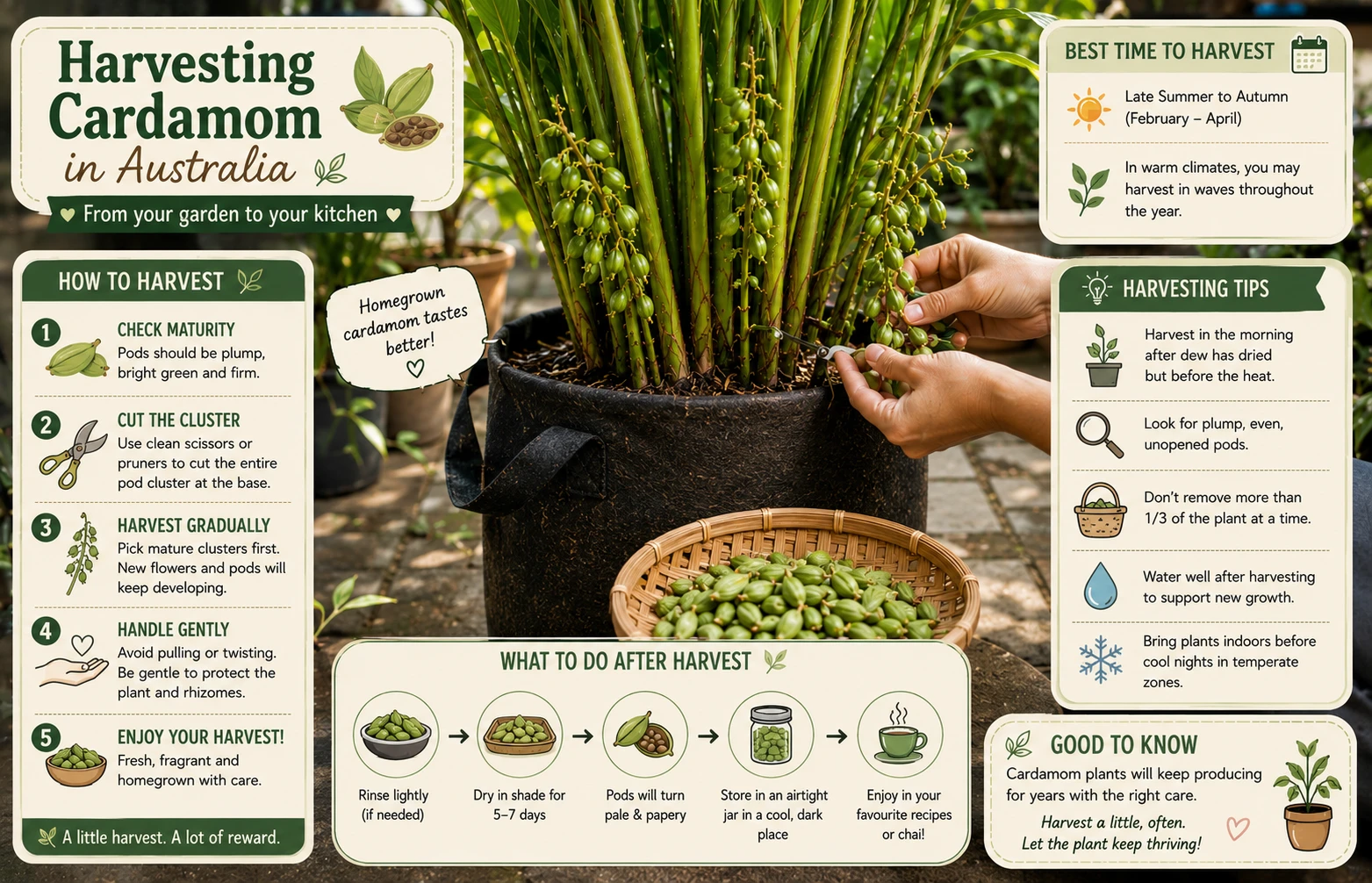
First Pod Harvest Year 2–3 in tropical/subtropical zones
🌿
Best Plant Source Daleys Fruit Tree Nursery (ships nationally)
⚠️
Watch Out For Alpinia sold as “cardamom” — always ask for Elettaria cardamomum
Climate Overview

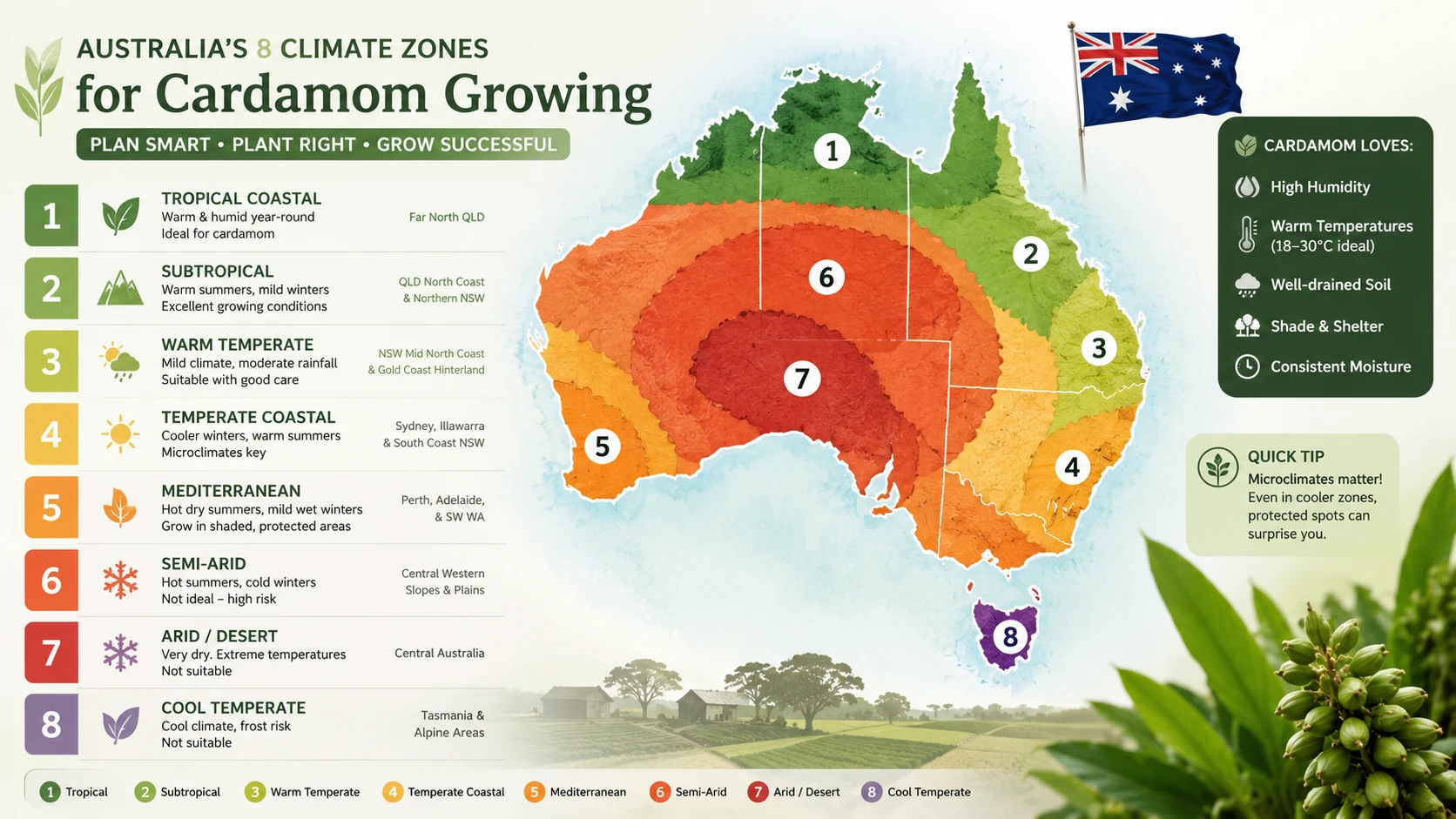
Australian Climate Zones for Cardamom

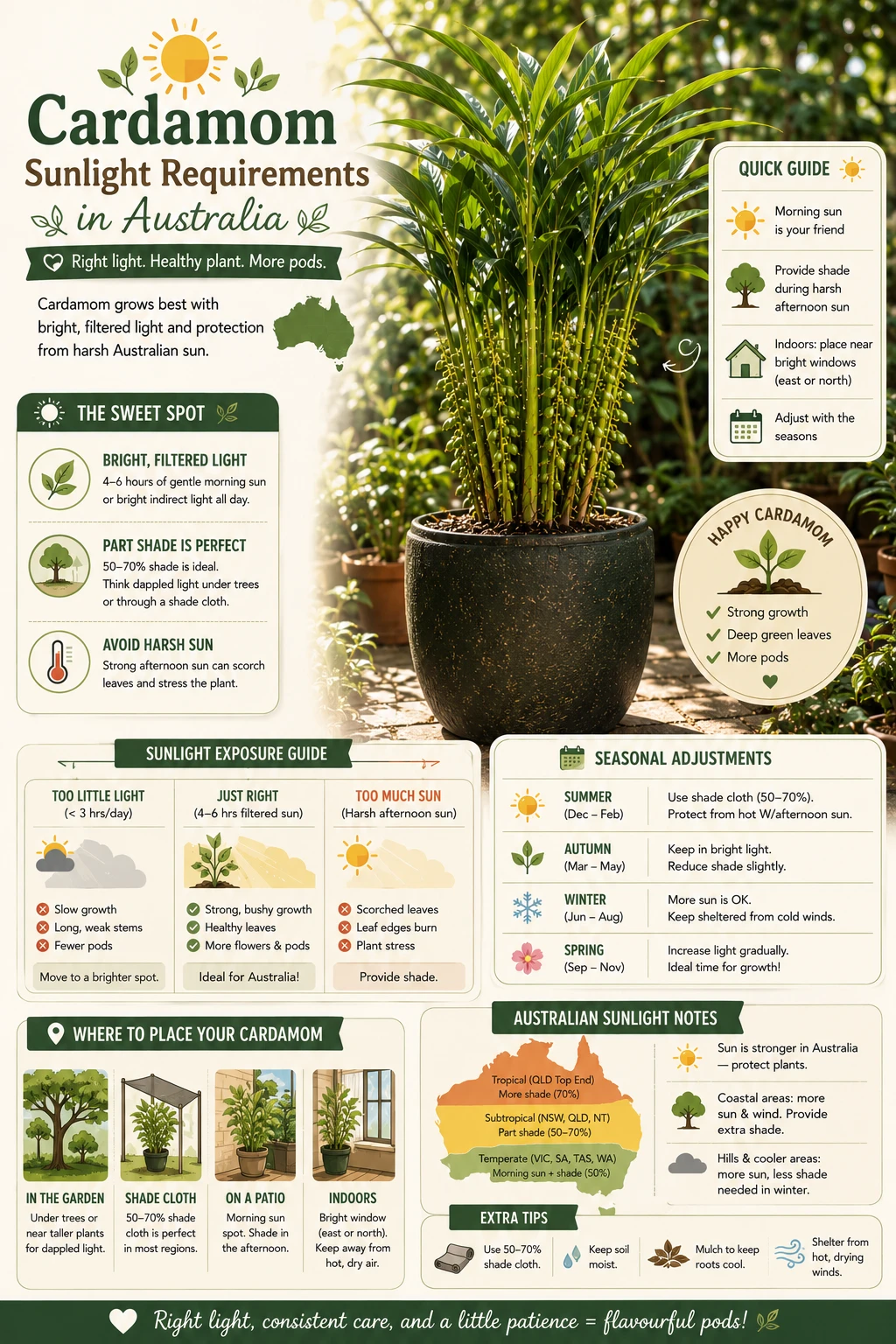
Australia’s 8 climate zones span from tropical monsoon in the north to alpine in the south. Cardamom (Elettaria cardamomum) is native to tropical rainforest understory — the top three Australian zones closely replicate its natural habitat.

Zone 1
Tropical — FNQ, Darwin, Kimberley — year-round outdoor ideal
Zone 2
Subtropical — Brisbane, Gold Coast — reliable outdoor growing
Zone 5–7
Temperate — Sydney, Melbourne — container + indoor strategy
10°C
Minimum temperature threshold — foliage dies back below this
Zone 1 — Tropical
FNQ (Cairns, Daintree), Darwin NT, Kimberley WA. Year-round hot and humid. Best conditions in Australia.
✓ Perfect ▾
Tropical Zone 1 — Far North Queensland map

🌴 Zone 1 Tropical — Growing Guide

Australia’s tropical north closely mirrors Kerala’s conditions — the native home of cardamom. Monsoonal rainfall, year-round warmth above 20°C, and high humidity make in-ground planting ideal.

  • Plant in dappled shade under banana, mango, or existing tree canopy
  • Wet season (Nov–Apr): excellent growth — monitor drainage closely
  • Dry season: irrigate every 5–7 days, mist foliage for humidity
  • Native stingless bees pollinate naturally — pods form without hand-pollination
  • Expect first flowering in Year 1–2, reliable pod harvest from Year 2–3
  • Atherton Tablelands altitude (600–900m) is climatically closest to Kerala
Zone 2 — Subtropical
SE Queensland (Brisbane, Sunshine Coast, Gold Coast), coastal NSW to Byron Bay. Warm humid summers, mild winters.
✓ Excellent ▾
Subtropical Zone 2 — Brisbane South-East Queensland

🌿 Zone 2 Subtropical — Growing Guide

SE Queensland’s warm, humid summers and mild winters rarely dip below 5–10°C. Outdoor year-round growing is viable with care. Brisbane to Byron Bay growers consistently report reliable flowering and pod production from Year 2–3.

  • Choose a north-facing sheltered position away from frost pockets
  • Mulch heavily (10–15cm) to protect roots from any cold snaps
  • July–August: slight foliage reduction is normal — do not over-water
  • Flowering reliable from year 2–3 in SE Queensland conditions
  • Hand-pollinate morning flowers for best pod set
  • Gold Coast and Northern Rivers: near-tropical — highly productive
Zone 3–4 — Semi-arid
Inland QLD, inland WA, parts of SA/NT. Hot summers but dry — humidity supplementation essential.
⚠ With Care ▾
Semi-arid Zone 3-4 — Perth and inland WA

⚠️ Zone 3–4 Semi-arid — Growing Guide

Hot, dry summers are the biggest challenge — this is the opposite of cardamom’s preferred humid conditions. Success is possible with extra infrastructure but requires consistent attention.

  • Container growing gives most control over humidity and temperature
  • Shade cloth (50–70%) essential during peak summer heat
  • Cool-mist humidifier or regular misting is non-negotiable
  • Drip irrigation keeps roots consistently moist without wasting water
  • East-facing sheltered position preferred — avoid harsh afternoon west sun
  • Focus on foliage first — pods are an achievable bonus with sustained effort
Zone 5–7 — Temperate
Sydney, Melbourne, Adelaide, Perth. Four distinct seasons, cold winters. Container growing with indoor overwintering.
🪴 Container ▾
Temperate Zone 5-7 — Melbourne Victoria

🪴 Zone 5–7 Temperate — Growing Guide

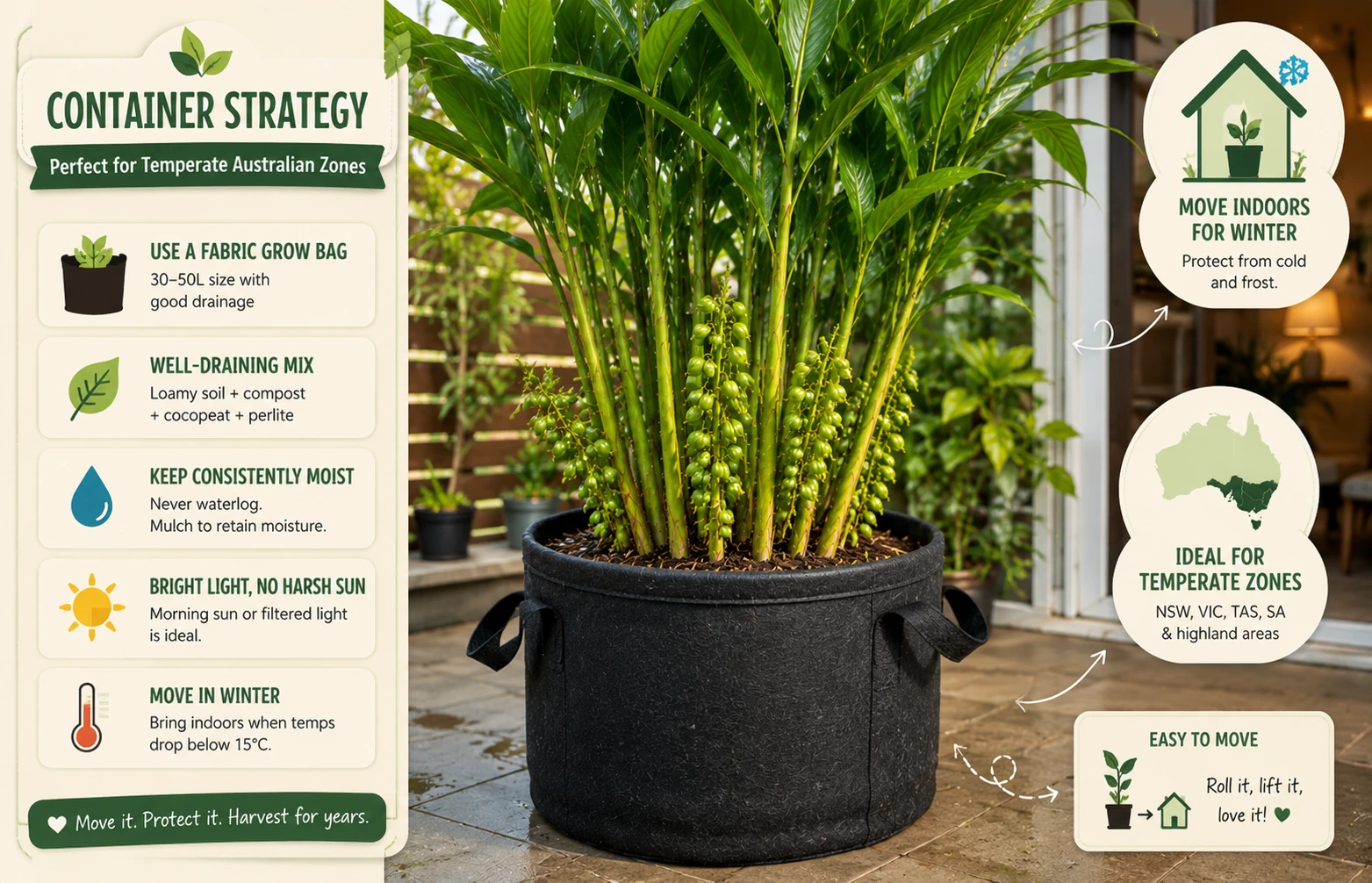
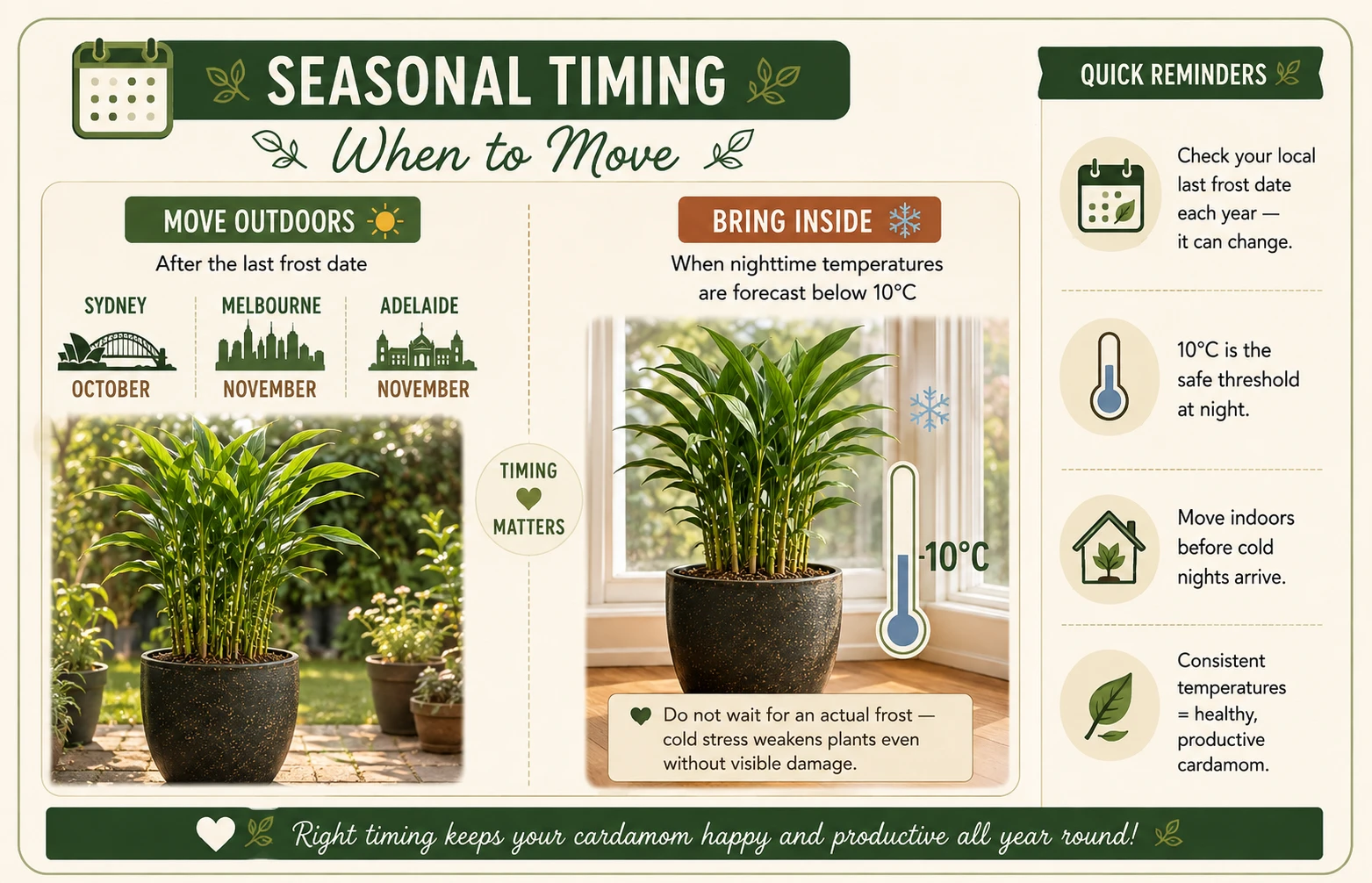
Container strategy is the standard method in Sydney, Melbourne, Adelaide, and Perth. Move outdoors October–April; bring indoors May–September. Cardamom makes a beautiful, long-lived tropical houseplant in all four cities.

  • Sydney: outdoors October–May, indoors June–September
  • Melbourne: outdoors November–March only, indoors the rest of the year
  • Perth: Mediterranean summers suit outdoor placement October–April
  • Dedicated humidifier (2–4 hrs/day) essential indoors in all cities
  • Full-spectrum LED grow light during indoor months significantly improves health
  • Avoid placing indoors near heater vents — dry hot air damages foliage rapidly
Zone 8 — Alpine/Cold
Tasmania, ACT highlands, alpine VIC/NSW. Winters too cold and prolonged. Indoor or heated greenhouse only.
🏠 Indoor Only ▾
Cold Zone 8 — Alpine and cold regions Australia

🏠 Zone 8 Indoor/Greenhouse — Growing Guide

Tasmania, Canberra, and alpine areas require fully indoor or heated greenhouse growing. However, cardamom thrives as a long-term tropical houseplant and can be genuinely rewarding in these climates with the right setup.

  • Heated greenhouse or conservatory is the single most effective upgrade
  • Full-spectrum LED lighting essential for at least 6–8 hours daily
  • Humidifier running daily is critical — alpine and cold air is very dry
  • Indoor plants grow more slowly but can live for 10–20 years as houseplants
  • Pod production requires supplemental pollination and greenhouse conditions
  • Minimum indoor temperature: keep above 12°C at all times for healthy growth
Smart Growing Tool

Australian Cardamom Zone Suitability Checker

Select your state and setup — get an instant verdict on what’s achievable, the best growing strategy for your exact location, and a personalised planting calendar.

🗺️ Zone Suitability Checker

Australian Zone Suitability Checker

Tell us where you are in Australia and what you want to achieve — get a personalised growing strategy and seasonal planting calendar for your specific climate zone.

State-by-State Guide

Growing Cardamom by Australian State

Specific guidance for each major Australian region — what works, what to watch out for, and precise strategies that succeed in your local climate.

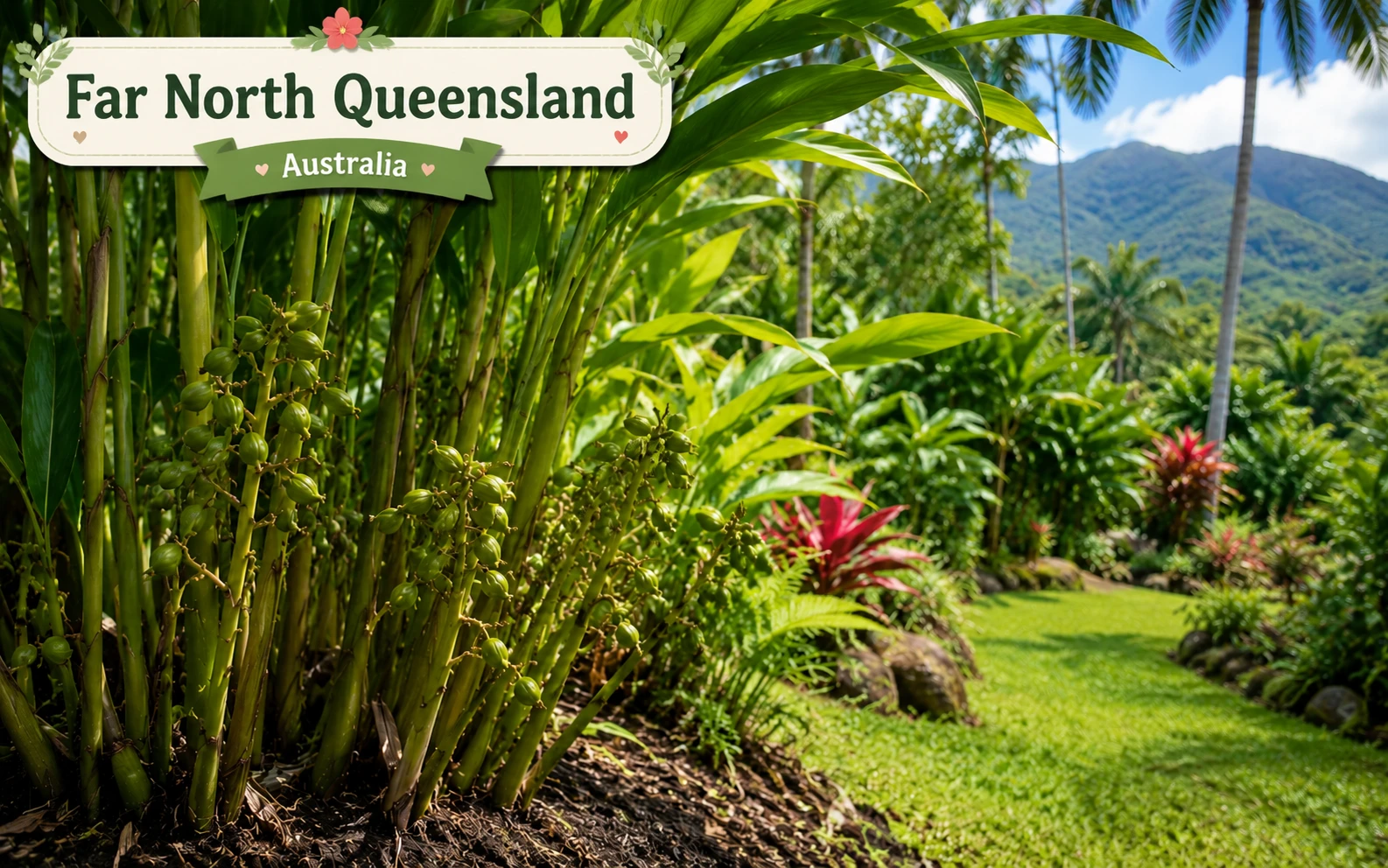
Cardamom thriving outdoors in tropical Far North Queensland garden near Cairns
🌴 Zone 1 — Tropical · Ideal

Far North Queensland

The Cairns region, Atherton Tablelands, and Daintree area are the best places in Australia to grow cardamom outdoors.

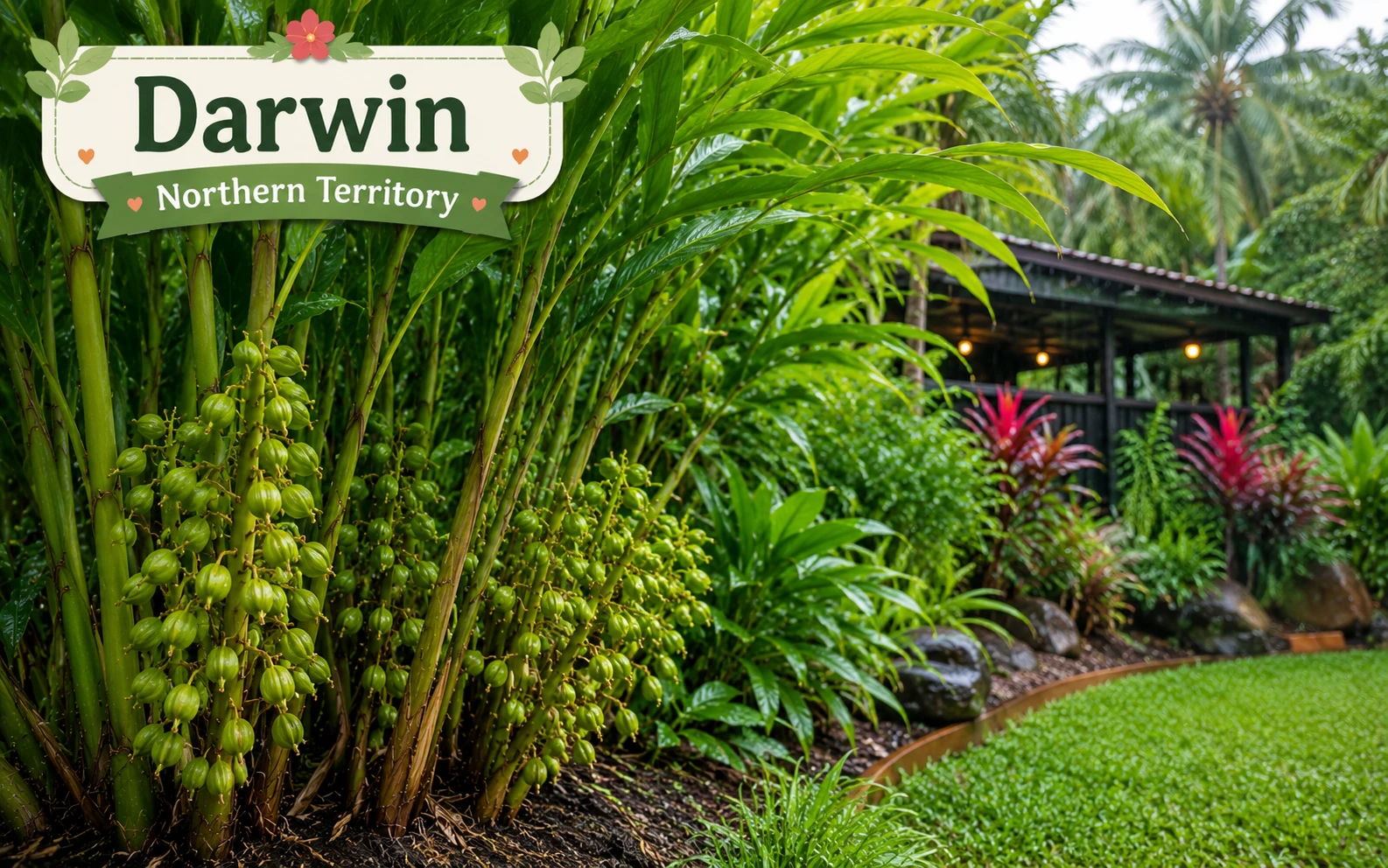
Cardamom growing in Darwin Northern Territory tropical monsoon garden
🌴 Zone 1 — Tropical · Excellent

Darwin & Northern Territory

Darwin’s monsoonal tropical climate suits cardamom exceptionally well with hot year-round conditions and dramatic wet/dry seasons.

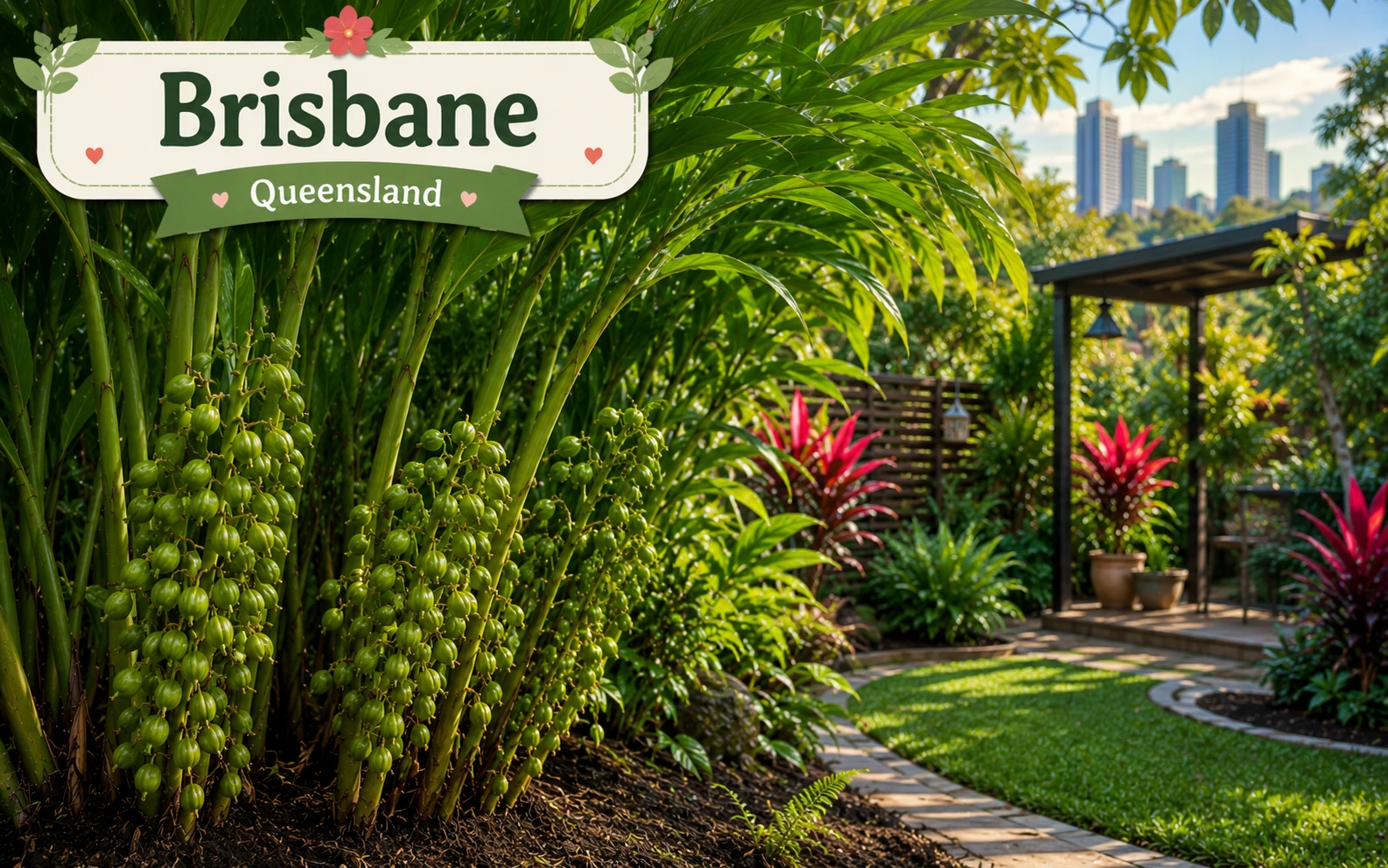
Cardamom growing in sheltered Brisbane subtropical garden
🌿 Zone 2 — Subtropical · Very Good

Brisbane & South-East Queensland

Brisbane, Gold Coast, and the Sunshine Coast fall in Australia’s subtropical zone 2 — warm humid summers and mild winters that suit cardamom very well.

🌴 Far North Queensland — Full Guide

The combination of monsoonal rainfall, warm temperatures year-round, and high humidity closely mirrors Kerala’s growing conditions. Daleys Fruit Tree Nursery confirms growing cardamom on “coastal sub-tropical” red loam in FNQ with excellent results.

Plant in dappled shade under existing tree canopy — mimics native habitat
Atherton Tablelands altitude (600–900m) is climatically closest to Kerala
Wet season growth is rapid — ensure excellent drainage to prevent root waterlogging
Native stingless bees present — pods often form without hand-pollination

🌴 Darwin & Northern Territory — Full Guide

The wet season (November–April) provides the humidity surge that triggers panicle initiation. During the dry season, supplement irrigation is essential. Darwin’s red clay-loam soils suit cardamom well when drainage is properly managed.

Wet season: monitor drainage — roots cannot tolerate waterlogging for more than 24 hours
Dry season (May–Oct): irrigate every 5–7 days, mist foliage regularly
Plant in the shelter of other trees — intense dry season sun scorches leaves

🌿 Brisbane & SE Queensland — Full Guide

SE Queensland’s warm humid summers and mild winters make cardamom growing viable year-round in sheltered positions. Brisbane typically sees its coldest nights in July–August (rarely below 5°C). Occasional cold snaps may cause leaf dieback but plants recover fully by spring.

Choose a north-facing sheltered position — avoid frost pockets
Mulch heavily (10–15cm) to protect roots from any cold snaps
July–August: slight foliage reduction is normal — do not over-water
Flowering is reliable from year 2–3 in SE Queensland conditions
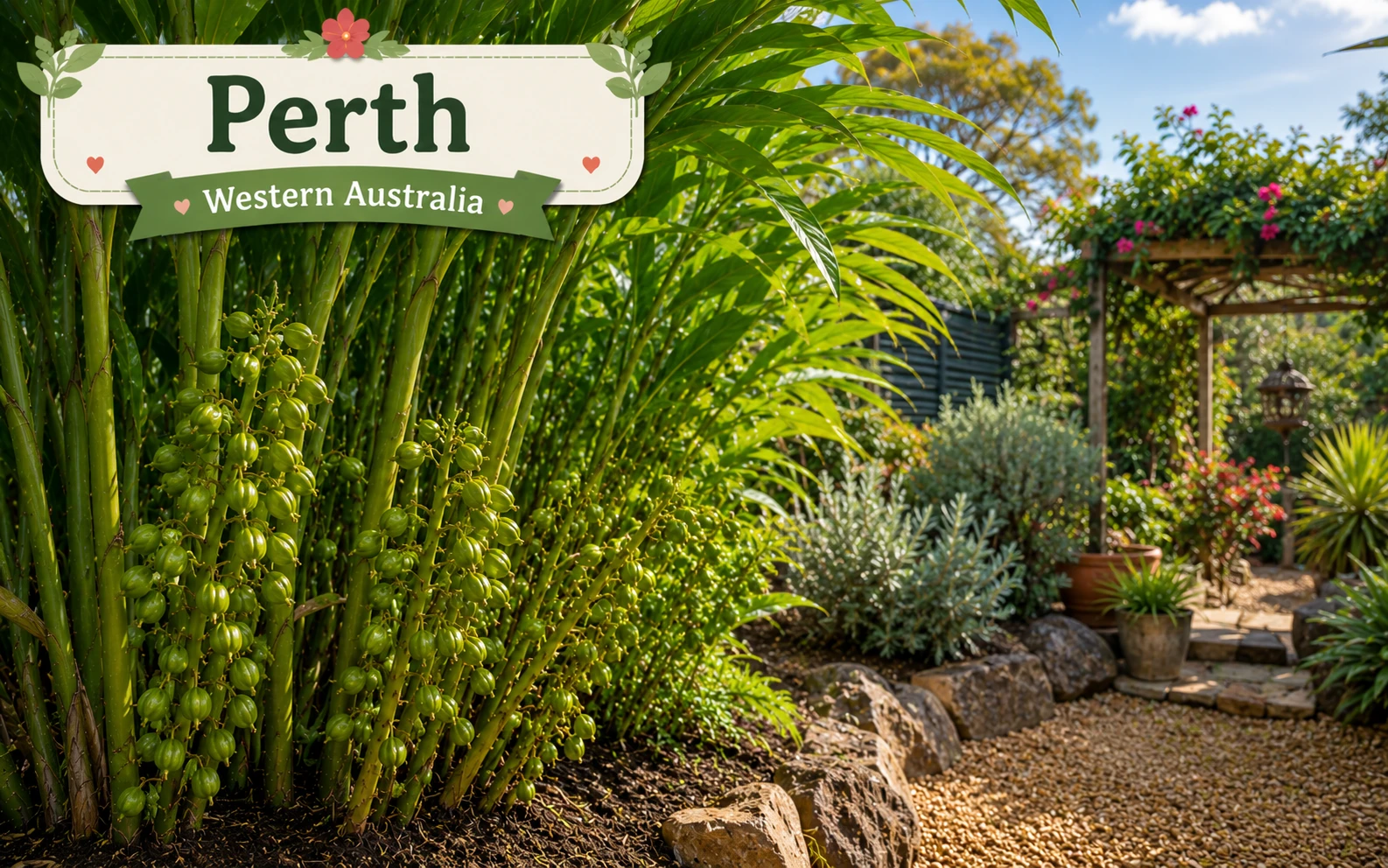
Cardamom in Perth Western Australia sheltered Mediterranean garden
⚠ Zone 5 — Mediterranean · Container

Perth & South-West WA

Perth’s Mediterranean climate — hot, dry summers and mild, wet winters — presents particular challenges for cardamom that can be overcome with the right strategy.

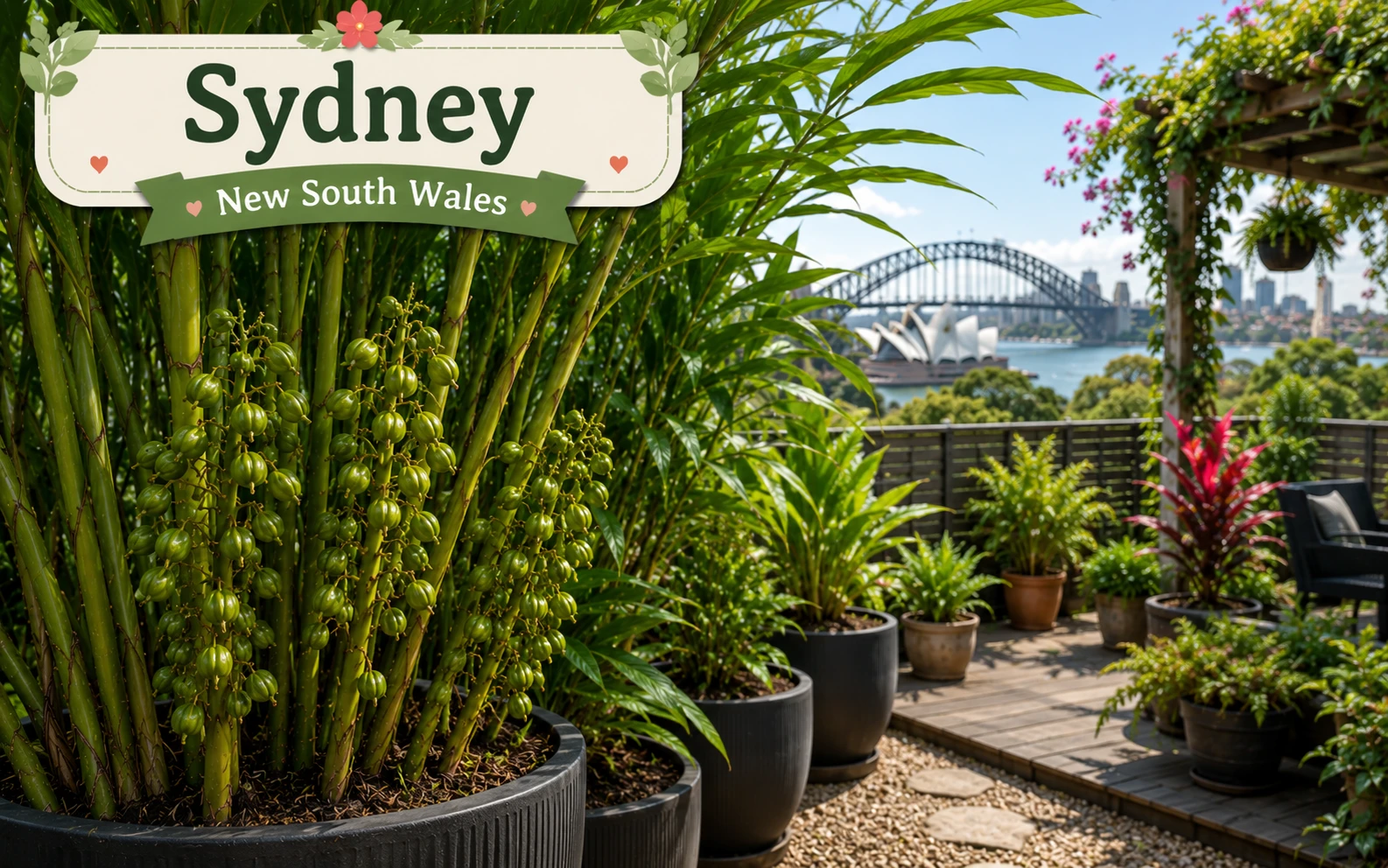
Cardamom growing in sheltered Sydney garden with container strategy
🪴 Zone 5–6 · Container Strategy

Sydney & NSW Coast

Sydney’s temperate coastal climate has warm summers suited to outdoor cardamom and cool winters that require protection — container growing is the standard approach.

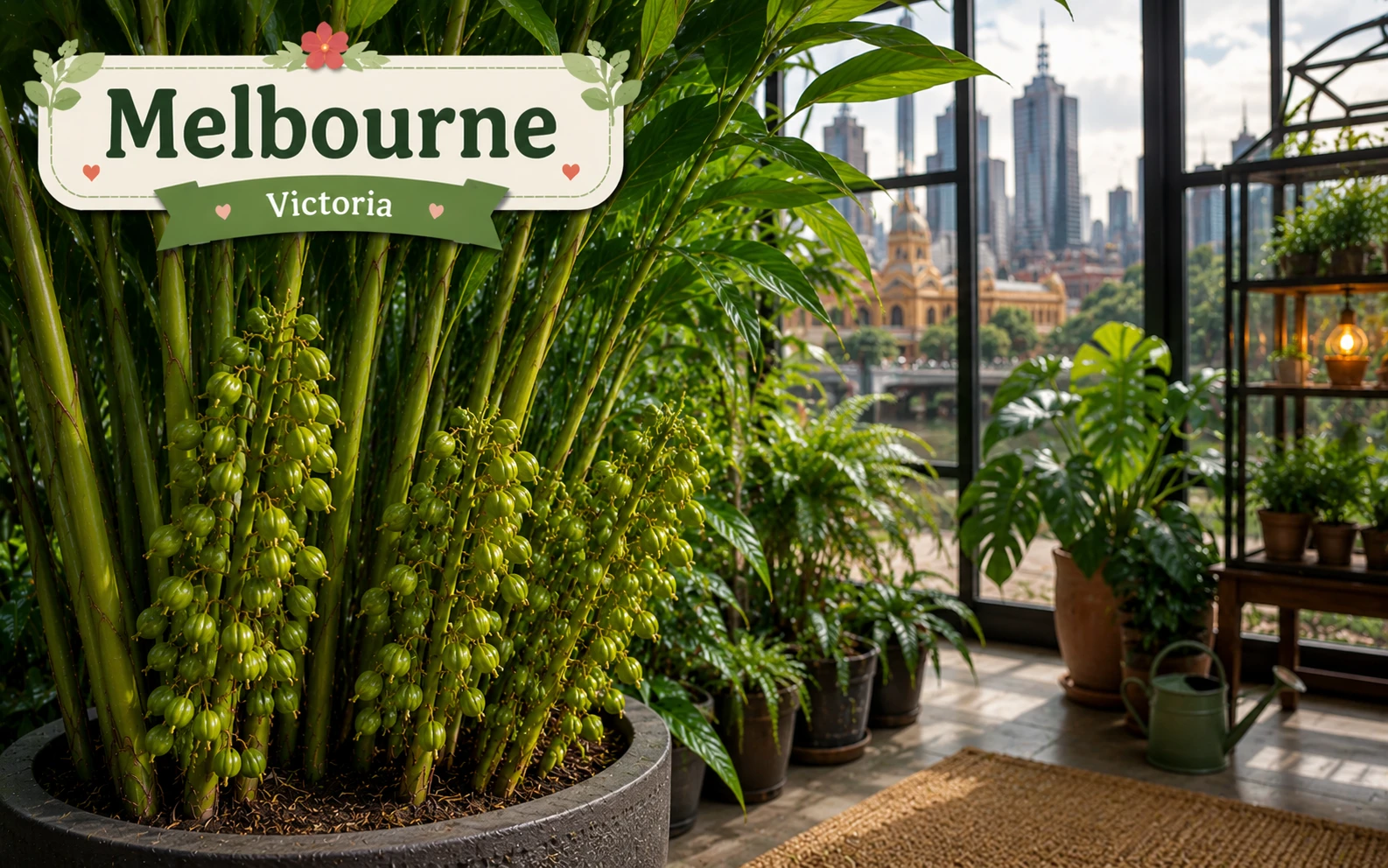
Cardamom as indoor houseplant in Melbourne conservatory setting
🏠 Zone 6–7 · Indoor / Greenhouse

Melbourne & Victoria

Melbourne’s cold, often wet winters are the most challenging in mainland Australia for cardamom — but it thrives as a beautiful long-lived tropical houseplant.

⚠ Perth & South-West WA — Full Guide

The dry summer heat without humidity is the opposite of cardamom’s preferred conditions. Supplement with drip irrigation and misting. Container growing with indoor overwintering during cold snaps (June–August) gives the best results. Northern Perth suburbs are warmer and more suitable.

Run a humidifier or misting system in summer — ambient humidity is critically low
East-facing sheltered courtyard position preferred — avoid harsh afternoon west sun
Bring indoors June–August if temperatures forecast below 8°C

🪴 Sydney & NSW Coast — Full Guide

Containers outdoors October–May, indoors June–September. In sheltered inner Sydney gardens and Northern Beaches / Gosford / Illawarra areas, cardamom can sometimes overwinter outdoors with heavy mulching. Further north in coastal NSW, conditions improve significantly.

Move outdoors after last frost risk — typically mid-October in Sydney
North-facing courtyards with brick walls add significant warmth retention in winter
Byron Bay and Northern Rivers: near-subtropical conditions — year-round outdoor growing viable

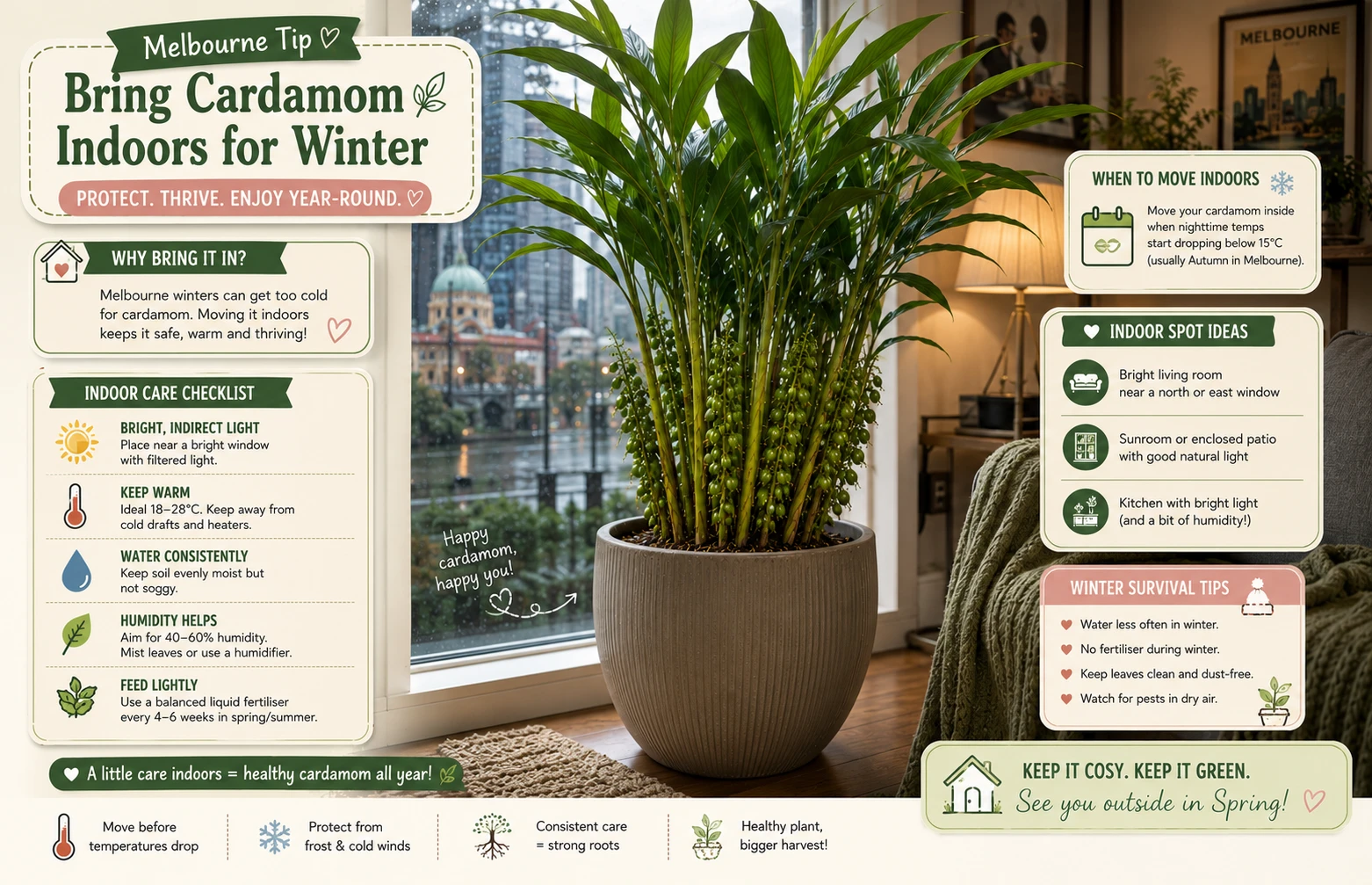
🏠 Melbourne & Victoria — Full Guide

In-ground outdoor growing is not viable. Container growing works well: outdoors November–March in a very sheltered north-facing position, indoors April–October. A heated greenhouse or conservatory is the single biggest upgrade for Melbourne growers.

Heated conservatory or greenhouse unlocks reliable flowering potential
Outdoors November–March only — sheltered north-facing position essential
Dedicated humidifier essential indoors — Melbourne winter air is very dry
Full-spectrum LED grow light April–October for indoor plants
Variety Selection

Cardamom Varieties Best for Australia

Not all cardamom is the same. Choosing the right variety for your Australian climate zone significantly improves your chances of success. Here’s how the main types compare.

Green Cardamom Elettaria cardamomum growing in Australian Zone 1-2 tropical garden
🟢
Green Cardamom
Elettaria cardamomum
The true culinary cardamom — the one you want if harvesting pods for spice. Native to tropical rainforest understory in Kerala, India. Requires warm, humid, shaded conditions. Available from Daleys Nursery. Best suited to zones 1–2 (tropical and subtropical Australia). Can be grown as a houseplant in temperate zones.
✓ Zones 1–2 Ideal
Black Cardamom Amomum subulatum suited to cooler Australian climate zones
Black Cardamom
Amomum subulatum
Native to Himalayan foothills (1,500–2,000m altitude) — naturally tolerates cooler, drier conditions than green cardamom. Smoked, camphor-like flavour — used in different South Asian dishes. Potentially better suited to temperate Australian zones (Sydney, Adelaide) than green cardamom. Large, dark pods. Still needs some warmth to produce fruit.
⚠ Zones 2–5 Possible
Siam Cardamom Amomum krervanh growing in tropical Far North Queensland Zone 1
🌿
Siam / Thai Cardamom
Amomum krervanh
Native to Southeast Asian tropical rainforests. Strong camphor-eucalyptus aroma. Similar growing requirements to green cardamom — tropical to subtropical. Less common in Australian nurseries. Suitable for tropical zones in FNQ and Darwin. Not readily available as a plant in Australia — sourcing from seed may be required.
✓ Zone 1 Suitable
False Cardamom — Alpinia ornamental ginger frequently mislabelled as cardamom in Australian nurseries
⚠️
False Cardamom (Avoid)
Alpinia zerumbet / Alpinia nutans
Frequently sold as “cardamom” at Australian garden centres, especially in Queensland. These are ornamental gingers — the pods have no culinary cardamom value whatsoever. Identification: true cardamom flowers are white with purple veining at ground level; Alpinia flowers are yellow-throated and appear at the top of tall canes. Always ask for the botanical name Elettaria cardamomum before purchasing.
✗ Not True Cardamom
Australian availability note: Green cardamom (Elettaria cardamomum) is the primary variety available in Australia. Daleys Fruit Tree Nursery in Kyogle, NSW is the most reliable Australian source and ships nationally. Always verify the botanical name before purchasing from any other source.
Seasonal Calendar

Australian Cardamom Planting Calendar

Australia’s seasons are the reverse of the northern hemisphere. This calendar is tailored for Australian growers — note that “spring” here means September–November.

🌏 Southern Hemisphere Calendar Note: All seasonal dates and months in this guide follow the Southern Hemisphere calendar. Australian summer runs December–February; winter is June–August. If you have found growing guides from UK, US, or Indian sources, their seasonal advice will be approximately 6 months out of phase with Australian conditions — always use this page’s Australian-specific timing.
☀️

☀️ Summer (Dec–Feb)

Tropical: peak growth, monitor drainage in wet season
Subtropical: water every 3–4 days, hand-pollinate flowers
Temperate: plant outdoors (sheltered), water daily in heat
All zones: balanced NPK feed monthly, add potassium supplement
🍂

🍁 Autumn (Mar–May)

Tropical: harvest pods, plant new divisions in April
Subtropical: harvest pods, prepare for cooler months
Temperate: begin moving containers indoors (May)
All: reduce watering as temperatures drop
❄️

🌨 Winter (Jun–Aug)

Tropical: best division and planting season
Subtropical: foliage may reduce — protect roots with mulch
Temperate: indoors only, minimal watering, stop feeding
All: no NPK fertilising, humidifier essential indoors
🌱

🌸 Spring (Sep–Nov)

Tropical: panicle formation begins, increase irrigation
Subtropical: best planting and division time (Sep–Oct)
Temperate: move containers outdoors from Oct–Nov
All: resume NPK feeding, inspect for pest activity
Best planting time by zone: Tropical zones (QLD, NT, Kimberley): plant in the dry season (May–September) for best establishment before the wet season growth surge. Subtropical zones: plant September–October (early spring) for best establishment before summer. Temperate zones: plant October–November after all frost risk has passed.
Soil for Australian Conditions

Soil pH & Australian Soil Guide for Cardamom

Cardamom thrives in slightly acidic, well-draining, humus-rich soil at pH 5.5–6.5. Australian soils vary enormously by state and region — here’s exactly what to do in each location.

🌴
Far North Queensland
pH 5.5–6.5 naturally
Red clay-loam soils in FNQ are naturally well-suited with minor amendment. Add 20–25% coarse organic matter for drainage. Test annually — heavy wet season rainfall can gradually acidify soil below 5.5. Red loam from the Atherton Tablelands is particularly excellent for in-ground cardamom.
🌿
Brisbane / SE Queensland
pH 5.8–6.5 ideal
SE Queensland soils range from clay loam to sandy loam. Amend with 25–30% quality compost. Clay-heavy soils in western suburbs need perlite (20%) for drainage improvement. Subtropical soils generally respond well to cardamom with standard amendment. Soil testing kits from Bunnings are adequate for annual monitoring.
🏡
Sydney / NSW
Adjust to pH 5.8–6.5
Sydney loam is generally suitable with minor amendments. Clay-heavy western Sydney soils need perlite (20–25%) plus organic matter. Coastal sandy soils need significant organic matter addition. For containers: 40% quality loam + 30% coco coir + 30% perlite. Test annually as Sydney tap water affects pH over time.
🪴
Melbourne / Victoria
Adjust to pH 6.0–6.5
Melbourne clay soils are problematic for cardamom drainage. For in-ground (greenhouse only): add perlite (25–30%) plus compost. Container mix is strongly preferred: 40% quality potting mix + 30% coco coir + 30% perlite. Test pH annually — Melbourne tap water can push soil alkaline over time. Sulfur correction is the standard fix.
☀️
Perth / WA
Adjust to pH 6.0–6.5
Perth’s sandy soils need the most significant amendment — add 30–40% organic compost and 15% clay loam to improve moisture retention. Hard bore water in parts of WA pushes pH alkaline over time — monitor annually and correct with sulfur powder. Container growing strongly recommended to maintain consistent soil conditions year-round.
🌊
Darwin / Northern Territory
pH 5.5–6.5 naturally
Darwin’s red clay-loam soils are naturally good for cardamom when drainage is managed. Key risk is wet season waterlogging — plant on raised mounds (15–20cm) or in raised beds. Add organic matter (20–25%) to improve structure. Wet season rainfall intensity can leach nutrients — feed monthly during the growing season to replace losses.
⚠️ Universal soil rule for Australia: Never let cardamom roots sit in waterlogged soil. In all Australian climate zones, adequate drainage is the single most important soil factor. If in doubt, add more perlite and use raised beds or mounded planting positions.

Container Soil Mix — All Australian Zones

For Australian container growing in any climate zone, use this proven mix:

Premium potting mix for cardamom container growing — Australian growers guide
40%
Quality Potting Mix
Use premium brands — Osmocote, Yates Premium, or Richgro. Cheap mixes compact quickly and impede drainage over time.
Coco coir for cardamom potting mix — moisture retention in Australian containers
30%
Coco Coir
Retains moisture, improves soil structure, and is slightly acidic (pH 5.5–6.5). Available at Bunnings and major hardware stores.
Perlite granules for drainage in cardamom containers — prevents waterlogging
30%
Perlite
Ensures excellent drainage and prevents waterlogging — the single most common killer of potted cardamom in Australian homes.
Seasol liquid seaweed conditioner — monthly application for Australian cardamom
Monthly
Seasol Seaweed
Apply as liquid soil conditioner monthly throughout the growing season. Improves root health and microbial activity. Widely available at Bunnings.
Epsom salt magnesium foliar spray for preventing yellowing in Australian cardamom
Monthly
Epsom Salt Spray
1 tbsp per 4L as a monthly foliar spray provides magnesium — prevents yellowing leaves common in Australian container cardamom.
Australian tip: Bunnings and major hardware stores stock perlite and coco coir in most states. For premium potting mixes, Richgro and Osmocote Professional are reliable choices widely available across Australia. Avoid cheap potting mixes — they compact quickly and impede drainage.
Water Management

Water Restrictions & Cardamom Irrigation in Australia

Water is both essential for cardamom and subject to local restrictions in many Australian states. Here’s how to keep your cardamom thriving while staying within your local water rules.

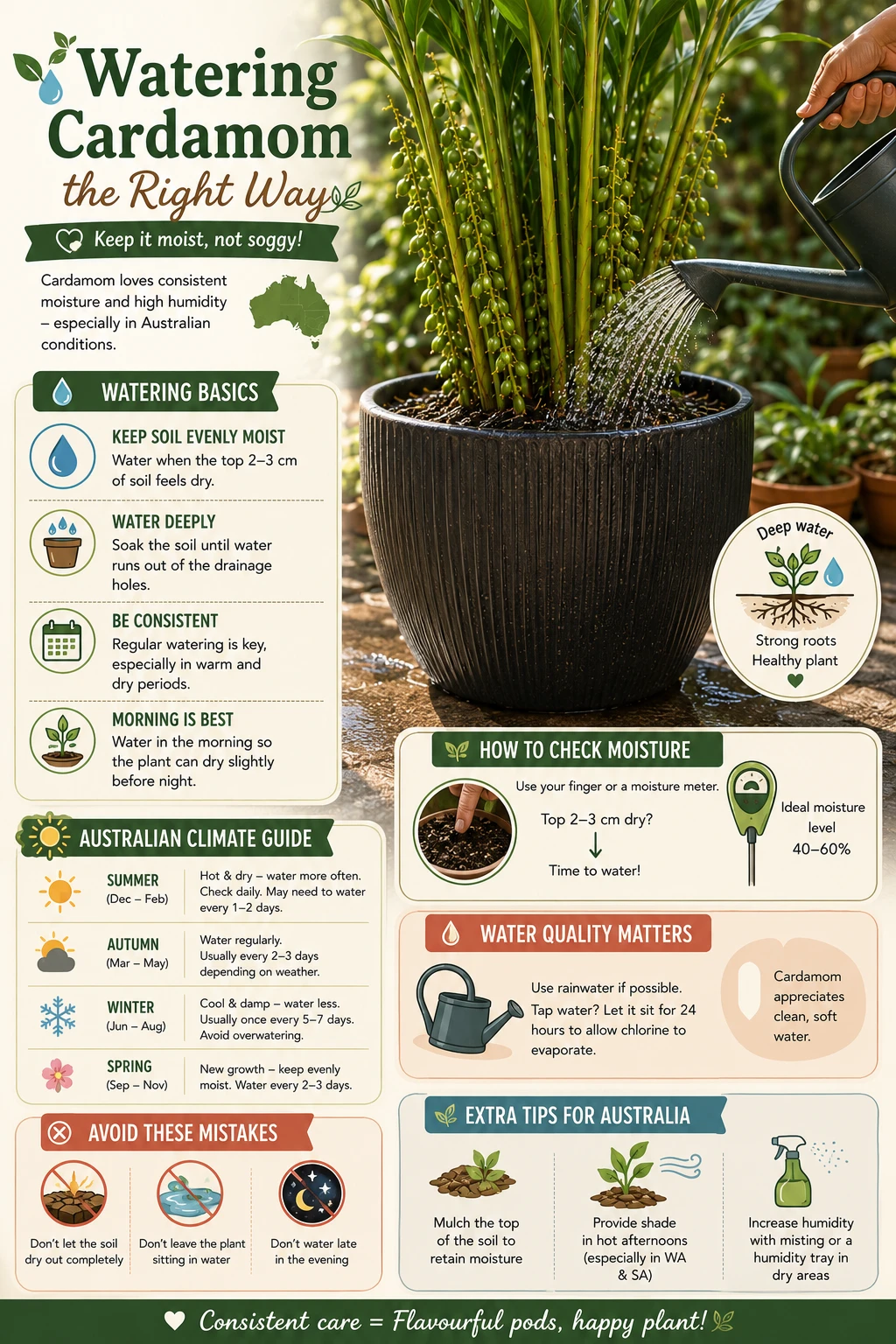
LocationSummer Watering Freq.Winter Watering Freq.Restriction RiskBest Strategy
FNQ / Darwin (wet season)Rainfall dependent — monitorEvery 5–7 days (dry season)LowRely on monsoon, supplement in dry season
Brisbane / SE QLDEvery 3–5 daysEvery 7–10 daysMediumDrip irrigation, deep mulch, collect rainwater
SydneyEvery 3–5 days outdoorsMinimal (indoors)MediumContainer moves indoors — indoor watering not restricted
PerthEvery 2–3 days (very dry)Every 7–10 daysHighWater restrictions apply — use designated watering days, drip only
MelbourneEvery 3–5 days (outdoors Nov–Mar)Minimal (indoors)Low–MediumMost watering done indoors — not subject to outdoor restrictions
AdelaideEvery 3–4 daysMinimal (indoors)HighStrict water restrictions — rainwater tank essential for garden cardamom

Water-Saving Strategies for Australian Growers

  • Drip irrigation systems deliver water directly to roots — eligible for use on any watering day in most states. Highly efficient for cardamom.
  • Rainwater tanks are unrestricted in most Australian states. A 1,000L tank can sustain a container cardamom through most of summer.
  • Deep mulching (10–15cm) reduces watering frequency by up to 40% by retaining soil moisture.
  • Watering time matters — always water in the early morning. Evening watering encourages fungal issues in humid zones.
  • Self-watering pots with reservoir bases are excellent for container growing in Perth and Adelaide.

Humidity — The Hidden Water Requirement

Cardamom needs moisture in the air as much as in the soil. In most of Australia (excluding tropical zones), supplementing humidity is critical:

  • A cool-mist humidifier running 2–4 hours daily dramatically improves indoor cardamom performance in Melbourne, Sydney, and Perth.
  • Grouping plants together creates a microclimate of higher humidity around the foliage.
  • Pebble trays with water under the pot add passive humidity as water evaporates.
  • Misting foliage in the morning — not evening — adds brief humidity without fungal risk.
Australian-Specific Tips

Cardamom Care Tips for Australian Conditions

Australian growing conditions differ significantly from UK, USA, and Indian guides you might find online. These tips are specific to Australian climate realities.

Cardamom plant with deep mulch in Australian garden — essential moisture retention technique
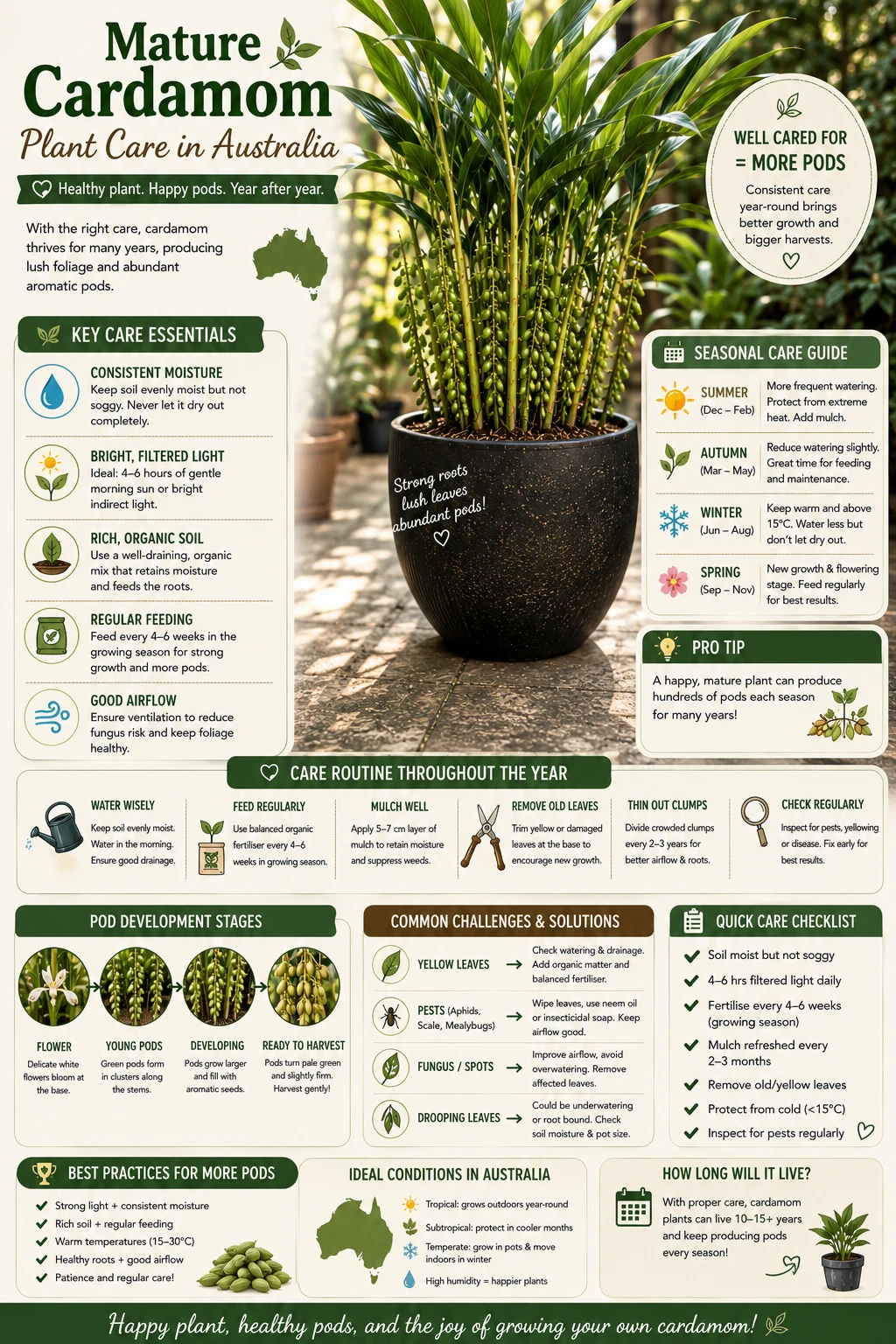
Mulching in Australia: Sugar cane mulch (widely available at Bunnings) and hardwood bark chips are the two best options. Apply 10–15cm depth around the base. Keep mulch 5cm from the stem to prevent rot. Refresh annually — mulch breaks down into organic matter that benefits root health.

Key Australian-Specific Care Points

Raised mound planting to prevent wet season waterlogging for cardamom in Queensland and NT
💧 Wet Season Waterlogging
Raise plants on mounds 15–20cm above surrounding soil in QLD and NT. Even in ideal tropical zones, wet season flooding destroys roots within 48 hours. Prevention is critical and cheap; cure is impossible once root rot sets in.
Misting cardamom foliage to supplement humidity during Australian dry season
💨 Dry Season Humidity
Australia’s dry season air is extremely low in humidity in all zones. Mist foliage daily or use a humidifier. This affects tropical dry seasons as much as temperate zones — it’s the most commonly neglected care step.
Shade cloth protecting cardamom from intense Australian afternoon sun — east-facing position
☀️ Afternoon Sun Intensity
Australian afternoon sun is significantly more intense than the filtered canopy light cardamom evolved under. Always provide shade after 12pm in all zones. East-facing positions that receive morning sun and afternoon shade are ideal across all Australian climates.
Native stingless bee Tetragonula pollinating cardamom flower in tropical Australia
🐝 Native Bee Pollination
Australia’s native stingless bees (Tetragonula species) actively pollinate cardamom flowers in tropical zones. Outdoor tropical plants often produce pods without hand-pollination. In temperate zones or indoors, hand-pollinate every open flower in the morning using a small brush.
Sugar cane mulch applied 10-15cm deep around cardamom base for moisture retention
🍃 Mulching is Non-Negotiable
Australia’s intense sun rapidly dries soil. Apply 10–15cm of bark mulch or sugar cane mulch around every cardamom plant. Keep mulch 5cm away from the main stem. Refresh annually as mulch breaks down into beneficial organic matter.
pH testing soil for cardamom growing — managing hard bore water alkalinity in Perth WA
🔬 Water Quality & pH
Hard bore water in parts of WA and inland Australia raises soil pH over time. Test annually with a simple kit from Bunnings. If pH climbs above 6.5, correct with agricultural sulfur. Symptoms of alkaline soil: yellowing new leaves despite regular feeding.
Australian biosecurity certified nursery — buying cardamom from approved Australian sources
🛡️ Buy Australian-Grown Stock
Plants shipped internationally carry biosecurity risk and may introduce exotic pathogens. Purchase from Australian nurseries — Daleys Fruit Tree Nursery and Rare Fruit Council sources are the safest choices. Australia’s strict biosecurity rules exist for good reason.
Seasol and Osmocote fertiliser schedule for cardamom spring feeding in Australia
🌱 Fertiliser Schedule
Use Seasol liquid seaweed (at Bunnings and hardware stores Australia-wide) monthly, plus Osmocote slow-release granules in spring. Stop feeding completely in winter — a common mistake that stresses dormant plants and causes excessive soil salt build-up.
Pest & Disease Management

Cardamom Pests & Diseases in Australia

Australian cardamom growers face a familiar set of pests plus some unique regional challenges. Early identification and organic first-line treatment keep most issues manageable.

Spider mite damage on cardamom leaves — stippled yellow webbing common in dry Australian climates
🕷️ Spider Mites
Most common in dry summers — especially Perth, Adelaide, Melbourne, and Sydney. Causes stippled, yellowing leaves with fine webbing on leaf undersides. Hot dry conditions cause rapid population explosions.
Fix: Neem oil spray (5ml/L + dish soap), increase humidity, cold water blast. Repeat every 5 days for 3 cycles.
Mealybugs — white cottony deposits on cardamom stems and indoor plants
🐛 Mealybugs
Common on indoor plants in Melbourne and Sydney, and in sheltered positions. White cottony deposits in leaf joints and on stems. Can quickly spread to neighbouring plants if not isolated immediately.
Fix: 70% isopropyl alcohol on cotton swab for small infestations. Neem oil spray for larger outbreaks. Isolate affected plants immediately.
Thrips Sciothrips cardamomi damage — silvery streaks and deformed pods in tropical FNQ
🦟 Thrips (Sciothrips cardamomi)
The most destructive commercial cardamom pest. Most relevant for tropical zone growers in FNQ and Darwin. Causes silvery streaking on leaves and deformed pods. Can devastate crops if left unchecked for a single season.
Fix: Spinosad (ICRI-recommended) for confirmed thrips. Blue sticky traps for monitoring. Neem oil as preventative spray monthly in tropical zones.
Scale insects on cardamom stems causing sooty mould in Queensland
🐜 Scale Insects
Brown or white hard bumps on stems and leaf undersides. Produce honeydew which encourages sooty mould growth. Common in sheltered indoor and greenhouse positions. Queensland and subtropical zones particularly susceptible.
Fix: Scrape off manually, treat with horticultural oil spray (available at Bunnings). Repeat fortnightly for 2 months for full control.
Fungus gnats from overwatered cardamom soil — common in indoor plants in Melbourne and Sydney
🦟 Fungus Gnats
Small flies hovering around soil — larvae damage roots. Common in overwatered indoor plants across all Australian cities. Worse in winter when cold soil stays wet longer than it should. Correct watering habits prevent most outbreaks entirely.
Fix: Allow soil to dry slightly between waterings. Yellow sticky traps for adults. Bacillus thuringiensis israelensis (Bti) drench for larvae.
Root rot symptoms on cardamom — yellowing and wilting caused by waterlogging in tropical wet season
🍄 Root Rot (Pythium/Phytophthora)
The most serious disease issue for Australian cardamom growers, especially in tropical wet seasons. Caused by waterlogging combined with soil pathogens. Yellowing, wilting foliage with root damage when plant is lifted from soil.
Fix: Prevention is key — raised mounds and excellent drainage. Once established: remove from waterlogged soil, trim affected roots, treat with Trichoderma-based biological fungicide. Repot in fresh mix.
Leaf spot Phyllosticta disease on cardamom — brown spots with yellow halo in high rainfall FNQ
🍃 Leaf Spot (Phyllosticta)
Brown spots with yellow halo on leaves. Common in humid tropical and subtropical zones, particularly during periods of high rainfall in FNQ and Darwin. Aesthetic rather than plant-threatening at low severity — act quickly at first sign.
Fix: Remove affected leaves promptly. Improve air circulation. Copper-based fungicide spray for persistent outbreaks. Avoid wetting foliage when watering.
Aphid clusters on cardamom new growth during spring flush in subtropical Australian zones
🐝 Aphids
Cluster on new growth and flower stems. Can vector diseases between plants. Common in subtropical zones during spring flushes of new growth. Green, black, or brown clusters on tender new shoots — act early as populations double rapidly.
Fix: Strong water jet to dislodge. Neem oil spray. Introduce ladybirds if available. Yellow sticky traps for monitoring population.
Australian biosecurity note: Do not import cardamom plants or rhizomes from overseas — this risks introducing exotic pathogens and pests that could harm Australian agriculture. Always buy from Australian-certified nurseries. For suspected new pest identifications, contact your state’s Department of Agriculture pest reporting line.

🔬 Pest & Disease Symptom Checker

Describe what you see on your cardamom plant — select the symptoms below — and get an instant diagnosis with specific treatment advice for Australian conditions.

Step 1: Select all symptoms you can see on your plant:

Garden Design

Companion Planting in Australian Gardens

Strategic companion planting improves cardamom growing conditions, deters pests, and creates the microclimate of filtered shade and elevated humidity that cardamom evolved under.

The ideal Australian cardamom companion planting scenario in tropical zones: Banana or heliconia providing overhead canopy at 3–4m height, with ginger and turmeric as ground-level companions creating a dense humid microclimate. In subtropical zones: use an existing tree fern or shade tree as overhead canopy with lemongrass around the perimeter and ginger as a ground-level companion.
Sourcing in Australia

Where to Buy Cardamom Plants in Australia

Cardamom is not at every garden centre — but it is available from specialist Australian sources. Always confirm you’re buying Elettaria cardamomum (true green cardamom), not Alpinia species.

Daleys Fruit Tree Nursery tropical plants Kyogle NSW Australia — best source for cardamom plants Australia
🌿 Daleys Fruit Tree Nursery
Australia’s most reliable specialist tropical plant nursery. Based in Kyogle, NSW — ships nationally. Lists Elettaria cardamomum with documented growing reports from FNQ customers. Extensive documentation and growing notes provided with purchase.
Visit daleysfruit.com.au →
Rare Fruit Council plant sales Queensland NSW WA — cardamom plants from experienced home growers
🌐 Rare Fruit Council Plant Sales
Rare Fruit Councils in Queensland, NSW, and WA hold regular plant sales where cardamom plants and rhizomes are occasionally available from experienced home growers. Plants from these sales come with growing advice from the sellers. Check your local chapter for sale dates.
Visit rarefruit.org.au →
Bunnings Warehouse tropical plant section Queensland spring — cardamom plants occasionally stocked
🏪 Bunnings Warehouse
Bunnings does not reliably stock true Elettaria cardamomum nationally, but tropical stores in Queensland (Cairns, Townsville, Brisbane) occasionally carry it — especially in spring. Check the tropical plant section and always verify the botanical name on the label before purchasing.
Check bunnings.com.au →
Australian Etsy sellers cardamom seeds rhizomes plants ships Australia nationally
🛒 Australian Etsy Sellers
Several Australian Etsy sellers offer cardamom seeds, rhizomes, and established plants. Filter search results by “Ships from Australia” and check seller reviews carefully. Always confirm species is Elettaria cardamomum — not Alpinia — before ordering. Good for sourcing seeds if plants are unavailable.
Search Etsy Australia →
Amazon Australia cardamom seeds growing kits humidifiers drip irrigation national delivery
🛍️ Amazon Australia
Amazon.com.au stocks cardamom seeds, growing kits, and related supplies with fast national shipping. Also excellent for sourcing growing accessories — humidifiers, drip irrigation kits, grow lights for indoor growers in Melbourne and Sydney. Filter by “Sold in Australia” for fastest delivery.
Search Amazon Australia →
Facebook Tropical Plant Groups Australia cardamom rhizomes plants community growers
📱 Facebook Tropical Plant Groups
Groups including “Tropical Fruit Growers Australia,” “Queensland Exotic Fruit & Plants,” and “Tropical Plant Collectors Australia” frequently have cardamom rhizomes and plants offered by local growers — often very affordable. Community knowledge shared in these groups is also invaluable for Australian-specific growing questions.
Find Facebook groups →
Tropical nursery Cairns Atherton Tablelands FNQ Queensland locally grown cardamom plants
🌱 Queensland Nurseries (FNQ)
Specialist tropical nurseries in the Cairns, Atherton, and Daintree regions often stock cardamom plants for local pickup. These nurseries typically have the healthiest local-climate-adapted stock. Ask at the Atherton Tablelands markets — local growers regularly sell divisions from established plants.
Search: “tropical nursery Cairns,” “Atherton nursery Queensland”
⚠️ Beware of false cardamom at Australian garden centres: Alpinia zerumbet (shell ginger) and Alpinia nutans are frequently mislabelled as “cardamom” across Australia — particularly in Queensland. The pods of Alpinia have no culinary cardamom value. Always ask the nursery for the botanical name Elettaria cardamomum. Identification: true cardamom flowers are white with purple veining at ground level on prostrate stems; Alpinia has yellow-throated flowers at the top of tall canes.
Expert Answers

Growing Cardamom in Australia — 20 Questions Answered

Yes — cardamom grows very well in large parts of Australia. Far North Queensland (Cairns, Daintree, Atherton Tablelands), Darwin NT, and the Kimberley WA are ideal year-round outdoor locations. Subtropical zones (Brisbane, Gold Coast, SE Queensland, northern NSW) support reliable outdoor growing with some care. Temperate cities (Sydney, Melbourne, Adelaide, Perth) require container growing with indoor overwintering. Daleys Fruit Tree Nursery — Australia’s specialist tropical plant source — lists Elettaria cardamomum with a preferred climate of “Tropical” and documents successful growing reports from FNQ customers.
Year-round outdoor growing is possible in Far North Queensland (Cairns, Port Douglas, Atherton Tablelands, Daintree), Northern Territory (Darwin, Katherine), Kimberley WA (Broome, Kununurra), and coastal Queensland from approximately Mackay northward. Subtropical outdoor growing — with some winter care — is viable in Brisbane and SE Queensland, Gold Coast, Sunshine Coast, central Queensland coast, northern NSW coast (Byron Bay, Ballina, Coffs Harbour), and the coastal WA strip from Geraldton to Broome.
Yes — Brisbane and SE Queensland fall in Australia’s subtropical zone 2, making year-round outdoor cardamom growing viable. Brisbane’s warm humid summers are excellent for cardamom. Winters are mild (rarely below 5°C in most suburbs), though occasional cold snaps may cause some leaf dieback. Choose a sheltered, north-facing position with filtered afternoon light. Apply heavy mulch (10–15cm) over the root zone for winter protection. Cardamom grown in Brisbane conditions typically flowers from year 2–3 and can produce pods reliably with hand-pollination or natural bee visitors.
In Sydney: container growing works well — outdoors October–May in a sheltered north-facing position, indoors June–September. Sydney’s warmer inner-west and northern suburbs are more suitable than western Sydney. In Melbourne: containers are essential year-round. Outdoors in a very sheltered courtyard November–March only; indoors April–October with a full-spectrum grow light. Both cities support cardamom as a beautiful long-term tropical houseplant. Pod production is more achievable in Sydney than Melbourne without greenhouse conditions.
Best planting timing by zone: Tropical zones (QLD, NT, Kimberley): plant in the dry season May–September before wet season growth surge. Subtropical SE QLD and northern NSW: plant September–October (early spring) for establishment before summer. Sydney: plant October–November after frost risk passes. Melbourne and southern cities: plant November only when temperatures are consistently above 15°C. In tropical and subtropical areas, autumn planting (March–April) works but gives plants less time to establish before their first cooler/drier period.
The most reliable Australian source is Daleys Fruit Tree Nursery (daleysfruit.com.au) in Kyogle, NSW, which ships Elettaria cardamomum nationally and has extensive grower documentation. Other options: Rare Fruit Council plant sales in QLD and NSW; Facebook groups including “Tropical Fruit Growers Australia” and “QLD Exotic Fruit & Plants”; Australian-based Etsy sellers (filter by Australia, confirm species). In Far North Queensland, specialist tropical nurseries in the Cairns and Atherton region often stock plants locally. Always verify the species is Elettaria cardamomum, not Alpinia (commonly mislabelled in Australian garden centres).
It depends on your location. Tropical zone (FNQ, Darwin): there is no true winter — cardamom grows year-round. Subtropical QLD (Brisbane, Gold Coast): foliage may reduce slightly in the coolest weeks (July–August) but the plant survives and recovers — heavy mulching of the root zone is important. NSW, Victoria, SA, southern WA: outdoor winter survival is not reliable — container growing with indoor overwintering is necessary. The minimum temperature threshold is around 10°C for foliage survival, and sustained temperatures near 0°C can damage rhizomes in all but the most protected positions.
Yes — Queensland is arguably the best state in Australia for backyard cardamom growing. Far North Queensland is exceptional (similar to Kerala conditions). SE Queensland (Brisbane, Gold Coast, Sunshine Coast) supports reliable outdoor growing in sheltered positions. Central Queensland coast (Townsville, Mackay) is also viable. Key considerations: provide filtered shade (cardamom burns in direct Queensland sun), ensure excellent drainage during wet season, mulch heavily, and water consistently during dry periods. In most of coastal Queensland from Brisbane northward, cardamom can be treated as a permanent garden plant.
Yes — Darwin’s tropical monsoonal climate is ideal for cardamom. The wet season (November–April) provides the humidity surge that triggers panicle initiation — similar to the monsoon onset pattern in Kerala. The dry season (May–October) requires supplemental irrigation (every 5–7 days) and regular misting to maintain humidity. Plant in filtered shade under existing trees. Darwin’s clay-loam soils are generally suitable but drainage must be excellent during the wet season — raise plants on mounds if your garden area retains water. Darwin growers can expect plants to flower and produce pods reliably from year 2–3.
Perth’s Mediterranean climate (hot dry summers, mild wet winters) is challenging but achievable for cardamom with the right approach. The dry summer heat combined with low humidity is the opposite of cardamom’s preferred conditions. Container growing is recommended — outdoors in a sheltered east-facing position in summer with daily misting or a drip irrigation system, indoors or under shelter June–August. Perth’s northern suburbs (Joondalup, Wanneroo) are warmer and more suitable. A greenhouse or enclosed verandah with a humidifier transforms Perth’s suitability for cardamom significantly. Water restrictions apply in Perth — use a drip system on your designated watering days.
The target is well-draining, humus-rich, slightly acidic soil at pH 5.5–6.5. For in-ground growing in tropical/subtropical Australia: amend native soil with 25–30% organic compost and ensure excellent drainage. Red loam soils in FNQ and Darwin are naturally well-suited with minor amendment. Sandy Perth soils need significant organic matter (30–40%) addition. Melbourne and Sydney clay soils need perlite (20–25%) plus organic matter to improve drainage. For all container growing: 40% quality loam + 30% coco coir + 30% perlite. Test and adjust pH annually — hard bore water in some areas can push pH alkaline over time. Agricultural sulfur corrects alkaline soil; dolomite lime corrects overly acidic conditions.
Watering frequency varies significantly by Australian climate: Tropical wet season (FNQ, Darwin Nov–Apr): rainfall usually sufficient — monitor drainage rather than watering. Tropical dry season: every 5–7 days for in-ground, every 3–4 days for containers. SE Queensland summer: every 3–5 days, check daily in heat waves above 35°C. Perth summer: every 2–3 days (very dry and hot — comply with local water restriction days). Southern cities in summer: every 3–5 days outdoors. All zones in winter: reduce by 40–50% and test soil before each watering. The finger test rule: water when the top 2–3cm of soil is dry to the touch. Australian afternoon sun dries soil much faster than northern hemisphere growing guides suggest.
Yes — Australian cardamom is susceptible to spider mites (especially in dry summers in southern states), mealybugs (common on indoor plants), aphids (which can vector disease), and scale insects. In tropical Queensland, thrips (Sciothrips cardamomi, the most destructive commercial cardamom pest) can be an issue. Fungus gnats are common in overwatered indoor plants in Melbourne and Sydney. Root rot (Pythium) is the most serious disease risk, primarily caused by waterlogging. First-line organic treatment: cold-pressed neem oil spray (5ml/L with liquid soap) treats most soft-bodied pests. Spinosad is the recommended treatment for thrips. Yellow and blue sticky traps for monitoring. See our full pest guide for complete treatment protocols.
Yes — a shadehouse is an excellent solution for Australian growers, particularly in subtropical and semi-arid areas. A shadehouse with 30–50% shade cloth mimics the forest understory conditions cardamom evolved under and provides protection from intense Australian afternoon sun while maintaining good air circulation and natural humidity from rainfall. In subtropical QLD, a shadehouse allows reliable year-round outdoor growing. In temperate areas, a shadehouse provides some frost protection but is not sufficient for full winter survival in Melbourne or southern cities. A combination of shadehouse spring–autumn plus indoor winter is a good strategy for Sydney and Adelaide. Shade cloth is available at Bunnings and most hardware stores in Australia.
Wet season waterlogging is one of the biggest risks for tropical zone cardamom in Australia. Solutions: plant on raised mounds (15–20cm above surrounding soil level) to improve natural drainage; improve soil structure with organic matter and coarse sand (20%+) before planting; install subsurface drainage pipes if the area retains water; choose positions with natural slope that shed water; use raised garden beds. During heavy wet season rainfall, check soil drainage every few days — if water sits around roots for more than 24 hours, emergency drainage improvement is needed. Container growing on raised platforms above the ground gives the best wet season control and is strongly recommended for Darwin and FNQ first-time growers.
Use a balanced liquid NPK (10:10:10) monthly during the growing season — in tropical Australia this is nearly year-round; in subtropical areas September–April; in temperate cities October–March. Switch to a potassium-rich supplement (tomato feed or potassium sulfate) when panicles form — typically October–February in subtropical QLD. Apply magnesium sulfate (Epsom salt — 1 tablespoon per 4 litres) as a monthly foliar spray for magnesium. Excellent Australian-available options: Seasol liquid seaweed (widely available from Bunnings, excellent soil conditioner), Osmocote Professional slow-release granules (spring application), and worm castings worked into the top layer of soil. Stop feeding completely in winter in temperate Australian cities.
Yes — this is a well-documented and widespread problem in Australia. Alpinia zerumbet (shell ginger) and Alpinia nutans are frequently sold as “cardamom” or “cardamom ginger” at Australian garden centres, particularly in Queensland where the tropical climate allows both plants to thrive. These are ornamental gingers — the pods have no culinary value as true cardamom spice. To identify true Elettaria cardamomum: flowers are white with purple veining and appear at ground level on prostrate stems (not at the top of canes like Alpinia); leaves smell distinctly of cardamom when crushed; and the plant label should say Elettaria cardamomum. If the label says “cardamom plant” without the botanical name, ask the nursery to confirm. Daleys Fruit Tree Nursery and specialist tropical nurseries in FNQ are the most reliable sources of the genuine species in Australia.
Timeline depends on propagation method and location: From rhizome division in tropical QLD or Darwin — expect first flowering in year 2, first pods in year 2–3. From rhizome in subtropical SE QLD — first flowering in year 2–3, pods year 3. From seed anywhere in Australia — add 2 years to those timelines (first pods year 4–5 in tropics, year 5–6 in subtropics). In temperate cities (Sydney, Melbourne), pod production is rare without greenhouse conditions. Once established, tropical zone plants in Australia can produce multiple harvests per year with harvest rounds every 25–35 days during peak season — similar to commercial Indian growing patterns.
In tropical Australia (FNQ, Darwin, Kimberley): native stingless bees (Tetragonula species) are present and actively pollinate cardamom flowers — hand-pollination is often not required for outdoor plants in these zones. In subtropical SE Queensland: some native bee activity occurs but is less consistent — monitoring and supplementary hand-pollination during morning flowering improves pod set rates significantly. In temperate cities (Sydney, Melbourne): hand-pollination is essential for indoor or sheltered container plants — there are no appropriate pollinators indoors. Method: use a soft artist’s brush in the morning when flowers are freshly open to transfer pollen from stamen to stigma. Even in tropical zones, hand-pollination as a supplement to natural pollination increases pod production by an estimated 30–40%.
Heavy mulching (10–15cm) is essential for Australian cardamom, particularly in tropical and subtropical areas where intense sun rapidly dries soil. Best Australian mulch options: sugar cane mulch (widely available from Bunnings — breaks down to add organic matter, very popular in Queensland); hardwood bark chips (long-lasting, good in subtropical and temperate areas); fallen leaves and leaf litter (excellent — mimics cardamom’s native forest floor habitat and adds beneficial organic matter as it decomposes); and lucerne/straw (good moisture retention but breaks down faster and needs more frequent refreshing). Apply mulch broadly around the plant base out to the drip line, keeping it 5cm away from the stem to prevent rot and collar disease. Refresh annually or as the mulch decomposes.
Continue Learning
Olivia Turner — BSc Horticulture, Spice Plant Specialist
🌿
Written by
BSc Horticulture · Spice Plant Specialist · Oregon State University

Olivia writes all growing and plant content on CardamomNectar. Her BSc in Horticulture from Oregon State University and research into tropical spice cultivation across different climate zones gives her the depth to address Australia’s unique growing challenges — from tropical Far North Queensland to temperate Melbourne — with specific, practical guidance.

View all articles by Olivia →
Emily Rhodes — Nutrition and Culinary Specialist, Content Reviewer
Reviewed by
Nutrition & Culinary Specialist · Content Reviewer

Emily reviews all CardamomNectar content before publication. All Australian climate zone classifications, state-specific growing recommendations, nursery source information, and species identification guidance on this page have been cross-referenced against ABC Organic Gardener, Daleys Nursery documentation, and Australian grow zone databases before publication.

View all articles by Emily →

Similar Posts