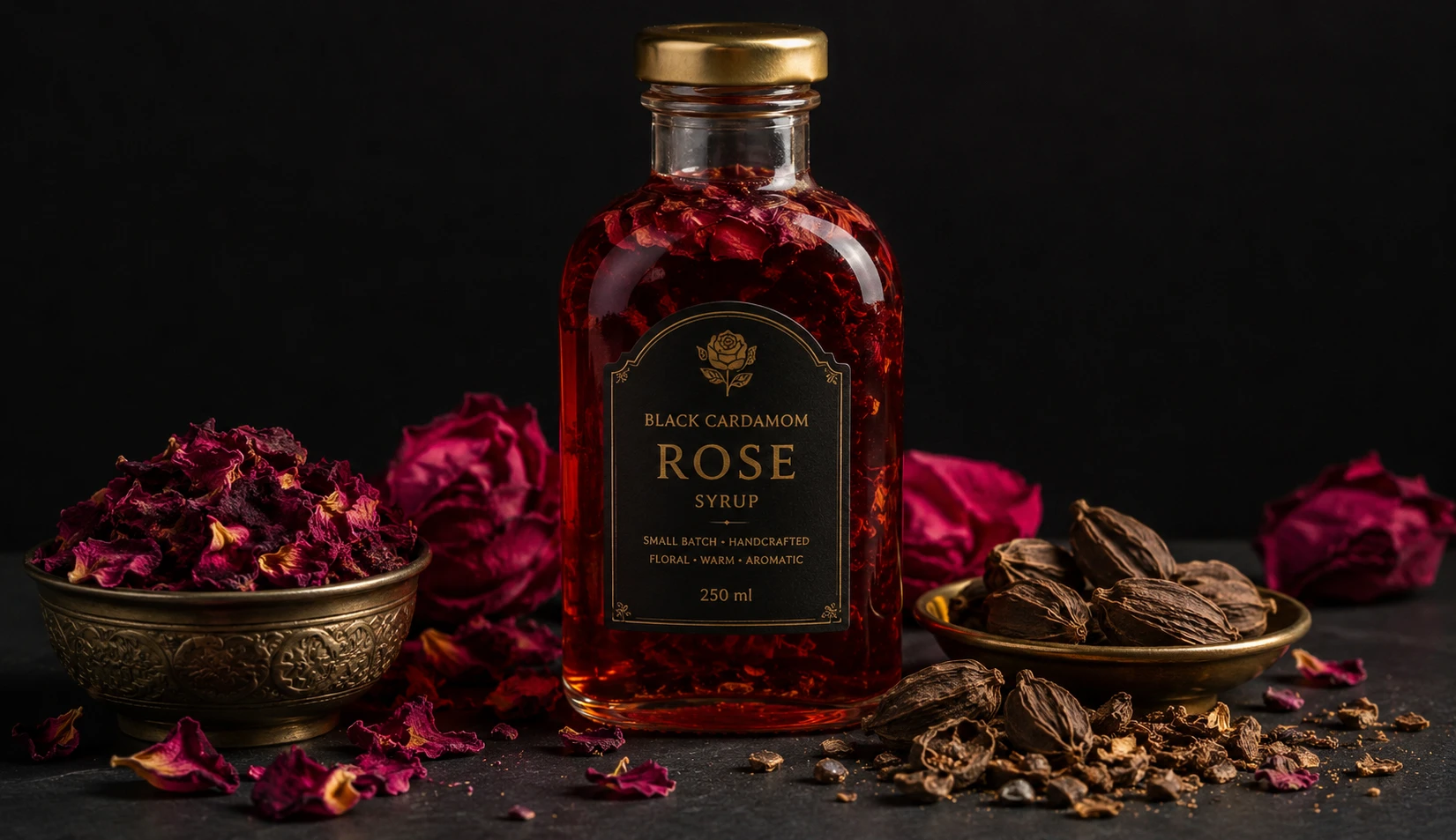
The South Asian flavour combination no other syrup recipe uses with black cardamom. Camphor-smoke from badi elaichi beneath the floral depth of dried rose petals — a 48-hour cold steep that produces the gulab-elaichi syrup of Pakistani and Persian tradition, rebuilt for your kitchen.
The gap this fills: Every rose cardamom syrup recipe on the internet uses green cardamom — the light, citrusy pods common in chai masala and Scandinavian baking. None use black cardamom (badi elaichi). This recipe is the first dedicated black cardamom rose syrup, producing a flavour profile rooted in Pakistani and Persian tradition rather than a Western approximation of South Asian spice.
If you’ve been searching for a homemade rose simple syrup with more depth than the usual green cardamom versions, this is it — the black cardamom edition no other recipe makes. Green cardamom rose syrup tastes bright and floral — pleasant, accessible, and common. Black cardamom rose syrup tastes like something older. The camphor-smoke of badi elaichi sits beneath the rose fragrance the way wood smoke sits beneath a mountain evening — present but not dominant, deepening everything above it.
The chemistry explanation: black cardamom’s dominant volatile compounds are cineole and camphor — the same class of compounds responsible for the warming, almost medicinal quality of eucalyptus and certain aged spices.[1] Rose petals contribute geraniol, citronellol, and nerol — light, floral alcohols that layer on top of camphor without competing.[2] The result is a naturally balanced flavour stack: floral on top, smoke underneath, with a clean sweet base from the caster sugar.
This is not a fusion recipe. It is a reconstruction. Gulab-elaichi (rose-cardamom) combinations have existed in South Asian and Persian cuisine for centuries — in chai, in sharbat, in mithai. The master black cardamom simple syrup is its bartender’s sibling. This rose variation returns it to its cultural home.
🌹 Cultural Context — Gulab-Elaichi
The combination of rose (gulab) and cardamom (elaichi) is one of the oldest flavour pairings in South Asian and Middle Eastern culinary tradition. In Pakistan, Iran, and the Arab world, rose water and cardamom appear together in chai, sharbat, rice pudding (kheer), and festive drinks. The badi elaichi (black cardamom) specifically appears in Mughal-era cooking — in biryanis, kormas, and rich syrups used in desserts and hospitality drinks. This syrup reconnects a modern Western cold-steep technique to that tradition.
The quality of the dried rose petals determines 60% of this syrup’s character. The petals must be culinary grade — dried without pesticides or chemical preservatives.
🌹 Dried Red Rose Petals
Strongest flavour + deepest colour
Most authentic gulab note
Best for chai and mocktails
Source: South Asian grocery
Rating: ⭐⭐⭐⭐⭐ Best
🌸 Food-Grade Rose Water
Clean, intense floral note
Add after straining — never heat
No colour contribution
Use 1–2 tsp per batch
Rating: ⭐⭐⭐⭐ Excellent
🌷 Dried Pink Rose Petals
Subtle flavour, minimal colour
Good for lighter applications
Widely available — bulk tea shops
Add more petals (4 tbsp) to compensate
Rating: ⭐⭐⭐ Acceptable
❌ Potpourri / Decorative Roses
Treated with chemicals
Not safe for consumption
No culinary grade certification
Do not use under any circumstances
Rating: ✗ Never use
Where to find culinary rose petals in the US and UK: South Asian grocery stores (Pakistani, Indian, Bangladeshi) almost always carry dried gulab petals. Middle Eastern grocery stores carry them year-round under the name “dried rosebuds” or “edible rose petals.” Online — Amazon, Frontier Co-op, and Mountain Rose Herbs are reliable sources. Always check for “culinary grade” or “food grade” labelling.
⭐ The Two Key Ingredients4–6 Black Cardamom Pods + 3 tbsp Dried Rose Petalspods: crack to expose seeds · petals: culinary grade only, never potpourri · 🛒 Rose Petals on Amazon →
200gWhite caster sugar — white keeps the rose colour clearest
100mlFiltered water
1 tspLemon juice optional — brightens the rose colour and flavour
1 tspVodka optional — extends shelf life to 6–7 weeks
OR 1–2 tspFood-grade rose water add after straining — if not using dried petals
Instructions
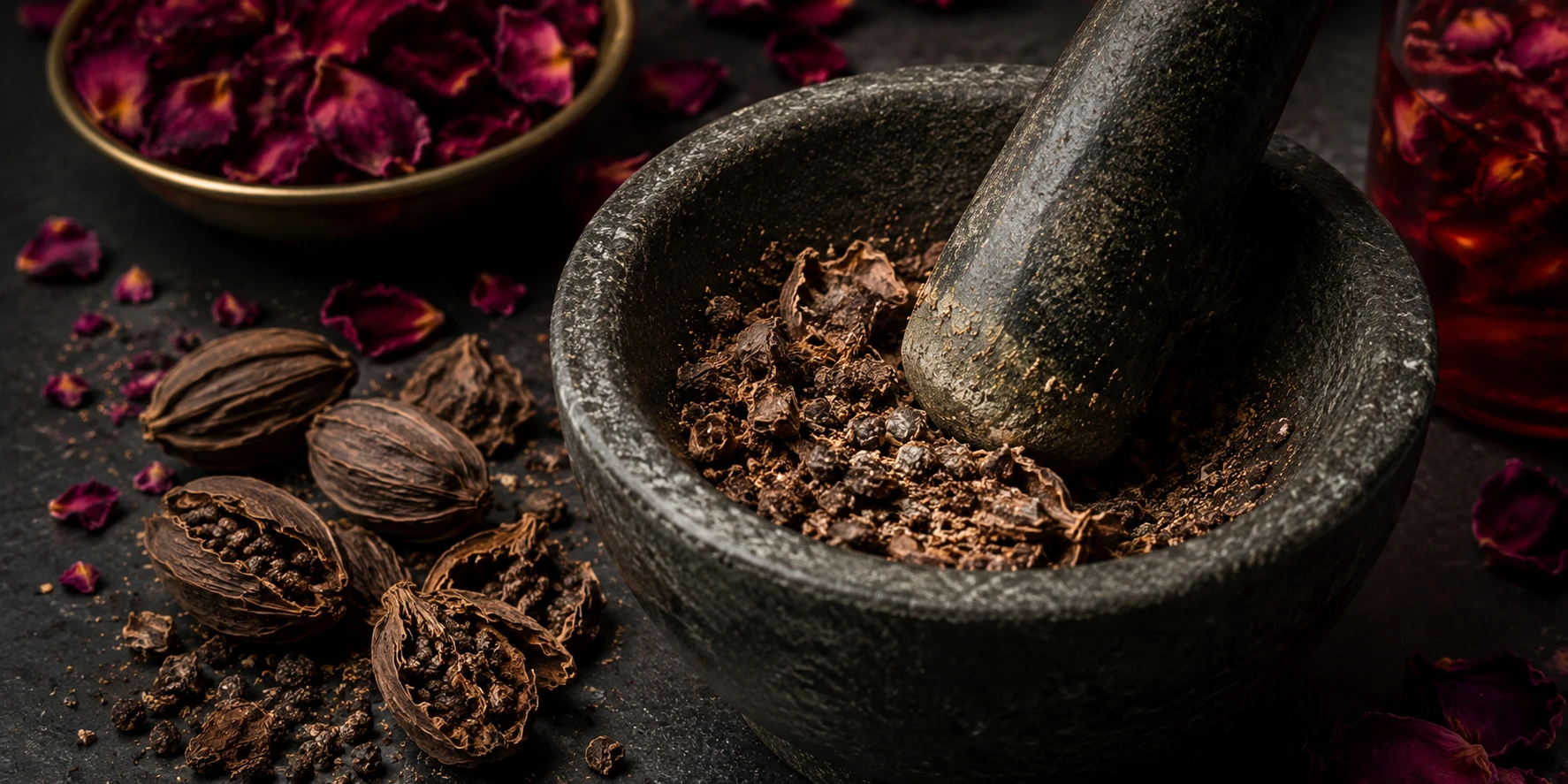
1Lightly crush 4–6 pods — crack husk to expose seeds, do not grind to powder
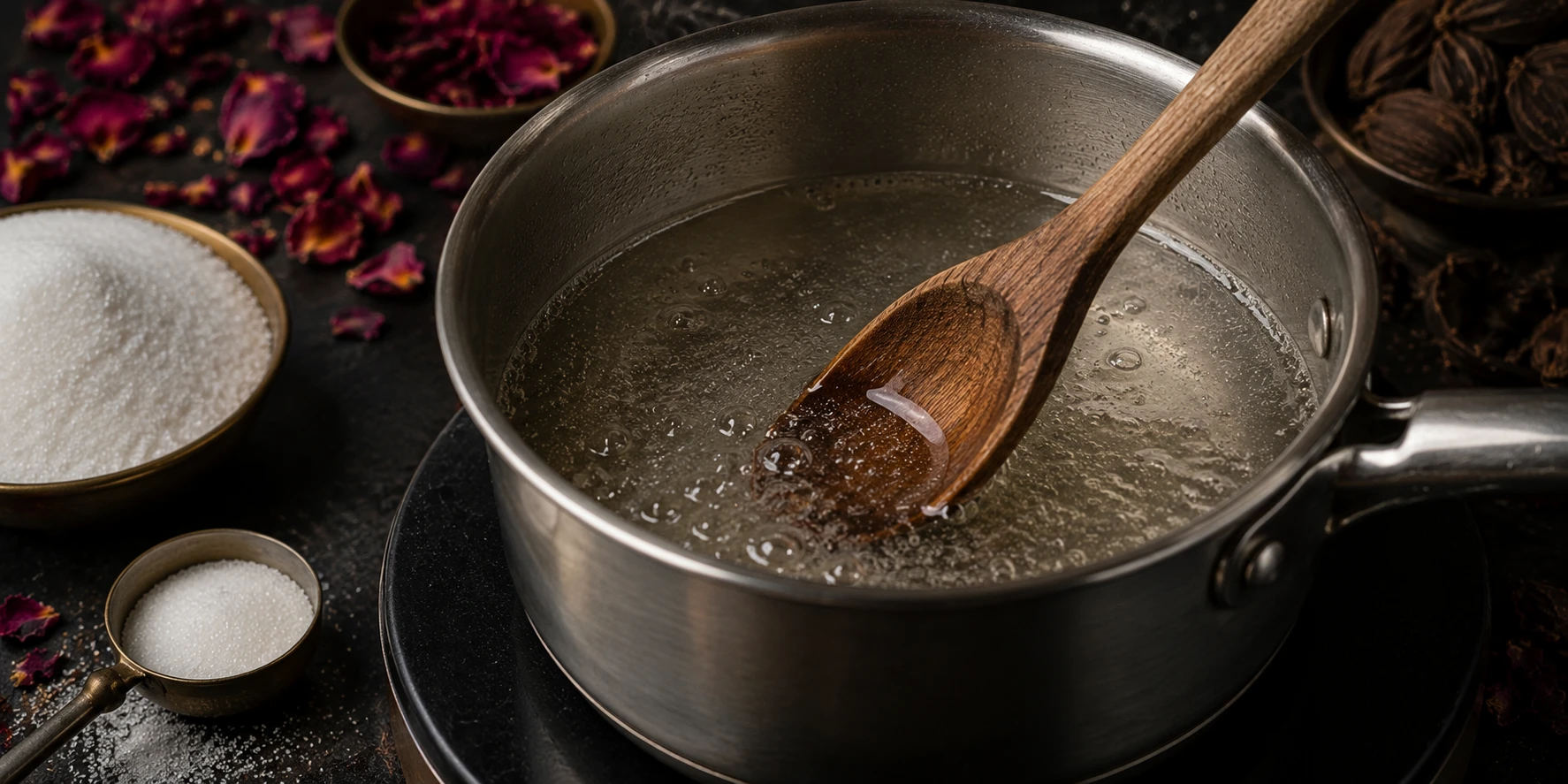
2Dissolve sugar in water over low heat — stir 3–4 min until clear. Do not boil
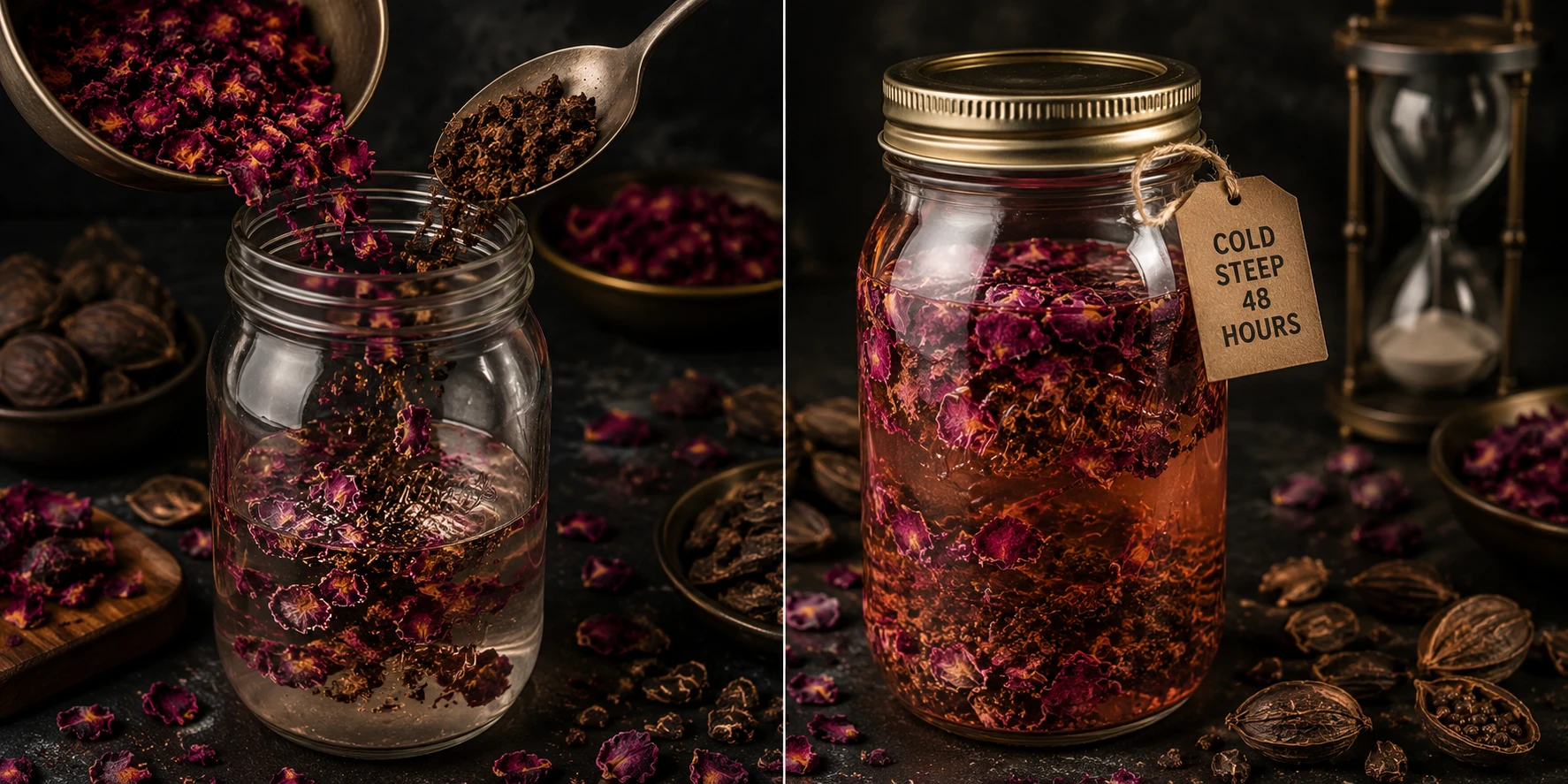
3Remove from heat. Add rose petals and crushed pods. Transfer to glass jar
4Cool uncovered 20 min, seal, refrigerate for 48 hours
5Strain through fine mesh. Add lemon juice + vodka if using. Bottle in glass, label
💡 Rose water alternative: Skip the dried petals — make the plain cardamom syrup, strain, then stir in 1–2 tsp food-grade rose water after it cools. Produces a cleaner, more intense floral note. Never add rose water during the heat step — it loses its aroma above 50°C.
Ingredients
Yields ~220ml (approximately 14–18 servings). Slightly less than the plain master recipe due to the rose petals absorbing some syrup during the 48-hour steep. Use white caster sugar for this variation — brown or demerara sugar darkens the colour and masks the rose-amber visual that makes this syrup distinctive.
Sugar colour matters here: White caster sugar keeps the rose-amber colour of the dried petals visible in the finished syrup. Using the demerara variation would produce a darker syrup where the rose colour is lost. If you want a brown-sugar-rose version, use demerara and add more petals (4 tbsp) to compensate.
Place 4–6 black cardamom pods in a mortar and apply one firm press — split the grey outer husk to expose the dark seed clusters inside. Each pod should be split open but still in one piece. Do not grind to paste. Over-crushed pods release tannins that compete with both the rose note and the camphor-smoke.
4 vs 6 pods: Use 4 pods for a subtle smoke note beneath the rose — the rose stays dominant. Use 6 pods when you want an equal balance of floral and camphor-smoke. Both are correct; the choice depends on application. For chai and mocktails, 4 pods. For cocktails, 5–6.
2
Dissolve Sugar — Low Heat, 3–4 Minutes, No Boil
Combine 200g white caster sugar with 100ml filtered water in a small saucepan over low heat. Stir continuously until fully dissolved and clear — 3–4 minutes. Caster sugar dissolves quickly; do not let the syrup approach a simmer. Remove from heat immediately when the liquid is clear.
Why no boil for this recipe specifically: Boiling destroys the anthocyanin pigments responsible for the rose-amber colour. Even a brief boil will produce a paler, more yellowish syrup. Low heat, full dissolution, immediate removal — this is the colour step.
3
Add Rose Petals + Pods, Cool, Refrigerate 48 Hours
Transfer warm syrup to a clean glass jar. Add 3 tbsp dried culinary rose petals and the crushed pods. Stir once — the petals will begin releasing colour immediately, turning the warm syrup a pale rose. Leave uncovered on the counter for 20–25 minutes until room temperature. Seal and refrigerate for 48 hours.
What to expect at 24 hours: Open the jar and smell at 24 hours — the gulab-elaichi combination should already be clearly present. The colour will be deeper than at the start. If the rose note is faint at 48 hours, the petals may be old — steep 12 more hours. Fresh, well-stored dried petals produce full extraction in 48 hours.
4
Strain, Add Lemon, Bottle — The Colour Reveal
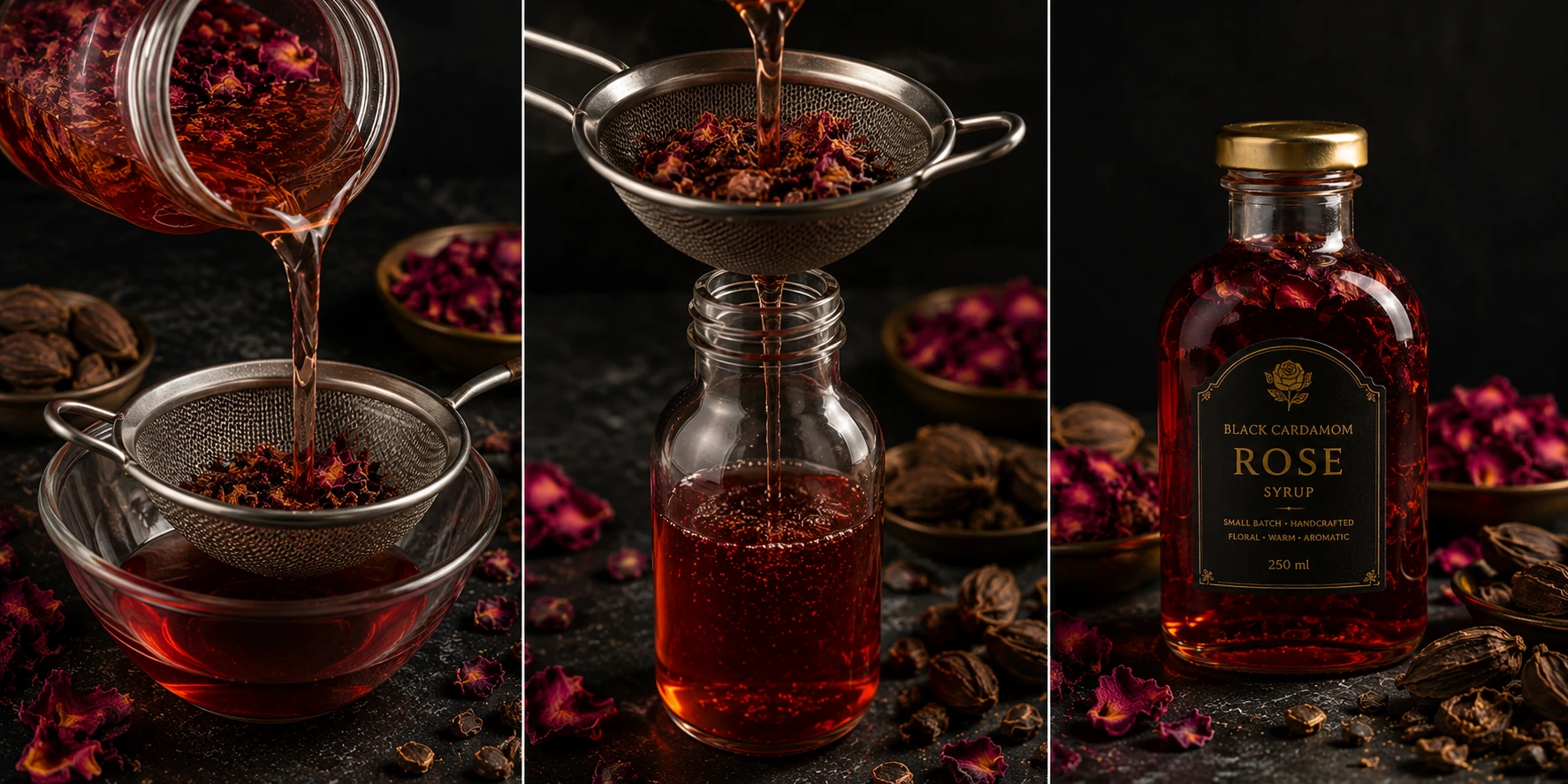
After 48 hours, the syrup will be a deep rose-amber — a warm pink-brown with visible clarity. Strain through fine mesh into a clean glass bottle, pressing the spent petals and pods gently to extract remaining syrup. Add 1 tsp fresh lemon juice now if using — the acidity brightens both the colour and the rose flavour immediately. Add vodka if using. Seal and label.
Lemon juice effect: Adding lemon juice after straining shifts the syrup’s pH slightly, which deepens the pink-red of the anthocyanin pigments. This is why Persian rose sharbat is often finished with citrus — it brightens the colour and cuts through sweetness simultaneously.
Quantities are for a single serving — the rose note is delicate, start with less and adjust
⭐ Signature Use
Badi Elaichi Gulab Chai
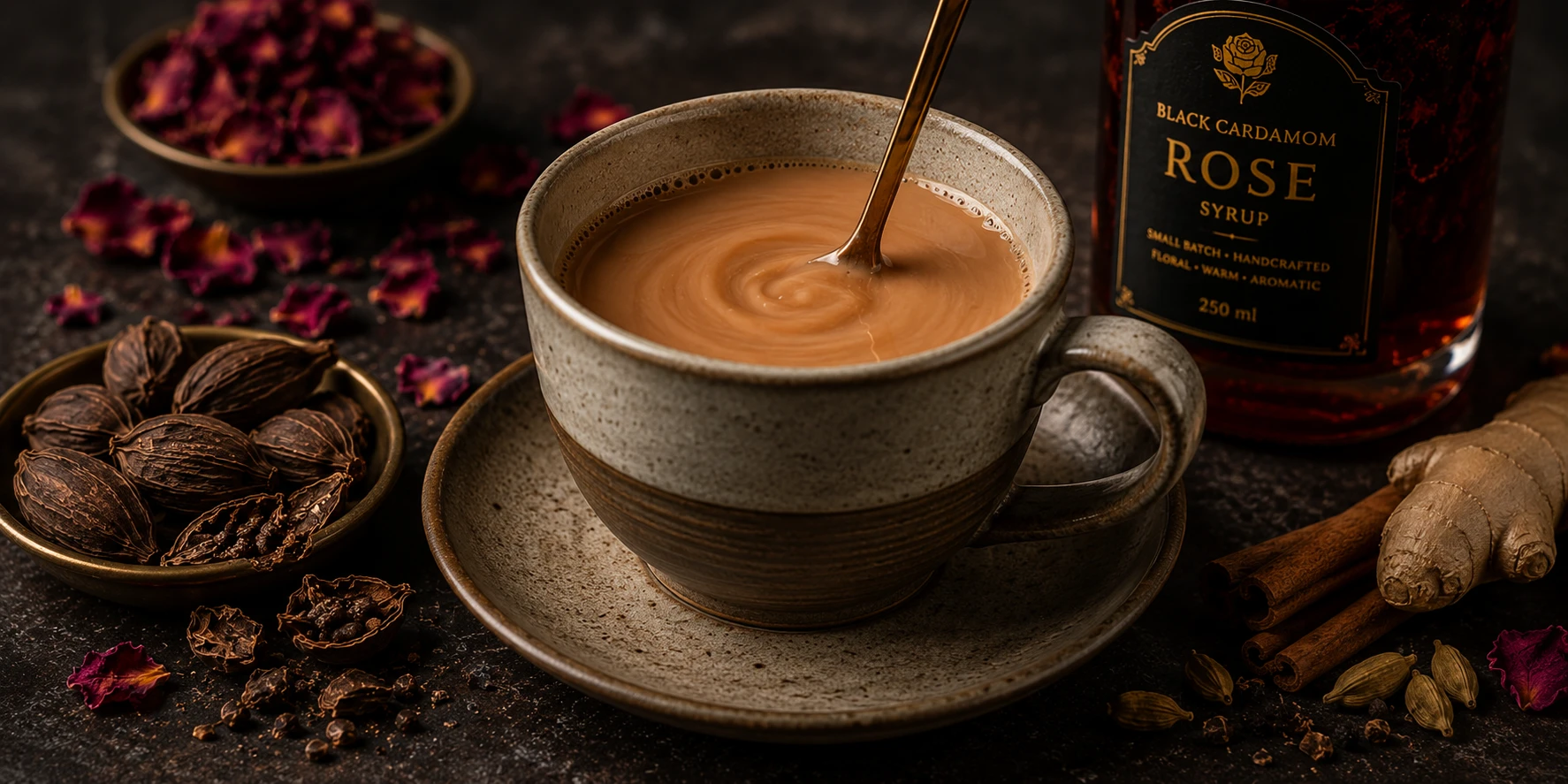
1–2 tsp stirred into brewed black tea or masala chai before adding milk. This syrup replaces both the sugar and the rose water that traditional Pakistani and Persian chai sometimes includes. The camphor-smoke note deepens as the tea cools slightly.
🥤 Mocktail
Rose Cardamom Spritz (Mocktail)
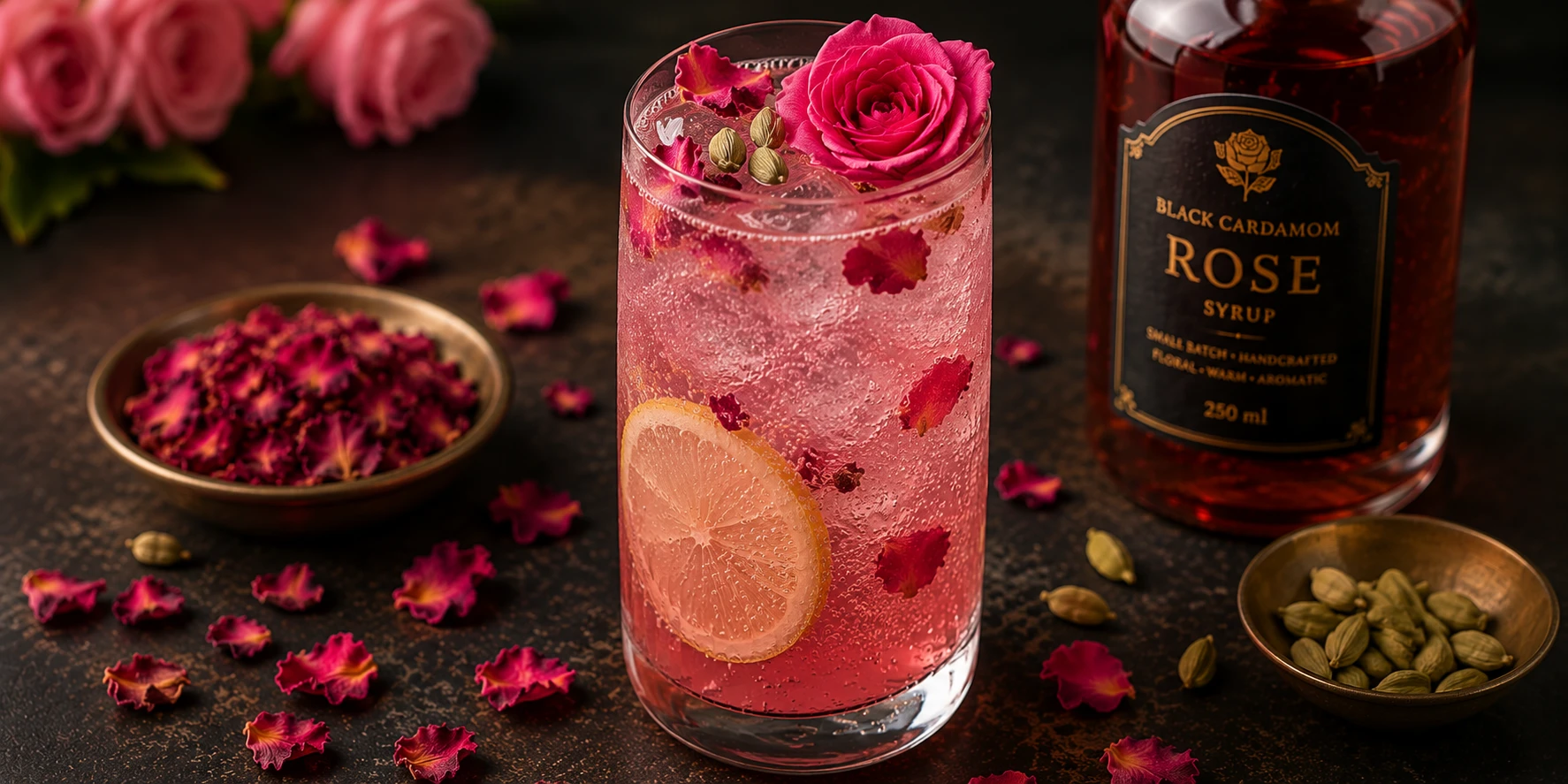
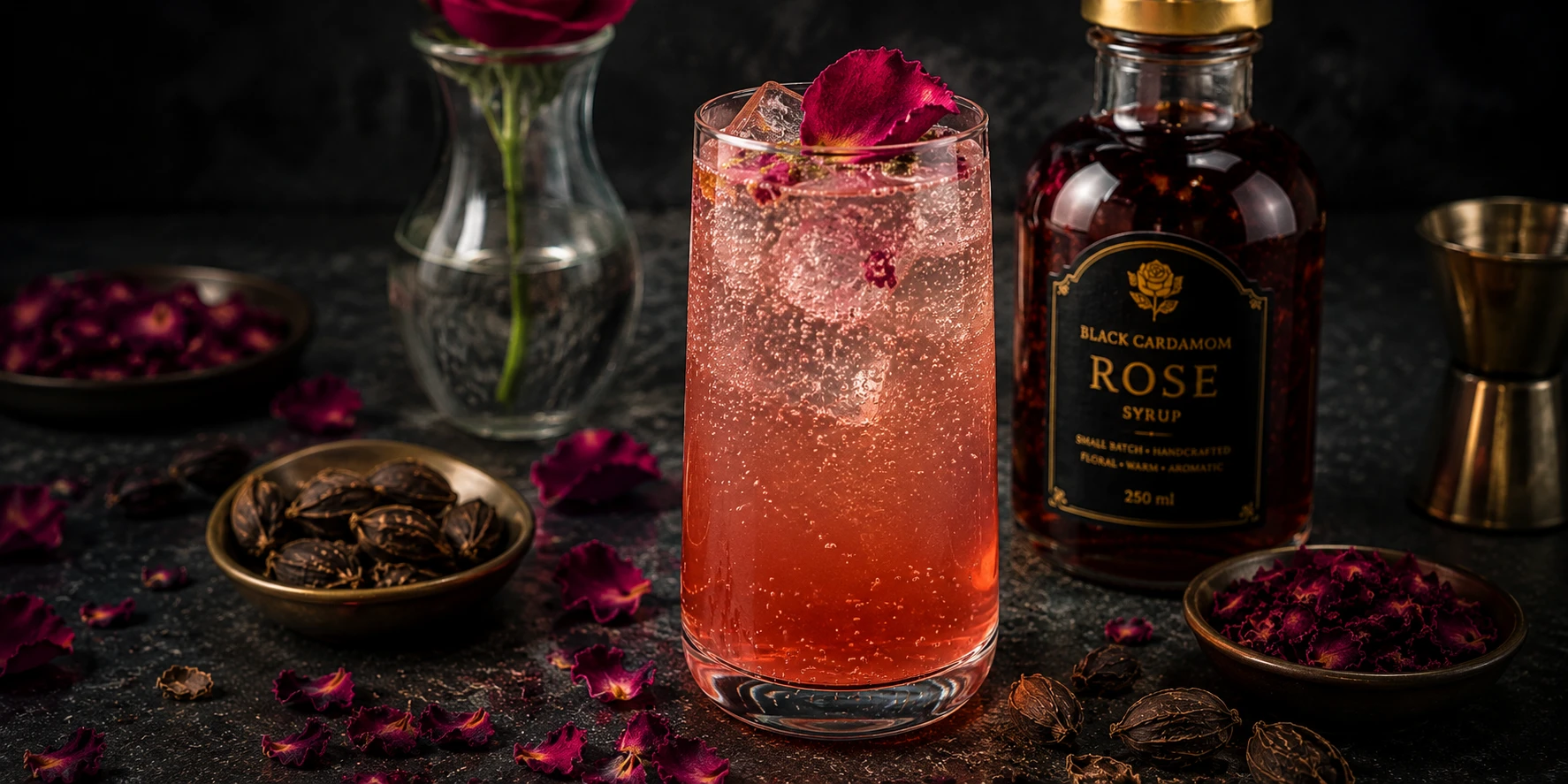
2 tbsp syrup + ½ oz fresh lemon juice + ice + sparkling water. Stir gently. Garnish with a dried rose petal. This is the no-alcohol entry point and the application with the highest Pinterest viral potential — the rose-amber colour photographs beautifully against sparkling water and ice.
☕ Coffee
Black Cardamom Rose Latte
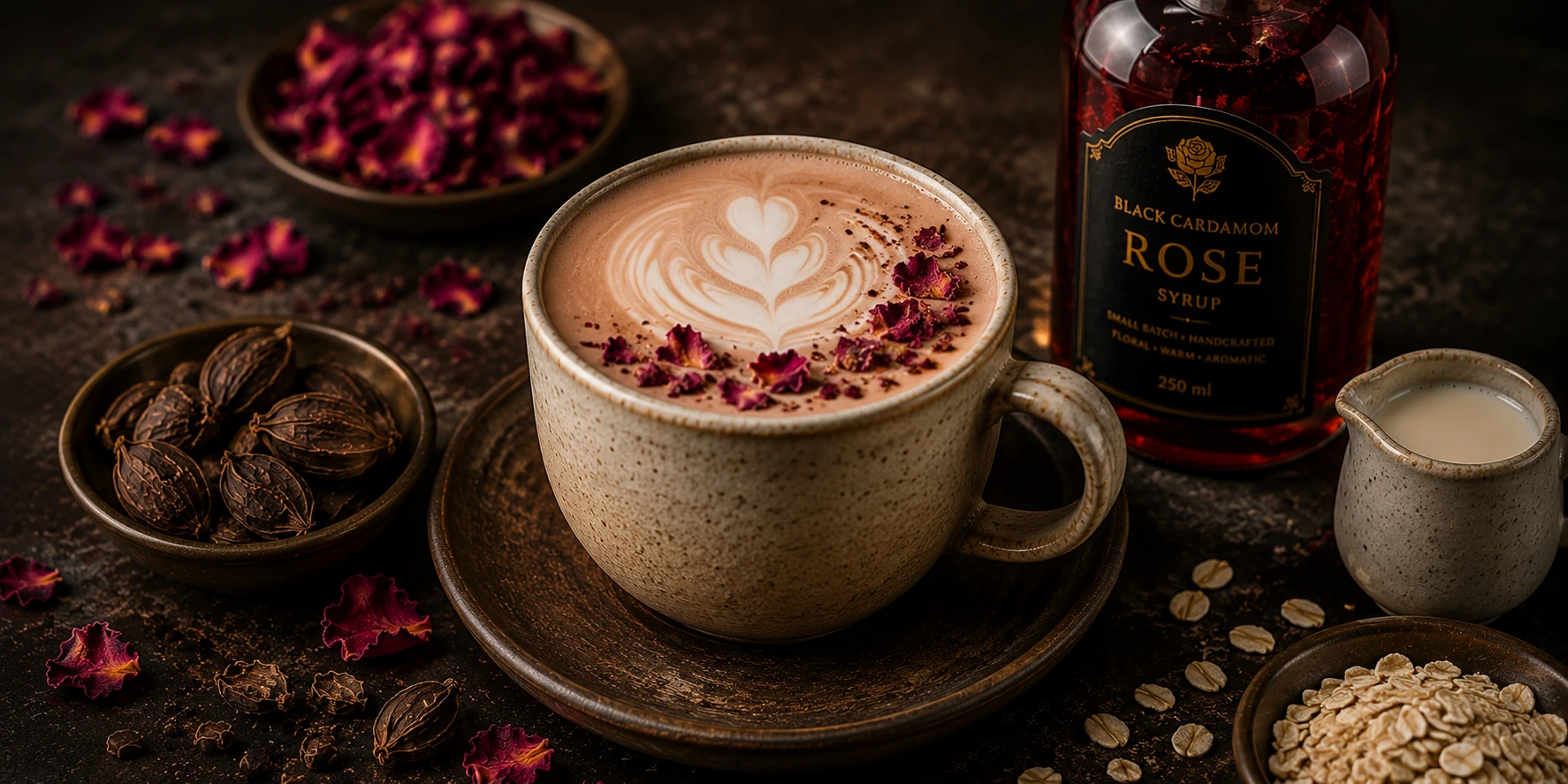
1–2 tsp syrup in steamed oat milk with a double espresso shot. Oat milk amplifies the rose fragrance in a way dairy does not — the fat content carries the floral compounds and releases them on each sip. The camphor-smoke of black cardamom cuts through oat milk’s natural sweetness.
🍸 Cocktail
Rose Cardamom Gin Cocktail
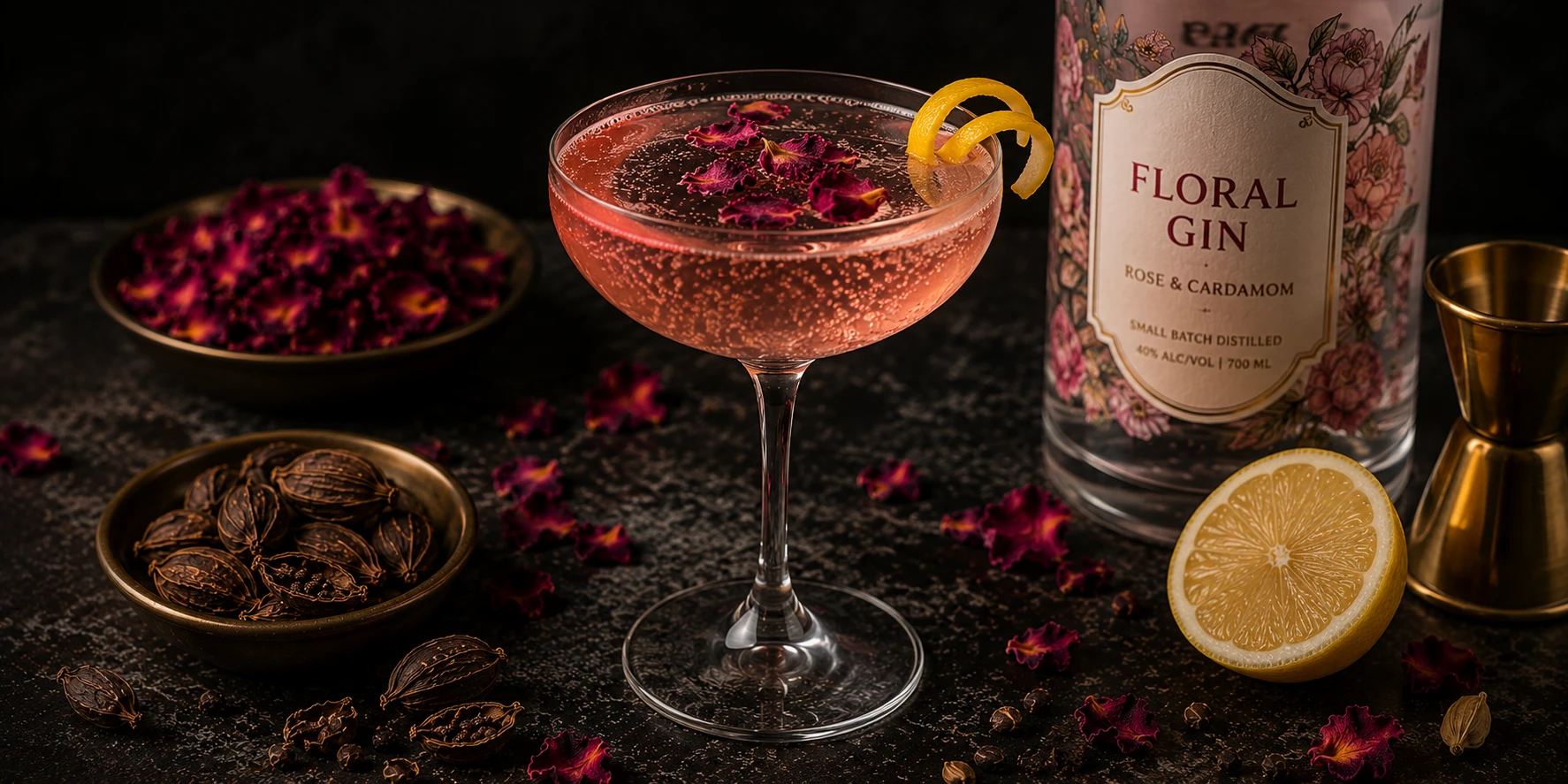
¼ oz this syrup + 1.5 oz floral gin (Hendricks, Bombay Sapphire) + ½ oz lemon juice + top with soda. The botanical overlap between floral gin and this syrup creates a natural harmony. Black cardamom’s camphor note amplifies gin’s juniper without competing with it.
🥛 Traditional
Sharbat-e-Gulab (Rose Sherbet)
2–3 tbsp syrup stirred into cold full-fat milk or water. Traditional South Asian festive drink — served at iftar, weddings, and Eid celebrations. Adding black cardamom to the syrup gives it a deeper, more complex gulab note than commercial rose syrup produces.
Select what you’re out of — get exact swap quantities and what changes in the finished syrup.
✓ No Black Cardamom Pods
Closest substitute: 3 green cardamom pods — produces a lighter, citrusy-floral rose syrup without the camphor-smoke. This is closer to what every other rose cardamom syrup recipe makes. The result is good but different.
To approximate the smoke note: Add ¼ tsp lapsang souchong tea (a smoked Chinese tea) tied in cheesecloth during the steep. Steep for 24 hours only — longer produces bitterness. This is an approximation, not a replacement. Order black cardamom pods →
✓ No Dried Rose Petals
Best substitute: 1–2 tsp food-grade rose water added after straining (never during heat). Rose water produces a cleaner, more intense floral note with no colour contribution. Use a quality rose water — cheap rose water tastes synthetic. Cortas and Nielsen-Massey are reliable brands in the US and UK.
Hibiscus alternative: 1 tbsp dried hibiscus flowers produces a deep magenta colour and a tart-floral note. The flavour profile shifts toward hibiscus + cardamom rather than rose + cardamom — different but also beautiful in mocktails.
✓ No White Caster Sugar
White granulated sugar: Fine — dissolves slightly slower (4–5 min vs 3–4 min) but produces the same result. White granulated is the most common substitute.
Demerara or turbinado: Works but produces a darker syrup where the rose-amber colour is obscured. If you use brown sugar, increase petals to 4 tbsp to compensate for the visual loss. See the demerara variation for a full brown-sugar cardamom syrup recipe.
✓ No Lemon Juice
The lemon juice is optional — the syrup is complete without it. Lemon juice brightens the rose colour (pH effect on anthocyanins) and cuts sweetness. Without it the syrup is slightly more muted in colour and flavour — still excellent.
Substitutes for lemon’s brightness: ½ tsp apple cider vinegar achieves the same pH effect on colour with a neutral flavour contribution. ¼ tsp citric acid dissolved in the warm syrup also works and is more neutral than vinegar.
Ingredient Substitutes for Black Cardamom Rose Syrup
Substitute for black cardamom pods
Use 3 green cardamom pods — produces a lighter citrusy-floral rose syrup without the camphor-smoke note. To approximate the smoke, add a small amount of lapsang souchong tea tied in cheesecloth during a 24-hour steep only.
Substitute for dried rose petals
Add 1–2 tsp food-grade rose water after straining instead of dried petals. Never add rose water during the heat step as it loses aroma above 50°C. Alternatively use 1 tbsp dried hibiscus flowers for a tart-floral note with deep magenta colour.
Substitute for white caster sugar
White granulated sugar dissolves slightly slower but produces the same result. Demerara or turbinado sugar works but produces a darker syrup where the rose-amber colour is obscured — increase rose petals to 4 tbsp to compensate.
Substitute for lemon juice
Lemon juice is optional — the syrup is complete without it. Substitutes: half a teaspoon of apple cider vinegar or a quarter teaspoon of citric acid dissolved in the warm syrup both achieve the same pH effect on anthocyanin colour without significantly affecting flavour.
Storage & Shelf Life
Rose petals introduce additional organic matter — this gives this variation a slightly shorter shelf life (4–5 weeks) than the plain master recipe (4–6 weeks). The syrup may develop a slight cloudiness over time as the rose compounds settle — this is normal. Shake before using.
Storage options for black cardamom rose syrup — shelf life and ratings
Method
Container
Shelf Life
Notes
Rating
Refrigerated — glass
Sealed glass jar or bottle
4–5 weeks
Glass preserves both the camphor compounds and the rose anthocyanins. Best colour and flavour retention.
Recommended
Refrigerated + vodka
Glass jar + 1 tsp vodka
6–7 weeks
Vodka inhibits microbial growth from the rose organic matter. Best option for batch-making.
Best Life
Refrigerated — plastic
Plastic bottle
2–3 weeks
Camphor and cineole permeate plastic. Shorter life than glass for this variation — not recommended.
Not Ideal
Frozen — portions
Silicone ice cube tray → zip bag
3 months
Freeze in tbsp portions. Rose syrup freezes well — colour and flavour preserved. Perfect for chai sweetener servings.
Recommended
Room temperature
Any
3–5 days max
Rose petals shorten room-temperature stability. Always refrigerate this variation.
Select your target yield — all quantities update automatically.
4–6 podsBlack Cardamom
3 tbspRose Petals
200gCaster Sugar
100mlFiltered Water
~220mlFinal Yield
14–18Servings
Difficulty Level & Time Breakdown🌶 1 / 5 — Beginner
Time Breakdown
Crushing pods2 min
Dissolving sugar4 min
Adding petals + pods, cooling5 min
Passive steep (refrigerator)48 hrs
Straining, finishing, bottling4 min
Hands-on total~15 min
Skill Requirements
Can crack a pod with a mortar or the flat of a knife
Can stir a saucepan at low heat without letting it boil
Has access to culinary-grade dried rose petals
Has a glass jar with a lid and fine-mesh strainer
Can identify when sugar is fully dissolved (clear liquid)
Who is this for? Anyone who wants to explore South Asian and Middle Eastern flavour traditions at home. No cooking experience required beyond the ability to dissolve sugar in water. The most beginner-friendly of the four syrup variations — the only variable is rose petal quality, evaluated by smell.
Expert Tips
🌹
Buy Petals from South Asian Grocers
Pakistani and Indian grocery stores in the US and UK carry culinary dried rose petals (gulab petals) at significantly lower cost than specialty tea shops or Amazon — often £2–3 for enough petals for 4–5 batches.
🍋
Always Add Lemon After Straining
Adding lemon juice after straining deepens the rose-pink colour through a pH effect on anthocyanin pigments. Add it before and the heat destroys the same pigments you’re trying to enhance.
🫙
Glass Only — Twice as Important Here
Both camphor from black cardamom and rose fragrance compounds permeate plastic during the 48-hour steep. This variation loses both its aroma and its colour character if stored or steeped in plastic.
👃
Check at 24 Hours
The gulab-elaichi combination is one of the fastest-extracting of the four variations. At 24 hours the syrup should already smell distinctly of rose and cardamom. If it doesn’t, your petals are old — add another tablespoon and steep the full 48 hours.
📸
Pour into Sparkling Water for Photos
This syrup is the most visually striking of all four variations — the rose-amber colour against sparkling water and ice is genuinely Pinterest-viral material. Photograph before adding milk or tea to show the colour at its most vivid.
🧊
Freeze in Tablespoon Portions
For chai use, freeze in 1 tbsp silicone cubes — the exact serving size for a single cup. One cube per cup of brewed chai. Three months of daily gulab-elaichi chai from a single batch.
A cold-steeped simple syrup infused with black cardamom pods (badi elaichi) and dried culinary rose petals for 48 hours. Unlike green cardamom rose syrups, the black cardamom version adds a camphor-smoke note beneath the floral rose sweetness — producing a layered gulab-elaichi syrup rooted in South Asian and Middle Eastern flavour tradition. No other syrup recipe combines these two ingredients with black cardamom specifically.
Can I use rose water instead of rose petals?+
Yes — add 1–2 tsp food-grade rose water after straining instead of dried petals during the steep. Rose water produces a cleaner, more intense floral note with no colour contribution. Dried petals produce a more subtle, complex floral note with rose-amber colour. Never add rose water during the heat step — it loses its aroma above 50°C.
What is the difference between black and green cardamom rose syrup?+
Green cardamom rose syrup is light and citrusy-floral — common in Scandinavian and South Asian desserts. Black cardamom rose syrup has a camphor-smoke note beneath the rose that produces more depth and complexity — closer to traditional Pakistani and Persian gulab-elaichi combinations. Black cardamom rose syrup pairs with chai and warm drinks; green cardamom rose syrup pairs better with light cakes and Scandinavian pastries.
How long does black cardamom rose syrup last?+
4–5 weeks refrigerated in sealed glass — slightly shorter than the plain master recipe due to rose petals introducing additional organic matter. Adding 1 tsp vodka extends this to 6–7 weeks. Signs of spoilage: new cloudiness beyond the initial slight turbidity, off smell, or fermentation bubbles. Freeze in 1 tbsp portions for up to 3 months.
What drinks use rose cardamom syrup?+
Chai tea sweetener, rose latte (especially with oat milk), mocktail spritz with soda water, gin cocktails, sharbat-e-gulab (South Asian rose drink with cold milk), and iced coffee. The floral note pairs particularly well with dairy — milk, cream, and oat milk amplify the rose fragrance while the camphor-smoke of black cardamom cuts through the fat.
Where do I find culinary rose petals?+
South Asian grocery stores (Pakistani, Indian, Bangladeshi) almost always carry dried gulab petals at the lowest cost. Middle Eastern grocery stores carry them year-round as “dried rosebuds.” Online — Amazon, Frontier Co-op, and Mountain Rose Herbs are reliable. Always check for “culinary grade” or “food grade” labelling. Never use potpourri or decorative roses — they are treated with chemicals.
Why does my rose syrup not have pink colour?+
Two reasons: petal quality or boiling. Deeply pigmented red rose petals produce the strongest colour. Light pink petals produce minimal colour — use 4–5 tbsp to compensate. Boiling destroys the anthocyanin pigments responsible for pink-red colour — the heat step must stay below a simmer. For more vibrant colour, add 1 tsp dried hibiscus petals during the steep and 1 tsp lemon juice after straining.
Can I make a sugar-free or honey-based rose cardamom syrup?+
Yes — substitute 200g white caster sugar with an equal weight of raw honey (200g) for a honey-based variation. The flavour gains a floral-honeyed depth that pairs beautifully with the rose note. For a sugar-free version, use 200g erythritol or allulose — both dissolve with the same low-heat method and work identically in the 48-hour cold steep. Note that allulose may produce a slightly less sweet result; taste and adjust before bottling.
What is the best substitute for black cardamom pods in this recipe?+
The closest substitute is 3 green cardamom pods — the result will be a lighter, citrusy-floral rose syrup without the camphor-smoke note that defines the black cardamom version. To partially approximate the smokiness, add a small amount of lapsang souchong tea (smoked Chinese tea) in cheesecloth during a 24-hour steep. This is an approximation only — black cardamom’s cineole and camphor compounds are unique and cannot be fully replicated.
Singh G, et al. “Volatile constituents and antioxidant activity of Amomum subulatum Roxb. (large cardamom) from various regions of India.” Natural Product Research, 2013. PubMed PMID 22946853 ↗
Baser KHC, et al. “Chemical composition of the essential oil of Rosa damascena Mill.” Journal of Essential Oil Research, 2008. PubMed PMID 17997520 ↗
About the Authors
Written by
Emily RhodesCulinary Writer & Spice Researcher
Emily covers South Asian spice culture and kitchen science for CardamomNectar. Her research into gulab-elaichi (rose-cardamom) combinations draws on market visits to Karachi, Dubai, and London’s Pakistani and Persian food communities, where this flavour pairing has been used for centuries in chai, sharbat, and mithai.
Dr. Bennett specialises in volatile oil composition and spice phytochemistry. For this article he reviewed the interaction between black cardamom’s camphor-cineole volatile compounds and rose’s anthocyanin pigments and geraniol-citronellol fragrance compounds — confirming the cold-steep temperature recommendations and colour chemistry explanations.
 Written by
Emily Rhodes
Covers South Asian spice culture and kitchen science. Market visits to Kerala, Karachi, and Dubai.
Written by
Emily Rhodes
Covers South Asian spice culture and kitchen science. Market visits to Kerala, Karachi, and Dubai. Reviewed by
Dr. Michael Bennett
Specialist in volatile oil composition and spice phytochemistry. All technical claims peer-reviewed.
Reviewed by
Dr. Michael Bennett
Specialist in volatile oil composition and spice phytochemistry. All technical claims peer-reviewed.