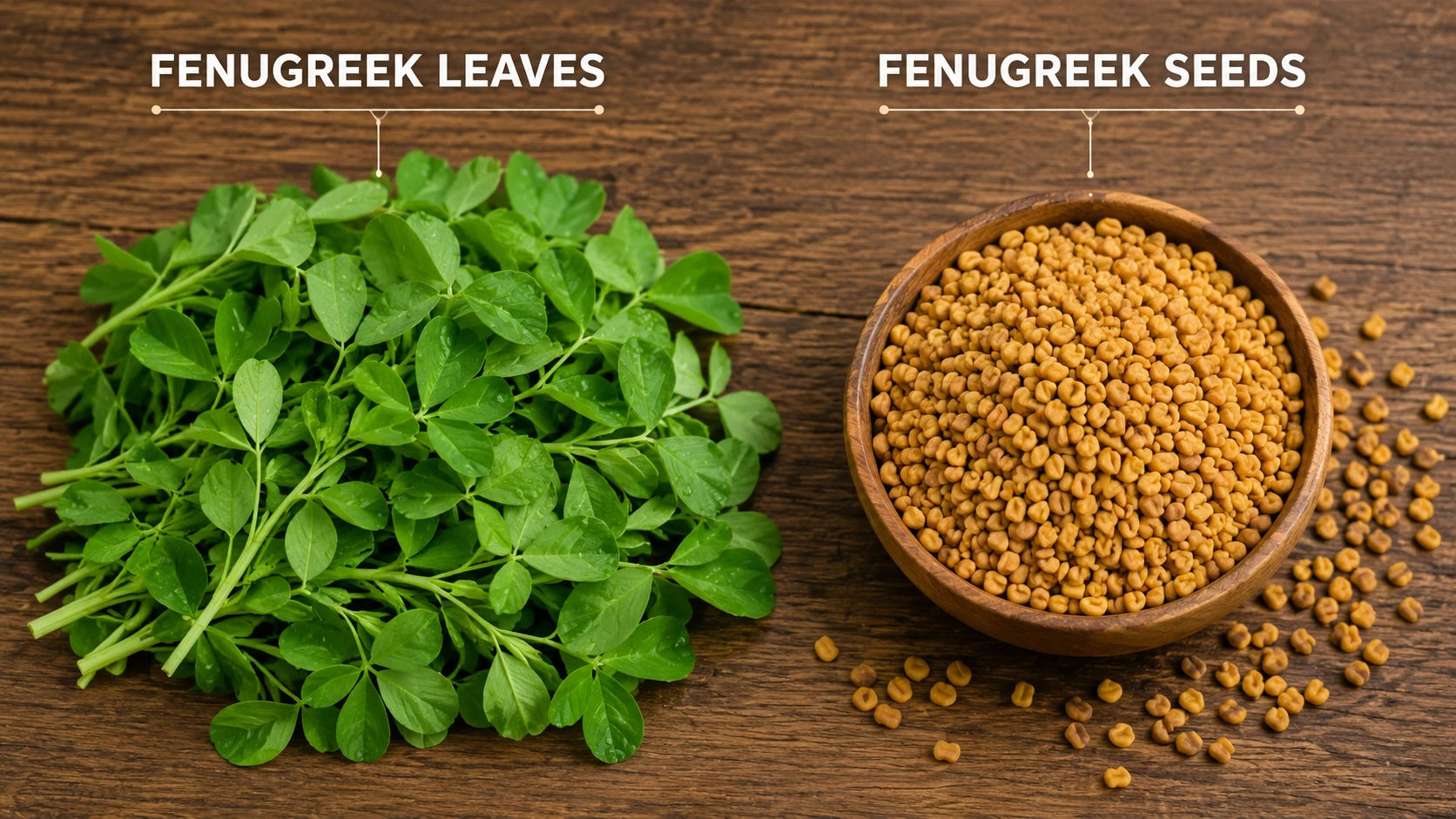
Fenugreek Leaves vs Seeds — 10 Key Differences + When to Use Each
Same plant — completely different ingredients. Which to use in your dish, how to substitute one for the other, and why getting this wrong changes everything.
Leaves (methi) are a herb — milder, green, used mid-to-end of cooking for aroma and bulk. Seeds are a spice — intense, bitter-maple, used at the start of cooking (tadka) or for health preparations. They are not interchangeable in most recipes. Substitution ratio: 1 tsp fenugreek seeds ≈ 3–4 tsp kasuri methi (dried leaves), added at opposite cooking stages.
Are Fenugreek Leaves and Seeds the Same?
No — fenugreek leaves and seeds come from the same plant (Trigonella foenum-graecum) but are completely different ingredients with different flavour profiles, culinary functions, cooking stages, nutritional compositions, and health benefits. Treating them as interchangeable is one of the most common spice mistakes in South Asian and Middle Eastern cooking.
Think of it like this: leaves are the herb (like basil or coriander), seeds are the spice (like mustard seeds or cumin). From the same plant — but used as differently as you would use basil leaves and fennel seeds in Italian cooking.
Understanding the Fenugreek Plant
Fenugreek (Trigonella foenum-graecum) is an annual legume that produces both edible leaves and edible seeds — an unusual plant that functions simultaneously as an herb (leaves) and a spice (seeds). Both parts have been used for thousands of years across South Asia, the Middle East, North Africa, and the Mediterranean — but in entirely different culinary contexts, at different stages of cooking, and for different purposes.
The leaves are harvested young — before the plant matures — and used fresh or dried as a cooking herb. The seeds are harvested when the pods dry and mature, and used as a spice. Because they are collected at different life stages of the plant, their chemical composition, texture, aroma intensity, and culinary role are significantly different.
Both leaves and seeds contain sotolon — the compound responsible for fenugreek’s maple-like aroma. However, seeds contain significantly higher concentrations of sotolon, saponins (especially diosgenin), and alkaloids (trigonelline, choline) — compounds that create intense bitterness and a more powerful aroma. Fresh leaves contain more chlorophyll, Vitamin C, and beta-carotene — which contribute a green, herbal character with milder bitterness. Dried leaves (kasuri methi) fall between the two: more concentrated than fresh but far milder than seeds.
Fenugreek Leaves vs Seeds — Complete At a Glance Table
Every key difference in one reference table — all four forms included| Feature | Fresh Leaves (Methi) | Kasuri Methi (Dried) | Whole Seeds | Ground Seeds (Powder) |
|---|---|---|---|---|
| Type | Herb (fresh) | Herb (dried) | Spice (whole) | Spice (ground) |
| Flavour | Mild bitter, grassy, herbal, slightly sweet | Concentrated, earthy-maple, aromatic | Intensely bitter, maple-nutty when cooked | Bitter, pungent, immediate |
| Bitterness | Low–Mild | Medium | High (raw) → Medium (cooked) | High — can over-bitter if excess |
| Cooking stage | Mid-to-end (last 5–10 min) | Finishing (last 1–2 min) | Start — hot oil (tadka) | Mid — with dry spices |
| Adds bulk/texture | Yes — like spinach | No — flavour only | Slight — small hard seeds | No — dissolves into dish |
| Shelf life | 3–5 days (refrigerated) | 12+ months (sealed) | 2–3 years (sealed) | 3–6 months at full potency |
| Where to buy | Indian/Middle Eastern grocery stores | Most South Asian grocery stores, some supermarkets | South Asian stores, health food stores, online | Spice shops, health stores, online |
| Main use | Paratha dough, sabzi (vegetables), dal, saag | Finishing curries, butter chicken, dal makhani | Tadka, biryani, achar, tea, soaking | Spice blends, marinades, supplements |
| Health use | Vitamins C, K; calcium; folate; antioxidants | Same as fresh (concentrated) | Blood sugar, lactation, iron, digestion | Supplements, precise therapeutic dosing |
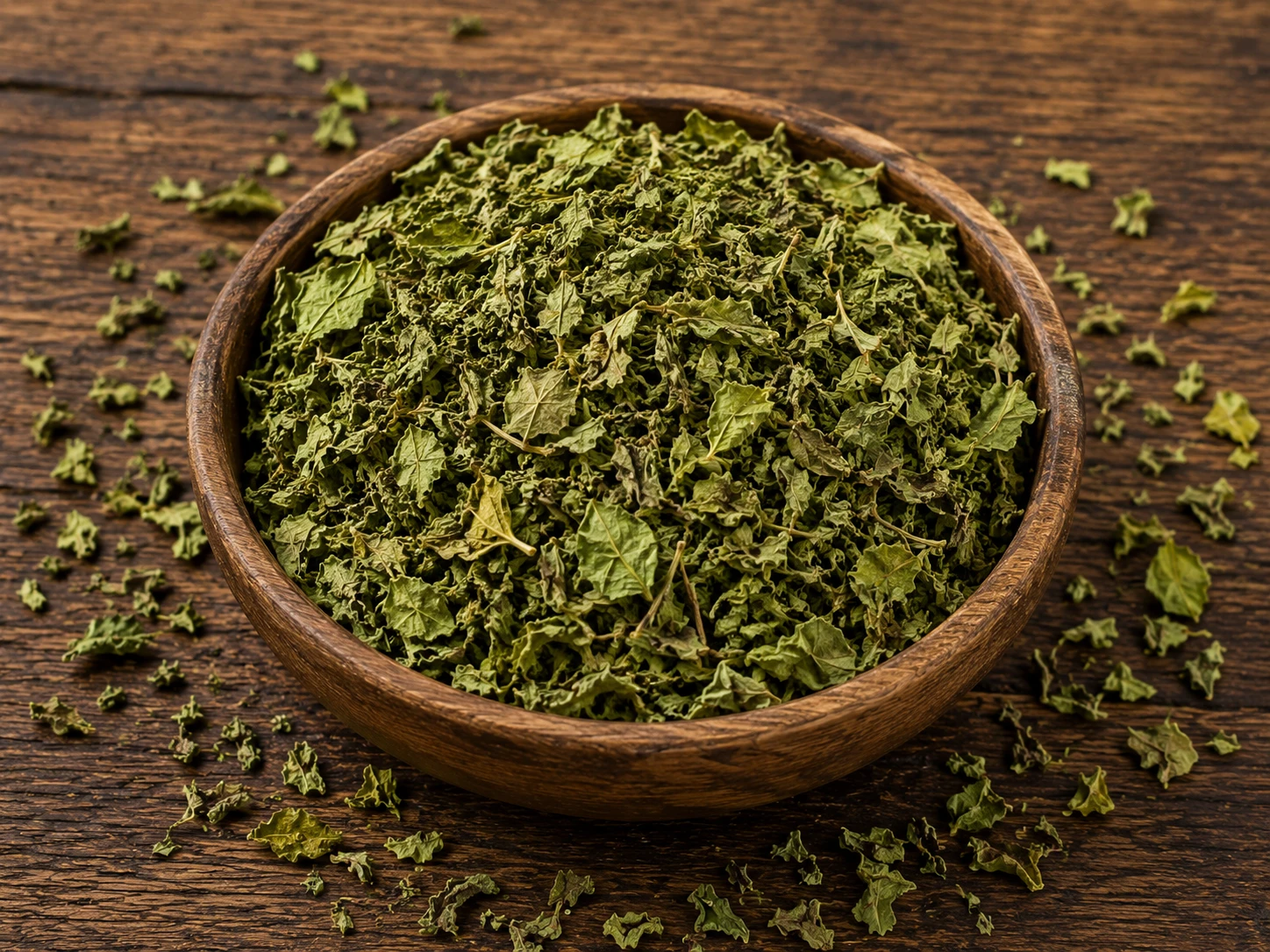
Visual Guide — What Each Form Looks Like
Click any image to view full resolution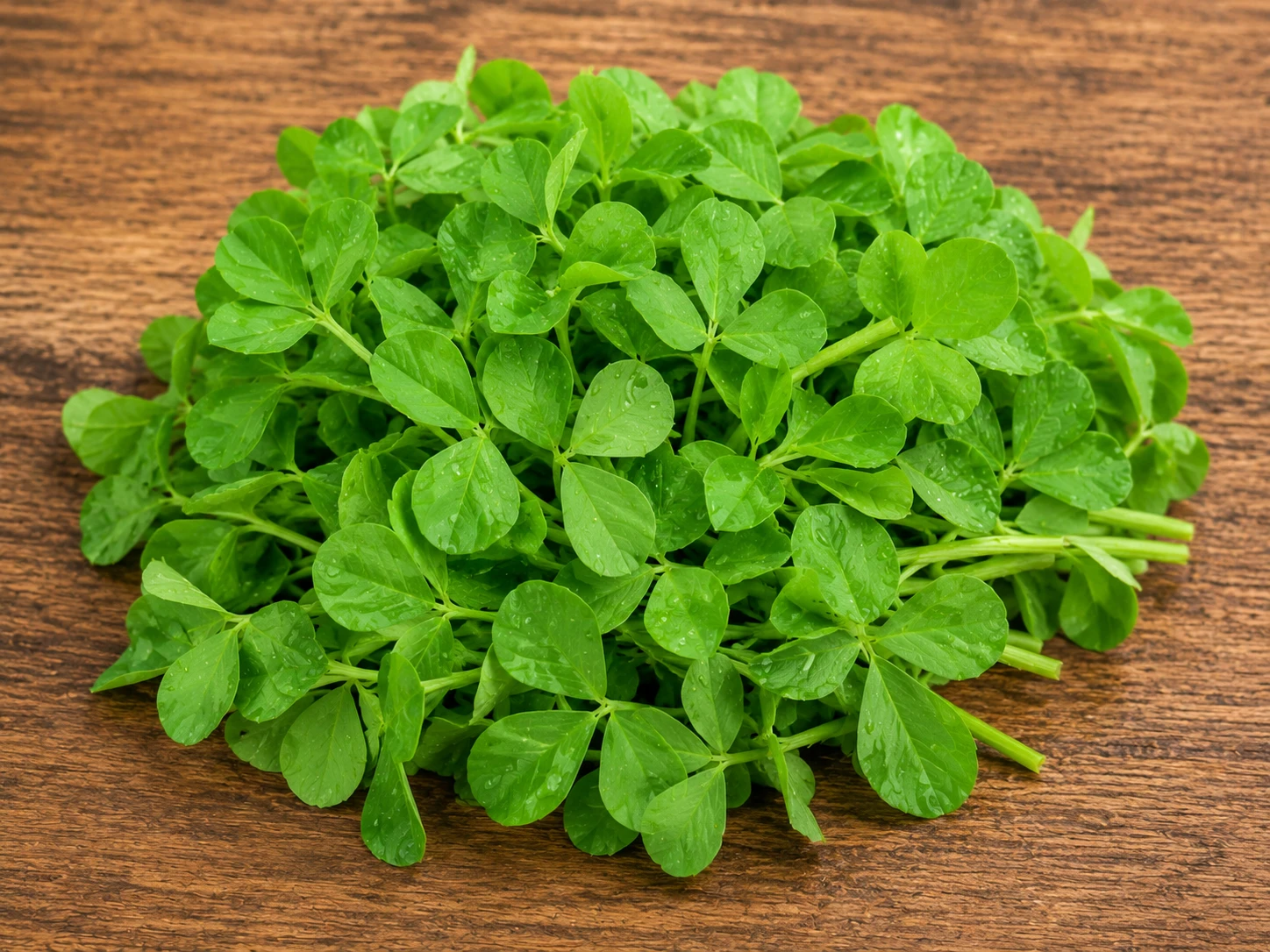
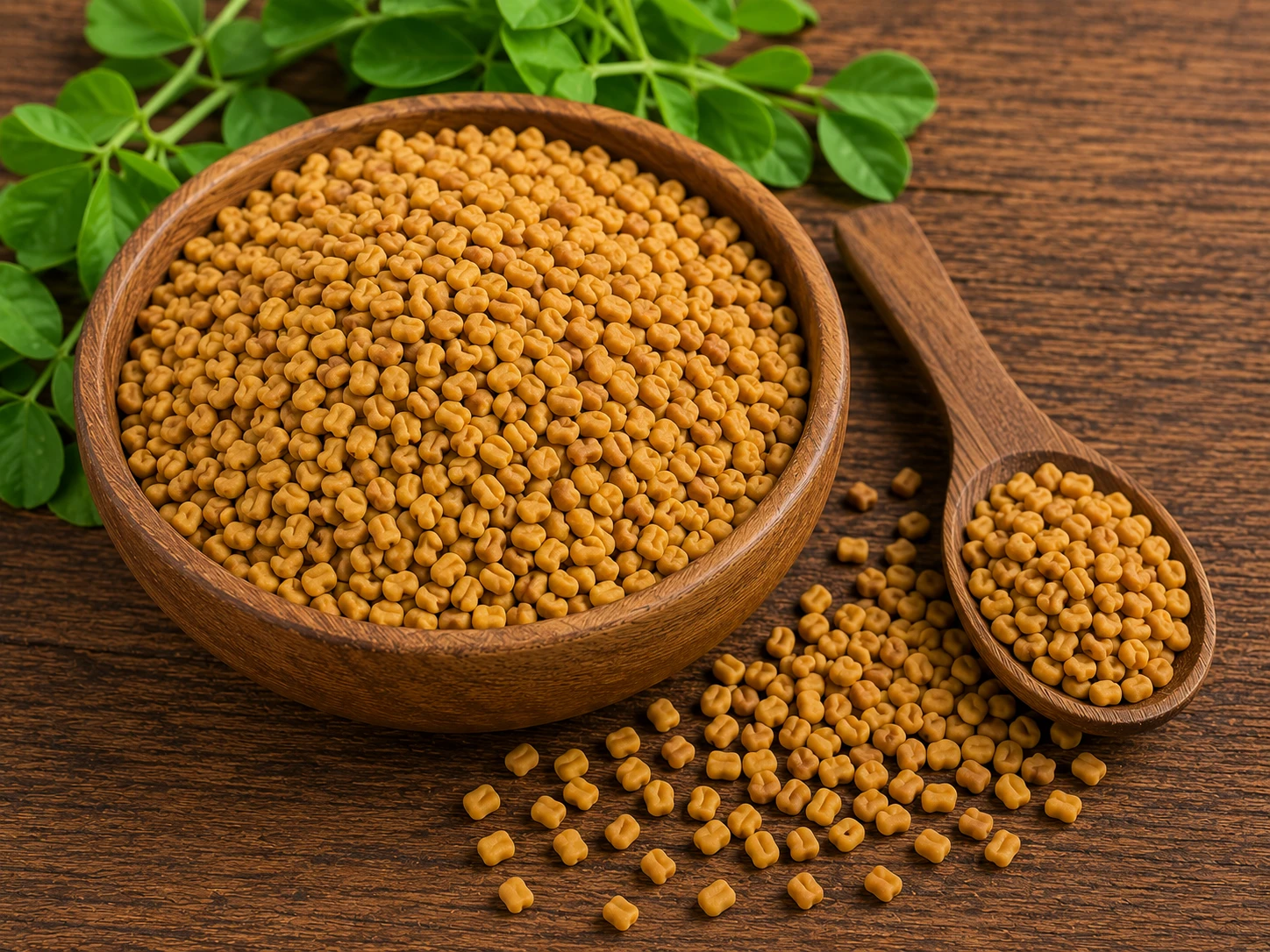
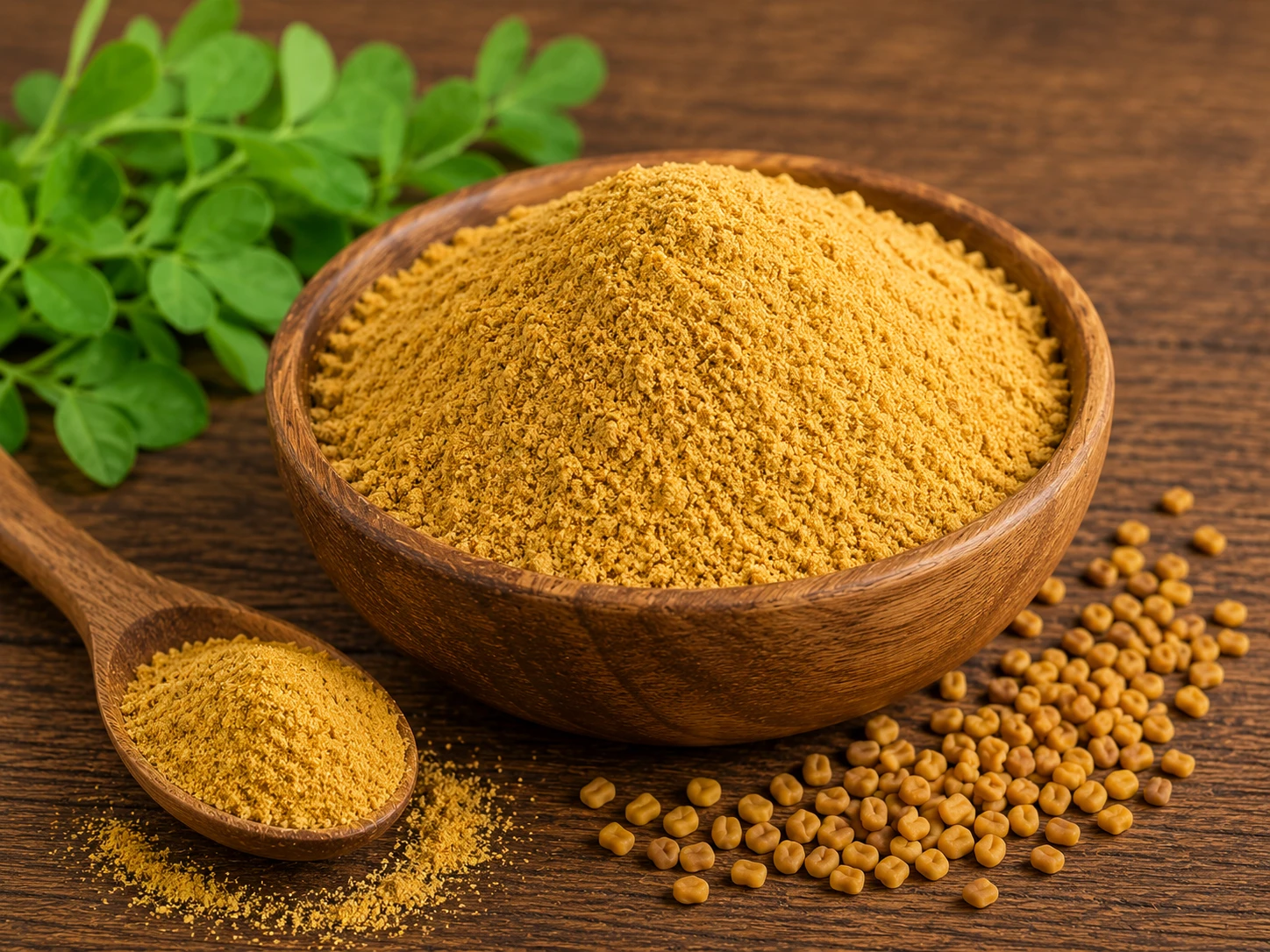
10 Key Differences Between Fenugreek Leaves and Seeds
Detailed breakdown of every meaningful difference — with practical guidance1Plant Part — Leaf vs. Seed
This is the fundamental biological difference. Fenugreek leaves are harvested from the shoots and stems of the young plant — typically when the plant is 20–30cm tall, before it flowers and sets seed. They are trifoliate (three-leaflet clusters, resembling clover), bright green, and tender. Fenugreek seeds are the mature, dried seeds harvested from the seed pods after the plant has completed its lifecycle. The seed is hard, amber-coloured, and roughly cuboid, 2–4mm in size. These two parts are harvested at completely different times and represent different stages of the same plant’s life.
2Flavour Intensity — Mild Herb vs. Intense Spice
This is the most important practical difference. Seeds contain significantly higher concentrations of sotolon (maple aroma), saponins (bitterness), and alkaloids (trigonelline, choline) than leaves. The result:
🌿 Leaves — Flavour Character
- Mildly bitter — pleasant rather than harsh
- Herbal, slightly grassy freshness
- Subtle maple note in background
- Fresh leaves: greener, brighter
- Dried (kasuri methi): more concentrated, earthy-sweet
- Easy to use generously without over-seasoning
🟡 Seeds — Flavour Character
- Intensely bitter raw — almost medicinal
- Nutty-maple when toasted/cooked properly
- Strong sotolon concentration at distance
- Can easily over-bitter a dish if excess
- 1 tsp seeds = significant seasoning
- Require controlled quantities
3Cooking Stage — The Most Critical Difference
Getting this wrong is the main cause of bad fenugreek experiences in cooking:
🌿 Leaves — Add When?
- Fresh leaves: mid-cook (5–10 min before end) — they wilt quickly and release flavour
- Kasuri methi: last 1–2 minutes — crush between palms and sprinkle over finished dish
- Adding too early kills the herbal aroma
- Adding too late (fresh leaves) leaves them raw-tasting
- Never add kasuri methi in the tadka stage
🟡 Seeds — Add When?
- Whole: first — into hot oil at tadka stage
- Dry-roasted: first — before adding to blends or grinding
- Powder: mid-cook — with dry spices after onions
- Never add powder to bare hot oil — it burns instantly
- Seeds need early cooking to mellow bitterness
4Texture and Bulk — Presence vs. Absence
Fresh fenugreek leaves have significant physical presence in a dish — they add volume, green colour, and texture similar to spinach or other cooking greens. In dishes like aloo methi, the leaves are as important for body as they are for flavour. In methi paratha, they are kneaded into the dough.
Seeds add minimal bulk — they are small, and while they remain as discrete seeds unless ground, they do not significantly change a dish’s volume. Ground seeds and kasuri methi both add zero textural bulk — they integrate into dishes invisibly.
5Bitterness Profile — Herbal vs. Assertive
Both forms of fenugreek are bitter, but the nature and intensity of that bitterness differs significantly. Seeds’ bitterness comes from high concentrations of saponins, alkaloids, and tannins — compounds that can make an entire dish aggressively bitter if overused. This bitterness is managed through cooking method: tempering in oil, dry-roasting, and long cooking all reduce it.
Leaves’ bitterness is milder and more herbal — comparable to the slight bitterness of radicchio or endive. It adds complexity without dominating. Kasuri methi sits between the two: more assertive than fresh leaves but far milder than seeds. This is why kasuri methi can be added generously (1–2 tsp per dish) while seeds must be used in small amounts (¼–1 tsp typically).
6Mucilaginous (Slippery) Quality
Fenugreek seeds — particularly when soaked in water — develop a mucilaginous (slippery, gel-like) texture from their high galactomannan content. This soluble fibre is responsible for fenugreek water’s thick texture and is the key compound behind the seeds’ blood sugar benefits. When seeds are cooked in liquid for extended periods, this property can thicken sauces slightly.
Fenugreek leaves have no significant mucilaginous quality. They add no thickening effect to dishes. This is an important textural consideration in dishes where sauce consistency matters.
7Regional Cooking Traditions — Where Each Form Dominates
🌿 Leaves — Prominent In:
- North Indian: aloo methi, methi dal, methi paratha
- Pakistani: methi gosht, methi paratha, saag methi
- Punjabi: all cream-based curries (kasuri methi)
- Mughlai: butter chicken, dal makhani (kasuri methi finishing)
- Egyptian: occasionally as greens in traditional dishes
- Less common in South Indian and Yemeni cooking
🟡 Seeds — Prominent In:
- South Indian: sambar powder, rasam, tadka in all dals
- Bengali: panch phoron (five spice blend)
- Egyptian/Arab: helba tea, hulbeh paste, aish merahrah bread
- Ethiopian: berbere spice blend
- Turkish: çemen paste for pastırma
- All South Asian achar (pickle) recipes
8Availability and Shelf Life
Fresh fenugreek leaves have the shortest shelf life of all forms — 3–5 days refrigerated. They are available at Indian, Pakistani, and Middle Eastern grocery stores but rarely in mainstream supermarkets in Tier 1 countries. They cannot be substituted by growing from seeds at home without a 3-week wait. This limited availability and short shelf life is why kasuri methi and fenugreek seeds are far more commonly stocked in diaspora kitchens.
Kasuri methi lasts 12+ months sealed — easy to keep on hand. Whole seeds last 2–3 years — the most pantry-friendly form. Ground seeds last 3–6 months at full potency before flavour degrades.
9Health Benefits — Different Strengths
While both forms offer health benefits, they excel in different areas due to their different compound concentrations:
🌿 Leaves — Health Strengths:
- Vitamin C — especially fresh leaves (synthesised, then lost in drying)
- Vitamin K — bone health and blood clotting
- Beta-carotene / Vitamin A precursor
- Calcium (fresh leaves: ~395mg/100g)
- Folate — cell division, pregnancy
- Dietary fibre for gut health
- Iron (lower concentration but still meaningful)
🟡 Seeds — Health Strengths:
- Galactomannan fibre — blood sugar regulation
- Iron — 33.5mg/100g (highest in seeds)
- Protein — 23g/100g (much higher than leaves)
- Diosgenin — DHT blocking, hormonal support
- Trigonelline — neuroprotective, blood sugar
- Lactation support (galactagogue)
- Soaking further improves mineral bioavailability
10Interchangeability — When You Can and Cannot Swap
The short answer: they are not reliably interchangeable. The longer answer has nuance by dish type:
- ✅ Can substitute (partial): In slow-cooked dishes where seeds provide background flavour (not tadka), kasuri methi can partially replicate the fenugreek note — added at the end rather than the start. Use 3–4x the volume of kasuri methi for every 1 part seeds called for.
- ✅ Can substitute (limited): Fresh leaves for kasuri methi at 3:1 ratio (3 tbsp fresh = 1 tbsp kasuri methi) — works in curry sauces and dal.
- ❌ Cannot substitute: Leaves of any form for seeds in tadka (tempering). Leaves will burn in hot oil. Seeds cannot provide the green, leafy bulk that fresh methi provides in aloo methi or methi paratha.
The 4 Forms of Fenugreek — Complete Guide
Fresh leaves, kasuri methi, whole seeds, ground powder — each form explainedForm 1: Fresh Fenugreek Leaves (Methi / ہری میتھی)
Fresh fenugreek leaves are the young, green trifoliate leaves harvested before the plant flowers. They resemble clover in shape, are bright green in colour, and have a mild grassy-bitter flavour with a light herbal sweetness. They wilt quickly in heat, releasing their gentle fenugreek aroma into the dish.
How to use: Wash thoroughly (sandy soil clings to leaves). Add to hot dishes in the last 5–10 minutes of cooking. They can also be finely chopped and kneaded into bread dough (methi paratha) or used as a cooking green — like spinach — in sabzi preparations. The stalks are slightly more bitter than the leaves; remove for milder flavour or keep for more intensity.
Where to find: Indian and Pakistani grocery stores, some Middle Eastern stores, and selected Asian supermarkets. Seasonal availability may vary. Rarely found in mainstream Western supermarkets.
Form 2: Kasuri Methi (Dried Fenugreek Leaves / کسوری میتھی)
Kasuri methi is fresh fenugreek leaves dried and crumbled — named after Kasur, a town in Punjab historically known for fenugreek cultivation. The drying process concentrates the flavour approximately 3x compared to fresh leaves, creating an aromatic, earthy-sweet dried herb with considerably less bitterness than the seeds.
How to use: Crush between the palms immediately before adding — this releases the aromatic compounds. Add in the final 1–2 minutes of cooking (after the flame is lowered or the dish is nearly finished). The heat is enough to bloom the aroma without cooking out its delicacy. In butter chicken and dal makhani, kasuri methi is the signature finishing touch that defines the dish.
Where to find: Most Indian grocery stores and increasingly in mainstream supermarkets’ international aisles (UK: Tesco, Waitrose World Food; US: Whole Foods, Indian/South Asian specialty stores).
Form 3: Whole Fenugreek Seeds (Methi Dana / میتھی دانہ)
Whole fenugreek seeds are the most versatile form — they can be tempered in oil, dry-roasted, soaked overnight, sprouted, ground fresh, or infused in oil. Their hard seed coat protects the volatile compounds, giving them exceptional shelf life (2–3 years) compared to all other forms.
How to use: Add to hot oil at the very beginning of a tadka — before onions, garlic, or anything else. Sizzle for 15–30 seconds until nutty-maple aroma emerges and seeds darken slightly. Add next ingredients immediately. For health use, soak overnight in water and eat with the soaking water on an empty stomach in the morning.
Form 4: Fenugreek Powder (Ground Seeds / میتھی پاؤڈر)
Ground fenugreek seed powder is convenient but degrades faster than whole seeds (3–6 months at full potency vs. 2–3 years for seeds). Use in spice blends, marinades, curry pastes, and health drinks where powder integrates more easily than whole seeds. Never add directly to hot oil — it burns instantly.
Best practice: Buy whole seeds and grind small amounts fresh as needed. A spice grinder takes 30 seconds and produces dramatically fresher powder than any jarred product older than 3 months.
Dish-by-Dish Guide — Which Form for Which Recipe
Exact guidance for every major dish that uses fenugreek| Dish | Form Used | When to Add | Amount (4 servings) | Note |
|---|---|---|---|---|
| Butter Chicken | Kasuri Methi | Last 1–2 min | 1–1½ tsp (crushed) | The signature finishing step — do not skip |
| Dal Makhani | Kasuri Methi | Last 2 min | 1 tsp (crushed) | Adds aromatic depth to the cream-butter base |
| Aloo Methi | Fresh Leaves | Mid-cook (with potatoes) | 2–3 cups fresh leaves | Leaves provide bulk — kasuri methi cannot substitute here |
| Methi Paratha | Fresh Leaves (or kasuri methi) | Kneaded into dough | 1 cup fresh / 2 tbsp kasuri | Fresh: texture + flavour. Kasuri: flavour only |
| Methi Dal | Fresh Leaves or Kasuri Methi | Last 5 min (fresh) / last 2 min (kasuri) | 1 cup fresh / 2 tsp kasuri | Both work — fresh gives more body |
| Dal Tadka | Whole Seeds | First — into hot ghee | ¼–½ tsp seeds | Classic South Indian tempering — seeds essential here |
| Biryani | Whole Seeds | First — into hot oil with whole spices | ¼–½ tsp seeds | Part of the whole spice base — gives background depth |
| Garam Masala | Whole seeds (dry-roast then grind) | Dry-roast with other spices before grinding | 1 tsp per batch | Contributes warm base note to the blend |
| Achar (Pickle) | Whole Seeds | Into hot oil with other pickling spices | 1–2 tsp per 500g produce | Traditional — bitter note integrates over pickling period |
| Methi Chicken | Fresh Leaves + Kasuri Methi | Fresh: mid-cook. Kasuri: finish | 1 cup fresh + 1 tsp kasuri | Dual approach gives both body and finishing aroma |
| Fenugreek Tea (Helba) | Whole Seeds | Simmered in water 5–10 min | 1 tsp per 2 cups water | Leaves produce a different, lighter tea |
| Morning Health Drink | Whole Seeds (soaked overnight) | Soaked, eaten on empty stomach | 1 tsp seeds per glass water | Leaves cannot be soaked — seeds only for this use |
| Paneer Dishes | Kasuri Methi | Last 1–2 min | 1–1½ tsp (crushed) | Finishing herb — defines paneer masala character |
| Sambar (South Indian) | Whole Seeds (in sambar powder) | Dry-roasted into the powder | ¼ tsp per serving | Essential component of sambar powder’s complex base |
Substitution Ratios — Leaves for Seeds & Seeds for Leaves
Exact quantities when you need to substitute one form for the other| If Recipe Calls For | Best Substitute | Amount to Use | Cooking Stage Change | Result Quality |
|---|---|---|---|---|
| 1 tsp whole seeds (tadka) | Celery seeds (best), or mustard seeds | 1 tsp celery seeds | None — add at same tadka stage | Good — closest structural match |
| 1 tsp whole seeds (flavour) | Kasuri methi | 3–4 tsp kasuri methi | Major — add at end, not start | Moderate — different stage, similar flavour |
| 1 tsp kasuri methi (finishing) | Fresh fenugreek leaves (chopped) | 1 tbsp fresh leaves | Minimal — add 2–3 min earlier | Good — same plant, slightly different character |
| 1 tsp kasuri methi (finishing) | Fenugreek powder | ¼ tsp powder | Major — add earlier with dry spices | Moderate — more bitter, less aromatic |
| 1 cup fresh fenugreek leaves | Mustard greens | 1 cup mustard greens | None — add at same time | Good for bulk — different flavour |
| 1 cup fresh fenugreek leaves | Kasuri methi + watercress | 1 tbsp kasuri + ¾ cup watercress | Add kasuri at end, watercress mid-cook | Good — covers both flavour and bulk |
| 1 tsp fenugreek powder | Ground celery seeds | 1 tsp | None — add at same stage | Good — closest non-fenugreek substitute |
Nutrition & Health Comparison — Leaves vs Seeds
Which is more nutritious, and for which health goals?| Nutrient / Benefit | Fresh Leaves (per 100g) | Seeds (per 100g) | Winner |
|---|---|---|---|
| Calories | 49 kcal | 323 kcal | Leaves (lower calorie) |
| Protein | 4.4g | 23g | Seeds ✓ |
| Fibre | 3.7g | 24.6g | Seeds ✓ |
| Iron | 1.9mg | 33.5mg | Seeds ✓ (17x more) |
| Calcium | 395mg | 176mg | Leaves ✓ (2x more) |
| Vitamin C | 52mg | 3mg | Leaves ✓ (17x more) |
| Vitamin K | High | Negligible | Leaves ✓ |
| Beta-carotene | High (green leaves) | Low | Leaves ✓ |
| Folate | 57mcg | 57mcg | Equal |
| Galactomannan (blood sugar) | Trace | High | Seeds ✓ |
| Diosgenin (DHT, hormones) | Low | High | Seeds ✓ |
| Trigonelline (neuroprotective) | Low | High | Seeds ✓ |
| Blood sugar support | Moderate (fibre) | Strong (galactomannan) | Seeds ✓ |
| Hair growth (topical) | Good (paste) | Best (more diosgenin) | Seeds ✓ |
| Bone health | Good (calcium, Vit K) | Moderate | Leaves ✓ |
| Antioxidants | High (chlorophyll, carotenes) | Good (flavonoids) | Leaves ✓ |
Fenugreek Leaves vs Seeds — 10 FAQs Answered
Featured snippet-optimised answers to the most searched questionsNo. Fenugreek leaves and seeds come from the same plant (Trigonella foenum-graecum) but are completely different ingredients. Leaves are the herb — harvested young, green, mild in bitterness, used mid-to-end of cooking. Seeds are the spice — mature, hard, intensely bitter-maple, used at the start of cooking (tadka) or for health preparations. They have different flavour profiles, different cooking stages, different nutritional compositions, and cannot be used interchangeably in most dishes.
In some dishes, yes — but not all. Fenugreek leaves (especially kasuri methi) can replace seeds in slow-cooked dishes where seeds provide background flavour, but the cooking stage must change — leaves go in at the end, not the beginning. In tadka (tempering), leaves cannot replace seeds as they will burn in hot oil. Ratio: 3–4 teaspoons of kasuri methi approximately equals 1 teaspoon of fenugreek seeds in flavour intensity, though the character will differ.
Fresh methi (fresh fenugreek leaves) and kasuri methi (dried fenugreek leaves) are the same plant part at different moisture levels. Fresh leaves are green, moist, and mild — used mid-cook or kneaded into bread, adding both flavour and bulk. Kasuri methi is dried and concentrated (approximately 3x more intense than fresh), dark olive green, used as a finishing herb crushed over dishes in the last 1–2 minutes of cooking. Use 3 tablespoons of fresh leaves for every 1 tablespoon of kasuri methi called for.
Fenugreek seeds are significantly better for hair than leaves. Seeds contain much higher concentrations of diosgenin (a 5-alpha reductase inhibitor that blocks DHT), nicotinic acid (improves scalp circulation), protein (keratin building), and iron. For hair masks and infused oils, always use seeds — soaked overnight and blended into paste, or cold-infused in carrier oil. Leaves can be used topically but provide far fewer of the hair-specific active compounds than seeds.
No — kasuri methi cannot be used in the tadka (tempering) stage. Adding dried fenugreek leaves to hot oil at the beginning of cooking will burn them almost instantly, producing a bitter, harsh flavour. Only whole fenugreek seeds can withstand the tadka stage. If you only have kasuri methi and need to replace seeds, add the kasuri methi later in cooking — with the onions or as a finishing herb — and use celery seeds or mustard seeds as the tempering spice instead.
Both are nutritious but in different ways. Seeds are better for blood sugar (galactomannan fibre), iron (33.5mg/100g vs. 1.9mg in leaves), protein (23g vs. 4.4g), lactation support (diosgenin), and hormonal health. Fresh leaves are better for Vitamin C (52mg vs. 3mg in seeds), calcium (395mg vs. 176mg), Vitamin K, beta-carotene, and antioxidants. The ideal is to eat both regularly — they are nutritionally complementary rather than competing.
Butter chicken uses kasuri methi specifically because it is a finishing herb that adds aromatic complexity at the end of cooking without bitterness. Fenugreek seeds added early in butter chicken’s creamy tomato sauce would create bitterness that overpowers the dish’s signature mild-rich character. Kasuri methi, added in the final 1–2 minutes, provides the characteristic earthy-sweet aromatic note that defines butter chicken without altering its flavour base. The choice of leaf over seed is deliberate and recipe-critical.
Fenugreek leaves are bitter but significantly milder than the seeds. Fresh leaves have a pleasant mild bitterness similar to endive or radicchio — it adds flavour complexity without being harsh. Kasuri methi (dried leaves) is slightly more concentrated but still far milder than seeds. Fenugreek seeds are intensely bitter raw — almost medicinal — due to much higher concentrations of saponins and alkaloids. This bitterness in seeds only mellows when they are cooked in oil, dry-roasted, or soaked overnight.
Yes — fenugreek is one of the easiest herbs to grow at home. Sow fenugreek seeds (standard culinary seeds work fine) in a pot or directly in soil. Germination takes 3–5 days. Harvest leaves by cutting the stems when plants are 15–20cm tall, after approximately 3 weeks. The plant will regrow several times if you leave some stem. It grows well indoors in a sunny spot or outdoors in spring and summer. One bag of fenugreek seeds can supply months of fresh leaves.
Methi dana (میتھی دانہ) in English is fenugreek seeds. “Methi” is the Urdu and Hindi word for fenugreek (both the plant and the leaves), while “dana” means seeds or grains. So methi dana specifically refers to the fenugreek seeds — the small, hard, amber-coloured seeds used as a spice. The leaves alone are called just “methi” or “methi patta” (leaves of methi). Kasuri methi specifically refers to dried fenugreek leaves.
About the Author & Reviewer
Botanical science + culinary expertiseEmily Rhodes is a culinary writer specialising in South Asian spices. She has spent years testing elaichi conversion ratios across different origins and grades to produce the precision data used in this guide.
Dr. Bennett holds a doctorate in Botanical Sciences specialising in Zingiberaceae. He verified all volatile oil data and conversion ratios against IISR benchmarks and peer-reviewed literature on Elettaria cardamomum oleoresin composition..
Complete Fenugreek Series — CardamomNectar
Every aspect of fenugreek covered in depthFenugreek Substitute Guide
Best replacements with exact ratios
Fenugreek Powder vs Seeds
9 differences + conversion ratios
How to Use Fenugreek Seeds
12 complete methods
Fenugreek for Hair Growth
Science, benefits, 6 DIY recipes
Fenugreek Water Benefits
Daily health drink guide
Fenugreek & Maple Syrup
The sotolon science explained