One pod, five ways to know it. Cardamom, start to finish.
From the seedling to the store shelf — Elettaria cardamomum and Amomum subulatum, explained in five focused guides.


Cardamom is the seed pod of two unrelated ginger-family plants: green cardamom, sweet and floral, for tea and desserts; and black cardamom, smoky and earthy, for savory cooking only. It’s the third most expensive spice by weight, native to Kerala, and now farmed from Guatemala to Tanzania.
Two spices wearing one name
Cardamom comes from two unrelated plants in the ginger family, Zingiberaceae. What most people picture — the small green pod in a cup of chai — is Elettaria cardamomum, native to the moist forests of Kerala’s Western Ghats and traded for over 4,000 years.
Black cardamom (Amomum subulatum) is a different plant entirely — larger, smoky, savory-only. Treating the two as interchangeable is the single most common cardamom mistake in a home kitchen.
Both belong to Zingiberaceae, the ginger family — which is why cardamom shares flavour compounds with ginger, turmeric, and galangal, its closest cousins on the spice rack. That shared chemistry (1,8-cineole, terpineol) is part of why cardamom pairs so naturally with ginger in chai, and why galangal is often cited as its nearest botanical relative outside the genus.
Today it’s grown commercially from Guatemala — now the world’s largest exporter — to India, Sri Lanka, and Tanzania. This page is the map; the five guides ahead hold the depth.

The black cardamom plant
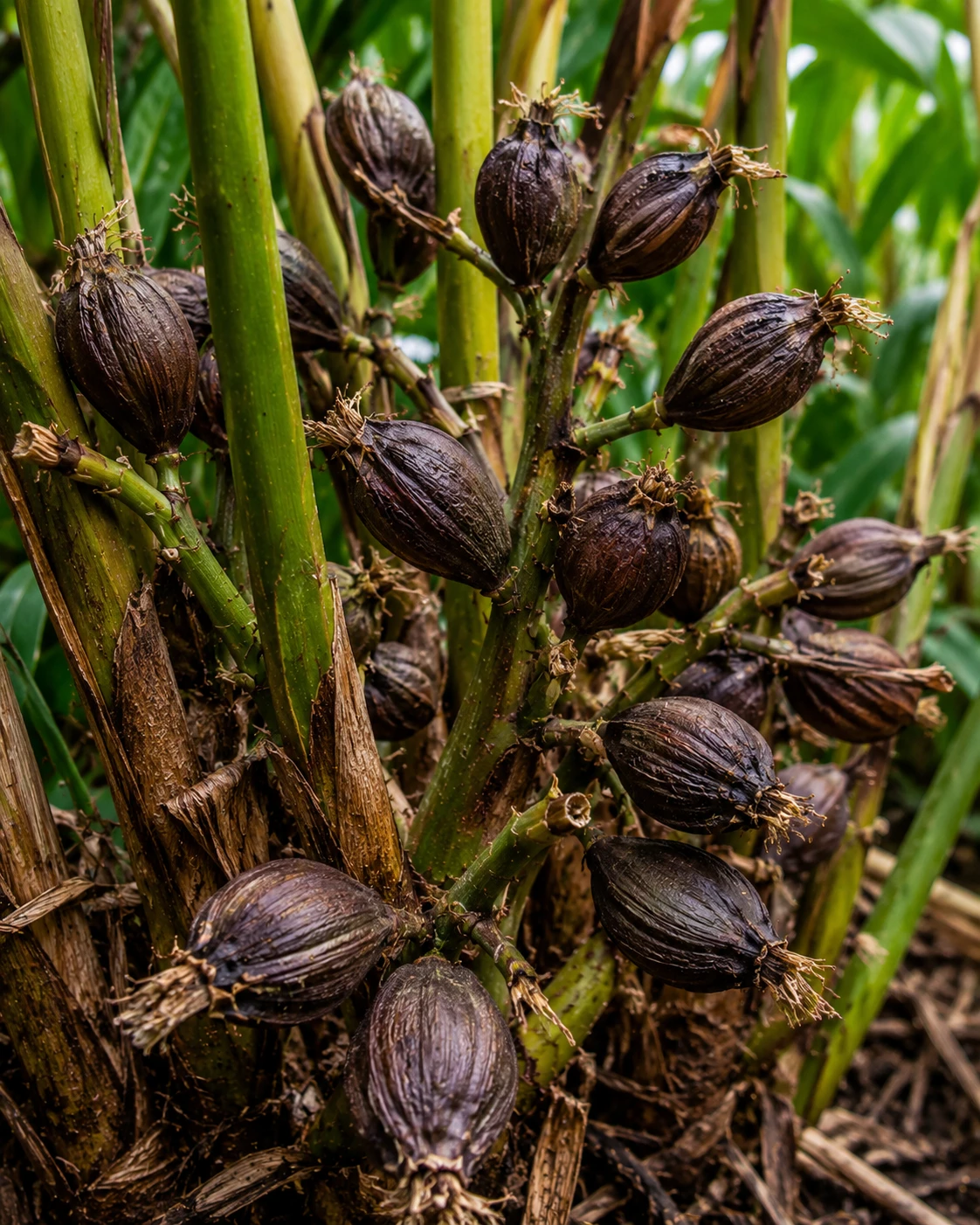
Black cardamom (Amomum subulatum) grows wild and cultivated across the eastern Himalayan foothills — Sikkim, Nepal, and parts of southern China — in cooler, higher-altitude conditions than green cardamom prefers.
Its pods are three to four times larger than green cardamom, with a coarse, dark brown, ridged husk. After harvest, pods are traditionally dried over open wood fires for days — this slow smoking is what builds the deep, resinous, camphor-forward aroma that defines badi elaichi, and it’s a step green cardamom never goes through.
Because the two plants are unrelated in genus, they don’t share a growing region, a harvest method, or a flavour chemistry — which is exactly why substituting one for the other in a recipe changes the dish far more than most cooks expect.
| 🟢 Green Cardamom | ⬛ Black Cardamom | |
|---|---|---|
| Botanical name | Elettaria cardamomum | Amomum subulatum |
| Flavour | Sweet, floral, citrusy | Smoky, earthy, camphor-like |
| Best for | Tea, desserts, baking, coffee | Biryani, curries, garam masala only |
| Pod size | Small, pale green | Large, coarse, dark brown |
| Also called | Elaichi, hel, true cardamom | Badi elaichi, hil kalan |
| Relative price | Higher — the one sold as “cardamom” | Lower per pod, sold separately |
Full substitution ratios and prep tips are in the Cooking guide.
The Cardamom Journey
Every guide on this page is a stop on the same journey — here’s how they connect, in order.
Planted
A rhizome or seed goes into shaded, humid soil — the start of the Growing guide.
Identified
Two to three years later, pods form — this is where the Basics guide picks up.
Hand-Picked
Pods are harvested individually, several times a season, by ripeness alone.
Graded & Sold
Pods are sorted by size and colour, then traded — see live rates in Price Today.
Cooked
The pod finally reaches a kitchen — chai, biryani, or dessert. Full detail in Cooking.
Common Cardamom Myths
Fact: they’re different plant species — Elettaria cardamomum and Amomum subulatum — with unrelated flavour profiles. Swapping one for the other changes a dish completely.
Fact: whole pods infuse gradually and are meant to be removed before serving; ground cardamom disperses instantly and stays in the dish. The two aren’t drop-in substitutes for each other in every recipe.
Fact: India is cardamom’s native home, but Guatemala has been the world’s largest exporter by volume for decades, with Sri Lanka and Tanzania also producing commercially.
Fact: cardamom is graded by pod size, colour, and moisture content — grading is a major factor behind the wide price range you’ll see across brands and markets.
Quick Glossary
A handful of words that come up across every guide on this page.
- Elaichi
- The Hindi/Urdu word for cardamom, used across South Asia.
- Husk
- The outer papery shell of the pod that holds the seeds inside.
- Oleoresin
- The aromatic oil-and-resin blend inside the seeds that gives cardamom its scent.
- 1,8-Cineole
- The dominant aroma compound in cardamom, also found in eucalyptus and ginger.
- Rhizome
- An underground stem used to propagate new cardamom plants without seed.
- Zingiberaceae
- The ginger plant family cardamom belongs to, alongside turmeric and galangal.
- Grading
- Sorting harvested pods by size and colour, which directly affects market price.
- Garam Masala
- A North Indian spice blend where cardamom is almost always a core ingredient.
Nutrition at a Glance
Cardamom is used in small pinches, not spoonfuls — so treat these as reference figures, not a meal plan. Full breakdown with vitamins and minerals in the Basics guide.
| Nutrient | Amount |
|---|---|
| Calories | 311 kcal |
| Dietary fibre | 28g |
| Manganese | 28mg (very high) |
| Iron | 14mg |
| Magnesium | 229mg |
What to Look for When Buying Cardamom
Four things separate a good batch from a stale one — check these before you pay.
- Colour: plump, pale to medium green pods — bleached-white or brown-spotted pods are old or sun-damaged.
- Seal: buy from an airtight, opaque container — cardamom’s oils evaporate fast under light and air.
- Whole over ground: ground cardamom loses aroma within weeks; whole pods keep it for a year or more.
- Weight test: good pods feel heavy and slightly springy, not papery or hollow when squeezed.
Quick Conversions
The measurements that come up most often mid-recipe.
| If a recipe calls for… | Use |
|---|---|
| 1 whole pod | ≈ 15–20 seeds inside |
| 1 tsp ground cardamom | ≈ 10–12 whole pods, seeds only, ground |
| 1 pod, crushed | ≈ 1/8 tsp ground |
| Green cardamom in a savoury dish | Use whole, remove pods before serving |
Dish-specific ratios and substitute amounts are in the Cooking guide.
Cardamom Around the World
One spice, radically different roles depending on where you are.
🇮🇳 South Asia
The everyday spice of chai and garam masala — green cardamom is used almost daily in Indian, Pakistani, and Bangladeshi kitchens.
🇸🇦 Middle East
Ground into Arabic coffee (qahwa) as a defining flavour, and used whole in slow-cooked rice and meat dishes.
🇹🇷 Turkey
One of the world’s top cardamom importers per capita — almost entirely for flavouring Turkish coffee alongside the grounds.
🇸🇪 Scandinavia
A baking spice first — cardamom buns (kardemummabullar) are a Swedish and Finnish staple, arriving via old Viking trade routes.
🇬🇹 Guatemala
Not a traditional user of the spice at all — yet it’s the world’s largest grower and exporter, almost entirely for the export market.
🇪🇹 Ethiopia
A core ingredient in berbere spice blend, giving many Ethiopian stews their characteristic warmth.
🇬🇧 UK & Europe
Increasingly common in specialty coffee shops and craft cocktail bars, often via black cardamom syrups and bitters.
Cardamom vs Other Spices
Where cardamom typically sits in the global price hierarchy — for live current rates, see the Price Today guide.
Illustrative ranking based on typical global retail price bands, not live figures — those are on the Price Today guide.
Which Guide Answers This?
If you already know your exact question, this table sends you straight there.
| If you’re asking… | Go to |
|---|---|
| “My cardamom plant isn’t flowering” | Growing Cardamom → |
| “What can I use instead of cardamom?” | Cooking with Cardamom → |
| “Is green cardamom the same as black?” | What Is Cardamom → |
| “Can I have cardamom while pregnant?” | Health Benefits → |
| “Why did cardamom prices jump this year?” | Price Today → |
| “How do I store pods so they stay fresh?” | Cooking with Cardamom → |
| “Where does cardamom actually grow?” | What Is Cardamom → |
Pick your path in
Every row below previews one guide. The tags name what’s inside — the full how-to lives behind the button.
 Growing
Growing Cardamom
From a single seed or rhizome to a full harvest — regional climate notes, indoor growing, plant care, and the pests that actually matter.
Open the Growing Guide →✓ Reviewed by Dr. Michael Bennett — July 2026
 Cooking
Cooking with Cardamom
The widest guide in the library — substitutes, prepping whole pods, green-versus-black by dish, tea, and a full recipe collection.
Open the Cooking Guide →✓ Recipes tested by Emily Rhodes — updated July 2026
 The Basics
What Is Cardamom?
The plant itself, from the ground up — species and origins, the powder, the essential oil, and the 4,000-year trade history behind it.
Open the Basics Guide →✓ Botanically verified by Dr. Michael Bennett — July 2026
 Health
Health Benefits
What the clinical evidence actually supports, what’s still just tradition, and the specific situations where caution is warranted.
Open the Health Guide →✓ Medically reviewed by Dr. Michael Bennett — July 2026
 Market
Price Today
Live rates across the regions that move the market most, plus the demand and supply trends explaining why.
Check Today’s Price →✓ Rates verified July 19, 2026 — updated regularly
Before you dive in
Cardamom is a spice made from the seed pods of two unrelated ginger-family plants. Green cardamom (Elettaria cardamomum) is sweet and floral; black cardamom (Amomum subulatum) is smoky and earthy. See the Basics guide for the full botany.
Green is smaller, sweeter, and floral — tea, desserts, baking. Black is larger, smoky, and camphor-like — savory dishes only. See the comparison inside the Cooking guide.
Native to the Western Ghats of Kerala, South India. Also grown commercially in Guatemala, Sri Lanka, and Tanzania.
Pods are hand-picked individually at the right ripeness, several times a season — making it the third most expensive spice by weight. See live rates on the Price guide.
Yes — USDA zones 10-12 outdoors, or indoors in a warm, humid, low-light spot anywhere. Full methods in the Growing guide.
Culinary amounts are generally considered safe; concentrated supplements should be discussed with a doctor first. See the Health guide.
Cinnamon plus nutmeg for green cardamom; cloves with smoked paprika for black, in savory dishes. Full ratios in the Cooking guide.
KAR-duh-mum, in most English dialects. It’s also widely known as elaichi in Hindi and Urdu, and hel or hal in Arabic.
Yes — “cardamon” is simply a common misspelling of cardamom. Both refer to the same spice.
Green cardamom is sweet, floral, and slightly citrusy with a cooling menthol note. Black cardamom is smoky, resinous, and camphor-like with almost no sweetness.
Both, depending on the type. Green cardamom suits sweet dishes and some savory ones; black cardamom is used almost exclusively in savory cooking.
Trace amounts aren’t considered toxic to dogs or cats, but it isn’t recommended as a regular addition to pet food, and concentrated forms like essential oil should be kept away from animals entirely.
Ginger and galangal — all three belong to the Zingiberaceae family and share overlapping aromatic compounds like 1,8-cineole.
Whole pods keep their aroma for about a year in an airtight container away from light and heat. Ground cardamom fades much faster — plan to use it within 2-3 months, or grind pods fresh as you cook. More detail in the Cooking guide.
Was this guide helpful?
Rate this guide
Leave a note
Saved on this device only — not published or visible to other visitors.
Emily Rhodes
Culinary writer specialising in South Asian spices — built this guide’s structure from years of reader questions about where to start with cardamom.
View profile →Dr. Michael Bennett, Ph.D.
Botanical scientist specialising in Zingiberaceae — verified every botanical claim on this page against IISR benchmarks.
View profile →How this guide is verified: every botanical and health claim on this page is checked against IISR (Indian Institute of Spices Research) benchmarks and peer-reviewed literature before publication, and re-reviewed whenever the linked guides are updated. Market figures are cross-checked against Spice Board India data.
Exploring other spices? Take a look at our Fennel Seeds guide next.
Sources: IISR (Indian Institute of Spices Research), Kozhikode · Ravindran & Madhusoodanan (2002), Cardamom: The Genus Elettaria, CRC Press · Kew Gardens POWO · Spice Board India.