Cardamom Plant (Elaichi) — Morphology, Origin, Uses & Life Cycle
A deep dive into the cardamom plant — its anatomy, where it comes from, how every part is used, its unique adaptations, and how to identify it.
Elettaria cardamomum is a perennial tropical herb in the ginger family, native to the Western Ghats of Kerala, India. It grows 6–15 ft tall from a spreading rhizome, produces white-purple flowers at ground level, and bears the aromatic green seed pods used worldwide as a spice. It lives 10–15 years and is also called elaichi (الائچی).
A Tall Herb With a Secret at Its Feet
Cardamom’s most surprising botanical trait is spatial: the plant looks like a tall, leafy tropical shrub — up to 15 feet — but its flowers and fruit never appear anywhere near that impressive foliage. They emerge separately, at ground level, on low creeping stems from the rhizome. This guide covers every part of the plant in detail: what it looks like, where it grows, why it’s built the way it is, and how to identify it with confidence.
“People are often surprised the pods don’t grow up on the tall stems. Once you know to look down, at the base of the clump, identifying a fruiting cardamom plant becomes instant.”
Dr. Michael Bennett — Botanist, CardamomNectarPlant Overview & Botanical Classification
Quick facts, scientific classification, and what makes this plant unique| ⚡ Cardamom Plant — Quick Facts | |
|---|---|
| Scientific name | Elettaria cardamomum Maton |
| Plant habit | Clumping perennial herb; pseudostems non-woody |
| Height | Typically 1.8–4.5 m (6–15 ft); varies with habitat |
| Leaf shape | Lanceolate, 40–60 cm long; pinnate venation; glossy adaxial surface |
| Flower color | White/pale cream petals + violet-purple streaked labellum (orchid-like) |
| Flower location | Ground level on prostrate panicles — separate from leafy pseudostems |
| Fruit type | Trigonal capsule (3-sided), green, 1–2 cm long |
| Seeds per capsule | 15–20 dark brown aromatic seeds (5–7 per locule × 3 locules) |
| Key aroma compounds | 1,8-Cineole (25–45%) + α-Terpinyl acetate (20–36%) |
| Native region | Western Ghats, southern India + Sri Lanka |
| Plant lifespan | 10–15 years; peak production years 4–8 |
| Family | Zingiberaceae (same as ginger, turmeric, galangal) |
Cardamom Plant at a Glance: The cardamom plant (Elettaria cardamomum Maton) is a herbaceous perennial in the order Zingiberales, family Zingiberaceae — the same family as ginger, turmeric, and galangal. It is the sole species in the genus Elettaria, native to the moist tropical rainforests of the Western Ghats of southern India and Sri Lanka. Its dried seed pods constitute one of the most expensive spices in the world, surpassed in price only by saffron and vanilla.
The plant is colloquially called the “Queen of Spices” — a title that reflects not just its price, but its extraordinary aromatic complexity. Its flavor profile is simultaneously sweet, spicy, floral, and citrus-like, driven by volatile compounds including 1,8-cineole (eucalyptol), terpinyl acetate, limonene, and linalool.
Plant height is typically reported as 1.8–4.5 m (6–15 ft), though this reflects considerable environmental variation. In native Western Ghats forests under optimal canopy shade and humidity, mature plants frequently exceed 3 m. In drier, more exposed conditions — or when grown in containers — the same species may reach only 1.5–2 m. Height is a function of habitat, not a fixed species characteristic.
Is Cardamom a Tree or a Plant? — The Clear Answer
A tree has a permanent woody trunk that persists for years. Cardamom has pseudostems — non-woody, soft structures made of rolled leaf sheaths. They die back after 2–3 years and are replaced. No true woody trunk ever forms.
Botanically, it is a clumping perennial herb — tall (up to 4.5 m) but entirely herbaceous. It belongs to the same family as ginger and turmeric, both also herbs, not trees. Its impressive height often misleads people into calling it a “tree.”
💡 Why people search “cardamom tree”: The plant’s height of up to 15 feet — taller than many ornamental trees — naturally leads people to assume it must be a tree. In commercial plantations in Kerala and Guatemala, dense rows of mature cardamom can look remarkably tree-like from a distance. But up close, there is no woody trunk — only soft, herbaceous pseudostems.
Elettaria cardamomum — small trigonal green capsules, sweet floral aroma. Native to Western Ghats, India.
Amomum subulatum — large ribbed dark pods, smoky camphor aroma. Native to Eastern Himalayas. Not the same plant.
Botanical Morphology — Precise Plant Anatomy
Every structural part explained — key to accurate identification📌 Key facts, quick scan: Stem = pseudostem, not true wood · Height 1.8–4.5 m · Leaves lanceolate, 40–60 cm, pinnate veins · Root = sympodial rhizome, not the spice · Clump spread 1.2–1.8 m wide · Architecture: 3 tiers (roots / ground pods / tall leaves)
Understanding cardamom’s morphology at a technical level is key to accurate plant identification, meaningful comparison with related species, and appreciating the biological architecture behind this remarkable spice plant.

Full plant — tall pseudostems with alternate lanceolate leaves
Alt: “Close-up of cardamom plant leaf showing glossy dark green surface and pinnate venation”
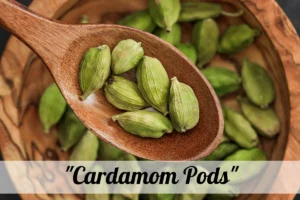
Trigonal capsules on prostrate ground-level panicle stems
Root System & Rhizome
vs. Ginger: Ginger rhizomes are thicker (3–5 cm), more irregularly branched, tan-beige coloured. Unlike ginger — cardamom rhizomes are not the spice; the pods are.
Pseudostem — False Stem
Critical: Pseudostems bear only foliage leaves. Flowers and pods emerge separately from the rhizome at ground level — never from the pseudostems.
Leaves — Shape, Venation & Texture
Venation: Pinnate — 1 midrib + 20–30 pairs of secondary veins at 45–60°.
Surfaces: Upper glossy dark green; lower paler with fine silky hairs.
Fragrance test: Crush a fragment — spicy-sweet scent confirms identity.
Growth Habit & 3-Tier Architecture
Three tiers:
① Subterranean — rhizome + roots
② Ground tier — prostrate flower/pod panicles (0–30 cm)
③ Aerial tier — tall pseudostems with foliage (up to 4.5 m)
This spatial separation of reproductive organs from vegetative organs is botanically distinctive.
Labeled Botanical Diagram
Key structural parts labeled for identification referenceThe diagram below shows the key structural parts of the cardamom plant with labels — a useful reference for identification and understanding how the plant is organized.
🌿 Cardamom Plant — Anatomical Structure
Flowers and pods grow at ground level on separate panicle stems from the rhizome, not on the tall pseudostems.
Cardamom vs. Related Zingiberaceae Species — Visual Comparison
Cardamom is often confused with ginger and turmeric because all three belong to the Zingiberaceae family. This chart clarifies the key morphological differences:
All three species belong to family Zingiberaceae but differ fundamentally in height, spice source, and inflorescence location.
The Cardamom Flower & Pod — In Detail
Full botanical anatomy, pollination, and green vs black cardamom comparison🔍 At a glance: White/cream petals + purple labellum streaks · orchid-like, zygomorphic · bloom at ground level, not on tall pseudostems · pods green, 3-sided (trigonal), 1–2 cm long · 15–20 seeds per pod (5–7 per locule × 3 locules) · flowers and pods on the same ground-level panicle stem
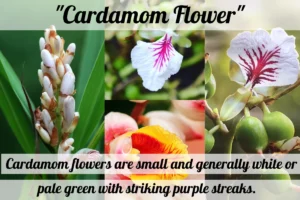
🌸 White petals, purple-streaked labellum
Alt: “Close-up of cardamom flower labellum showing violet purple streaks”
🫛 Trigonal green capsules — 15–20 seeds inside
Alt: “Cardamom pod cross-section showing three locules with dark brown seeds”
Cardamom Plant With Fruit — What It Looks Like
This is one of the most searched visual queries: people want to see a cardamom plant with its fruit (pods) visible. Here is exactly what to look for.
The defining visual of a fruiting cardamom plant: Tall dark-green pseudostems (up to 15 ft) bearing large lance-shaped leaves above ground — and at soil level, low-creeping panicle stems carrying clusters of small, bright green trigonal capsules. The pods are never up on the tall stems. This two-tier visual is unique among common spice plants.
Alt: “Cardamom plant with green seed pods growing at ground level while tall pseudostems rise above”
Alt: “Close-up of green cardamom seed pods on prostrate panicle stem”
💡 How to identify a fruiting cardamom plant: Look down, not up. The pods grow at ankle to knee height on trailing stems, separate from the tall foliage above. Green, firm, 3-sided pods = ready to harvest. Yellowish or splitting pods = over-ripe.
The Flower — Full Botanical Anatomy
Inflorescence Type: Prostrate Panicle (Raceme of Cincinni). Cardamom flowers are white or pale cream with conspicuous violet or purple streaks on the labellum — a distinctive, orchid-like appearance. The inflorescence is a prostrate panicle: a branching cluster on a horizontal creeping peduncle emerging directly from the rhizome, entirely separate from the tall foliage pseudostems.
| Flower Feature | Botanical Detail |
|---|---|
| Symmetry | Zygomorphic (bilaterally symmetrical) |
| Size | 1.5–2 cm across; 3–4 cm long including tubular base |
| Sepals | 3 fused, tubular green calyx, 1–1.2 cm |
| Petals | 3 petals: white to pale cream, oblong, 1.5–2 cm |
| Labellum | White base with bold violet/purple veining — pollinator landing platform |
| Ovary | Inferior, trilocular (3-chambered) |
| Bloom season | Monsoon, June–September (India); year-round in equatorial Guatemala |
| Duration | Individual flower: 2–3 days. Full panicle: 4–6 weeks |
Pollination Mechanism
Cardamom is primarily cross-pollinated by bees — mainly Apis and Trigona species. When a bee lands on the labellum (attracted by nectar guides and scent), it must push past the single fertile stamen to reach the nectary — depositing and collecting pollen in the process.
💡 Self-pollination rate: Despite being hermaphrodite, cardamom has a very low self-pollination rate (~10–15%) because the stigma sits above and away from the anther. Cross-pollination by bees is required for meaningful pod set.
From Flower to Pod — Development Timeline
| Stage | Timing | What Happens |
|---|---|---|
| Flower bud | Pre-monsoon (Apr–May) | Panicle emerges from rhizome |
| Anthesis | Jun–Sep (monsoon) | Flower opens; bee pollination occurs |
| Fertilization | 24–72 hrs post-pollination | Pollen tube fertilizes ovules in 3 locules |
| Fruit set | Days 1–14 | Ovary swells; green capsule forms |
| Capsule development | Days 14–60 | Trigonal shape established; seeds developing |
| Seed maturation | Days 60–90 | Essential oils accumulate; aroma intensifies |
| Harvest window | Days 90–110 | Pods green, firm — must harvest before splitting |
Green vs. Black Cardamom — Capsule Comparison
| Feature | Green (Elettaria) | Black (Amomum) |
|---|---|---|
| Capsule size | Small: 1–2 cm | Large: 2–4 cm |
| Shape | Trigonal, smooth-ridged | Ovoid, deeply ribbed |
| Color | Bright green (fresh) | Dark brown to black |
| Seeds/capsule | 15–20 | 20–50, smaller |
| Aroma | Sweet, floral, citrus | Smoky, camphor-like |
| Drying | Shade-dried | Smoke-dried |
| Native region | Western Ghats, S. India & Sri Lanka | Eastern Himalayas |
Phytochemical Profile — The Aromatic Compounds
Gas chromatography-mass spectrometry (GC-MS) analysis of Elettaria cardamomum seed oil identifies the following major constituents:
| Compound | Concentration | Aroma Note |
|---|---|---|
| 1,8-Cineole | 25–45% | Cool, camphor-like, eucalyptus |
| α-Terpinyl acetate | 20–36% | Fruity, floral, citrus |
| Linalool | 1–6% | Floral, lavender-like |
| Sabinene | 2–8% | Spicy, woody, peppery |
| β-Pinene | 1–4% | Fresh, piney, resinous |
| Limonene | 1–4% | Bright citrus, orange |
🔬 Why does origin affect aroma? The ratio of cineole to terpinyl acetate varies by growing region and cultivar. Indian Malabar cardamom tends toward more floral, “sweet” notes; Guatemalan varieties often show a cooler, more camphor-like profile — trained buyers can identify origin by smell alone.
Origin, Natural Habitat & Global Distribution
From the Western Ghats to a 3,000-year trade history to modern global cultivationWhere cardamom comes from: Native to the Western Ghats mountain range of southern India (Kerala, Karnataka, Tamil Nadu) and Sri Lanka. The Kerala highlands are historically known as the “Cardamom Hills” (Elamalai in Malayalam).
Natural Habitat Conditions
| Habitat Factor | Native Condition |
|---|---|
| Elevation | 600–1,500 m above sea level |
| Rainfall | 1,500–4,000 mm/year — monsoon with dry season |
| Temperature | 10–35°C — no frost, warm year-round |
| Light | Dappled forest shade — 30–50% canopy cover |
| Soil | Humus-rich, well-draining laterite forest soils, pH 5–6.5 |
| Humidity | 70–90% relative humidity year-round |
Historical Spread — How Cardamom Traveled the World
Where Cardamom Grows Today
Kerala, Karnataka & Tamil Nadu, India
The original, highest-quality source. Kerala’s Idukki district is the heart of Indian production — the “Alleppey Green” and “Mysore” varieties are benchmark grades.
Guatemala (Alta Verapaz)
~30,000–35,000 metric tons annually, ~70% of global supply. High-altitude cloud forests closely mirror Kerala’s conditions. Mostly exported to Gulf markets for qahwa coffee.
Sri Lanka
Centuries of cultivation in central highland districts (Kandy, Matale, Nuwara Eliya), known for a bold aroma.
Uganda & Tanzania
East African cultivation has grown significantly since the 1990s, meeting rising export demand.
Nepal & Bhutan
World’s largest producer of black cardamom (Amomum subulatum); some green cardamom in lower-altitude regions.
Uses of Every Part of the Cardamom Plant
One of the most completely utilized spice plants in the worldSeed Pods — The Primary Spice
Whole pods in biryanis, rice dishes, spice blends. Chewed after meals as a natural breath freshener.
Seeds — Culinary & Medicinal
Ground into chai, coffee, desserts. Used in Ayurveda as a digestive aid. Essential oil for perfumery.
Flowers — Edible & Aromatic
Fresh flowers are edible, used in herbal teas and as garnishes near growing regions.
Leaves — Wrapping & Flavoring
Used as natural food wrappers in South Indian cooking, similar to banana leaves.
Rhizome — Traditional Medicine
Used in poultices and decoctions in Ayurvedic and folk medicine traditions.
Essential Oil — Aromatherapy
Steam-distilled from seeds; used in high-end perfumes, cosmetics, and flavoring.
Interesting Facts About Cardamom Plant Uses
Arabic Coffee (Qahwa): Whole pods are added to coffee during brewing across the Arabian Peninsula — the tradition is so strong it’s virtually the “national spice” of several Gulf countries.
Natural Breath Freshener: Long before commercial mints, pods were chewed after meals across South Asia — the antimicrobial properties of cineole give this tradition a real scientific basis.
Life Cycle & Unique Botanical Adaptations
From germination to 10–15 years of pod production| Stage | Duration | What Happens |
|---|---|---|
| Seed germination | 3–6 weeks | Highest rate (60–80%) with fresh seeds soaked 12–24 hrs first |
| Seedling stage | Months 2–8 | First true leaves; delicate, sensitive to sun and drought |
| Vegetative growth | Year 1–2 | Pseudostems elongate; rhizome expands laterally |
| First flowering | Yr 2–3 (seed) / Yr 1–2 (rhizome) | Panicle stems emerge at rhizome base during monsoon |
| Pod maturation | 60–90 days post-flowering | Fertilized flowers become green seed pods |
| Peak production | Years 4–8 | Typically 2–3 kg pods per plant per year |
| Decline phase | Years 9–15 | Yield decreases; rhizome divisions taken to propagate new plants |
🌿 Life Cycle — Visual Timeline
Unique Botanical Adaptations
Deep Shade Tolerance
Monsoon-Synced Flowering
Sympodial Rhizome — Immortal Root
Ground-Level Fruiting
How to Identify the Cardamom Plant
Whether in a market, garden, or forest trail — confident identification in five checks| What to Look For | What You’ll See | Confidence |
|---|---|---|
| Leaf shape | Long, narrow, lance-shaped, dark glossy green | ⭐⭐⭐ High |
| Leaf fragrance | Crush a piece — instant spicy-sweet scent | ⭐⭐⭐⭐ Very High |
| Growth habit | Dense upright clumps, 6–15 ft tall | ⭐⭐⭐ High |
| Pod location | Small green trigonal pods at the base | ⭐⭐⭐⭐ Definitive |
| Pod fragrance | Crack a pod — sweet, citrus-spiced scent | ⭐⭐⭐⭐ Definitive |
| Flower location | Small white-purple flowers at ground level (monsoon) | ⭐⭐⭐⭐ Definitive |
What does a healthy cardamom plant look like? Deep green, upright, glossy leaves free from brown spots or yellowing. Firm pseudostems, not drooping. At the base, firm green pods and small flowers on clean panicle stems. The rhizome should be cream-colored and firm — never mushy or dark.
Natural Habitat & Ecological Profile
The forest ecology that shaped every trait covered on this pageThe cardamom plant’s physiology, flowering phenology, and morphology are all direct products of the ecological conditions in its native Western Ghats and Sri Lankan forests. The parameters below describe the plant’s natural habitat — not prescriptions for cultivation.
| Ecological Parameter | Native Condition | Botanical Significance |
|---|---|---|
| Temperature | 10–35°C; no frost | No frost-hardening mechanisms — product of frost-free montane origin |
| Light regime | 30–50% canopy openness | Leaf chloroplasts optimized for low-light photosynthesis |
| Rainfall | 1,500–4,000 mm; monsoon pattern | Monsoon onset triggers flowering phenology directly |
| Humidity | 70–90% year-round | Prevents desiccation of fine-hairy leaf underside |
| Soil | Laterite forest soils, pH 5–6.5 | Adapted to acidic, high-organic, well-drained substrate |
| Altitude | 600–1,500 m | Cooler temps moderate heat stress; elevated UV promotes essential oil synthesis |
🔬 Ecological note: Flowering is triggered by a combination of increasing photoperiod, rising temperature, and the first monsoon rains — a multi-factor environmental cue system that evolved over millions of years in the Western Ghats ecosystem.
Translate this ecological knowledge into practical growing — soil, pots, seasonal care, and harvest.
Continue Learning
Frequently Asked Questions
Every common question about the cardamom plant, answeredAbout the Author & Reviewer
Written by a spice researcher — reviewed by a plant scientist
Olivia is a spice researcher and food writer covering the botany, history, and identification of aromatic plants — with a particular focus on the Zingiberaceae family.
View full profile →
Dr. Bennett is a botanist and plant scientist specialising in tropical herb taxonomy and Zingiberaceae family botany, reviewing all botanical content on CardamomNectar.
View full profile →References & Sources
🌿 Cardamom Plant — Complete Quick Reference
- Scientific name: Elettaria cardamomum
- Family: Zingiberaceae (Ginger family)
- Common names: Cardamom, Elaichi, Queen of Spices
- Height: Typically 6–15 ft; varies with habitat
- Stem type: Pseudostem (non-woody, not a true stem)
- Root system: Sympodial horizontal rhizome
- Leaf shape: Lanceolate, dark green, 40–60 cm
- Flower: White + violet labellum; at ground level
- Fruit type: Trigonal capsule, green, 1–2 cm
- Seeds per capsule: 15–20 aromatic seeds
- Main aroma compounds: 1,8-Cineole + α-Terpinyl acetate
- Native region: Western Ghats, India & Sri Lanka
- World’s #1 producer: Guatemala
- Bloom season: Monsoon (June–September)
- First harvest: 2–3 yrs (seed) / 1–2 yrs (rhizome)
- Peak production: Years 4–8
- Plant lifespan: 10–15 years
- Key adaptation: Forest understory shade tolerance