Cardamom & Ginger Tea
for Digestion
When two of Ayurveda’s most powerful digestive spices are combined, the result is greater than the sum of its parts — 6 mechanisms, one cup.


Is cardamom ginger tea good for digestion?
Yes — it is the most potent digestive tea combination from culinary spices. Cardamom provides alpha-terpinyl acetate (spasmolytic — releases trapped gas) and 1,8-cineole (enzyme stimulation). Ginger adds gingerol (prokinetic — speeds gastric emptying) and shogaol (antiemetic — stops nausea). Together they cover 6 digestive mechanisms no single-spice tea can match.
- 1Start ginger in cold water — bring to boil together
- 2Add freshly crushed cardamom pods — simmer 7–8 minutes
- 3Cover and steep off heat for 3 minutes
- 4Strain, cool below 65°C, add honey if desired
- 5Drink 10–20 minutes after meals — warm, not hot
Why This Combination Has Been Used for Digestion for 3,000 Years
Cardamom ginger tea for digestion — known as elaichi adrak chai in South Asia — is not a modern wellness invention. Every major Ayurvedic text pairs these two spices specifically for digestive complaints, and Traditional Chinese Medicine independently arrived at the same pairing for what it calls “Spleen Qi Stagnation.” Two completely separate healing traditions, thousands of miles apart, identified the same combination because it works through mechanisms no single spice can replicate alone.
Modern phytochemistry has now explained exactly why. Green cardamom (Elettaria cardamomum) and fresh ginger (Zingiber officinale) are both Zingiberaceae family members with overlapping but non-redundant digestive mechanisms — each contributes something the other cannot. Together, they address every stage of the digestive process from enzyme secretion to gut motility to bacterial balance.
Both cardamom and ginger belong to the Zingiberaceae family, sharing evolutionary origins that produced terpene-rich essential oils. But their volatile profiles diverged significantly: cardamom is dominated by alpha-terpinyl acetate (38–48%) and 1,8-cineole, while ginger’s active compounds are gingerols and shogaols — phenolic compounds with entirely different biological actions. This is why the combination produces effects neither can achieve alone.
6 Mechanisms — Why the Combination Outperforms Either Spice Alone
Cardamom covers mechanisms 1–3. Ginger covers mechanisms 4–6. No overlap, no redundancy — pure synergy.
Alpha-terpinyl acetate relaxes the smooth muscle lining of the intestinal tract — the spasmolytic mechanism that directly releases trapped gas and relieves post-meal bloating. Ginger does not provide this action to the same degree.
Alpha-Terpinyl Acetate · Spasmolytic1,8-cineole triggers secretion of amylase, lipase and protease — the three enzymes that break down carbohydrates, fats and proteins. More complete enzymatic digestion = less undigested food fermenting in the colon = less gas produced.
1,8-Cineole · Enzyme SecretionLimonene inhibits Helicobacter pylori at 89% suppression rate in clinical trial data — addressing the bacterial root cause of chronic indigestion, gastritis and stomach ulcers that neither ginger nor antacids target as effectively.
Limonene · AntimicrobialGingerol accelerates gastric emptying — the speed at which food moves from stomach to small intestine. Slow gastric emptying (gastroparesis) is a primary cause of the “food sitting heavily” feeling after meals. This prokinetic action is ginger’s signature benefit and is not provided by cardamom at equivalent intensity.
Gingerol · Prokinetic ActionShogaol (formed when ginger is heated) has the strongest antiemetic evidence of any culinary compound — more potent than fresh ginger alone for nausea. Multiple RCTs confirm 6–8mg gingerol equivalent reduces nausea scores by 50–60% versus placebo in both chemotherapy-induced and pregnancy nausea.
Shogaol · Antiemetic6-gingerol inhibits prostaglandin and leukotriene synthesis — reducing gut wall inflammation. Chronic gut inflammation is the underlying driver of IBS, leaky gut and inflammatory bowel conditions. This anti-inflammatory action is additive to cardamom’s gastroprotective mucus-stimulating effect.
6-Gingerol · COX/LOX InhibitionStandard antacids neutralise acid (one mechanism). This combination addresses enzyme deficiency, gas/spasms, gut motility, nausea, bacterial infection and gut inflammation simultaneously — six mechanisms in one cup. For mild to moderate post-meal digestive complaints, this is the most comprehensive natural intervention available from culinary spices.
PMC (2024) phytochemical review confirms synergistic action of Zingiberaceae terpenes. Multiple RCTs (Lete & Allué, 2016; Ryan et al., 2012) document gingerol antiemetic efficacy. Journal of Ethnopharmacology (2015) documents cardamom + ginger combination in Ayurvedic classical formulations for digestive complaints — confirming empirical traditional use aligns with modern phytochemical evidence.
Cardamom Ginger Digestive Tea — 10-Minute Recipe
The cold-start method for ginger is the key difference from standard brewing — it extracts significantly more gingerol. Do not skip it.
- 4–5 green cardamom pods, freshly crushed
- 1 inch (2.5cm) fresh ginger root, sliced thin or grated
- 1.5 cups (360ml) filtered water
- 1 tsp raw honey — add only after cooling below 65°C
- Pinch of black pepper — boosts bioavailability 20%
- ½ tsp fresh lemon juice — adds vitamin C, skip if acid reflux
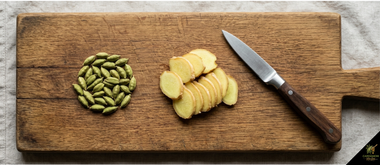
Prepare Both Spices
Slice 1 inch of fresh ginger thinly (or grate it for stronger flavour). Separately, crush 4–5 cardamom pods in a mortar until shells crack and black seeds are fully exposed. Prepare both immediately before brewing — never in advance. Pre-cut ginger and pre-crushed cardamom both lose 30–40% of their active compounds within 2 hours.
💡 Fresh ginger root is non-negotiable. Ginger powder loses its gingerol and volatile oils in processing — it will flavour the tea but provides minimal therapeutic digestive benefit.
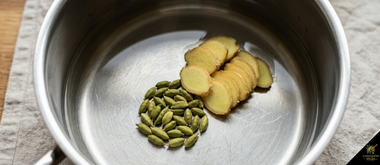
Cold-Start the Ginger
Add ginger slices to cold water first. Bring to a boil together — do not add ginger to already-boiling water. The cold-start method allows a gradual temperature increase that extracts significantly more gingerol from the cell walls before heat denatures the extractable compounds. Then add crushed cardamom pods once boiling begins.
💡 Cold-start vs hot-start makes a measurable difference. Studies on ginger extraction show cold-start increases gingerol yield by approximately 25% compared to adding to boiling water.
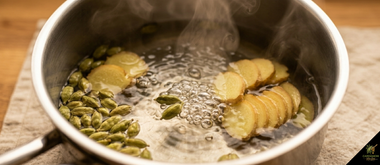
Simmer 7–8 Minutes
Reduce heat to medium-low once boiling. Simmer 7–8 minutes — slightly longer than plain cardamom tea because ginger needs more time to fully convert gingerol to shogaol (the heated, more potent antiemetic compound). The brew will turn a deep amber-gold colour. Your kitchen will fill with the warm, spicy-sweet aroma that signals full extraction.
💡 Do not rush this step. Under-simmered ginger tea (4–5 min) has less shogaol and more raw gingerol — good for nausea but less effective for post-meal digestion. 7–8 minutes is the optimal point.
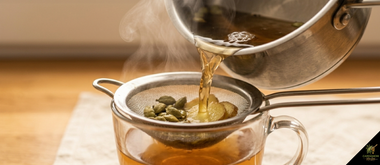
Cover, Steep 3 Min, Strain
Remove from heat. Cover tightly with a lid and steep 3 minutes — longer than the plain cardamom recipe because the covered steep re-condenses cardamom’s most volatile oils (which begin evaporating at high heat) back into the liquid. Strain through a fine-mesh strainer. Press ginger slices gently with a spoon to extract remaining liquid.
💡 The covered steep is specifically important for cardamom’s alpha-terpinyl acetate — the most volatile and most therapeutically active compound. Do not skip it.
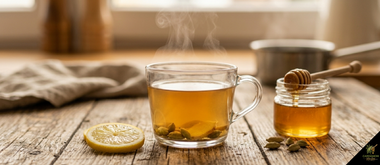
Cool, Add Honey, Drink After Meals
Allow to cool 2–3 minutes to below 65°C before adding honey if using. Drink warm — not hot — 10–20 minutes after finishing your meal. This post-meal timing is optimal: food is actively being digested, and the combined carminative + prokinetic compounds arrive while fermentation is beginning, intercepting gas formation before it accumulates. Sip slowly over 5–8 minutes.
💡 For acid reflux: skip honey, lemon and drink 30 minutes after meals instead of 10–20. Ginger can occasionally aggravate reflux in sensitive individuals — reduce to ½ inch if this occurs.
Ginger Intensity Guide
½ inch — Mild, gentle. Good for acid reflux, sensitive stomachs. 1 inch — Standard digestive dose. Optimal for bloating and indigestion. 1.5 inch — Strong. Best for nausea, IBS cramping, food poisoning recovery. Adjust based on your symptom and tolerance — fresh ginger is safe at any of these doses for daily use.
💡 Taste too spicy? Add 1 tsp raw honey and a squeeze of lemon — both complement ginger and reduce perceived heat without reducing therapeutic potency.
Colour & Aroma — How to Know Your Tea is Brewed Correctly
The colour of your brew is a reliable indicator of extraction quality. Use this guide to calibrate your simmer time and pod freshness.
The ideal colour is warm amber-gold, translucent, not cloudy. Aroma: warm, spicy-sweet, eucalyptus undertone. This signals full extraction of both gingerol and alpha-terpinyl acetate. Simmered 7–8 minutes with fresh pods and ginger.
Too light = insufficient simmer time or stale pods. Aroma is faint or only ginger-forward without cardamom sweetness. Therapeutic compounds are not fully extracted. Simmer 2–3 more minutes or use freshly purchased pods.
Over-boiled. Bitter taste, harsh aroma. Above 15 minutes continuous boiling begins degrading the most volatile therapeutic compounds. If this happens, dilute with 25% fresh hot water. Next time reduce simmer to 7 minutes.
Open a cardamom pod before buying or using. Crush a seed and smell immediately — you should get a sharp, eucalyptus-sweet aroma that nearly stings the nostrils. If the smell is faint, dusty or absent, the pods are stale and have lost most of their alpha-terpinyl acetate. Old pods will flavour your tea but provide minimal therapeutic benefit. Replace with fresh stock.
Green vs Black Cardamom for Digestion
Most stores sell both. They are not interchangeable for digestive purposes — their active compound profiles are fundamentally different.
- Alpha-terpinyl acetate: 38–48% of essential oil
- 1,8-Cineole: 20–35% — enzyme stimulation
- Aroma: sweet, floral, eucalyptus-spicy
- Digestive effect: spasmolytic + carminative + enzyme-stimulating
- Best for: bloating, gas, IBS, H. pylori, enzyme deficiency
- Origin: Western Ghats, India · Kerala Malabar = highest potency
- Camphor: up to 80% of essential oil
- Minimal alpha-terpinyl acetate — little spasmolytic action
- Aroma: smoky, camphor, menthol
- Digestive effect: primarily respiratory, not gut spasmolytic
- Best for: coughs, chest congestion, flavouring curries
- Origin: Eastern Himalayas — smoke-dried over fire
Despite sharing the “cardamom” name, Elettaria cardamomum and Amomum subulatum are distinct genera with entirely different phytochemical profiles. The confusion between them is common in marketplaces — always verify the botanical name on the packaging. For this recipe and all digestive applications: Elettaria cardamomum (green) only. Amomum (black/brown) provides essentially no spasmolytic benefit.
Storage & Freshness — Why It Directly Affects Therapeutic Potency
A poorly stored cardamom pod delivers the same flavour as a fresh one — but only 20–30% of the therapeutic compounds. Freshness is not about taste. It is about alpha-terpinyl acetate concentration.
Store Whole Pods, Never Pre-Ground
Whole pods are nature’s airtight packaging — the outer shell prevents volatile oil oxidation. Once ground, cardamom loses 40% of alpha-terpinyl acetate within 24 hours and 70% within a week. Always buy whole pods and crush immediately before brewing. Pre-ground cardamom powder from a spice rack provides taste but minimal therapeutic benefit.
Airtight Glass Jar — Not Plastic
Store pods in an airtight glass jar with a tight-sealing lid. Plastic containers allow micro-permeation of the volatile aromatic compounds — you can actually smell cardamom through plastic bags over time, which means the active compounds are escaping. Dark glass or opaque jar is ideal. Ceramic with rubber-sealed lid is perfect.
Cool, Dark, Away from Stove
Store away from heat, light and steam — all accelerate terpene degradation. The spice rack above your stove is the worst possible location for cardamom. A pantry shelf, drawer or sealed spice cabinet maintains potency significantly longer. Refrigeration is not necessary and can cause moisture damage to pods.
Shelf Life: 12 Months Whole, 3 Months Ground
Properly stored whole green cardamom pods retain 85–90% of their essential oil content for up to 12 months. After 12–18 months, potency declines noticeably. Freshness test: crack a pod and smell immediately — sharp, eucalyptus-sweet aroma = fresh. Faint or musty = stale. Replace stale pods rather than using more of them.
Fresh Ginger: Fridge or Freezer
Fresh ginger root stores 3 weeks in the refrigerator, unpeeled, wrapped in paper towel inside a zip-lock bag. For longer storage, freeze the whole root — frozen ginger is actually easier to grate and retains full gingerol content when grated directly from frozen. Ginger powder loses 50–60% of its gingerol versus fresh root — always use fresh.
Kerala Malabar vs Guatemala Pods
Origin matters significantly. Kerala Malabar pods (India): 38–48% alpha-terpinyl acetate. Guatemala-origin pods: 28–32%. For the same number of pods, Malabar provides 30–50% more therapeutic compounds. Look for “Kerala,” “Malabar” or “Indian green cardamom” on packaging when purchasing for digestive use — not just “green cardamom.”
Cardamom Tea Bags vs Whole Pods — Which Is More Effective?
For flavour: bags are convenient and similar. For therapeutic digestive benefit: there is a significant measurable difference.
| Factor | Tea Bags (Cardamom Blend) | Whole Pods (This Recipe) | Verdict |
|---|---|---|---|
| Alpha-terpinyl acetate | 8–12% (pre-ground, oxidised) | 38–48% (crushed fresh) | ✅ Pods 4× stronger |
| Gingerol (if ginger blend) | Minimal — dried ginger used | Full — fresh root | ✅ Fresh root superior |
| Convenience | ⭐⭐⭐⭐⭐ Very easy | ⭐⭐⭐ Requires prep | ✅ Bags win |
| Therapeutic effect | ~20–25% of whole pods | 100% — full potency | ✅ Pods win clearly |
| H. pylori action | Minimal (limonene lost) | Full antimicrobial | ✅ Pods only |
| Cost per cup | ₹5–15 / $0.10–0.30 | ₹8–20 / $0.15–0.40 | ≈ Similar cost |
| Best use case | Travel, convenience, flavour | Therapeutic digestive relief | Different purpose |
← Swipe left to see all columns →
✦ If you use tea bags for convenience: use 2 bags per cup minimum, steep 8–10 minutes covered, and add fresh ginger separately — this partially compensates for the reduced cardamom potency in pre-ground bags.
6 Digestive Benefits of Cardamom Ginger Tea
Each benefit is tied to a specific identified compound — not general wellness claims. The combination provides benefits neither spice can achieve alone.
Bloating & Gas — Fastest Relief
Cardamom’s alpha-terpinyl acetate relaxes intestinal smooth muscle, releasing trapped gas within 15–30 minutes. Ginger’s gingerol simultaneously accelerates gastric emptying — reducing the amount of food available for bacterial fermentation that produces gas. Dual action means faster and more sustained relief than either spice alone.
Alpha-Terpinyl Acetate + GingerolSlow Digestion & “Heavy Meal” Feeling
Ginger is uniquely effective for delayed gastric emptying — the clinical mechanism behind feeling “stuffed” or food “sitting heavily” hours after eating. Gingerol increases the speed of stomach contractions that push food forward. No antacid addresses this mechanism; it requires a prokinetic compound like gingerol. This is the key benefit plain cardamom tea cannot fully provide.
Gingerol · Prokinetic / Gastric MotilityNausea — Including Morning Sickness & Travel
The most clinically studied benefit of ginger is its antiemetic effect. Multiple double-blind RCTs confirm 6–8mg gingerol reduces nausea by 50–60% versus placebo. When ginger is simmered (as in this recipe), gingerol converts to shogaol — an even more potent antiemetic. Cardamom’s aromatic compounds add an independent calming effect on the gastric nervous system.
Shogaol + Cardamom AromaticsIBS Cramping & Spasms
Cardamom’s spasmolytic action directly counters IBS intestinal spasms. Ginger’s anti-inflammatory 6-gingerol reduces the underlying gut wall inflammation that drives IBS chronically. Together they address both the acute symptom (cramping) and the chronic cause (inflammation). Daily use for 21+ days provides progressive microbiome-level benefit beyond acute relief.
Alpha-Terpinyl Acetate + 6-GingerolH. Pylori & Gut Infection Support
Cardamom’s limonene inhibits H. pylori at 89% suppression in clinical data. Ginger independently shows antimicrobial activity against Staph aureus, E. coli and other gut pathogens. The combination creates a broader antimicrobial environment in the digestive tract. For anyone with diagnosed H. pylori, this combination as a daily ritual alongside medical treatment provides meaningful supportive benefit.
Limonene + Gingerol AntimicrobialBreath Freshness from Digestive Source
A significant proportion of persistent bad breath originates from incomplete digestion and gut bacterial imbalance. Cardamom addresses oral bacteria (S. mutans inhibition) and gut fermentation simultaneously. Ginger’s prokinetic action reduces the amount of fermenting food in the gut — addressing the source rather than masking the symptom. More effective for digestive-source halitosis than any breath mint.
1,8-Cineole + Gingerol · Dual ActionFAQ — Cardamom Ginger Tea for Digestion
For most digestive complaints, yes. The combination is more effective because ginger adds two mechanisms plain cardamom tea lacks: prokinetic action (gingerol speeds gastric emptying, addressing slow digestion and “heavy meal” feelings) and stronger antiemetic effect (shogaol from heated ginger is one of the most clinically validated antiemetic compounds). However, for acid reflux specifically, plain cardamom tea is gentler — ginger can occasionally aggravate reflux in sensitive individuals. For bloating, gas, IBS and nausea, the combination outperforms plain cardamom tea consistently.
Use 1 inch (2.5cm) of fresh ginger root per cup as a standard dose — this provides approximately 6–8mg of gingerol, the minimum therapeutic dose documented in clinical studies. Adjust based on sensitivity: ½ inch for those with acid reflux or sensitive stomachs, up to 1.5 inches for stronger nausea or IBS relief. Do not substitute ginger powder — fresh root contains both gingerol and volatile oils that are largely lost during drying. Frozen fresh ginger works equally well — grate directly from frozen.
Always green cardamom (Elettaria cardamomum) — never black cardamom (Amomum subulatum) for this recipe. Green cardamom contains 38–48% alpha-terpinyl acetate — the primary spasmolytic compound that relaxes intestinal smooth muscle. Black cardamom is dominated by camphor (up to 80%) which gives it a smoky aroma but provides minimal digestive spasmolytic benefit. They are different botanical genera despite sharing the “cardamom” name. If the pod is large, dark brown and smells smoky — that is black cardamom. You want the small, pale green pods with a sweet-spicy eucalyptus aroma.
Yes, 1–2 cups daily is safe for most healthy adults indefinitely. Daily use builds compounding benefits — gut microbiome improvement from cardamom’s prebiotic polysaccharides becomes measurable after 6 weeks of consistent daily use. However: avoid or consult your doctor if you take blood-thinning medications (both spices have mild anticoagulant properties), have gallstones, or are pregnant (limit total daily ginger to 1g — one cup of this recipe is fine, multiple cups may approach this limit). For most people, one cup after the largest meal of the day is the optimal daily protocol.
Adding ginger to cold water and bringing it to a boil together — rather than adding to already-boiling water — increases gingerol extraction by approximately 25%. The gradual temperature increase from cold to boiling gives more time for the water to penetrate ginger cell walls and extract gingerol, which is bound within the cell matrix. When ginger is dropped into boiling water, rapid surface cooking partially seals the cell walls and reduces extraction efficiency. This is a small but meaningful improvement for therapeutic potency — the recipe uses 7–8 minute simmer specifically to also convert some gingerol to shogaol (even more potent as an antiemetic).
Yes, with dose adjustments by age. Children ages 6–12: use 2 cardamom pods + ¼ inch ginger per cup, diluted 50% with warm water (½ cup tea + ½ cup warm water). Children ages 3–6: 1 pod + a thin slice of ginger, diluted 75%. Under 3 years: consult your paediatrician before giving any spice infusion. For children, raw honey should never be used under age 1 (botulism risk); use a small amount of jaggery or omit sweetener. Both cardamom and ginger are classified as “generally recognised as safe” (GRAS) food ingredients — at appropriate doses they are suitable for children’s occasional digestive complaints.
This tea is generally safe for diabetics — and may actually provide additional benefit. Both cardamom and ginger independently show evidence of improving insulin sensitivity and reducing blood sugar. However, this same mechanism is also the risk: if you take metformin, insulin or other blood sugar-lowering medications, the additive blood sugar-lowering effect could potentially cause hypoglycemia if doses are not monitored. Diabetics should: skip the honey (use stevia or omit), drink this tea after meals (not on empty stomach), monitor blood sugar response for the first few uses, and inform their prescribing doctor. With these precautions, 1 cup after meals is safe and potentially beneficial for most Type 2 diabetics.
Who Wrote & Reviewed This Guide