Cardamom Essential Oil Market Set to Hit $310.8 Million by 2033 — What It Means for Growers and Buyers
A new industry report published this week projects the global cardamom essential oil sector will more than double in value over the next seven years — driven by a surge in natural ingredient demand across food, wellness, and perfumery.
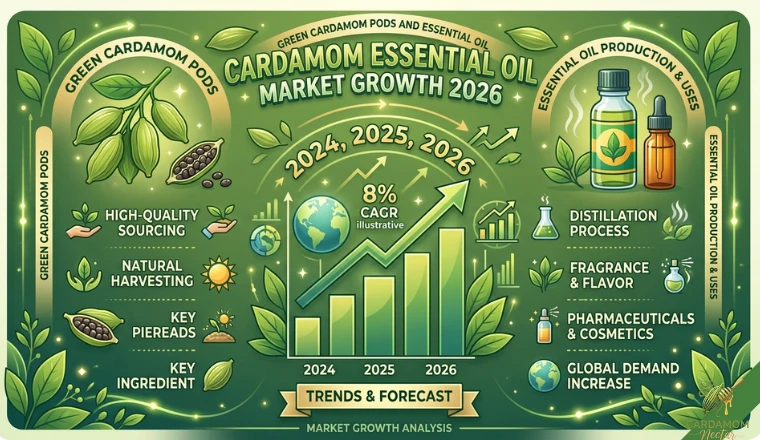
The global cardamom essential oil market — worth an estimated $184.9 million in 2026 — is forecast to reach $310.8 million by 2033, according to a new market report published this week by Persistence Market Research. The 7.7% annual growth rate is being fuelled by rising consumer demand for natural ingredients in food, beverages, personal care, and aromatherapy. For cardamom growers and traders, this is a signal that long-term structural demand for the spice is strengthening well beyond its traditional markets.
Why Is Cardamom Essential Oil Demand Growing So Fast?
The report identifies a clear structural shift: global consumers — particularly in North America, Europe, and the Gulf states — are increasingly replacing synthetic flavourings and fragrances with natural plant-derived alternatives. Cardamom essential oil sits at the exact intersection of this trend, with applications spanning from premium coffee and beverage flavouring to high-end perfumery, natural medicine, and clean-label food manufacturing.
This is not a short-term spike. The underlying forces reshaping demand are multi-year shifts in consumer behaviour that are proving resistant to economic cycles. Three sectors in particular are driving the acceleration:
Food & Beverage — The Largest Segment
The food and beverage sector accounts for over 65% of total cardamom oil demand, according to the report. Craft coffee brands, ready-to-drink botanical beverages, premium bakery chains, and Middle Eastern qahwa culture are all expanding their use of natural cardamom flavouring. Starbucks, Diageo, and PepsiCo are among the major beverage players integrating cardamom notes into specialty product lines. As clean-label regulations tighten in the EU and US, manufacturers are under increasing pressure to replace synthetic alternatives — directly benefiting natural cardamom oil producers.
Wellness & Aromatherapy — The Fastest Growing
Aromatherapy and personal wellness represent the fastest-growing application segment for cardamom essential oil. Wellness centres, spas, and home diffuser users are adopting cardamom oil for its documented calming, digestive, and mood-enhancing properties. The compound linalool — present in green cardamom’s volatile oil profile — modulates GABA-A receptor activity, producing mild anti-anxiety effects. This scientifically validated mechanism is driving adoption in a wellness sector that grew by over 12% annually in the last measured period.
Perfumery & Personal Care — The Premium Opportunity
Cardamom essential oil is present in over 300 commercial perfumes worldwide, serving as a distinctive middle note in Oriental, spicy, and woody fragrance families. The personal care sector — from premium soaps and skincare to hair care formulations — is increasingly incorporating cardamom oil as a natural fragrance and skin-benefiting agent. Brands including The Body Shop, L’Occitane, Forest Essentials, and Kiehl’s are among the representative players in this segment. As the luxury cosmetics market expands across Asia-Pacific and the Middle East, cardamom oil’s premium positioning makes it a natural beneficiary.
Application Breakdown — Where Cardamom Oil Is Used
| Application Segment | Market Share | Demand Level | Growth Trend |
|---|---|---|---|
| Food & Beverages | 65%+ | ↑ Strong | |
| Aromatherapy & Wellness | ~25% | ↑ Fastest Growing | |
| Perfumery & Cosmetics | ~8% | ↑ Rising | |
| Pharmaceuticals | ~4% | → Emerging |
How Is Cardamom Essential Oil Produced?
Understanding the production side matters for anyone tracking cardamom prices — because essential oil production directly competes with the spice trade for the same raw material.
Steam distillation accounts for approximately 72% of all commercial cardamom oil extraction, while CO₂ extraction contributes around 18%. The essential oil yield from dried cardamom seeds ranges between 3% and 8%, depending on extraction technology, origin quality, and seed maturity. This means producing 1 kg of cardamom essential oil requires between 12.5 kg and 33 kg of dried seeds — making raw material availability and pricing the single most important cost factor in the essential oil business.
India and Guatemala are the leading suppliers of raw cardamom for oil extraction, collectively contributing over 70% of global feedstock. Kerala’s Malabar-grade green cardamom — with its documented high 1,8-cineole content of up to 44% in premium lots — commands a premium for essential oil production due to superior oil yield and aroma complexity.
What Does This Mean for Cardamom Prices?
The essential oil sector’s expansion is a long-term price support factor for raw cardamom. When essential oil manufacturers compete with culinary buyers and exporters for the same Kerala and Guatemala supply, it adds a structural demand floor that prevents deep price corrections. This is particularly relevant in 2026, when India’s auction market has already seen average prices hold above ₹2,400/kg despite tightening seasonal arrivals.
The report also notes that organic-certified cardamom variants now represent 37% of total oil market supply — a segment commanding significantly higher farmgate prices. For Indian and Guatemalan farmers willing to invest in organic certification, the essential oil buyer segment represents a premium exit that the bulk spice market does not offer.
One important nuance: the essential oil market measures demand in value terms, not volume. Even small quantities of high-grade oil generate significant revenue. This means the sector growth does not require dramatically higher raw cardamom volumes — but it does require consistently high-quality, clean, aromatic pods that meet residue and purity standards for premium industrial buyers.
Regional Demand — Where Is Growth Happening?
The geographic distribution of essential oil demand tells an interesting story for the broader cardamom trade:
| Region | Demand Share | Key Driver |
|---|---|---|
| Asia-Pacific | 44% production share | Traditional medicine + culinary demand |
| Middle East & Africa | 14% trade participation | Qahwa coffee culture, personal care |
| North America | 19% consumption share | Natural flavouring, aromatherapy |
| Europe | 23% demand | Premium bakery, clean-label F&B, perfumery |
The Middle East deserves particular attention for readers following Pakistan and South Asian cardamom trade. The Gulf’s cultural reliance on cardamom-infused qahwa — with Saudi Arabia, UAE, and Kuwait collectively importing over 30,000 metric tonnes annually — creates a demand floor that is structurally resistant to price corrections. This demand is now being amplified by the essential oil boom, as Gulf personal care and wellness brands incorporate local cardamom into premium formulations for domestic and export markets.
Market Outlook — Key Takeaways for April 21, 2026
- ✓ Cardamom essential oil market valued at $184.9 million in 2026 — growing at 7.7% CAGR to $310.8M by 2033
- ✓ Food & beverage sector drives 65%+ of demand — clean-label shift replacing synthetic flavours
- ✓ Aromatherapy is the fastest-growing segment — 12%+ annual wellness centre adoption
- ✓ Essential oil demand adds a structural price floor — long-term support for raw cardamom prices
- ✓ Organic-certified cardamom commands premium pricing — 37% of oil market is organic
- ✓ Malabar-grade Kerala cardamom most valued for oil — high 1,8-cineole content drives premium
📊 Stay ahead of the cardamom market: Cardamom Nectar publishes daily price updates, export data, and market analysis every morning. Check back tomorrow for Wednesday’s market analysis — covering this week’s global supply-demand outlook in detail.
Read More on Cardamom Nectar
Sources: Persistence Market Research — Cardamom Essential Oil Market Report 2026–2033 (published April 2026) · IndexBox Cardamom Oil Market Forecast 2026–2035 · Mordor Intelligence Cardamom Market Analysis 2026 · India Spices Board auction data · All market size figures are analyst projections and subject to revision.