Black Cardamom Boulevardier
The Warmest Whiskey Negroni You’ll Make
Bourbon replaces gin. Black cardamom simple syrup bridges what the standard boulevardier leaves disconnected — its vanilla-oak warmth, Campari’s bitter bite, and the dark fruit of Carpano Antica. One spice addition. A completely different depth.


Build in a mixing glass → add ¼ oz black cardamom simple syrup + 1 oz Campari + 1 oz Carpano Antica + 1.25 oz high-rye bourbon → fill with ice → stir 30 seconds → strain into a chilled rocks glass over a large ice cube → express orange peel. The black cardamom bridges bourbon’s vanilla-oak with Campari’s bitterness in a way the standard boulevardier never quite achieves — every whiskey drinker who tries this asks what you changed.
- What is a boulevardier — and why add black cardamom
- Boulevardier vs Negroni — the key differences
- The flavour science — camphor, oak, and bitter gentian
- Recipe card — black cardamom boulevardier
- Step-by-step with method explanations
- 🥃 Boulevardier Smoke & Bitterness Balancer
- Bourbon guide — which works best
- Vermouth guide — the most impactful choice
- Which black cardamom syrup to use
- 4 black cardamom boulevardier variations
- Batch recipe — for 8 people
- FAQ — 12 questions answered
- More black cardamom cocktails
What Is a Boulevardier — And Why Black Cardamom Belongs In It
The boulevardier is bourbon’s answer to the Negroni. Created in 1920s Paris by Erskine Gwynne — an American writer who edited a monthly magazine called Le Boulevardier — the cocktail is simply a Negroni with bourbon substituted for gin. It was first published in Harry MacElhone’s 1927 book Barflies and Cocktails, then largely forgotten for eight decades before the craft cocktail movement rediscovered it in the late 2000s. It became an IBA official cocktail in 2020.
The standard boulevardier is excellent. But it has a structural gap that gin-based negronis don’t share: bourbon’s vanilla-oak-caramel sweetness and Campari’s bitter-citrus profile occupy opposite flavour poles, with sweet vermouth attempting to bridge them. The result can feel disconnected — warm whiskey on one side, aggressive bitterness on the other — particularly for drinkers accustomed to the negroni’s more cohesive botanical integration.
What Black Cardamom Does
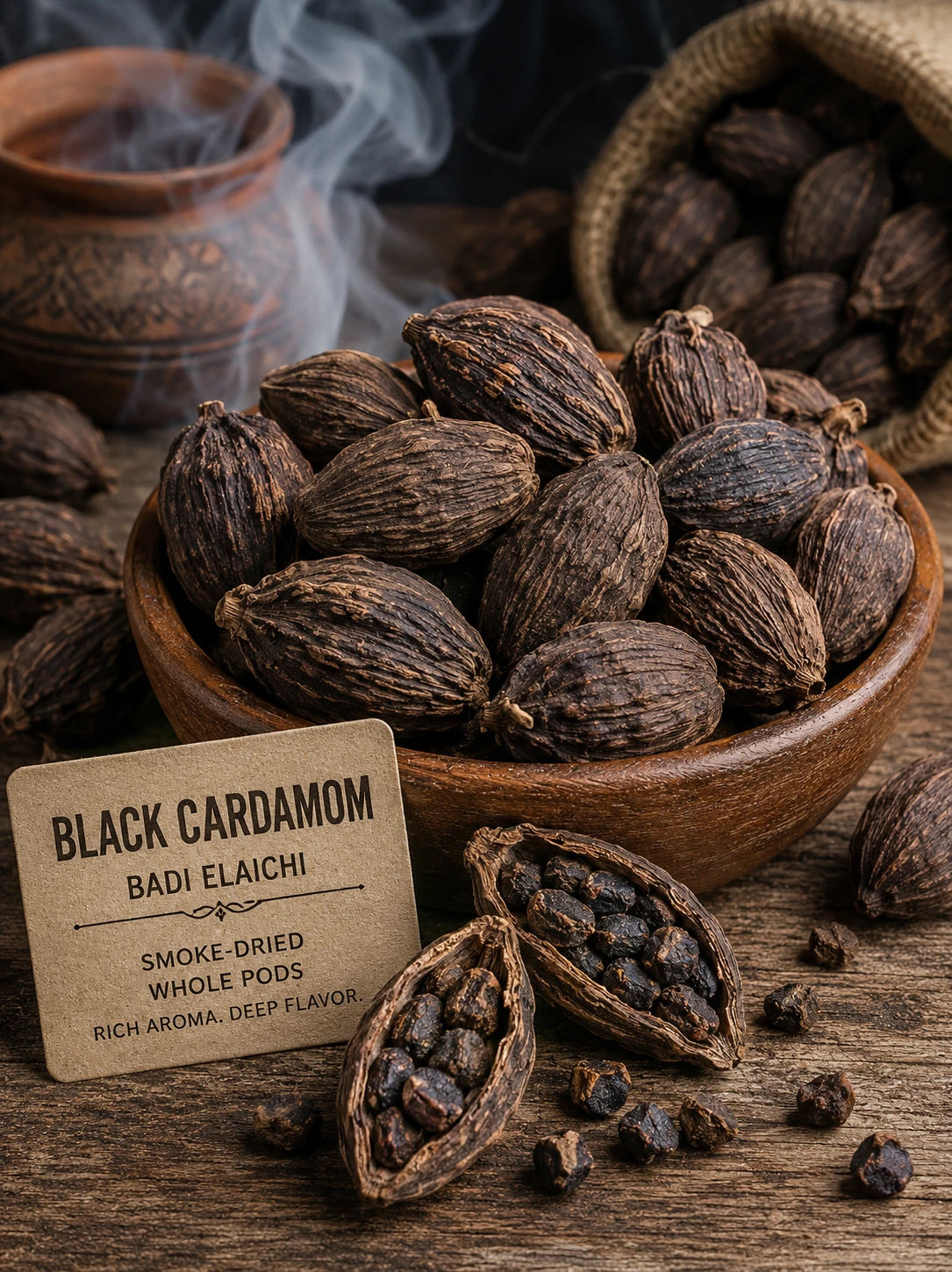
Black cardamom — badi elaichi, Amomum subulatum — is smoke-dried over open fire, which gives it a camphor-smoke, resinous character unlike any other spice. When dissolved into a 2:1 simple syrup and steeped for 48 hours, it releases 1,8-cineole and camphor volatiles that occupy an aromatic register distinct from both bourbon’s sweetness and Campari’s bitterness.
In a boulevardier, that camphor-smoke acts as a bridge rather than a fourth flavour. Bourbon’s vanilla and oak share an earthy, resinous quality with black cardamom’s smoke. Campari’s bitter botanicals share an herbal-resinous register with the cardamom’s cineole compounds. The syrup connects the two sides of the drink rather than sitting between them.
The result is a boulevardier that tastes more cohesive — more like a single, unified thing — than the standard build. Most drinkers describe it as tasting like a particularly exceptional bourbon was used, or that the bitters are unusually complex. They rarely identify the spice, because it reads as integration rather than addition.
Boulevardier vs Negroni — How They Differ
Both drinks share the same two-thirds of their recipe — Campari and sweet vermouth — and the same stirred-over-ice format. The spirit base is everything. Here is how black cardamom interacts differently with each.
🥃 Black Cardamom Boulevardier
Bourbon baseWarmingAutumn/WinterBourbon’s vanilla-caramel-oak profile creates a richer, warmer base. Black cardamom’s earthy smoke amplifies the oak’s resinous quality and softens the transition to Campari’s bitterness. The result is rounder, deeper, and more spirit-forward. Campari reads as a bitter accent rather than a dominant force. Higher ABV (~32%) — a contemplative sipper.
🍸 Black Cardamom Negroni
Gin baseBotanicalYear-round aperitivoGin’s botanical profile — juniper, citrus, coriander — gives a lighter, more aromatic base. Black cardamom’s camphor-smoke adds beneath the bitterness rather than bridging it. The result is more complex botanically, with the smoke reading as an added layer. Campari leads more prominently. Lower ABV (~28%) — a classic aperitivo opener.
If you are a gin drinker, start with the black cardamom negroni. If you are a bourbon or whiskey drinker — or if you find standard negronis too bitter — start here. The boulevardier’s whiskey warmth makes it the more approachable of the two for most non-gin drinkers, and black cardamom’s integration effect is arguably more pronounced in this build.
The Flavour Science — Camphor, Oak, and Bitter Gentian
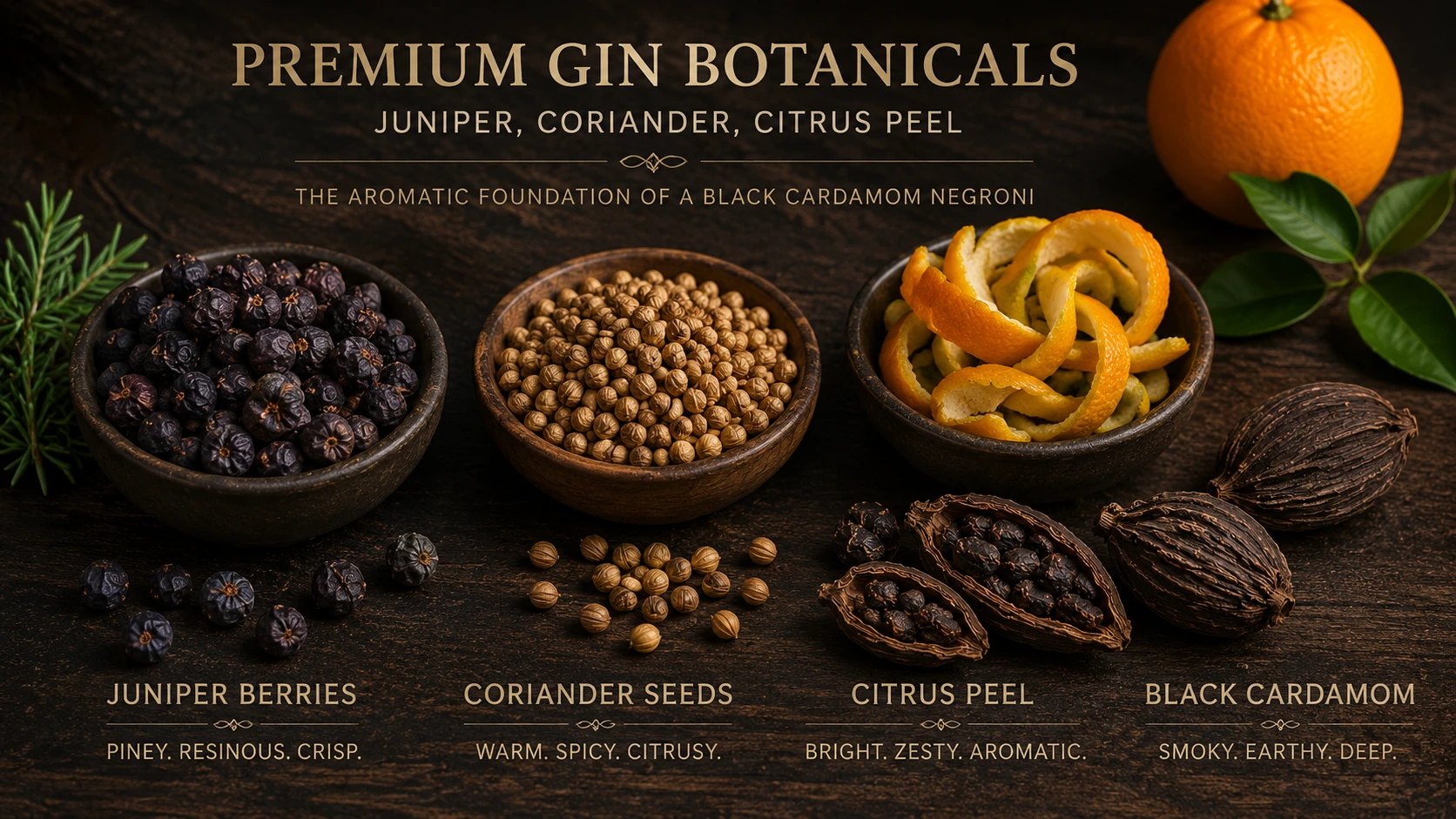
The three-way interaction in a black cardamom boulevardier: bourbon’s vanillin and oak lactones, Campari’s gentian alkaloids, and black cardamom’s cineole-camphor volatiles occupy adjacent but distinct aromatic registers — creating cohesion rather than competition.
| Component | Key Compounds | What It Contributes |
|---|---|---|
| High-Rye Bourbon | Vanillin (oak-derived), oak lactones, eugenol (spice), ethyl maltol (caramel) | Vanilla-caramel warmth, resinous oak, peppery rye spice — the spirit-forward centre of the drink |
| Campari | Gentian root alkaloids (amarogentin), rhubarb, orange citrus oils | Profound bitterness, orange-rhubarb character, persistent long finish — the bitter anchor |
| Carpano Antica Formula | Grape-derived wine base, vanilla extract, wormwood, dark fruit esters | Dark fruit, vanilla, slight chocolate — the bridge between bourbon and Campari in the standard build |
| Black Cardamom Syrup | 1,8-Cineole (25–40%), camphor, terpineol, resinous phenols from smoke-drying | Camphor-smoke, earthy warmth, resinous depth — connects bourbon’s oak with Campari’s botanicals |
| Orange Peel (expressed) | Limonene, citrus essential oils | Bright citrus top note — echoes Campari’s orange character and lifts the dark, rich base |
The flavour-bridging effect of black cardamom in a boulevardier is particularly interesting from a sensory chemistry perspective. Bourbon’s oak lactones (cis and trans-3-methyl-4-octanolide) share a resinous, coconut-adjacent character with black cardamom’s cineole compounds — both belong to cyclic ether families that produce similar sensory impressions. Campari’s gentian alkaloids bind to TAS2R bitter receptors and produce a long-finish bitter response. Black cardamom’s cineole does not activate these receptors — it occupies the same sensory register as the bourbon’s resinous compounds, creating a perceptual bridge between the two poles of the drink. At ¼ oz of a 48-hour-steeped 2:1 syrup in a ~3.25 oz serve, the contribution is aromatic rather than flavour-dominant — it reads as complexity in the bourbon, not as a separate spice addition.
Recipe — Black Cardamom Boulevardier

🥃 Black Cardamom Boulevardier
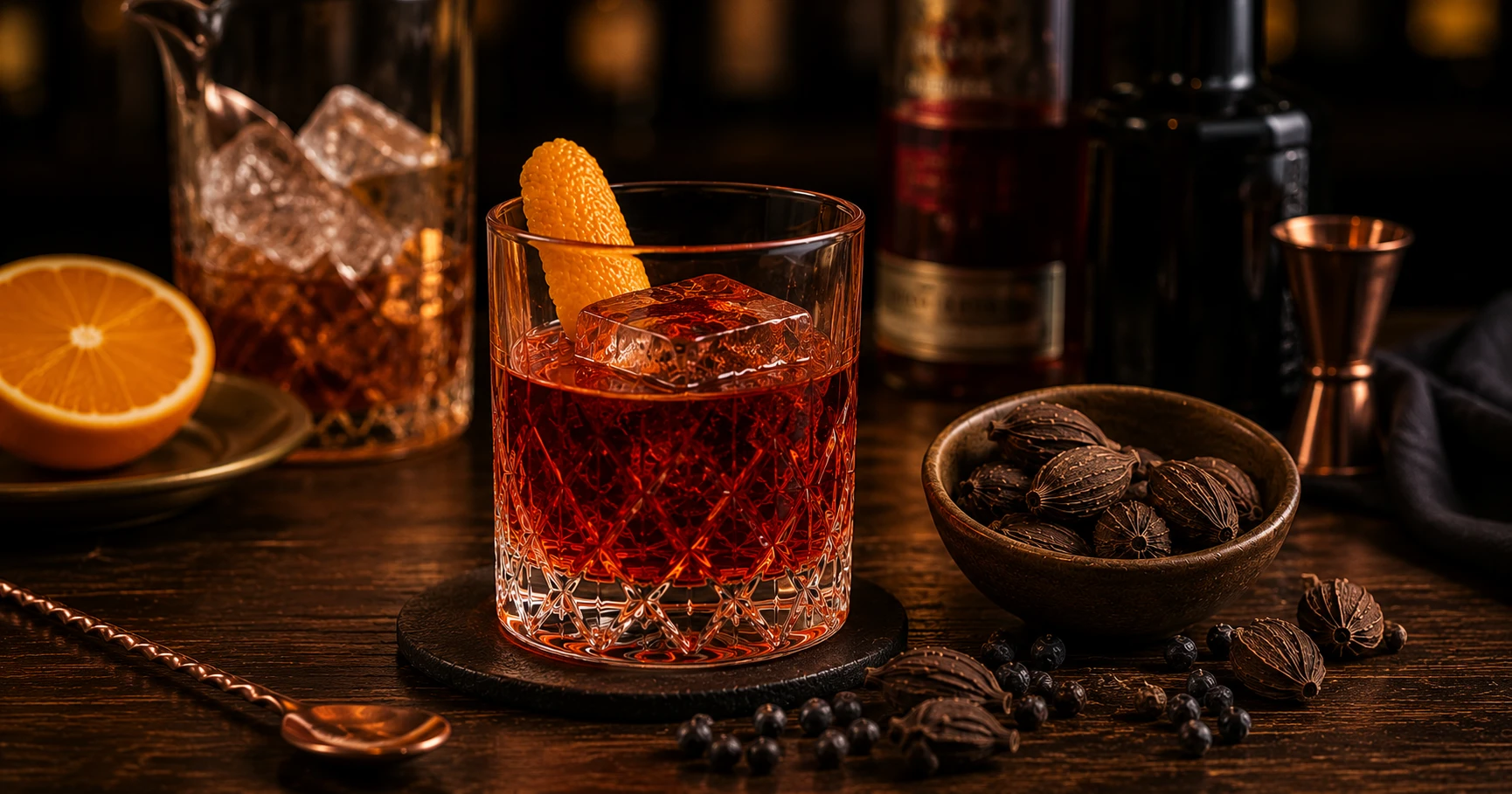
Bourbon, Campari, Carpano Antica, elevated by black cardamom simple syrup. The warmest, most integrated whiskey negroni variation — three minutes from glass to hand.
Ingredients
- 1.25 oz high-rye bourbon
- 1 oz Campari
- 1 oz Carpano Antica Formula
- ¼ oz black cardamom simple syrup
- 1 large ice cube (serving glass)
- 1 strip fresh orange peel
Method
- Chill glass — ice water 60 sec, discard
- Build in mixing glass — syrup first, then Campari, vermouth, bourbon
- Fill with ice — three-quarters full
- Stir 30 sec — slightly longer than a negroni — until frosted
- Strain — into chilled rocks glass over large ice cube
- Express orange peel — bend skin-down, run around rim
- Serve — as aperitivo or evening sipper
Step-by-Step — Method & Why Each Step Matters
The boulevardier is stirred the same way as a negroni, with one important difference: bourbon benefits from 30 seconds of stirring rather than 25 — it opens up more generously with slightly more dilution.
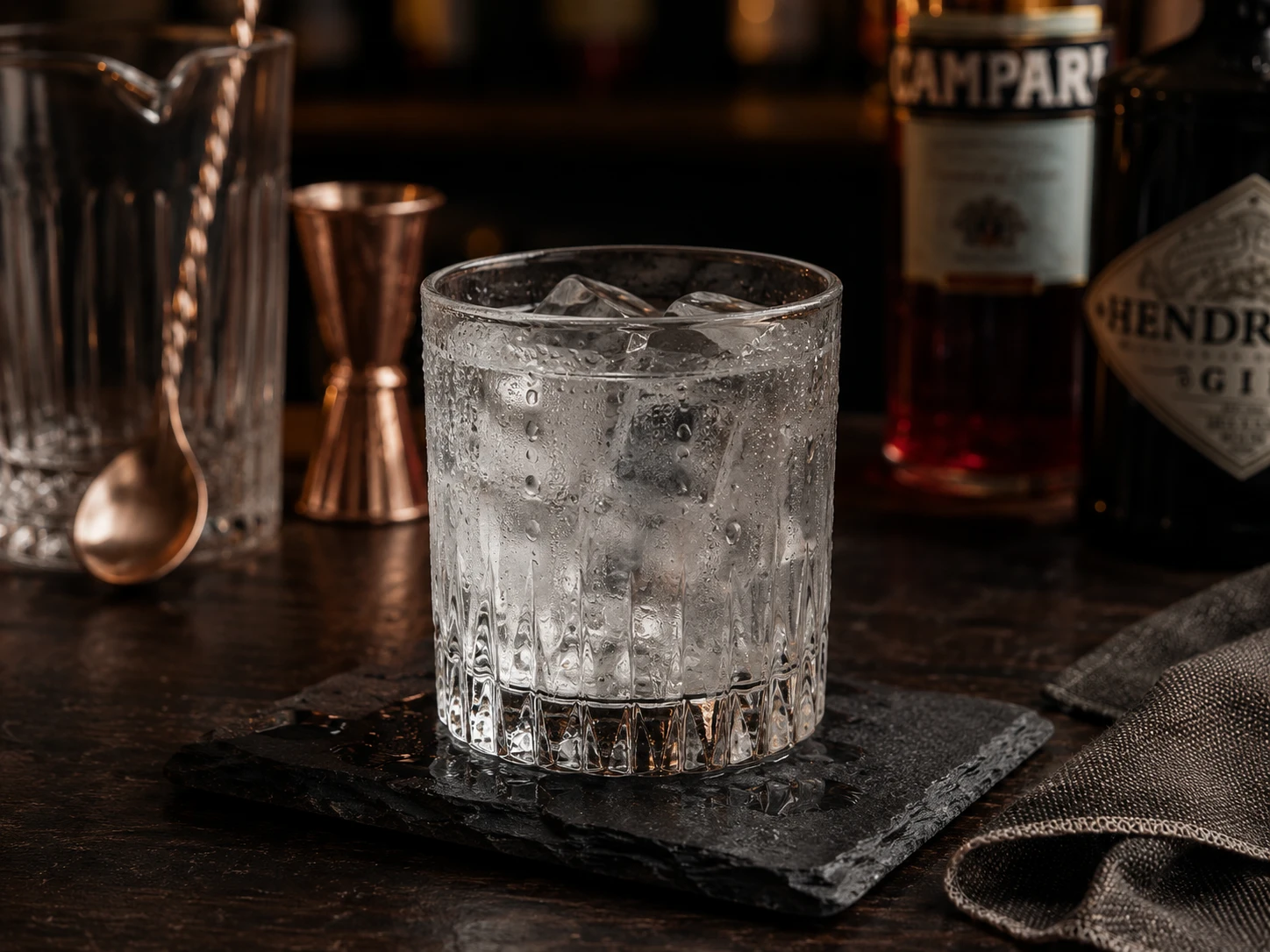
Fill a rocks glass with ice water and wait 60 seconds. Discard completely before adding the drink.
Why it matters: A warm glass causes rapid ice melt on contact, diluting and warming the drink before you reach the halfway point. A chilled glass extends the optimal drinking window significantly — critical for a spirit-forward drink like a boulevardier, which is best consumed slowly over 15–20 minutes as the ice melts gradually.
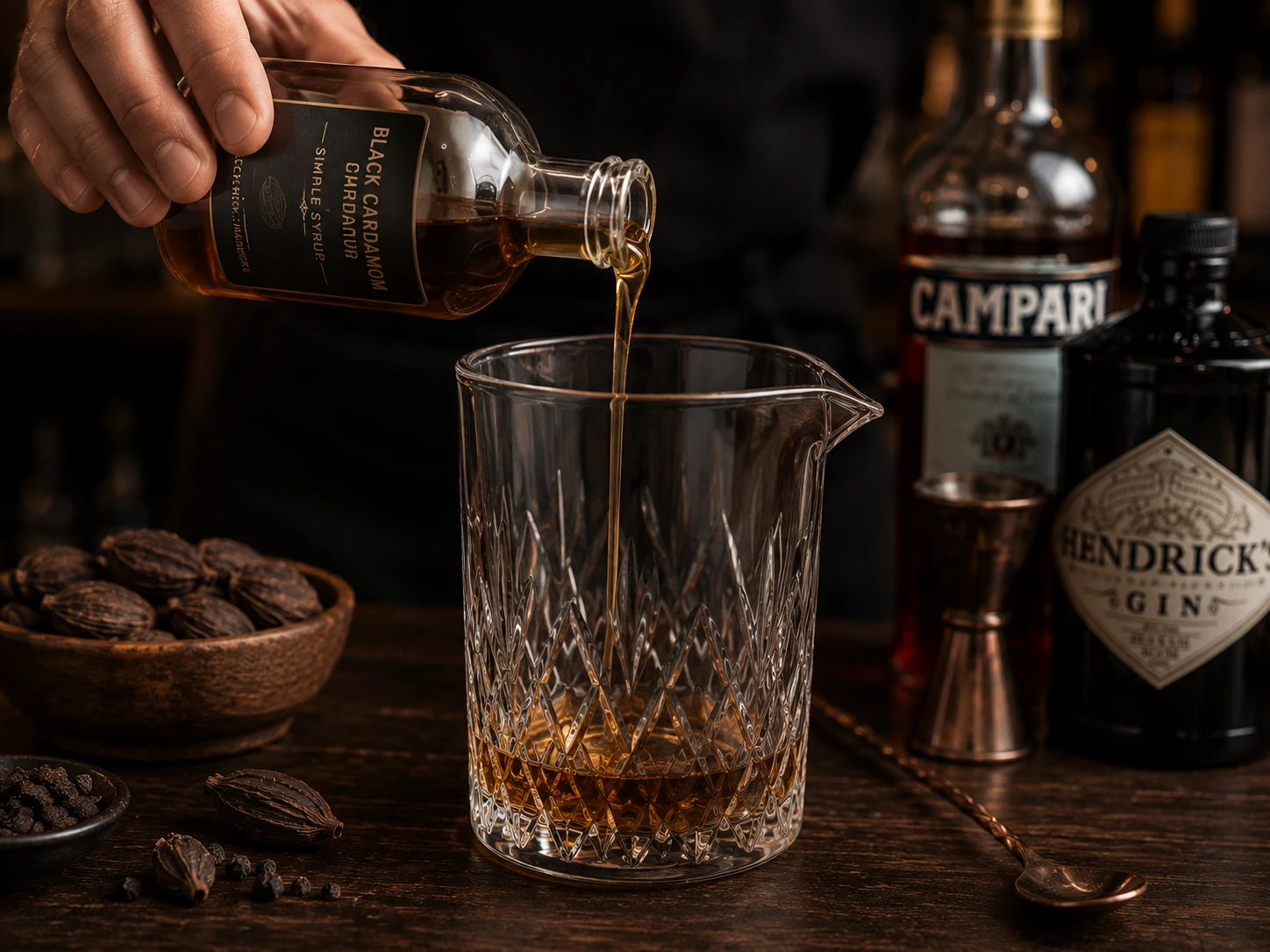
Measure ¼ oz black cardamom simple syrup into the mixing glass before any spirits.
Why it matters: The 2:1 sugar syrup is denser than spirits. Added first, it coats the bottom of the mixing glass; spirits poured on top create movement that begins distribution immediately. Stirring then completes the integration evenly. Syrup added last — a common shortcut — tends to sit concentrated at the bottom, producing an inconsistent first sip versus the last.
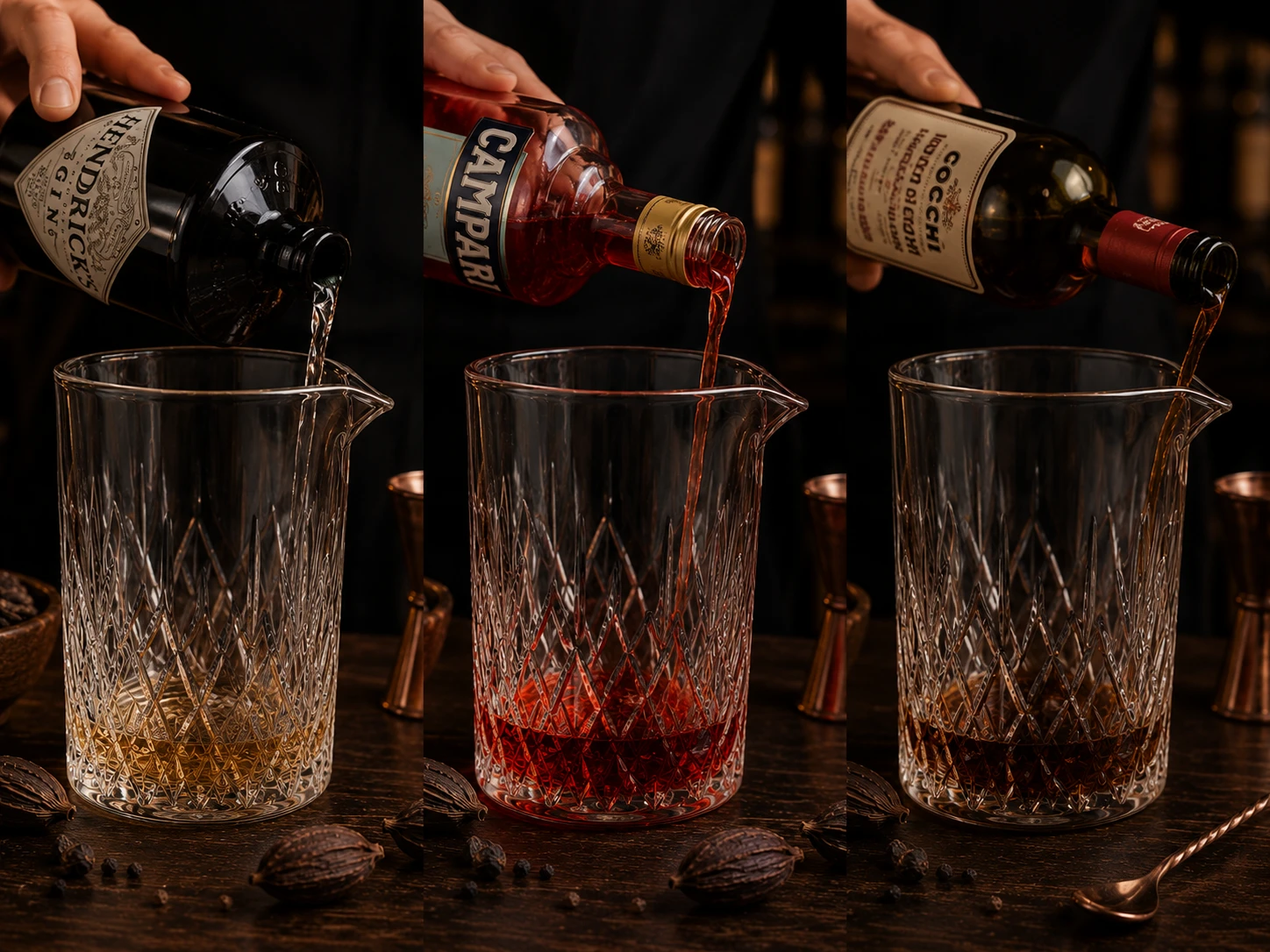
Add Campari, then Carpano Antica, then bourbon — measured precisely with a jigger. 1 oz Campari, 1 oz vermouth, 1.25 oz bourbon.
Why it matters: The slightly elevated bourbon ratio (1.25 oz vs the traditional 1 oz) compensates for Campari’s dominance in a sweet-syrup context. The original 1:1:1 boulevardier already risks Campari overpowering the whiskey — with a sweetness-adding syrup in the build, increasing the bourbon proportion restores the drink’s whiskey-forward character. Use a jigger without exception — eyeballing a 0.25 oz difference is impossible.
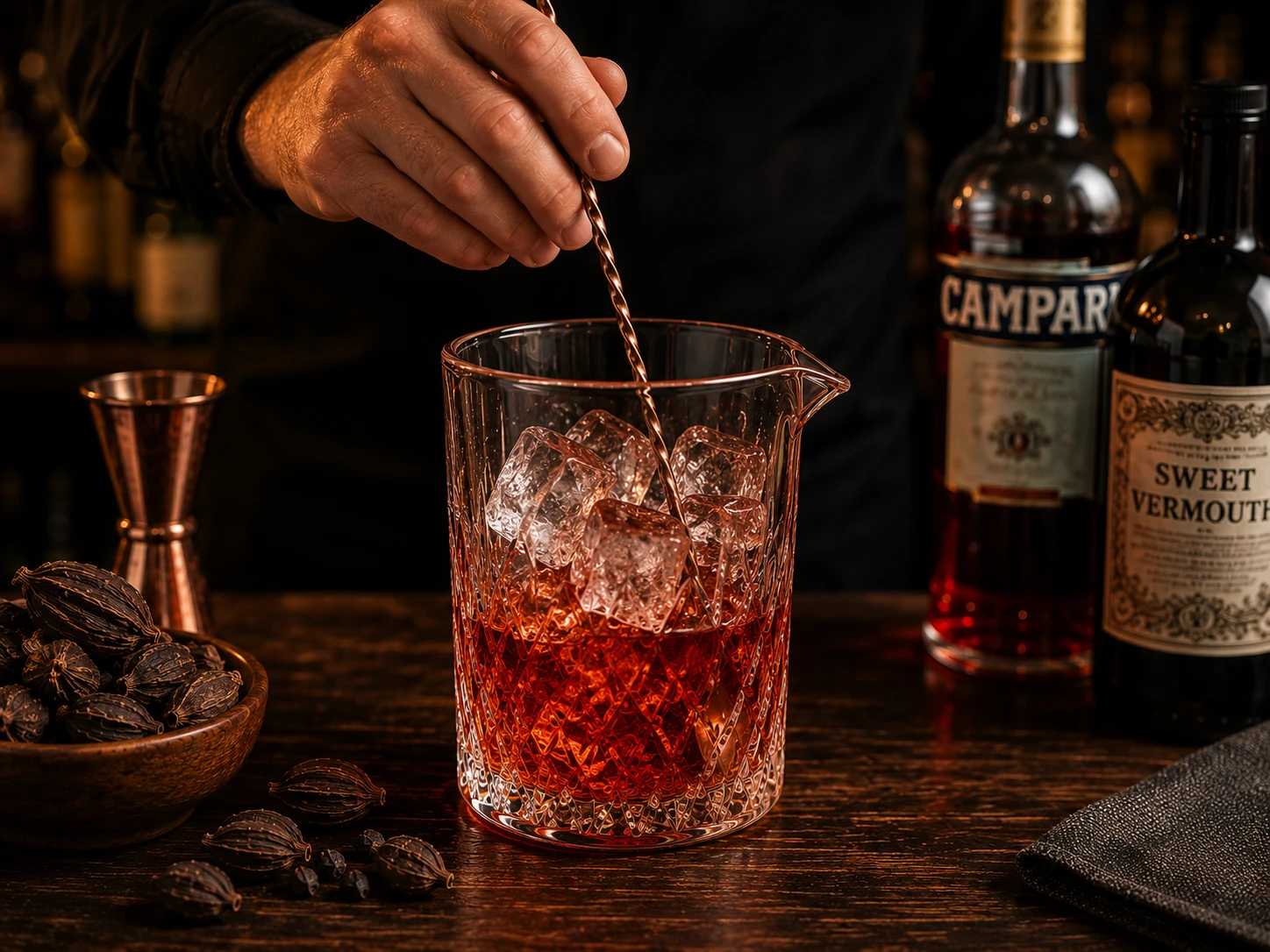
Fill the mixing glass three-quarters with ice. Stir gently for 30 seconds — slightly longer than a negroni — until the outside of the glass frosts and feels wet.
Why it matters: Bourbon interacts with dilution differently than gin. While gin’s botanical complexity can be diluted out quickly, bourbon’s oak-vanilla compounds are released by dilution — a small amount of water is what makes bourbon open up on the palate. The extra 5 seconds of stirring (versus a negroni’s 25) brings the drink to approximately 22–25% dilution, which is the optimal window for this specific combination of spirit, bitter, and vermouth.
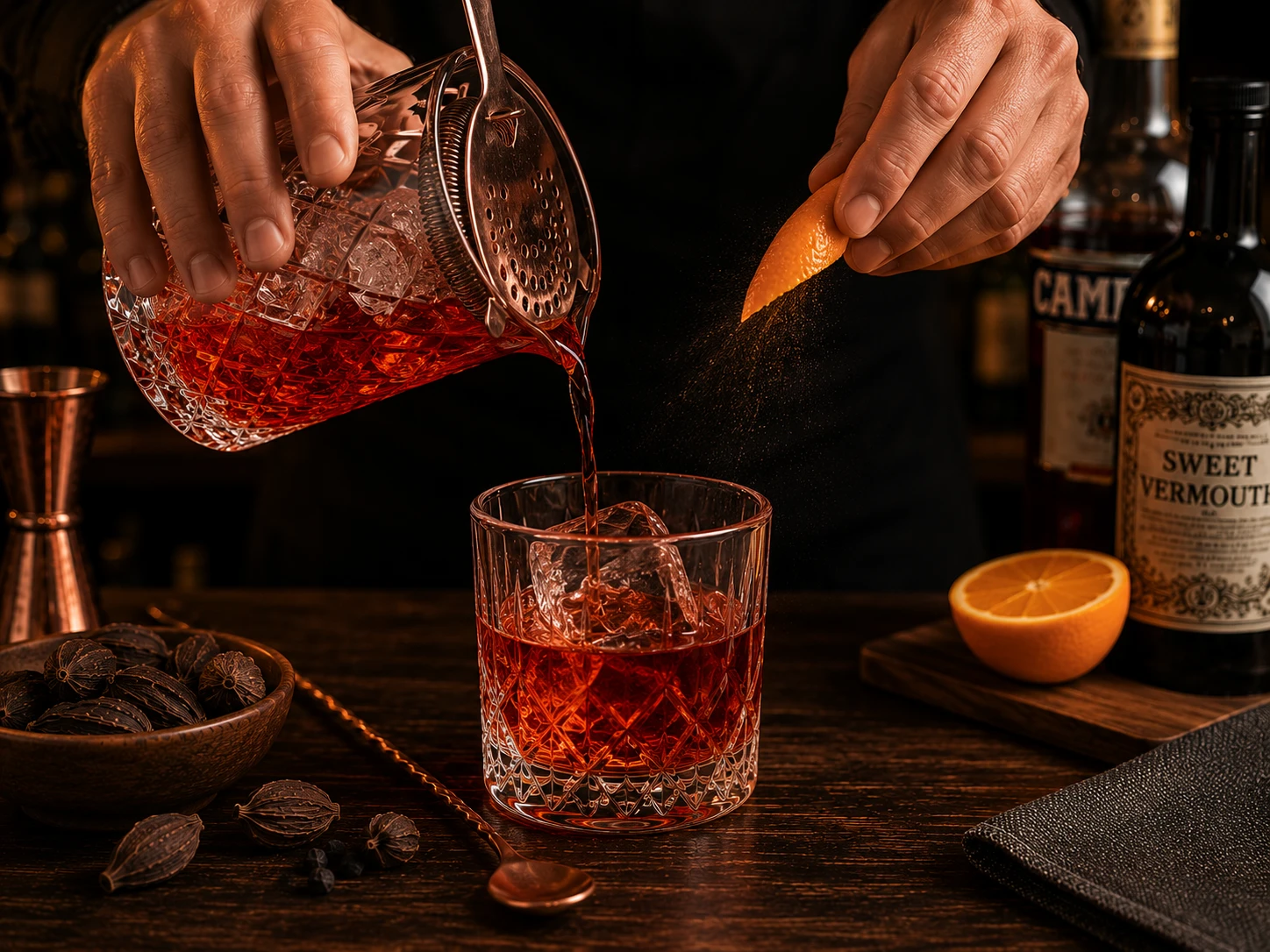
Strain through a Hawthorne strainer into the chilled rocks glass over a single large ice cube. Express orange peel skin-down sharply over the glass, then run around the rim.
Why it matters: A large ice cube melts significantly more slowly than small cubes because of its lower surface-area-to-volume ratio. In a spirit-forward drink consumed slowly over 15–20 minutes, this matters: you want controlled, gradual dilution that slowly opens the bourbon rather than rapid watering-down. The orange peel expression releases limonene oils that sit on the surface of the drink, creating an aromatic top note that lifts the dark, rich base of the boulevardier with every sip.
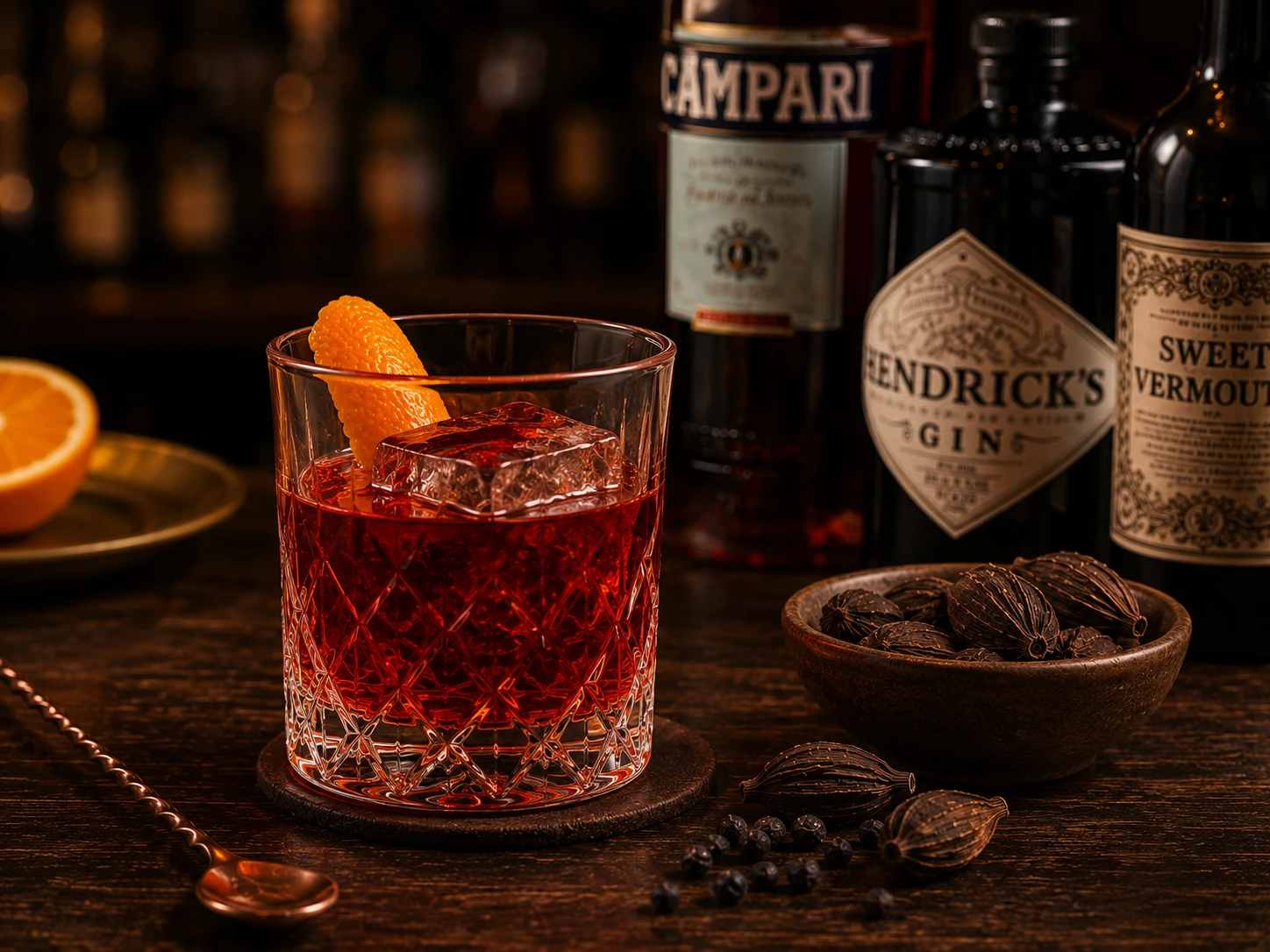
Serve immediately. The black cardamom boulevardier works as an aperitivo before dinner or as an evening sipper — it is more versatile than a standard negroni in this regard.
Why it matters: Unlike the negroni — which is primarily an aperitivo — the boulevardier sits comfortably in both the pre-dinner and after-dinner register. Its bourbon warmth and moderate bitterness stimulate appetite before a meal (the bitter compounds in Campari and vermouth are digestive stimulants), but its richer, darker character also works contemplatively after dinner in the way a neat whiskey does. The black cardamom’s aromatic compounds evolve and deepen as the drink opens up with gradual dilution — resist the urge to drink it too quickly.
🥃 Boulevardier Smoke & Bitterness Balancer
Every variable — bourbon type, vermouth choice, whiskey ratio, black cardamom syrup amount — shifts the character of this drink significantly. This tool shows you the result before you pour.
🥃 Black Cardamom Boulevardier Builder
Adjust ratios — bitterness, smoke, whiskey presence, ABV, and calories update instantly.
Your Boulevardier Profile
Estimates only — actual values vary by brand ABV.
Bourbon Guide — Which Works Best With Black Cardamom
The whiskey choice changes the character of this drink more than any other variable. Black cardamom’s earthy smoke amplifies different qualities in different whiskeys — here is how each category interacts.
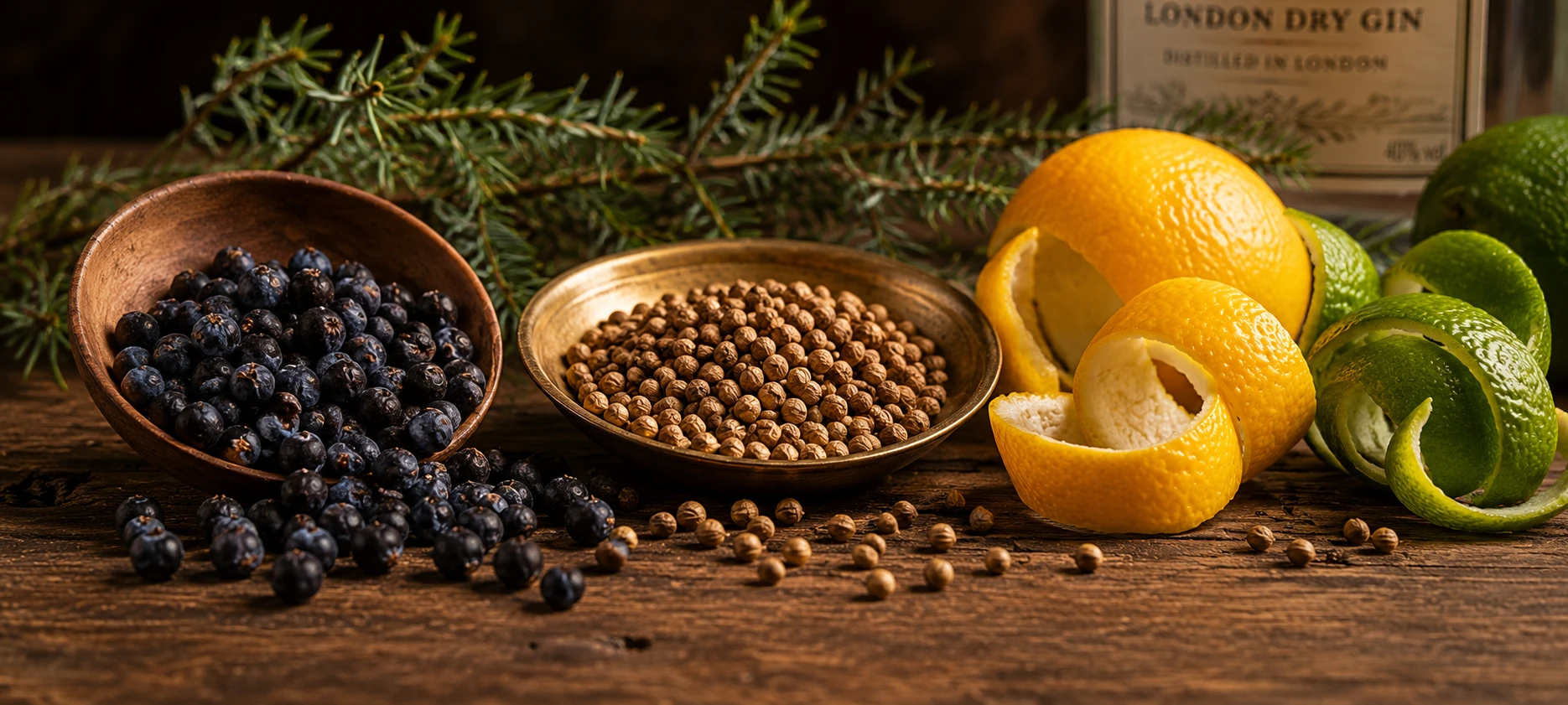
⭐ High-Rye Bourbon — Best Choice
Bulleit, Woodford Reserve, Wild Turkey 101. The rye’s peppery spice amplifies black cardamom’s earthy camphor-smoke character — the two share a common resinous, slightly sharp quality that creates a cohesive mid-palate rather than separate layers.
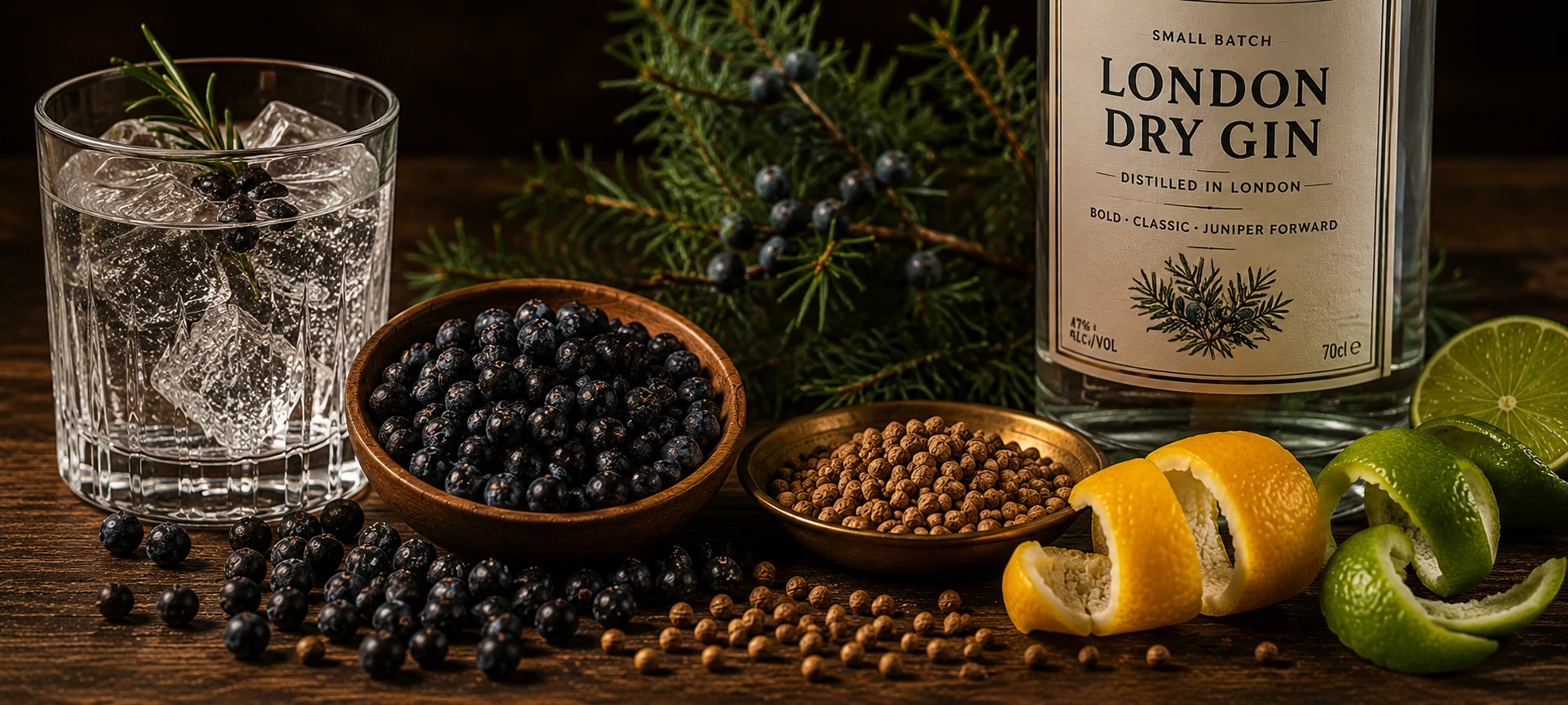
🌾 Wheated Bourbon — Softer Version
Maker’s Mark, W.L. Weller, Larceny. The wheat grain’s softer, rounder profile produces a sweeter, more approachable boulevardier where the black cardamom smoke reads more prominently rather than as a bridge. Good for those who find high-rye expressions too assertive.
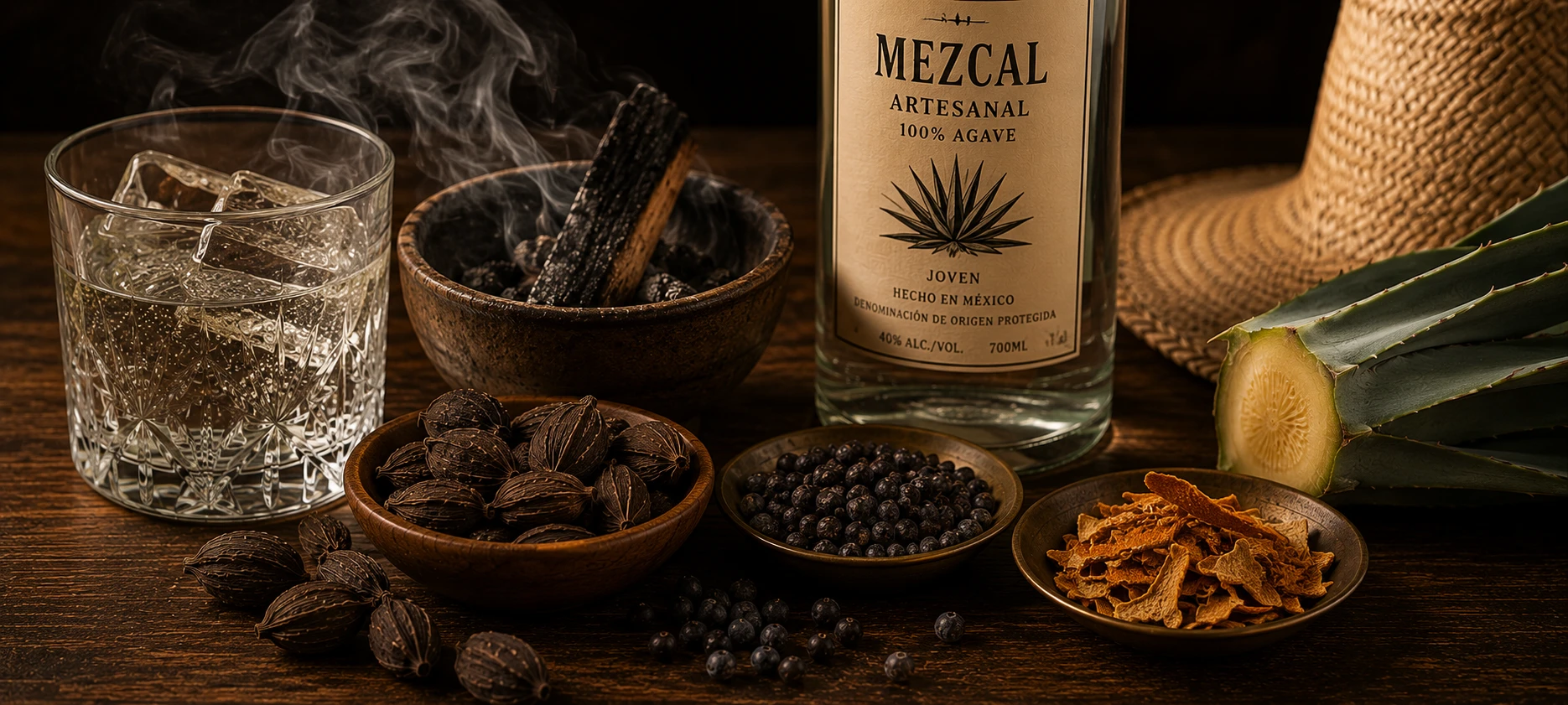
🌾 Rye Whiskey — Drier & More Assertive
Rittenhouse 100, Knob Creek Rye, Dickel Rye. Pure rye amplifies black cardamom’s camphor-smoke most directly — the combination becomes drier, more assertive, and more herbally complex. This is the bartender’s choice for a technically demanding, striking result.
🏴 Scotch — Advanced Variation
A blended Scotch (Johnnie Walker Black, Monkey Shoulder) creates something genuinely unusual: Scotch’s own smoke from peat interacts with black cardamom’s camphor-smoke. Two distinct smoke types — like the mezcal negroni — producing a very complex, very specific drink. Not the entry point, but extraordinary for Scotch drinkers.
Woodford Reserve and Bulleit are available at most UK supermarkets (Tesco, Waitrose, Sainsbury’s) and Marks & Spencer. Wild Turkey 101 is widely available through Asda and Amazon UK. For rye whiskey in the UK: Rittenhouse 100 is stocked at The Whisky Exchange; Knob Creek Rye at Master of Malt and most independent spirits retailers.
Vermouth Guide — The Most Impactful Choice
In a boulevardier, vermouth works harder than in a negroni — it needs to bridge a spirit (bourbon) that is far sweeter and more assertive than gin. With black cardamom syrup adding additional sweetness, the vermouth’s character becomes even more critical.
| Vermouth | Profile | With Black Cardamom | Available |
|---|---|---|---|
| ⭐ Carpano Antica Formula | Vanilla, dark fruit, slight chocolate — rich and complex | The vanilla note directly echoes bourbon’s oak-vanilla; chocolate aligns with black cardamom’s darker earthy notes. The most cohesive result. Best overall by a significant margin. | US + UK |
| Punt e Mes | Higher bitterness, quinine, amaro-adjacent profile | Creates a more bitter, complex build — the second layer of bitterness from Punt e Mes amplifies Campari without duplication. Best for experienced bourbon-Negroni drinkers who want intensity. | US + UK |
| Dolin Rouge | Lighter, fresher, slightly floral | Lacks the body to hold up against bourbon’s weight. The cardamom smoke reads more prominently but feels unmoored — missing the dark fruit bridge. Use only if Carpano is unavailable. | US + UK |
| Martini Rosso | Clean, reliable, neutral sweetness | Works as an entry-level option. Less complex than Carpano, but the black cardamom’s smoke still integrates cleanly. The most accessible and widely available choice. | US + UK supermarkets |
Which Black Cardamom Syrup to Use
CardamomNectar makes three black cardamom syrups, each producing a different character in this boulevardier. The choice meaningfully changes the drink.
| Syrup | Base Sugar | Effect in Boulevardier | Best For |
|---|---|---|---|
| ⭐ Black Cardamom Simple Syrup | White sugar, 2:1 ratio, 48-hr steep | Clean camphor-smoke with neutral sweetness — lets the bourbon and Campari lead while the smoke bridges. The reference recipe uses this version. Most versatile. | This recipe; first-time builders; bourbon forward |
| Black Cardamom Demerara Syrup | Demerara sugar (unrefined, molasses notes) | Smoke plus dark sugar richness — adds a molasses-brown-sugar depth that amplifies Carpano Antica’s dark fruit. Creates a richer, almost confectionery mid-palate. Exceptional in cold months. Slightly sweeter — reduce Campari to 0.75 oz to compensate. | Autumn/winter; Scotch variation; Old Fashioned drinkers |
| Black Cardamom Honey Syrup | Raw honey, 1:1 ratio, 24-hr steep | Smoke with floral honey warmth — lighter than the demerara, softer than the simple syrup. Works particularly well with wheated bourbon, where the honey and wheat create a rounded, sweet-smoke character. The most approachable version overall. | Wheated bourbon builds; spring/summer; lighter palates |
4 Black Cardamom Boulevardier Variations
Once the classic build is dialled in, these four riffs each produce something distinct — each is a valid destination in its own right.
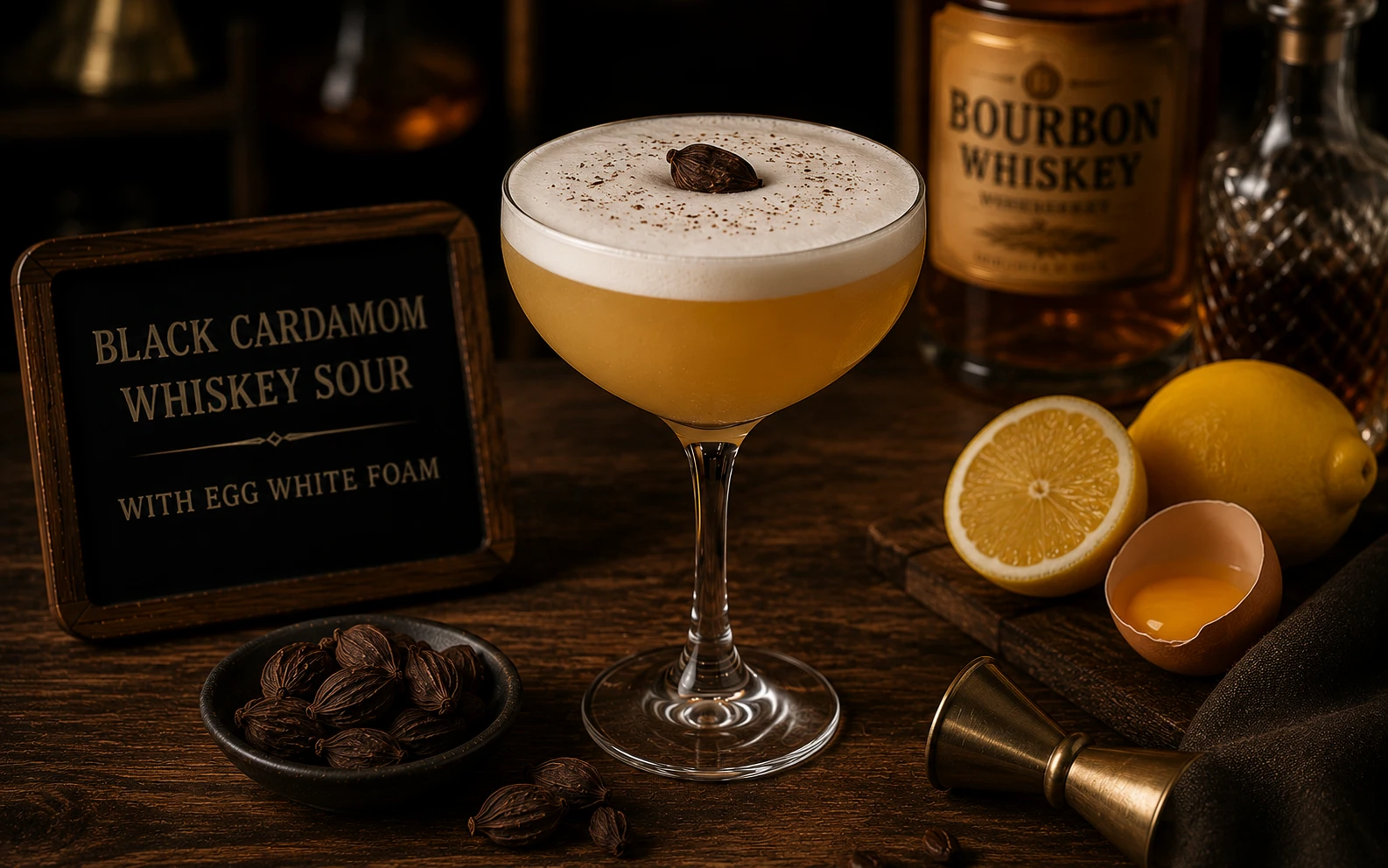
🌾 Black Cardamom Rye Boulevardier
Substitute rye whiskey for bourbon. Rye’s natural peppery spice and grain-forward dryness creates a more assertive, more complex drink — the black cardamom’s earthy camphor aligns more directly with rye’s herbal character than bourbon’s sweetness. Rittenhouse 100 at 100 proof gives this build the backbone it needs to stay cohesive under Campari’s bitterness. This is the bartender’s version — drier, technically demanding, and extraordinary.
Stir 30 sec · strain over large ice · express orange peel
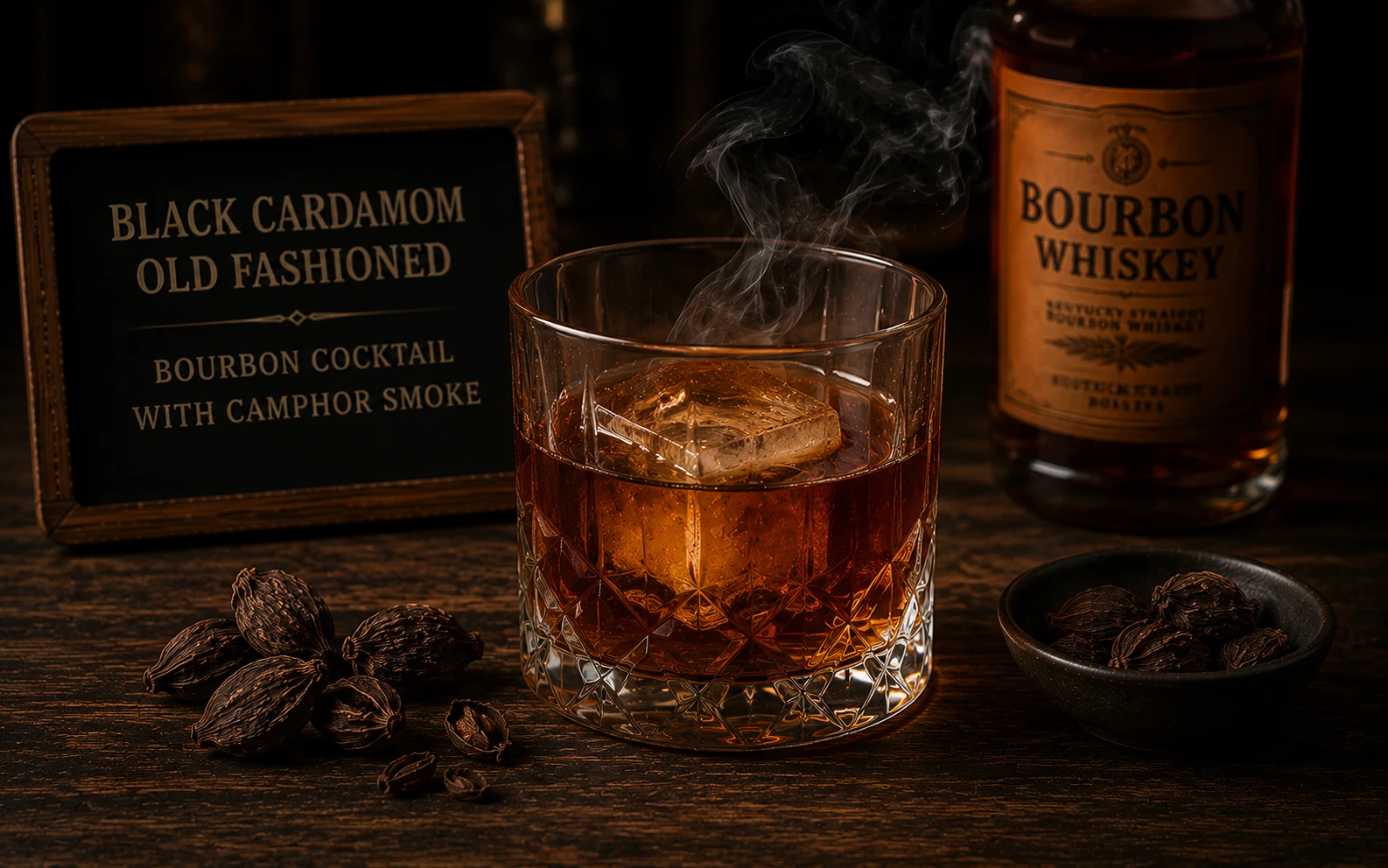
🍂 Black Cardamom Demerara Boulevardier
Swap the standard simple syrup for black cardamom demerara syrup. The unrefined sugar’s molasses-dark-sugar notes amplify Carpano Antica’s dark fruit and bourbon’s caramel character, producing the richest, most confectionery version of this drink. Reduce Campari to 0.75 oz to compensate for the demerara’s additional sweetness. This is the boulevard at its darkest and most warming — a cold-night drink.
Stir 30 sec · strain over large ice · orange peel garnish
🏴 Black Cardamom Scotch Boulevardier
Substitute blended Scotch for bourbon. Scotch’s peat-smoke (phenol-based, from the drying of malted barley) interacts with black cardamom’s camphor-smoke (terpene-based) in a parallel to the double-smoke negroni — two chemically distinct smoke profiles that layer without competing. The result is genuinely extraordinary for Scotch drinkers: familiar in the whisky sense, but with an entirely new aromatic dimension. Use Punt e Mes instead of Carpano to match Scotch’s assertive character.
Stir 30 sec · strain · express lemon peel (not orange) over glass
🍯 Black Cardamom Honey Boulevardier
Substitute black cardamom honey syrup for the plain simple syrup, and use a wheated bourbon (Maker’s Mark or Larceny). The floral honey warmth softens the transition between bourbon and Campari, while the black cardamom smoke reads as a lightly exotic finish rather than a structural element. This is the version to make for guests unfamiliar with bitter cocktails — it is approachable, rounded, and gently spiced without the intensity of the standard build.
Stir 25 sec · strain over ice · orange peel garnish
Batch Recipe — Black Cardamom Boulevardier for 8
Like the negroni, the boulevardier batches exceptionally well — no citrus, no egg, no carbonation. Make it the morning of a dinner party and refrigerate.
🥃 Batched Black Cardamom Boulevardier — Serves 8
Eight glasses of the same quality as a single pour — made in advance, served without effort.
Ingredients
- 10 oz high-rye bourbon
- 8 oz Campari
- 8 oz Carpano Antica Formula
- 2 oz black cardamom simple syrup
- 4 oz water (pre-dilution)
- 8 strips orange peel (serving)
Method
- Combine bourbon, Campari, vermouth, and syrup in a 750ml bottle
- Add 4 oz water — pre-dilution to match a stirred cocktail
- Seal and refrigerate — up to 3 weeks
- To serve — pour 4 oz per person over a large ice cube
- No stirring needed — pre-dilution handles it
- Express orange peel over each glass, use as garnish
A properly stirred boulevardier is diluted approximately 22–25% by volume from ice melt during stirring. Without pre-dilution, a batched boulevardier is too concentrated and the bourbon’s ABV feels harsh. Adding 4 oz water to an 8-serving batch (approximately 15% of total volume) replicates the dilution of a properly stirred individual cocktail. Pour straight over a large ice cube — no stirring required, identical quality every glass.
Frequently Asked Questions
What is a boulevardier cocktail?
A boulevardier is a stirred cocktail made with whiskey (bourbon or rye), Campari, and sweet vermouth — essentially a Negroni with bourbon substituted for gin. It was created in 1920s Paris by Erskine Gwynne, an American writer who missed his whiskey while living among Europe’s Negroni culture, and first appeared in print in Harry MacElhone’s 1927 book Barflies and Cocktails. It became an IBA official cocktail in 2020. The word “boulevardier” refers to a fashionable man-about-town who frequents the boulevards — a fitting name for a drink that is essentially gin’s classier, warmer-tempered American cousin.
What does black cardamom add to a boulevardier?
Black cardamom adds a camphor-smoke, resinous depth that bridges bourbon’s vanilla-oak character with Campari’s bitter-citrus profile. In a standard boulevardier, these two flavour poles — sweet, warm bourbon and bitter, citrusy Campari — are partially connected by vermouth but can still feel disconnected. Black cardamom’s cineole and camphor volatiles occupy an aromatic register that shares qualities with both bourbon’s oak resins and Campari’s botanical bitterness, creating a perceptual bridge rather than a separate flavour layer. Most drinkers describe the result as tasting like an exceptionally complex bourbon was used, or that the bitters are unusually multidimensional.
What is the best bourbon for a black cardamom boulevardier?
A high-rye bourbon — Woodford Reserve, Bulleit, or Wild Turkey 101. Rye’s peppery, grain-forward character amplifies black cardamom’s earthy camphor-smoke, and both share a resinous quality that creates cohesion rather than competition. Sweeter wheated bourbons (Maker’s Mark, W.L. Weller) produce a softer, more approachable version where the cardamom smoke reads more prominently. Pure rye whiskey (Rittenhouse 100, Knob Creek Rye) produces the driest, most assertive version. Avoid barrel-proof or heavily aged bourbons — their intensity overwhelms the subtler contributions of the cardamom syrup.
Boulevardier vs Negroni — which is better?
Neither is objectively better — they are different drinks for different moments. A Negroni (gin base) is more aromatic, lighter, and bitter-forward — the classic Italian aperitivo. A Boulevardier (bourbon base) is warmer, richer, and more spirit-forward — closer to a contemplative whiskey drink with bitter elements. For most whiskey drinkers, the Boulevardier is the more immediately accessible of the two; for gin drinkers, the Negroni. With black cardamom syrup, both drinks gain a camphor-smoke bridge that improves their internal cohesion — but the effect is arguably more pronounced in the Boulevardier, where the bridging role is more needed.
Do I stir or shake a boulevardier?
Always stir, never shake. A boulevardier is entirely spirits and fortified wine — no citrus juice, no egg, no ingredient requiring emulsification or aeration. Shaking produces cloudiness from air bubbles, over-dilutes the drink (approximately 3× faster than stirring), and produces a thinner, less silky texture. Stir gently for 30 seconds in a separate mixing glass three-quarters full of ice, until the outside of the glass frosts. Strain into the serving glass. The dense, smooth texture of a properly stirred boulevardier is one of its defining qualities.
What is the correct boulevardier ratio?
The original 1927 recipe called for 1:1:1 (whiskey:Campari:vermouth). Most modern bartenders increase the whiskey to 1.5:1:1, and some go to 2:1:1. For the black cardamom version, use 1.25:1:1 (1.25 oz bourbon, 1 oz each Campari and vermouth) plus ¼ oz black cardamom syrup. The slightly elevated bourbon prevents Campari from dominating after the syrup’s sweetness is added. Use the calculator on this page to adjust for your specific preference.
Can I use rye whiskey instead of bourbon?
Yes — many bartenders prefer rye. Its peppery, grain-forward character amplifies black cardamom’s earthy smoke more directly than bourbon’s sweeter profile. The result is a drier, more assertive drink where the camphor-smoke reads as a spice accent. Use the same ratio: 1.25 oz rye (Rittenhouse 100 is the best choice for this build), 1 oz Campari, 1 oz Carpano Antica, ¼ oz black cardamom simple syrup.
Is a boulevardier served on the rocks or straight up?
On the rocks (over ice) is more common and recommended for the black cardamom version — the gradual dilution allows the cardamom’s aromatic compounds to evolve as the drink opens up, similar to how a fine whisky reveals more complexity with a small amount of water. Straight up (strained into a coupe or Nick & Nora, no ice) produces a more concentrated, warmer, higher-ABV result for those who prefer their spirits undiluted. Both are valid.
What vermouth is best for a black cardamom boulevardier?
Carpano Antica Formula — by a significant margin. Its vanilla, dark fruit, and subtle chocolate notes bridge directly between bourbon’s oak-vanilla and black cardamom’s camphor-smoke, creating the most cohesive result. The vanilla in Carpano directly echoes bourbon’s vanillin compounds (produced during oak barrel ageing). Punt e Mes is a good second choice for those who want more bitterness. Avoid light vermouths like Dolin Rouge in this build — they lack the body to bridge the bourbon and Campari. Refrigerate vermouth after opening; use within 4–6 weeks.
How many calories are in a black cardamom boulevardier?
Approximately 210–230 calories for a standard pour (1.25 oz bourbon, 1 oz Campari, 1 oz sweet vermouth, ¼ oz 2:1 simple syrup). Bourbon contributes approximately 85 calories at 1.25 oz, Campari approximately 80 calories, Carpano Antica approximately 50 calories, and the black cardamom syrup approximately 15–20 calories. Slightly higher than a standard negroni due to the increased bourbon ratio.
What season is the black cardamom boulevardier best for?
Autumn and winter primarily — the combination of bourbon’s warmth, Campari’s bitterness, Carpano’s dark fruit, and black cardamom’s camphor-smoke creates a drink that feels atmospheric and warming in cold months. That said, it works year-round for bourbon drinkers. For a lighter summer version, use wheated bourbon, reduce to 1 oz, swap Carpano for Dolin Rouge, and serve over a large ice sphere in a wide glass — the drink becomes lighter and crisper while retaining the cardamom smoke character.
How does the black cardamom demerara syrup change this drink?
Swapping standard simple syrup for black cardamom demerara syrup adds molasses-dark-sugar richness on top of the camphor-smoke. In a boulevardier, where bourbon already brings vanilla-caramel, the demerara’s unrefined sugar creates a layered, almost confectionery mid-palate — like a bitter dark chocolate quality running through the drink. It makes the drink richer and sweeter; reduce Campari to 0.75 oz to compensate. The demerara version is particularly exceptional in cold months and pairs well with Scotch-based builds.
Where can I buy black cardamom pods?
In the US: Indian or Pakistani grocery stores (labelled badi elaichi), Patel Brothers, Whole Foods, or online through Diaspora Co. and Burlap & Barrel. A 50g bag costs $4–7 and makes 4–5 batches of syrup (16–20 cocktails per batch). In the UK: most Asian supermarkets, Whole Foods, Amazon UK, or Ocado. A 50g bag costs £3–6. For the strongest camphor character — which is what makes the integration effect most pronounced — single-origin Nepali black cardamom from Diaspora Co. (US) or Spice Mountain at Borough Market, London (UK) is the best source. See our full cardamom buying guide.
More Black Cardamom Cocktails
All built on the same black cardamom syrup family — make one batch, explore the full range.
Continue Exploring
| Page | What You’ll Find |
|---|---|
| Black Cardamom Cocktails Hub | All cocktails using black cardamom — full index |
| Black Cardamom Simple Syrup | The foundational syrup — make this first |
| Black Cardamom Demerara Syrup | Richer, darker — exceptional in the demerara variation above |
| Black Cardamom Honey Syrup | Floral warmth — best for the honey boulevardier variation |
| Black Cardamom Negroni | The gin-based sibling — lighter, more botanical |
| Cardamom Buying Guide | Where to source black cardamom pods in the US and UK |
| Green vs Black Cardamom | Why these are completely different spices |
WRITTEN BY
Emily Rhodes — Culinary & Spice WriterEmily covers South Asian spice culture, recipe development, and cocktail applications. Spice market visits in Kerala, Karachi, and Dubai. View full profile →
REVIEWED BY
Dr. Michael Bennett — Food Scientist & PhytochemistReviewed all technical content — volatile compound interactions, dilution chemistry, and bourbon-cardamom flavour pairing analysis. View profile →