Black Cardamom Substitute: Find the Best Swap by Dish & Spices You Have | CardamomNectar
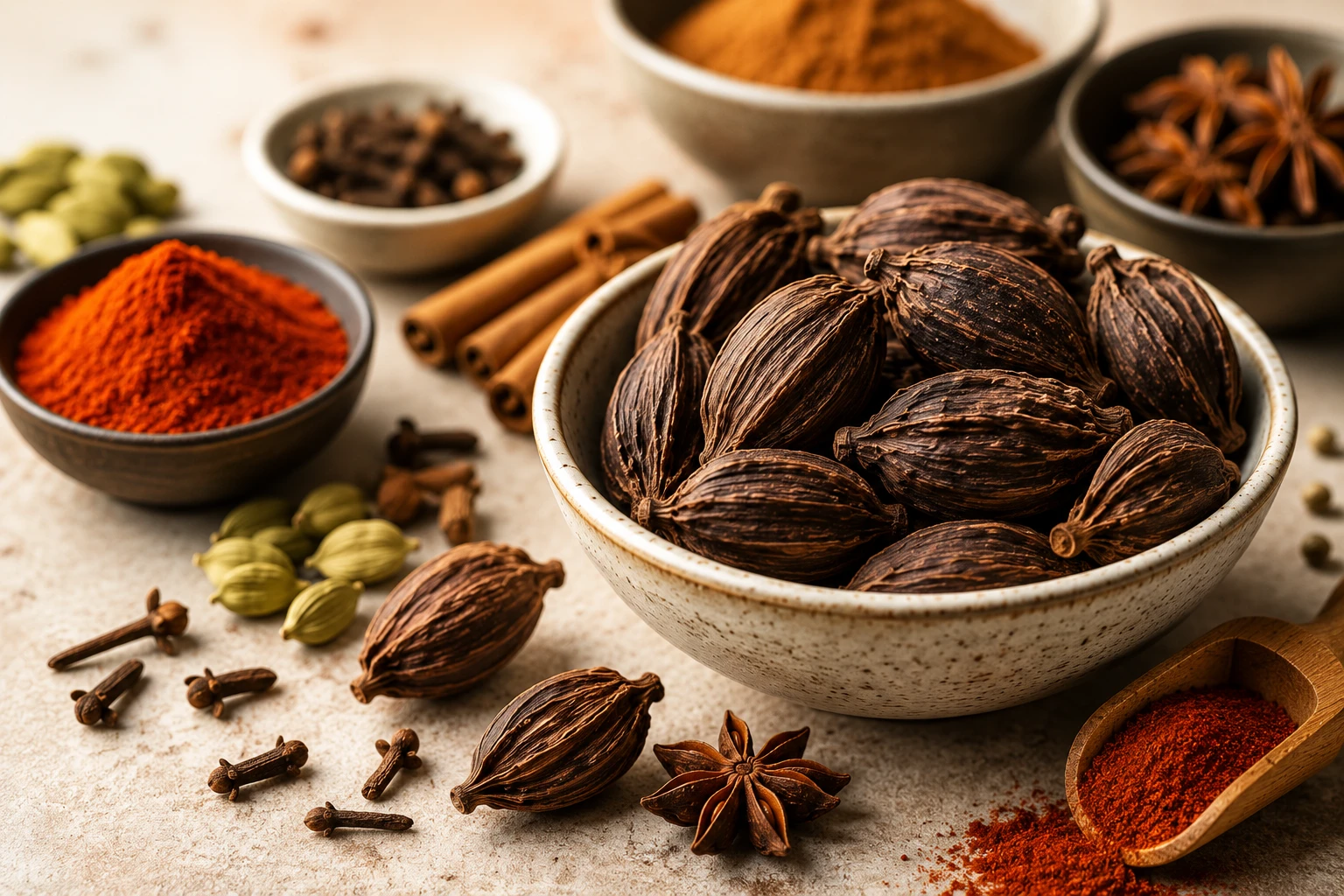
Black cardamom pods next to smoked paprika, cloves and star anise substitute spices
🔄 Interactive Substitute Finder

Black Cardamom Substitute

Pick your dish. Pick the spices you have. Get the exact substitute ratio — instantly. The only black cardamom substitute guide built around what’s actually in your spice drawer.

🔍 Interactive Finder ⚖️ Exact Ratios 🍽️ 9 Dish Types 🫙 Spice-Aware Results 🧪 Flavour Science
Best overallSmoked paprika + green cardamom
For biryaniCloves + smoked paprika
For broth/phoStar anise
For BBQ rubSmoked paprika or chipotle
Never useGreen cardamom alone
Emily Rhodes
Written byEmily Rhodes
Dr. Michael Bennett
Reviewed byDr. Michael Bennett
📅 Updated July 19, 202612 min read
Quick Answer

Black cardamom substitute, replacement, or alternative: The best all-purpose swap is 1/2 tsp smoked paprika plus one green cardamom pod per black cardamom pod. For biryani: 3–4 whole cloves plus 1/2 tsp smoked paprika per pod. For broth and pho: 1 star anise per 2 pods. For BBQ rubs: 1/2 tsp hot smoked paprika or chipotle powder per 1 tsp ground. Never use green cardamom alone — it tastes completely different. No substitute fully replicates black cardamom’s camphor-smoke profile. Use the interactive tool below to get the exact substitute based on your dish and available spices.

Black Cardamom Substitute — Fast Facts

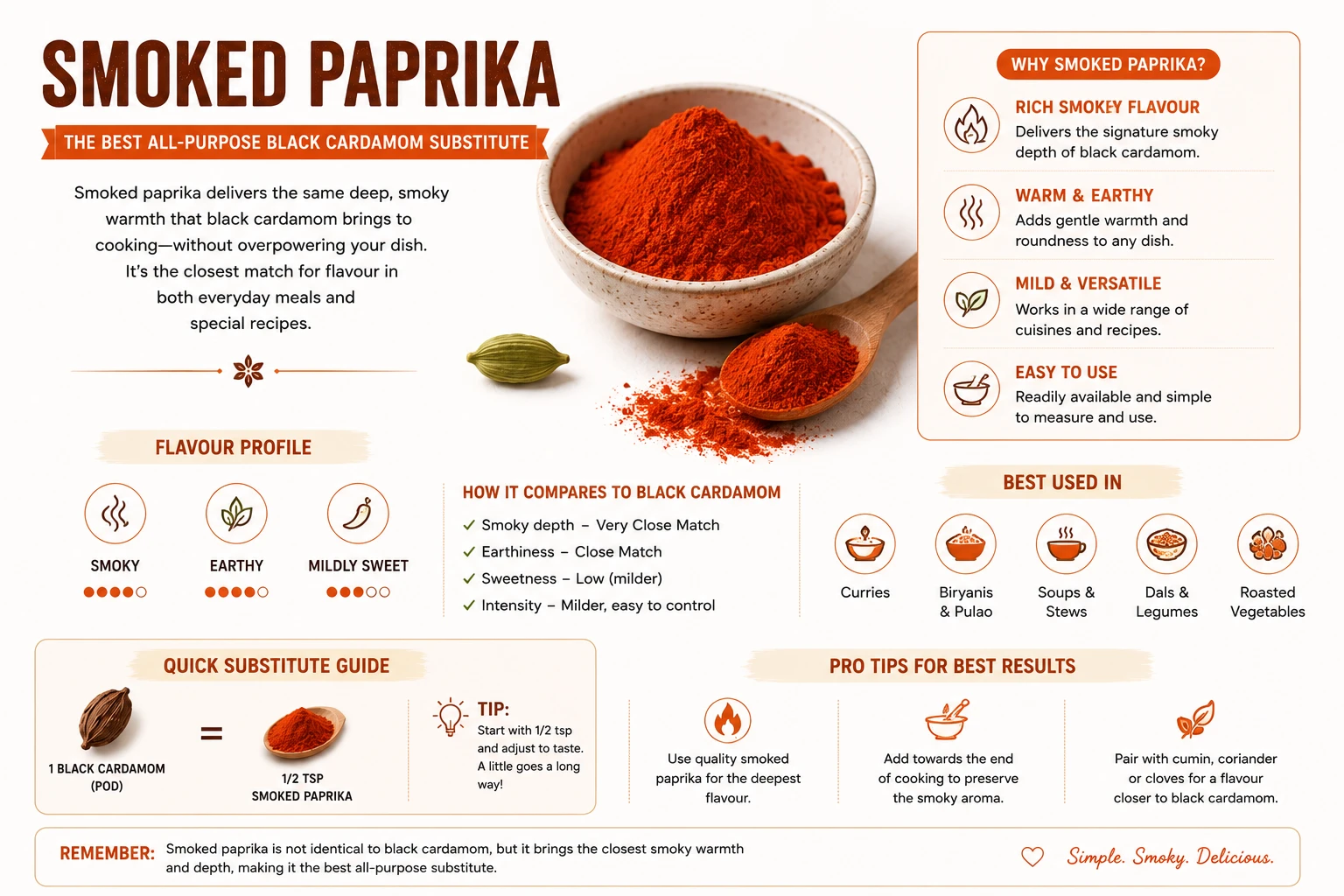
  • The best all-purpose black cardamom substitute, replacement, or alternative is 1/2 tsp smoked paprika plus 1 whole green cardamom pod per black cardamom pod.
  • For biryani and curry, whole cloves plus smoked paprika (3–4 cloves + 1/2 tsp paprika per pod) is the closest match, at roughly a 62% flavour match.
  • For bone broth and pho, 1 whole star anise pod replaces 2 black cardamom pods, though it shifts the flavour toward licorice rather than smoke.
  • Chipotle powder is a strong alternative to smoked paprika for BBQ rubs and smoky curries — both are made from smoked peppers and deliver a similar earthy heat.
  • Green cardamom cannot substitute for black cardamom — they are different species (Elettaria cardamomum vs. Amomum subulatum) with opposite flavour profiles.
  • No single spice replicates black cardamom’s camphor-smoke compounds (camphor, 1,8-cineole, guaiacol, cresol), which are produced by fire-drying the pods over an open flame.
  • When no adequate substitute is available, omitting black cardamom usually produces a better result than using the wrong spice — this is especially true in chai and tea, where black cardamom is rarely used in the first place.
  • Black cardamom is also known as badi elaichi, kali elaichi, or moti elaichi in South Asian markets.

Fact-checked by Dr. Michael Bennett, Food Scientist & Phytochemist · Last verified July 19, 2026

Interactive Substitute Finder

Tell the tool what you’re cooking and which spices you have on hand — it will calculate your best available black cardamom substitute with exact ratios and method notes.

🔍 Black Cardamom Substitute Finder
Step 1: Pick your dish · Step 2: Check what you have · Step 3: Get your substitute
No competitor has this
Step 1 Your Dish
Step 2 Your Spices
Step 3 Your Result
What are you cooking?
🍚 Biryani / Pulao
🍛 Meat Curry
🫘 Dal / Lentils
🍜 Broth / Pho
🔥 BBQ Dry Rub
🥩 Marinade
🍸 Cocktail Syrup
🫙 Garam Masala
Chai / Tea
Which of these do you have? (select all that apply)
🌶️ Smoked Paprika
🌶️ Chipotle Powder
🔩 Whole Cloves
Star Anise
💚 Green Cardamom
🪵 Cinnamon
🫙 Garam Masala
💧 Liquid Smoke
🥜 Nutmeg
🫐 Allspice

Not all spices are suitable for all dishes — the tool will calculate your best option from what you have selected.

Your Best Available Substitute
Complete steps 1 and 2 to see your result.
Step 1 of 3

Why Black Cardamom Is Hard to Substitute
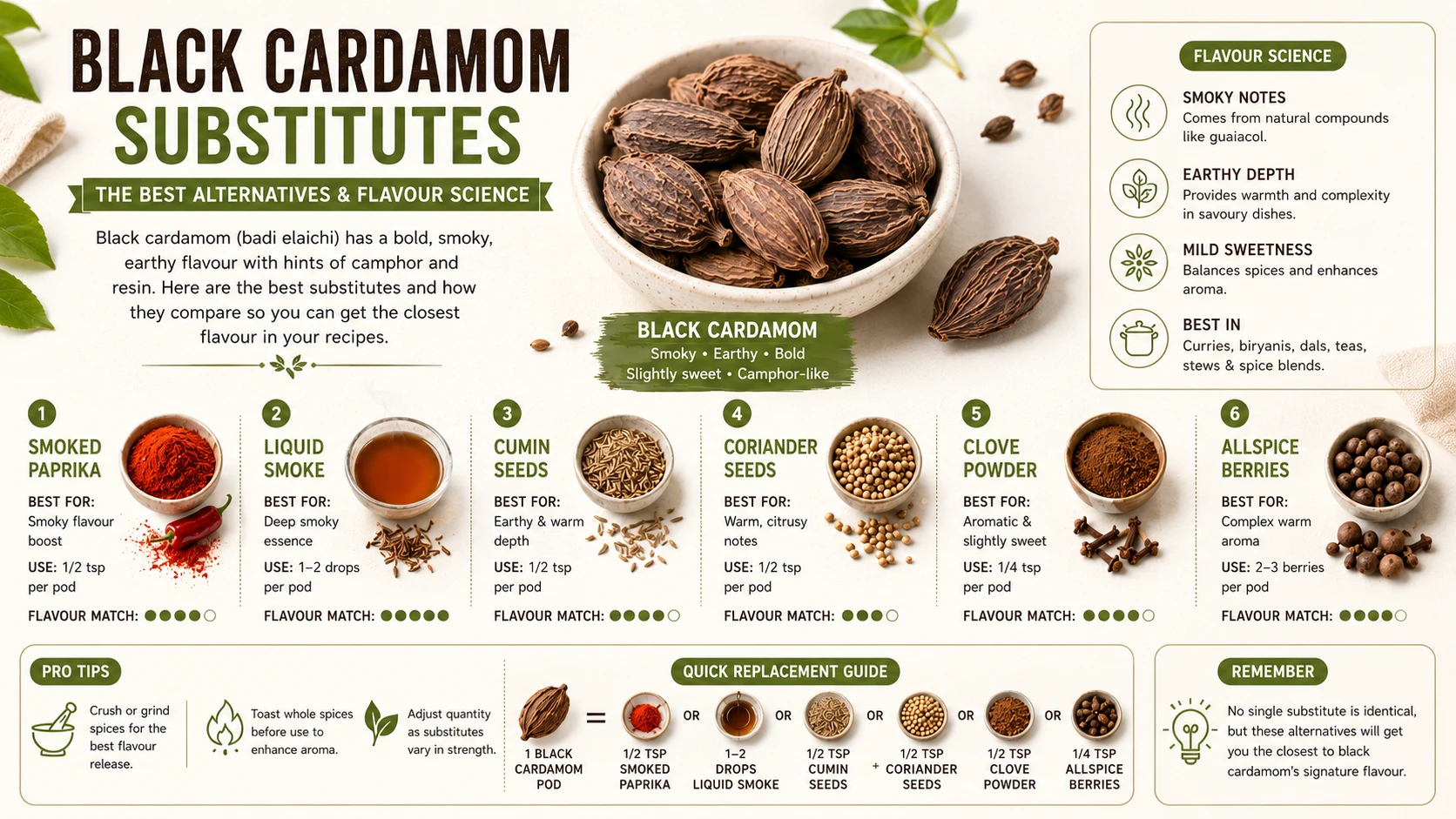
Black cardamom pods (badi elaichi) with alternative spices on dark surface — substitute guide with flavour science

Black cardamom’s campfire-smoke character comes from unique volatile compounds produced by fire-drying — no common spice fully replicates this

Black cardamom’s flavour comes from two compound groups almost entirely absent from other spices: camphor and 1,8-cineole (producing the campfire-smoke and menthol character) from the seeds, and guaiacol and cresol (producing woody-ash smoke background) from the fire-drying process.

No single substitute contains both groups. Every substitute approximates only part of the profile — which is why the right substitute depends entirely on which flavour dimension matters most for your specific dish.

The Chemistry Behind Black Cardamom’s Campfire-Smoke Flavour

The Compound Gap: Why No Single Spice Works

The compound gap: Smoked paprika delivers capsanthin-based smoke colour and mild aroma — but zero camphor or cineole. Cloves deliver eugenol-based aromatic depth — but no smoke. Star anise delivers anethole-licorice — no smoke, no camphor. Cinnamon delivers cinnamaldehyde warmth — no smoke, no camphor. A blend of cloves plus smoked paprika is the closest practical combination, covering 2 of black cardamom’s 4 dominant compound groups.

Flavour dimensions — what your black cardamom substitute needs to replace

Campfire smoke
Very High
Camphor / menthol
High
Resinous / earthy depth
High
Aromatic pungency
Medium
Sweetness
Low
Licorice
None

How to Read This Ratio Chart at a Glance

This chart condenses every ratio on this page into one reference image, organised by application — biryani and curry at the top, moving down through dal, bone broth, BBQ dry rub, marinade, and finally cocktail syrup at the bottom. Each row pairs the black cardamom quantity with its closest substitute and the exact measurement to use in place of it.

Keep it open on your phone while cooking, or save it to your recipes board so it’s on hand the next time a recipe calls for badi elaichi and your spice drawer comes up short. The ranking mirrors the match percentages used throughout this guide, so the substitutes listed near the top of the chart are the ones worth reaching for first.
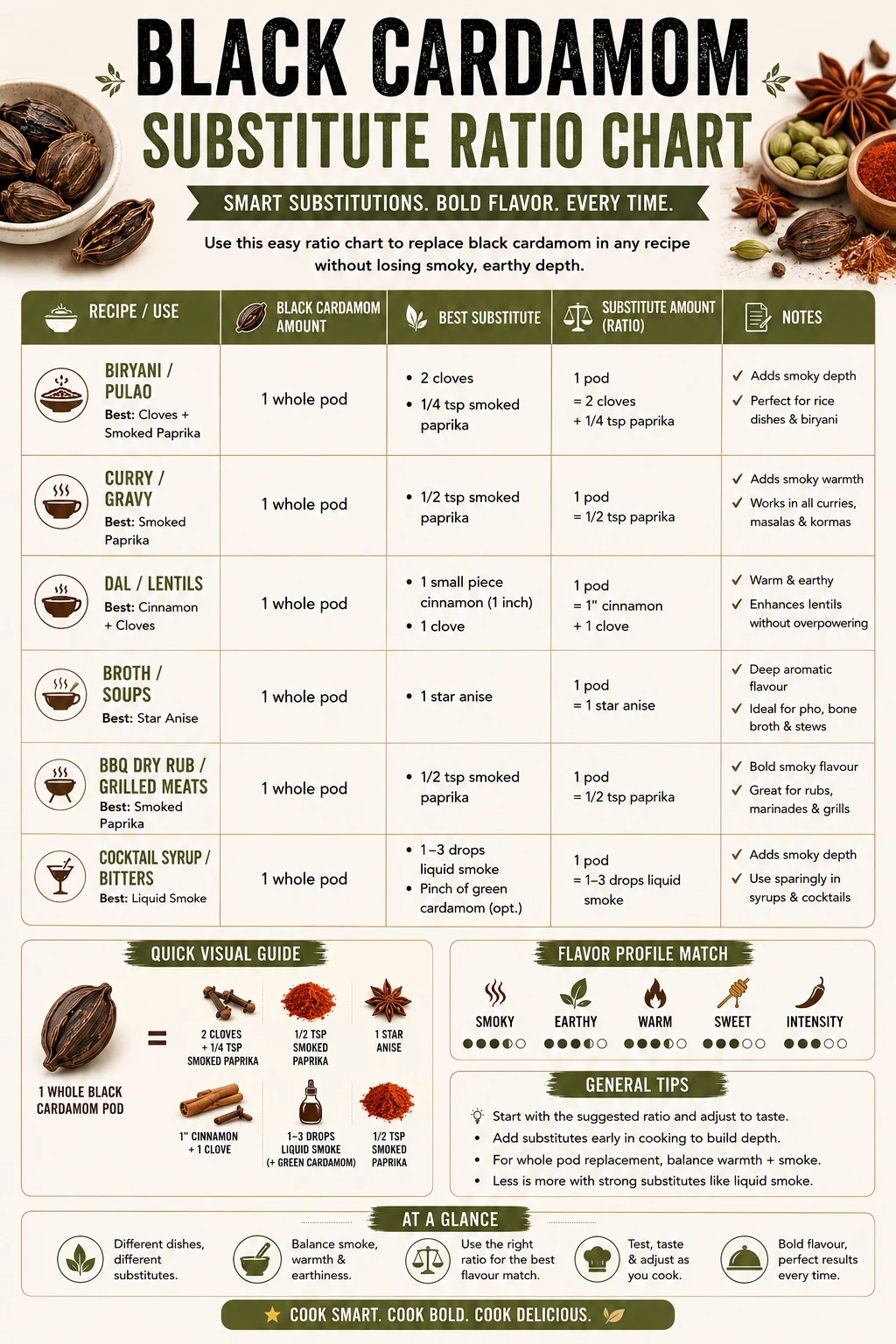
Black cardamom substitute ratio chart infographic — biryani, curry, dal, broth, BBQ rub and cocktail syrup ratios

Save this chart for quick reference in your kitchen

Top 7 Substitutes — Ranked

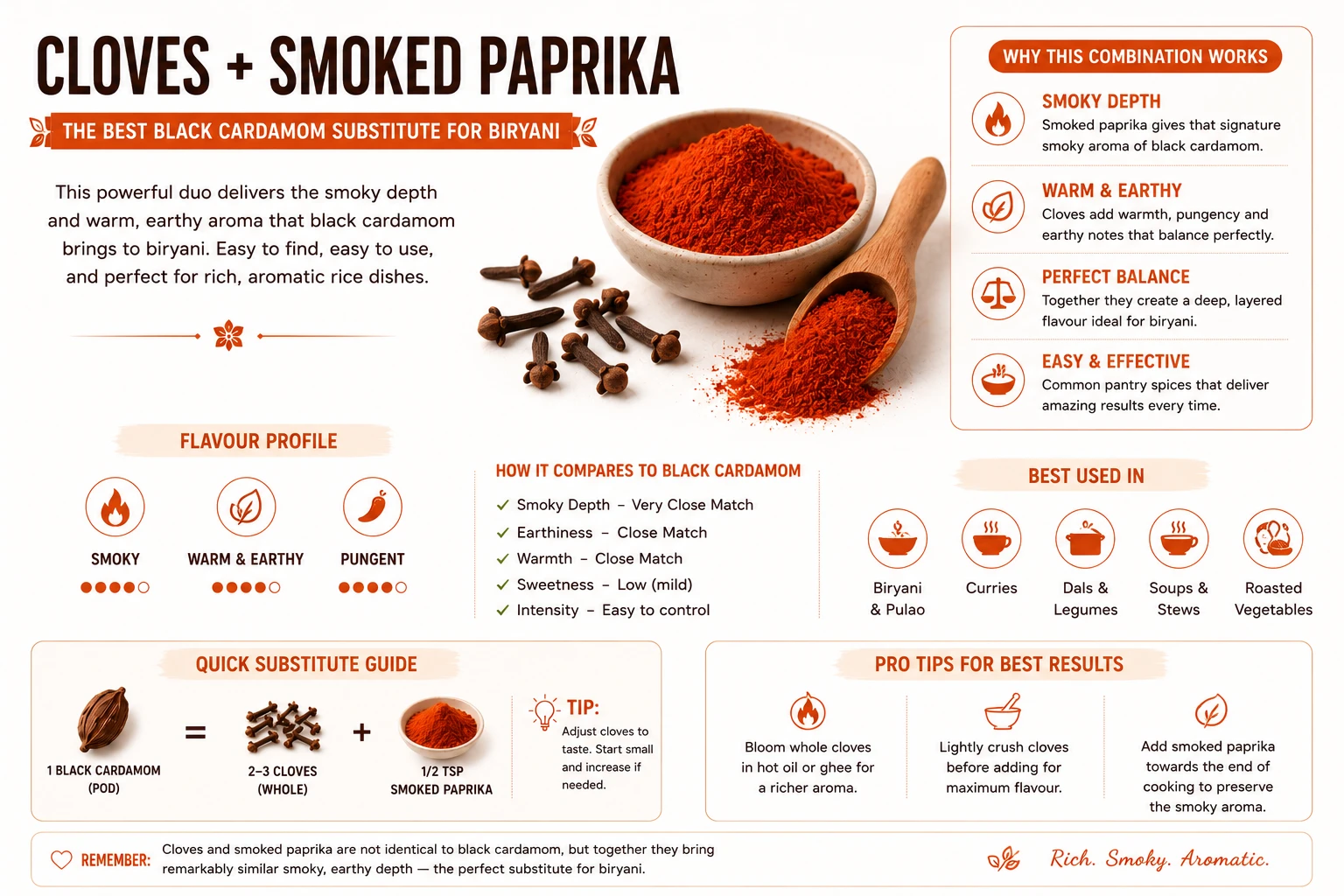
Smoked paprika and a whole green cardamom pod — the best all-purpose black cardamom substitute Best Overall

Smoked Paprika + Green Cardamom Pod

1/2 tsp smoked paprika + 1 green cardamom pod per pod

The best all-purpose approximation. Smoked paprika provides smoke colour and aroma; the green cardamom pod adds the spice-aromatic base. Together they hit 3 of black cardamom’s 5 flavour dimensions. The camphor-menthol note is still absent.

Works in: Biryani, curry, dal, marinade, garam masala. Avoid in: Cocktail syrups — paprika in cold liquid tastes wrong.
Overall match
58%
Best All-Purpose
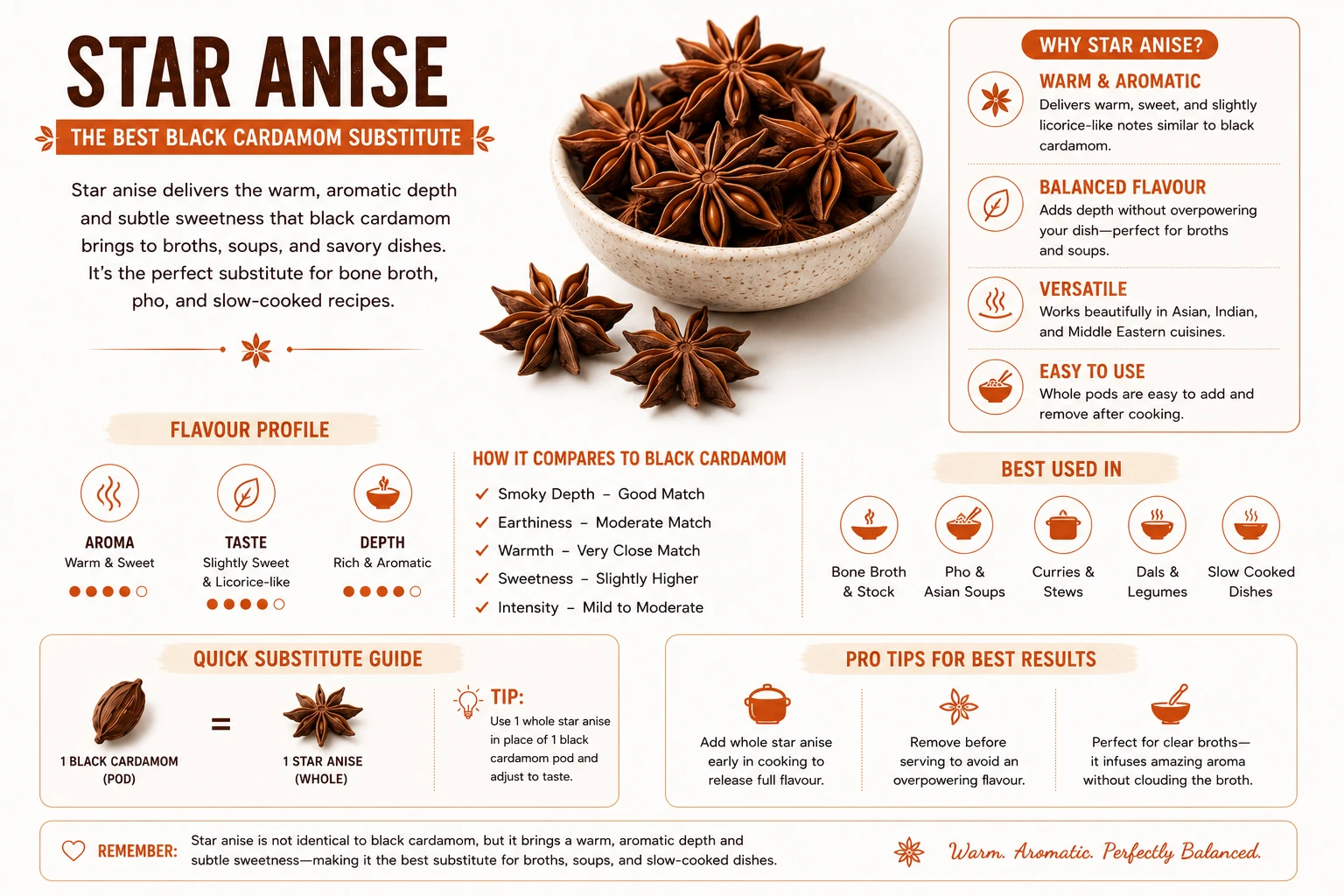
Whole cloves and smoked paprika — the best black cardamom substitute for biryani Best for Biryani

Whole Cloves + Smoked Paprika

3–4 cloves + 1/2 tsp smoked paprika per pod

Cloves’ eugenol provides aromatic depth and pungency; smoked paprika adds smoke colour and aroma. The closest result to black cardamom in a slow-cook biryani — though without the mentholated camphor finish. Remove cloves before serving.

Critical: Add smoked paprika with dry masala — never directly in hot oil. It burns and turns bitter.
Biryani match
62%
Best for Biryani
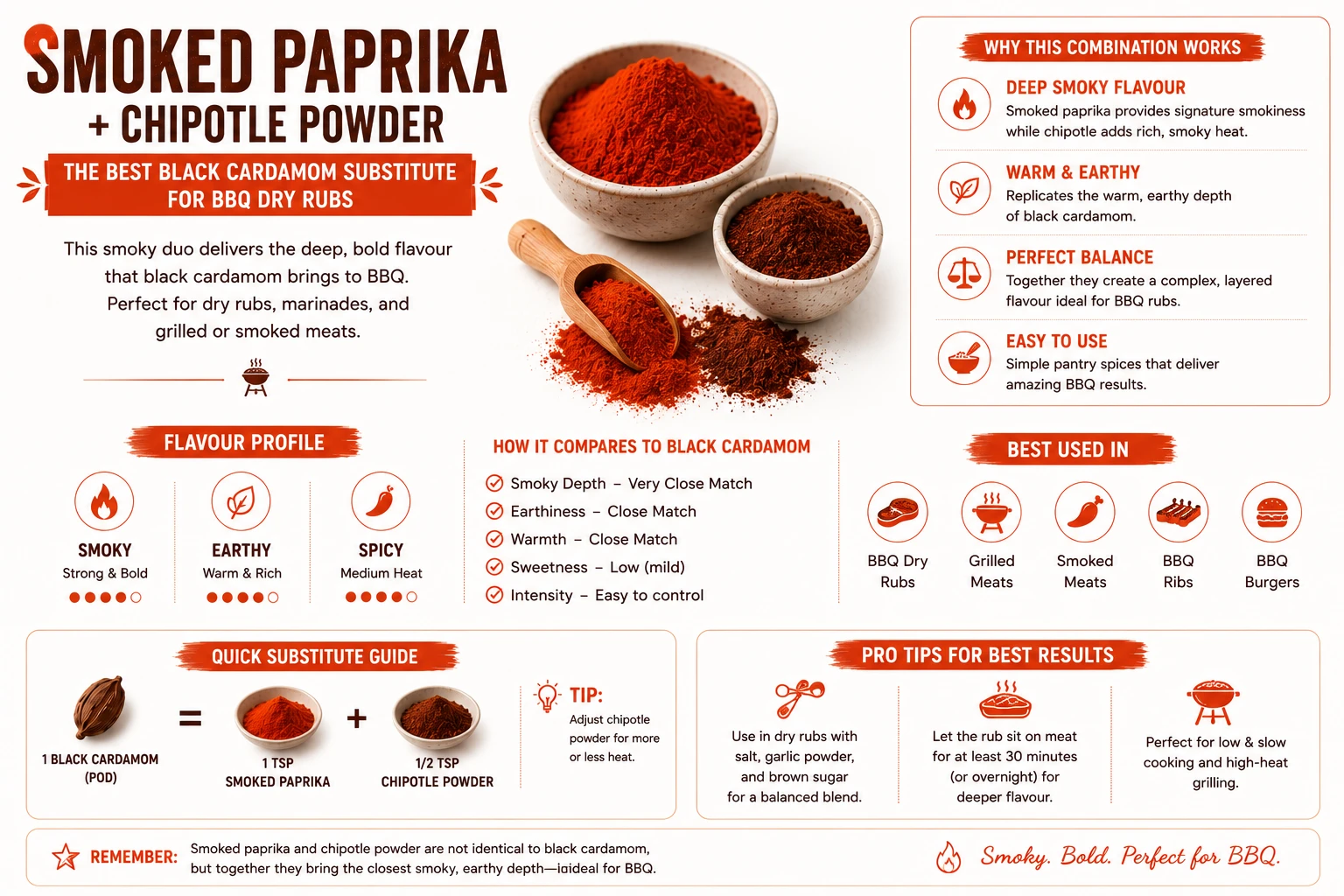
Whole star anise pods — the best black cardamom substitute for bone broth and pho Best for Broth

Star Anise

1 whole star anise per 2 black cardamom pods

Star anise is already a co-ingredient in authentic Vietnamese pho alongside black cardamom. It provides licorice-forward depth rather than smoke — appropriate in broth, out of place in biryani and curry.

Broth applications only. Licorice note is jarring in South Asian cooking contexts.
Broth match
50%
Broth / Pho Only
Hot smoked paprika and chipotle powder — the best black cardamom substitute for BBQ dry rubs Best for BBQ

Hot Smoked Paprika or Chipotle Powder

1/2 tsp hot smoked paprika (or chipotle powder) per 1 tsp ground black cardamom

At BBQ temperatures, actual grill smoke amplifies the paprika’s smoke character — making this the application where smoked paprika performs best as a standalone substitute. Chipotle powder is an equally effective alternative: it’s also made from smoke-dried peppers, so it brings the same earthy smoke plus a little extra heat. Use hot smoked paprika or chipotle powder — not sweet paprika.

Mix into rub cold — never bloom paprika or chipotle powder directly in hot oil.
BBQ match
55%
BBQ / Dry Rub
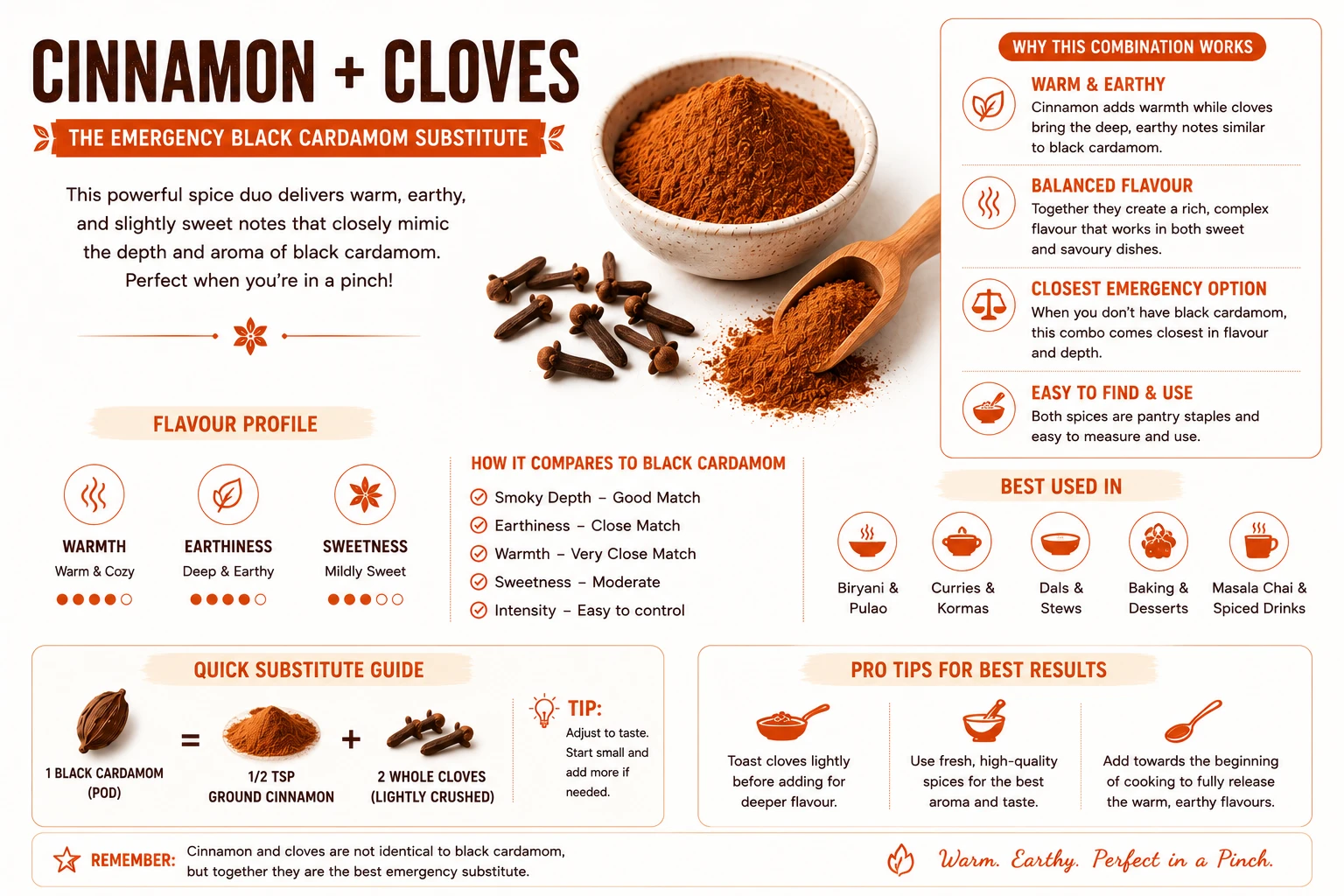
Ground cinnamon and whole cloves — emergency black cardamom substitute Emergency Substitute

Cinnamon + Cloves

1/4 tsp cinnamon + 1 whole clove per pod

Provides aromatic warmth and depth but misses the smoke character entirely. Produces a dish that tastes like a warm-spiced version of the intended result rather than a smoky one.

Best in: Dal where black cardamom plays a background role. Not for biryani or broth.
Overall match
38%
Emergency Only
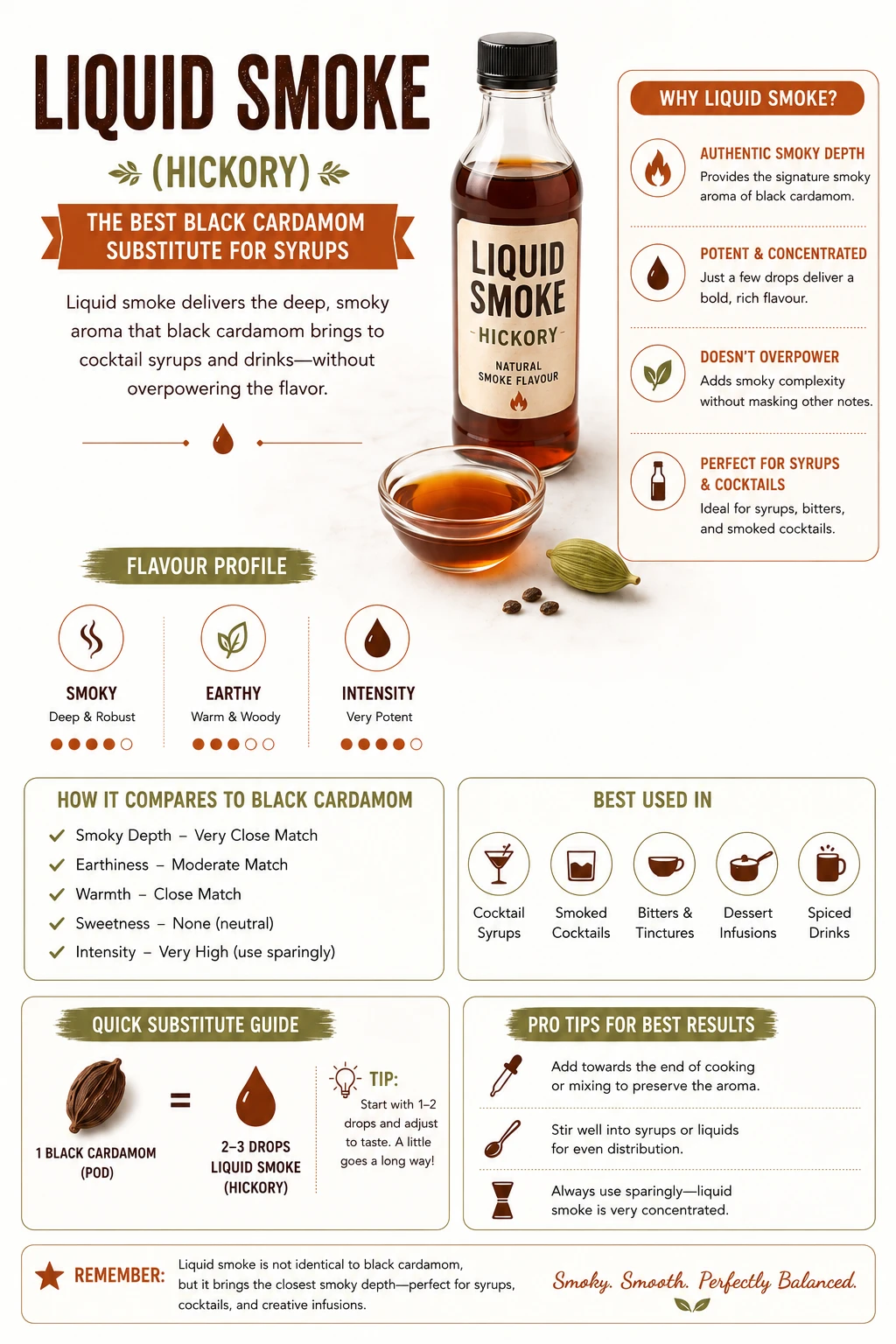
Liquid smoke and green cardamom pod — black cardamom substitute for cocktail syrup Cocktail Syrup

Liquid Smoke + Green Cardamom

2 drops liquid smoke + 1 green cardamom pod (48-hr steep)

The only cold-liquid option that approximates smoke at all. Liquid smoke is harsher and more artificial than black cardamom’s natural camphor smoke — the result is noticeably inferior. For cocktail syrups, buying black cardamom is the only real option.
Syrup match
30%
Poor — buy black cardamom
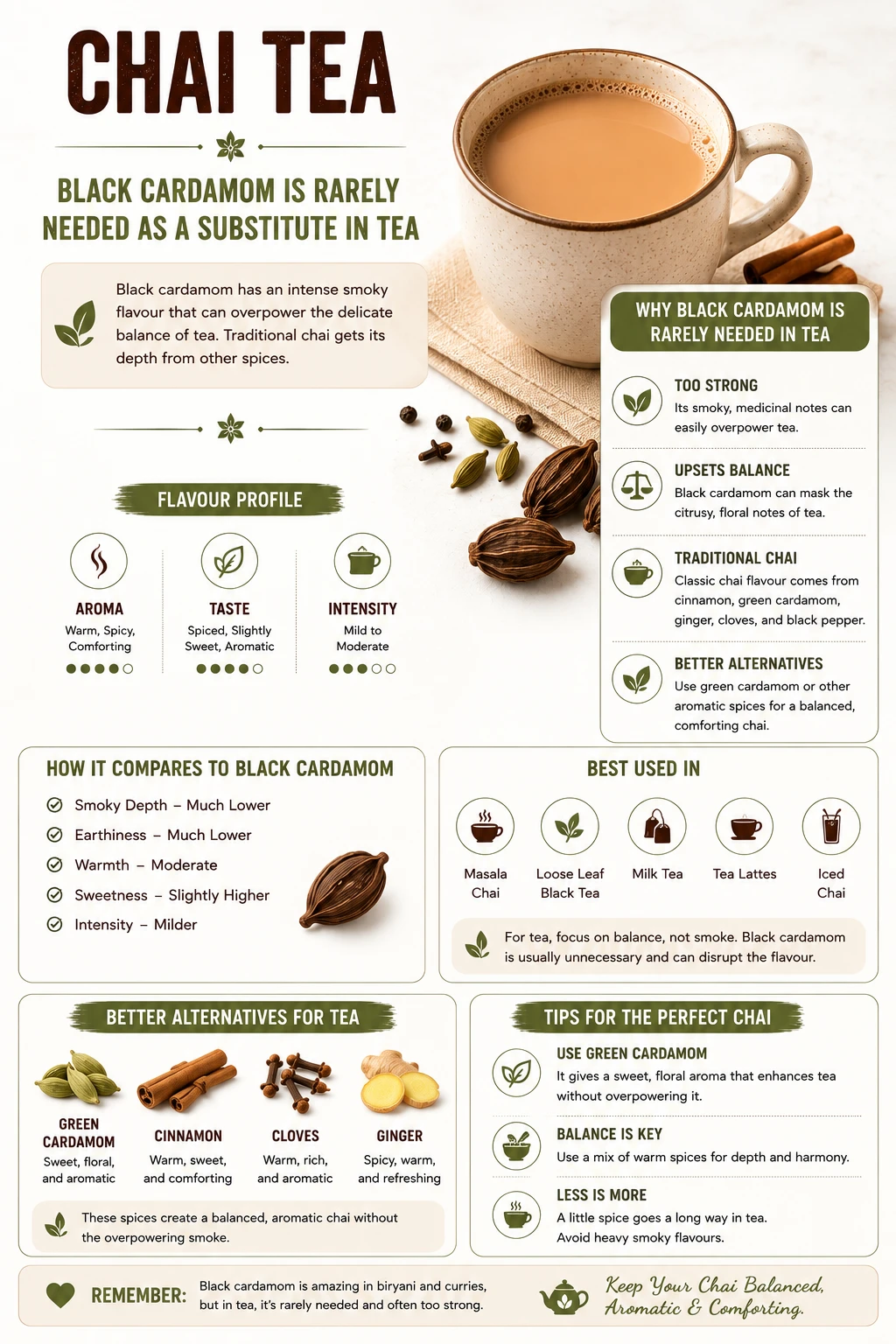
Chai tea cup — black cardamom is rarely needed as a substitute in tea Chai / Tea

Omit, or Trace Smoked Paprika

Best: omit entirely. If needed: a single grain of smoked paprika steeped and strained out

Black cardamom is almost never used in chai or tea — traditional masala chai calls for green cardamom, not black. If a recipe specifically calls for black cardamom in a tea or chai blend, its role is background smoke rather than a defining note, so omitting it changes the drink the least.

If you truly want a trace of smoke, steep a single grain of smoked paprika with the tea leaves and strain thoroughly — anything more will taste of raw paprika rather than tea.

Overall match
20%
Omit Instead

Complete Black Cardamom Substitute Ratio Table

How to Read the Ratio and Match-Percentage Columns

Each row below covers one cooking application — biryani, curry, dal, bone broth, BBQ rub, marinade, garam masala, chai/tea, and cocktail syrup — with the exact substitute quantity and a match percentage estimating how closely it reproduces badi elaichi’s full flavour profile.

ApplicationAmount of Black CardamomBest SubstituteRatioMatch %Method Note
Biryani (6 servings)2–3 whole podsCloves + smoked paprika3–4 cloves + 1/2 tsp paprika per pod62%Cloves in ghee bloom; paprika with dry masala. Remove cloves.
Meat curry (4 servings)1–2 whole podsCloves + smoked paprika3 cloves + 1/2 tsp paprika per pod58%Bloom cloves in ghee 30 sec. Paprika with dry spice stage.
Dal / lentils (4 servings)1 whole podCloves + smoked paprika1–2 cloves + pinch paprika55%Most forgiving application — lentils mask absence of camphor.
Bone broth (2L)2–3 cracked podsStar anise1 star anise per 2 pods50%Shifts flavour to licorice. Fine for pho, not South Asian broth.
BBQ dry rub (100g)1 tsp ground seedsHot smoked paprika or chipotle powder1/2 tsp per 1 tsp ground55%Grill smoke amplifies both — best-performing single-sub application.
Marinade (500g meat)1/2 tsp ground seedsSmoked paprika + cinnamon1/4 tsp paprika + pinch cinnamon48%Fat in yogurt marinade blends the paprika smoke well.
Garam masala blend1 tsp ground seedsSmoked paprika + green cardamom (ground)1/2 tsp paprika + 1/2 tsp ground green cardamom50%Green cardamom for spice base; paprika for smoke colour.
Chai / teaRarely called forOmit (or trace smoked paprika)Omit — or 1 grain smoked paprika, steeped & strained20%Traditional chai uses green cardamom, not black. Omission changes the drink least.
Cocktail syrup (500ml)6–8 whole podsLiquid smoke + green cardamom2 drops liquid smoke + 1 green pod per pod30%Poor — buy black cardamom. No substitute works well here.
💡 Honest advice: Black cardamom is available in virtually every South Asian grocery, most large supermarkets (Indian spice section), and online. Whole pods cost approximately £3–6 / $4–8 per 50g and last 2–3 years stored correctly. If you cook biryani, dal, or bone broth regularly — a small bag of badi elaichi will outperform every substitute and pay for itself many times over.

What Never Works as a Black Cardamom Substitute

Common Substitution Mistakes to Avoid

❌ Green cardamom (choti elaichi) alone — The most common mistake. Green cardamom is floral, sweet, citrus-forward — the exact opposite of black cardamom’s smoky-resinous character. Using it in biryani in place of badi elaichi produces a perfumed, sweet result that experienced cooks immediately identify as wrong. These species are not interchangeable.
❌ Generic ground cardamom from a jar — Almost always green cardamom, not black. Same wrong result as fresh green cardamom. If the jar says “cardamom” without specifying black — it is green.
❌ Nutmeg or mace — Popular on generic substitute lists but no flavour overlap with black cardamom specifically. Nutmeg is sweet and warm; black cardamom is smoky and resinous. Nutmeg works for green cardamom — never for black.
❌ Ginger — Sharp, bright, peppery — none of which approximate black cardamom’s camphor-smoke. Another generic list entry that does not apply specifically to black cardamom substitution.
❌ Allspice — Warm-spice character without smoke. Suitable as a green cardamom substitute in baking. Not appropriate as a black cardamom substitute in biryani or savory South Asian cooking.

Black Cardamom Substitute vs Green Cardamom Substitute

Why the Two Species Need Completely Different Substitutes

Every ranking above assumes you’re replacing black cardamom (Amomum subulatum) specifically — not cardamom in general. If your recipe calls for green cardamom (Elettaria cardamomum, choti elaichi) instead, the substitute logic is different: green cardamom’s floral-citrus profile is closer to cinnamon, nutmeg, mace, and allspice — semantic cousins in the ginger family, Zingiberaceae — none of which appear on this page’s ranked list for black cardamom. See our complete cardamom substitute hub for green cardamom swaps, whole-pod-to-ground conversions, and a side-by-side comparison across both species.

Frequently Asked Questions About Black Cardamom Substitutes

General Substitution Questions

What is the best substitute for black cardamom?

The best all-purpose black cardamom substitute is 1/2 tsp smoked paprika plus one whole green cardamom pod per black cardamom pod. Smoked paprika provides the smoke colour and aroma; the green cardamom pod adds the spice-aromatic base. For biryani specifically, use 3–4 whole cloves plus 1/2 tsp smoked paprika. For broth and pho, use 1 star anise per 2 black cardamom pods. No substitute fully replicates the camphor-smoke profile of black cardamom.

What is a good replacement for black cardamom?

The best black cardamom replacement depends on the dish: smoked paprika plus green cardamom for an all-purpose replacement, whole cloves plus smoked paprika for biryani and curry, star anise for broth and pho, and hot smoked paprika or chipotle powder for BBQ rubs. No single replacement fully reproduces black cardamom’s smoky, camphor-forward character, so the right choice depends on which flavour dimension matters most in your recipe.

What is a good alternative to black cardamom?

For an alternative to black cardamom, use 1/2 tsp smoked paprika plus 1 whole green cardamom pod per pod as a general-purpose option. For a biryani alternative, use 3–4 whole cloves plus 1/2 tsp smoked paprika. For a BBQ rub alternative, hot smoked paprika or chipotle powder performs best, since grill smoke amplifies both. Green cardamom alone is never an acceptable alternative — its flavour profile is the opposite of black cardamom’s.

Can I use green cardamom instead of black cardamom?

No — green cardamom (choti elaichi) cannot substitute for black cardamom (badi elaichi). They are different species with opposite flavour profiles. Green cardamom is floral, sweet, and citrus-forward. Black cardamom is smoky, camphor-forward, and resinous. Using green cardamom in a biryani or dal that calls for black cardamom produces a perfumed, sweet result instead of the intended smoky depth. They are not interchangeable in any direction.

What spice is most similar to black cardamom?

No single spice is fully similar to black cardamom because its camphor-smoke character is produced by fire-drying — a process unique among common spices. The closest approximations by flavour dimension: smoked paprika for smoke aroma; whole cloves for aromatic pungency; star anise for bold lingering quality in broth; cinnamon for background warmth. A blend of whole cloves plus smoked paprika is the most practical combination and the closest achievable match in cooking applications.

Can I omit black cardamom entirely from a recipe?

Omitting black cardamom is often better than substituting incorrectly. In biryani, omitting it produces a less smoky but otherwise intact dish. In bone broth, the result is a simpler but still good stock. In BBQ rubs and cocktail syrups, black cardamom’s contribution is significant enough that omission noticeably flattens the result. In chai and tea, where black cardamom rarely appears in the first place, omission is almost always the right call. When no good substitute is available — omit rather than use an ingredient that changes the character more than its absence would.

Is smoked paprika a good substitute for black cardamom?

Smoked paprika is the best single-ingredient approximation of black cardamom’s smoke character. It provides smoke colour, aroma, and some depth. However, it completely lacks the camphor-mentholated-resinous character of black cardamom’s cineole and camphor compounds. Smoked paprika alone is most effective in BBQ rubs and marinades. For biryani and curry, it works better combined with whole cloves. It does not work in cocktail syrups where it makes the liquid taste of raw paprika when cold.

Can I use chipotle powder instead of black cardamom?

Chipotle powder is a solid substitute for black cardamom in BBQ rubs, marinades, and smoky curries, where it performs almost identically to hot smoked paprika. Both are made from smoke-dried peppers and deliver a similar earthy, smoky heat, though chipotle powder adds noticeably more spiciness. Use it at the same ratio as smoked paprika — around 1/2 tsp per 1 tsp of ground black cardamom — and mix it in cold rather than blooming it in hot oil. It is not recommended for biryani, dal, or cocktail syrup, where its chili heat is out of place.

Dish-Specific Substitution Questions

What can I substitute for black cardamom in biryani?

For black cardamom in biryani, use 3–4 whole cloves plus 1/2 teaspoon smoked paprika per pod. Bloom the cloves in hot ghee at the start exactly where black cardamom would go. Add smoked paprika with the dry masala powder — not directly in hot oil, as paprika burns and turns bitter. Remove cloves before layering the rice, just as you would remove black cardamom pods. This substitute matches approximately 62% of black cardamom’s contribution to biryani.

Can I substitute star anise for black cardamom?

Star anise is a partial substitute for black cardamom in broth and pho applications only. Use 1 whole star anise pod per 2 black cardamom pods in long-simmered broths. Star anise delivers licorice-forward depth but no camphor-smoke. In biryani, curry, or BBQ applications, star anise produces an out-of-place licorice flavour and should not be used as a substitute.

What is a substitute for badi elaichi?

Badi elaichi (black cardamom) substitute by dish: biryani — 3–4 whole cloves plus 1/2 tsp smoked paprika per pod; dal — 1–2 cloves plus a pinch of smoked paprika; bone broth — 1 star anise per 2 pods; BBQ dry rub — 1/2 tsp hot smoked paprika or chipotle powder per 1 tsp ground badi elaichi; cocktail syrup — 2 drops liquid smoke plus 1 green cardamom pod (poor approximation). Sourcing actual badi elaichi always produces better results than any of these substitutes.

What is a good kali elaichi substitute?

Kali elaichi (black cardamom) and badi elaichi refer to the same spice, so the substitute logic is identical: smoked paprika plus green cardamom for an all-purpose swap, whole cloves plus smoked paprika for biryani and curry, and star anise for broth. Use the interactive finder above to get the exact ratio for your specific dish.

Can I use allspice instead of black cardamom?

Allspice is a poor substitute for black cardamom specifically. Allspice (combining clove, cinnamon, and nutmeg character) has no smoke component and is primarily used as a green cardamom substitute in baking applications. In a biryani or South Asian meat dish calling for black cardamom, allspice adds warm spice notes without any of the defining camphor-smoke character. Use whole cloves plus smoked paprika instead — it produces a significantly closer result.

What if I only have garam masala — can it substitute for black cardamom?

Garam masala is an emergency substitute for black cardamom in curry and dal applications only. Traditional garam masala already contains a small proportion of ground black cardamom alongside other spices. Use 1/2 tsp of garam masala per black cardamom pod as a last resort — it adds the right flavour direction without dramatically changing the dish character. Do not use garam masala as a substitute in biryani where the whole spices are added separately, or in broth and syrup applications.

Is there a black cardamom substitute for chai or tea?

Black cardamom is rarely used in chai or tea — traditional masala chai calls for green cardamom, not black. If a recipe specifically calls for black cardamom in a tea blend, the best approach is to omit it rather than substitute, since its role is background smoke rather than a defining flavour. If a trace of smoke is truly wanted, steep a single grain of smoked paprika with the tea leaves and strain thoroughly before serving.

Other Common Substitution Questions

Can I use cinnamon alone instead of black cardamom?

Cinnamon alone is a weak substitute for black cardamom despite being commonly recommended on generic spice-substitution lists. Cinnamon provides warmth and sweetness (cinnamaldehyde) but has zero smoke or camphor character — the two dimensions that define black cardamom in savoury South Asian cooking. Cinnamon works far better as a green cardamom substitute in baking. If you only have cinnamon, pair it with a whole clove to add some aromatic pungency, and expect roughly a 35% match at best.

Is mace a good substitute for black cardamom?

No — mace is a substitute for green cardamom, not black cardamom. Mace shares green cardamom’s warm, slightly sweet, nutmeg-adjacent profile, which is why it appears on most generic “cardamom substitute” lists. It has no smoke or camphor component, so it will not replicate black cardamom’s role in biryani, bone broth, or BBQ rubs. Use smoked paprika plus cloves instead for black cardamom applications.

Can I use Indian bay leaf (tej patta) instead of black cardamom?

Indian bay leaf (tej patta) is not a direct substitute for black cardamom — the two are traditionally used together in the same whole-spice tempering, not as swaps for each other. Tej patta adds a mild, tea-like background note but contributes none of black cardamom’s smoke or camphor character. If black cardamom is unavailable, keep the tej patta in the recipe as usual and add the cloves-plus-smoked-paprika substitute separately to cover what the black cardamom would have provided.

How much ground black cardamom equals one whole pod?

One whole black cardamom pod is roughly equivalent to 1/4 teaspoon of ground black cardamom seeds, though this varies with pod size and how finely the seeds are ground. Because ground black cardamom loses its volatile camphor-smoke compounds quickly once exposed to air, cracking and grinding whole pods fresh gives a noticeably stronger result than pre-ground jar spice at the same measured quantity.

More from the Black Cardamom Guide


Rate this guide
Tap a star to rate

Leave a Comment


Reader Reviews

4.7
★★★★★
Based on 63 reader ratings
Amara K.★★★★★
July 12, 2026

The cloves + smoked paprika combo saved my biryani when I ran out of black cardamom halfway through cooking. Wasn’t identical but nobody at the table complained.

Farhan S.★★★★★
July 9, 2026

Finally an article that admits green cardamom doesn’t work instead of just listing it anyway like every other site. The interactive tool made picking a substitute genuinely fast.

Priya M.★★★★☆
July 5, 2026

Used the star anise ratio for pho broth and it was close enough. Wish there was a note on how long to simmer it, but otherwise very useful.

Daniyal R.★★★★★
June 30, 2026

Didn’t know chipotle powder could stand in for smoked paprika in a BBQ rub until I read this. Used it on ribs this weekend, turned out great.

Sana T.★★★★★
June 27, 2026

The ratio table is exactly what I needed — no scrolling through a wall of text to find one number. Bookmarked for whenever I forget to restock badi elaichi.

Michael O.★★★★☆
June 24, 2026

Good honest advice about just omitting it in some dishes rather than forcing a bad substitute. That’s rarer to see than it should be.

Ayesha N.★★★★★
June 20, 2026

I’ve made the mistake of using green cardamom for black before — this explained exactly why it went wrong. Wish I’d read this years ago.

Tom H.★★★★☆
June 15, 2026

The cocktail syrup section was honest that nothing really replaces it well — appreciated not being oversold a fake fix for that one.

Rabia K.★★★★★
June 11, 2026

Used the dal ratio last night — 1 clove and a pinch of smoked paprika, worked better than I expected for how little was needed.

James L.★★★★★
June 8, 2026

Clear, well organized, and the flavour science section actually explains the “why” instead of just giving a list. Rare for a recipe substitution page.

Emily Rhodes — Culinary Writer CardamomNectar
✍️ Written by Emily Rhodes
Culinary Writer & Spice Researcher · Kerala, Karachi, Dubai markets

Emily covers spice sourcing and recipe development at CardamomNectar. Every substitution in this guide was tested in her kitchen.

View Full Profile →
Dr. Michael Bennett — Phytochemist CardamomNectar
🔬 Reviewed by Dr. Michael Bennett
Food Scientist & Phytochemist · Volatile Oil Composition Specialist

Dr. Bennett reviewed all volatile compound data — camphor vs eugenol vs anethole substitution chemistry and match percentage estimates.

View Full Profile →