How to Grow Black Cardamom
The only growing guide written specifically for Amomum subulatum — not green cardamom. Correct soil, humidity, light, and watering for UK, US, and Australia growers.


To grow black cardamom (Amomum subulatum): plant a red-stemmed rhizome 10–15 cm deep in loamy, well-draining soil (pH 5.5–6.5) in a shaded position with 65–85% humidity. Keep soil consistently moist, feed monthly from April to September, and never expose to direct sun. First pods appear 3–4 years from planting at ground level — not on the main stems. Most failures are caused by three things: too much direct sun, low humidity indoors, and giving up before year 3.
Before You Start — Are You Growing the Right Species?
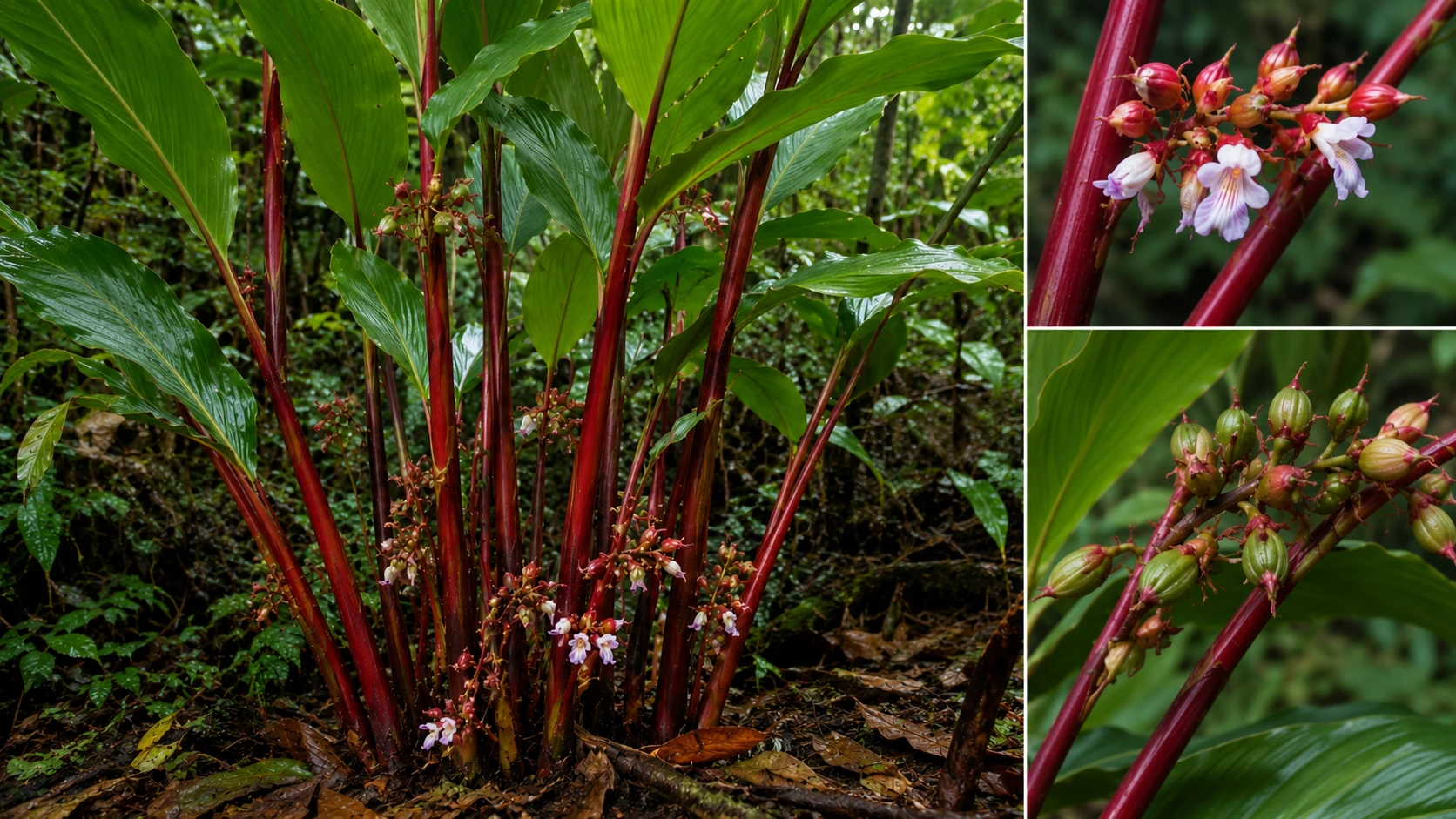
The red-stemmed black cardamom plant — Amomum subulatum. If the stems are green, you have a different species.
Most “black cardamom growing” guides online are actually written about green cardamom (Elettaria cardamomum) — or they treat both species as identical. They are not. Getting the species right before you plant affects every decision: soil, temperature tolerance, USDA zone, and where to look for pods at harvest.
This guide covers Amomum subulatum specifically. The differences that matter most for growing: black cardamom tolerates temperatures down to 10°C (cooler than green cardamom’s 15°C minimum), grows taller, needs slightly higher humidity, and takes 1–2 years longer to first pod. Its cooler temperature tolerance makes it more viable for UK and northern US growers than green cardamom.
Soil Preparation — The Right Mix
Black cardamom evolved on cool, humus-rich Himalayan forest floors — deep-rooted leaf litter over well-drained mineral soil. Replicate this with a three-part mix:
| Parameter | Target | What Happens if Wrong |
|---|---|---|
| Soil pH | 5.5–6.5 (slightly acidic) | Above 7.0 — nutrient lockout, chlorosis, stunted growth |
| Drainage | Water clears pot in 30 seconds | Slow drainage → rhizome rot → plant death |
| Organic matter | High (20–30%) | Low OM → dry root zone, poor nutrient availability |
| Clay content | Avoid | Any significant clay → waterlogging, anaerobic root conditions |
| Compaction | Light, open structure | Compacted soil → root stress, reduced rhizome spread |
Container vs Garden Bed — Which Is Right for You?
| Factor | Container Growing | Garden Bed Growing |
|---|---|---|
| Climate suitability | ✓ Any climate — move indoors below 10°C | USDA Zone 9–11 only (or UK Southwest sheltered) |
| Minimum container/bed | 40 cm wide × 30 cm deep | No width limit — rhizomes spread 60+ cm/yr |
| Drainage control | ✓ Easy — pot drainage holes | Depends on native soil quality |
| Humidity control | ✓ Can position near humidifier, bathroom | Ambient humidity only |
| Growth rate | Slower — root-bound limits | ✓ Faster — unrestricted rhizome spread |
| Pod production | Possible but lower yield | ✓ Higher yield once established |
| UK growers | ✓ Only viable option (most of UK) | Southwest/sheltered only |
Step-by-Step Planting Guide — Rhizome Method
Rhizome division is the strongly recommended propagation method — it produces pods 1–2 years faster than seed, has higher success rates, and is how black cardamom is grown commercially in Nepal and Sikkim. For seed growing, see: Growing Black Cardamom from Seed →
Buy from a verified supplier who confirms the species is Amomum subulatum with red stems. Inspect the rhizome on arrival — it should be firm, reddish-brown, 10–20 cm long, with at least one visible bud (a small whitish-green protrusion). Reject soft, shrivelled, mould-spotted, or completely dormant-looking rhizomes.
Mix your 60/30/10 soil blend (see Soil section above). Fill the container to within 15 cm of the rim — leave space to plant the rhizome at the correct depth without soil spilling. Check drainage: water poured in should drain freely within 30 seconds. If it pools, add more perlite before planting.
Make a shallow trench or depression about 10–15 cm deep. Lay the rhizome horizontally — not vertically. The bud (growth point) should face upward. Cover with soil and firm gently. Do not bury deeper than 15 cm — deep planting delays emergence and risks rot before the first shoot breaks through.
Water thoroughly after planting until water drains from the base. Place in a warm, consistently shaded position — no direct sun. Indoors: a bathroom, north-facing window, or a spot under a grow light. Outdoors: dappled shade, under trees or a shade cloth, never against a south-facing wall in full sun.
The first sign of success is a small, pointed, reddish shoot emerging from the soil surface. In warm conditions (22–25°C), this takes 4–6 weeks. In cooler conditions (15–18°C), allow up to 10 weeks. Do not dig up to check — disturbing the rhizome during this stage often kills it. Keep the soil moist and the position consistent.
Once the first shoot reaches 10–15 cm, apply a balanced liquid fertiliser at half the recommended dose. Full dose feeding begins in month 3. Year 1 focus: root system and pseudostem establishment. Do not be concerned if growth seems slow — black cardamom puts most of its first-year energy underground into the rhizome system, which supports decades of production.
Watering — Interactive Calculator
Overwatering and underwatering both kill black cardamom — the correct frequency depends on your climate, season, and container size. This calculator gives personalised guidance:
Watering method — how to water correctly
When you do water: water deeply and thoroughly until water drains from the pot base — then do not water again until the top 2–3 cm of soil is barely moist. This deep-and-dry-surface cycle is essential. Shallow, frequent watering creates a wet surface and dry root zone — the opposite of what black cardamom needs. The rhizome should always feel firm and cool, never sitting in moisture.
Humidity — The Critical Factor for Indoor Growers
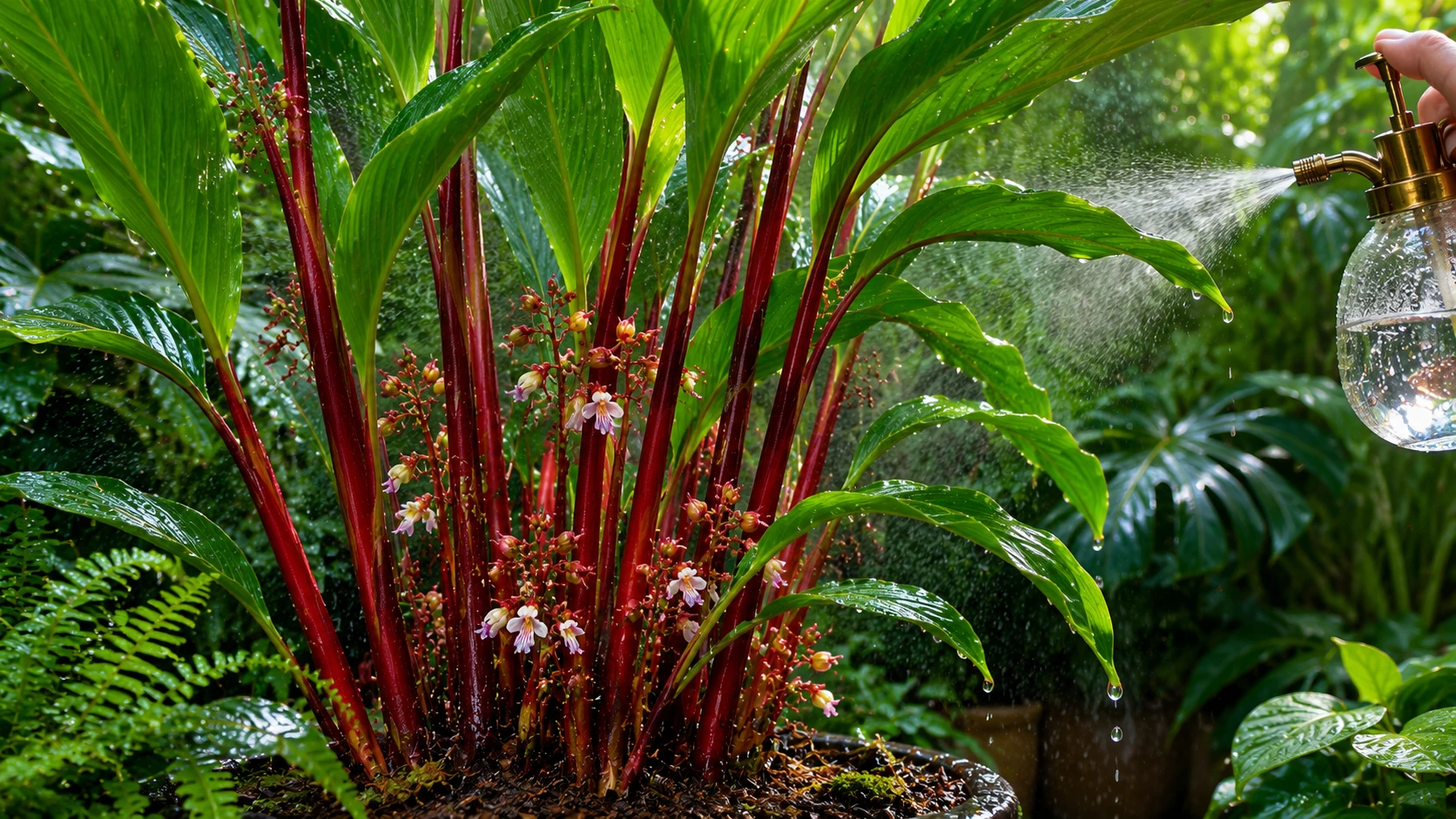
Black cardamom needs 65–85% relative humidity — significantly higher than most homes maintain, especially in winter
Humidity is the single most common reason black cardamom fails indoors in the UK and northern US. Most homes run at 30–50% RH — well below the 65–85% this plant requires. The gap is widest in winter when central heating dramatically dries indoor air.
| RH Level | Effect on Plant | Action Required |
|---|---|---|
| 65–85% RH | ✓ Ideal — no stress, active growth | Maintain — monitor in winter |
| 50–65% RH | Tolerated short-term — growth slows, leaf tips may brown | Supplement: pebble tray + grouping plants |
| 35–50% RH | Leaf tip browning, curling, yellowing — chronic stress | Humidifier required — pebble tray insufficient |
| Below 35% RH | Rapid decline — leaves curl, yellow, drop within weeks | Humidifier essential + relocate near water source |
Practical humidity solutions — in order of effectiveness
- Electric humidifier (best): A mid-range ultrasonic humidifier (e.g., Levoit, Crane) running 4–8 hours daily near the plant is the most reliable solution. Set to 65–70% and place within 1–2 metres. Cost: £25–£60 / $30–$80.
- Bathroom placement: If your bathroom gets adequate indirect light (north or east window), this is the most natural high-humidity location in most homes. Combine with a grow light for light-deficit bathrooms.
- Pebble tray: Fill a wide tray with pebbles, add water to just below the pebble surface, and sit the pot on top. As water evaporates it raises local humidity around the plant. Effective in summer, insufficient in winter with heating running.
- Plant grouping: Placing multiple plants close together creates a humidity microclimate. Works best combined with a pebble tray or humidifier. Grouping alone rarely reaches 65%+ RH.
- Misting (least effective): Misting briefly raises surface humidity but has no lasting effect on RH. Also risks fungal issues on foliage in low-airflow conditions. Not recommended as a primary humidity strategy.
Light Requirements — Shade Is Not Optional
In its native Himalayan understorey, black cardamom receives dappled, filtered light — the equivalent of 2–4 hours of indirect light per day, with no direct sun exposure. This is one of the most commonly misunderstood requirements for home growers.
| Light Situation | Suitability | Notes |
|---|---|---|
| Bright indirect — north/east window | ✓ Ideal indoors | Best indoor location in UK. Light but no direct rays. |
| LED grow light, 12–16 hrs/day | ✓ Excellent substitute | Full-spectrum, 2,000–5,000 lux. Best for low-light homes/winter. |
| Dappled outdoor shade | ✓ Ideal outdoors | Under trees, pergola, or 50% shade cloth — replicates native habitat exactly. |
| West window — afternoon sun | Tolerated with caution | Sheer curtain required to filter direct afternoon rays. |
| South-facing window — UK | ❌ Avoid in summer | Leaf scorch begins within days of direct exposure. Move or screen. |
| Full outdoor sun | ❌ Avoid entirely | Irreversible leaf burn. Severe cases kill the plant within weeks. |
| Deep shade — no window light | ❌ Insufficient | Below 500 lux, growth stalls. Use a grow light if no bright indirect source. |
Feeding Schedule — What, When, and How Much
Black cardamom is a heavy feeder during the growing season but needs complete rest from feeding in winter. Overfeeding in winter, or starting too early after planting, causes root burn in an already-stressed plant.
| Period | Fertiliser | Frequency | Notes |
|---|---|---|---|
| First 6–8 weeks after planting | None | — | Rhizome establishing — no active roots yet. Feeding causes salt burn. |
| Weeks 6–12 (establishment) | Balanced liquid — half dose | Every 3–4 weeks | Dilute to 50% of label recommendation. Build up slowly. |
| April – September (growing season) | Balanced liquid, high nitrogen | Monthly | Full dose. High N supports the large leaf canopy and pseudostem growth. |
| September – October (wind-down) | Low-nitrogen or potassium-based | Once, then stop | One late feed with low N / higher K hardens the plant for winter. Then stop. |
| October – March (winter rest) | None | — | No feeding. Plant is in slow dormancy. Feeding now causes root damage. |
Seasonal Care — Year-Round Calendar
- Resume watering as growth restarts
- Begin feeding at half dose (Apr)
- Repot if roots are circling base
- Move outdoor containers back out (when nights stay above 12°C)
- New red shoots emerging — normal and healthy
- Water 2–3× weekly — check soil every 2 days
- Feed monthly at full dose
- Outdoor plants: check shade cloth — sun angle changes
- Monitor humidity — AC drops indoor RH significantly
- Check for base-level flowers (Year 3+ plants)
- Reduce watering frequency gradually
- Final low-N feed in September, then stop
- Bring containers indoors before night temps hit 10°C
- Harvest pods if Year 3+ and pods feel firm
- Check for and remove dead pseudostems
- Water only when top soil layer dries out
- No fertiliser
- Humidifier critical — heating dries indoor air
- Maintain minimum 10°C — windowsill cold spots risk damage
- Grow light helpful to supplement low winter light
Problem Troubleshooter — What’s Wrong With My Plant?
Growing Black Cardamom in the UK — Specific Guidance
Black cardamom is better suited to UK conditions than green cardamom — its cooler temperature tolerance (minimum 10°C vs 15°C for green cardamom) means it handles UK winters with less stress when brought indoors. The main UK challenges are humidity and light rather than temperature.
- Light: UK winters have very low light levels — a full-spectrum LED grow light running 12–14 hours daily is highly recommended from October to March.
- Humidity: Central heating is the primary enemy. A humidifier near the plant from October to April is the single most impactful intervention for UK growers.
- Outdoor growing: Viable year-round only in very sheltered positions in Southwest England, West Wales, and mild coastal areas. Most UK growers should treat this as an indoor plant with outdoor summer positioning.
- Water quality: Southeast UK has hard, high-pH tap water. Collect rainwater or use a filtering jug for best results.
- Sourcing: Very few UK nurseries stock verified Amomum subulatum. See our sourcing guide → for verified UK suppliers.
For full indoor-specific guidance: Grow Black Cardamom Indoors — Complete UK & US Guide →
↑ Back to topFrequently Asked Questions
How long does black cardamom take to grow?
What soil does black cardamom need?
How much humidity does black cardamom need?
Can black cardamom grow in the UK?
Can I grow black cardamom from shop-bought pods?
Why are my black cardamom leaves turning yellow?
Does black cardamom need full sun or shade?
How is growing black cardamom different from green cardamom?
Continue in the Growing Series
This is Guide 1 of 8 in the Black Cardamom Growing Series
Emily has documented black cardamom cultivation in Sikkim and Nepal growing regions. Her growing guides are based on direct grower interviews and field observation. Full profile →
Dr. Bennett reviewed growing condition specifications, soil chemistry, humidity data, and Amomum subulatum botanical requirements for accuracy. Full profile →