Pho Broth Recipe with Black Cardamom
Authentic beef pho broth from scratch — blanched bones, charred ginger, toasted black cardamom in a cheesecloth sachet, simmered four hours at a bare simmer. This is why restaurant pho tastes different from home versions.


What is Pho Broth?
Pho broth (nước dùng phở) is the slow-simmered beef bone broth that forms the base of Vietnamese pho. It is made by blanching beef knuckle and marrow bones, simmering them for 3–4 hours with charred onion and ginger, and a toasted spice sachet containing black cardamom, star anise, cinnamon, coriander, fennel, and cloves. Black cardamom is the spice responsible for the distinctive smoky, camphor-forward depth in authentic restaurant pho — the note that most home recipes miss.
Why Black Cardamom is Pho’s Secret Spice
Ask most people what spice defines pho broth and they will say star anise. They are not wrong — star anise is pho’s most forward note. But the background smoke quality that makes a bowl of restaurant pho feel different from a home version — that camphor-forward, slightly mentholated depth — comes from black cardamom (thảo quả in Vietnamese, badi elaichi in South Asian kitchens). Vietnamese pho masters use it; many Western recipe writers skip it because it is unfamiliar. The result is broth that smells like pho but lacks the final layer.
Black cardamom’s cineole and camphor volatile compounds are released during the dry-toasting step and then slowly extracted into the broth during the long simmer. Unlike star anise which dominates quickly, black cardamom works slowly and subtly — it does not announce itself but its absence is immediately apparent to anyone who has eaten pho made the traditional way. The compounds are also heat-stable enough to survive a 4-hour simmer, which is why they can be added at the beginning rather than at the end like more delicate aromatics. For a deeper look at how black cardamom’s chemistry differs from green cardamom, see our green vs black cardamom guide.
This recipe also covers the two techniques most home pho recipes skip: the blanch-and-rinse step for bone clarity, and the charring of ginger and onion before they enter the pot. Both make a measurable, visible difference. The blanch step produces a crystal-clear broth; skipping it produces a grey-tinged cloudy one. The charred aromatics produce Maillard browning compounds that add a caramel-smoke depth no raw aromatics can replicate. Related technique: this same broth method applies to our black cardamom bone broth recipe.
↑ Back to top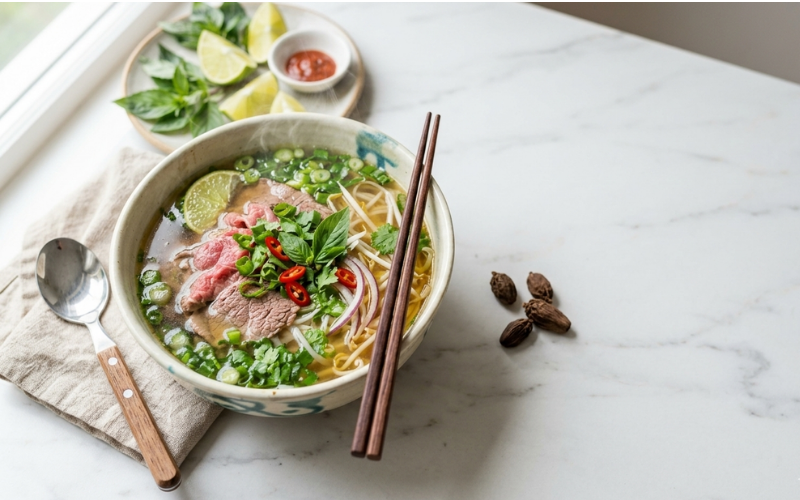
Clear, deeply flavoured Vietnamese beef bone broth. Blanched bones, charred ginger, toasted black cardamom sachet, simmered four hours at a bare simmer. The authentic method.
Ingredients
Yields approx. 3 litres broth · 8 servings
Pho Spice Guide — What Each Spice Does
Most recipes list pho spices without explaining their roles. This table shows exactly what each one contributes — and which ones you can skip vs which are essential.
| Spice | Flavour Role | Essential? | Skip Impact |
|---|---|---|---|
| Black Cardamom | Smoky camphor background depth — the note that distinguishes restaurant pho | High | Broth tastes flat in the base notes — missing the smoke dimension |
| Star Anise | Primary aroma — anise-forward, sweet, slightly licorice | Essential | Without it the broth doesn’t smell or taste like pho at all |
| Cinnamon | Warm sweetness and body — rounds the star anise edge | Essential | Broth becomes sharp and one-dimensional without cinnamon warmth |
| Coriander Seeds | Citrusy, floral background — lightens the heavier spices | Moderate | Subtle absence — broth is slightly heavier without it |
| Fennel Seeds | Mild anise-sweetness that supports star anise without doubling it | Moderate | Noticeable loss of layered sweetness in the broth |
| Cloves | Sharp punctuation note — adds intensity but must be used sparingly | Low-Moderate | Broth is less complex — cloves add the “bite” behind the sweetness |
| Charred Ginger | Maillard caramel-smoke aromatics + spicy heat foundation | High | Without charring, ginger is just sharp and raw — no caramel depth |
| Charred Onion | Sweet caramelised depth + colour to the broth base | High | Broth loses its characteristic amber-golden colour and sweetness |
Select what you have — get exact quantities and what you’ll lose.
Use: 2–3 green cardamom pods (lightly crushed) in place of 1 black cardamom pod. Add to the spice sachet and toast with the other spices.
Add: ¼ tsp smoked paprika directly to the broth in the last 30 minutes of simmering.
What’s missing: The camphor-smoke character. Green cardamom is citrus-floral; the broth will be aromatic and pleasant but will lack the background smoke note that defines authentic pho.
Use: 1 additional star anise pod (making 6 total) to compensate for missing base depth. Also add ¼ tsp smoked paprika in the last 30 minutes.
What’s missing: The camphor note. More star anise makes the broth more anise-forward, not smokier — but it helps fill the flavour gap somewhat. The broth will taste good but recognisably different from authentic pho.
Use: ½ tsp smoked paprika added to the broth in the last 30 minutes — not earlier (it discolours the broth if added at the start).
What’s missing: The aromatic, mentholated camphor quality. Smoked paprika gives a hint of smoke but none of the complex volatile oil character of black cardamom. This is a last resort.
Use: 2 extra cloves + ½ extra cinnamon stick added to the sachet. These deepen the warmth and complexity without replicating black cardamom’s smoke.
Warning: Cloves become overpowering quickly — do not add more than 2 extra, and taste the broth at 3 hours to check balance. Too many cloves is harder to fix than missing smoke.
The broth will still be excellent — star anise, cinnamon, charred ginger and good bones make a flavourful pho broth. The smoke-camphor dimension will be absent, but most people unfamiliar with traditional pho will not notice.
For experienced pho eaters: the absence will be apparent. Black cardamom is worth sourcing before you make this — it is inexpensive and one pod lasts the whole recipe.
Step-by-Step Instructions
7 steps · 4.5 hrs total · Mostly passive simmer time
-
 1
1Blanch Bones — Remove Impurities
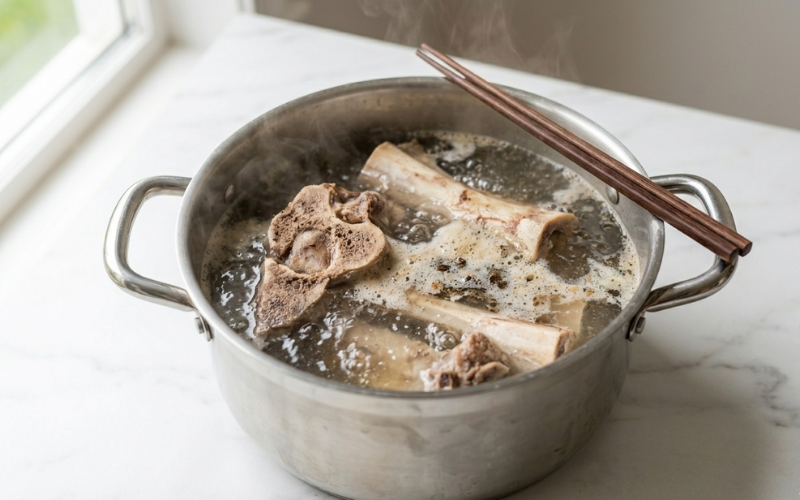
Place all beef bones in a large stockpot. Cover with cold water. Bring to a boil on high heat and boil hard for 5–8 minutes. You will see significant grey-brown scum rising — this is coagulated blood and bone proteins. Drain completely, discard the water. Rinse bones individually under cold running water, scrubbing off any dark residue. Return cleaned bones to the clean pot.
💡 Why this mattersThis single step is the difference between a crystal-clear golden broth and a cloudy grey one. The impurities that create cloudiness and off-flavours are soluble in the first boil — once drained and rinsed, they’re gone. Skipping this step means hours of skimming and still never achieving a clear broth. -
2
Char Onion and Ginger
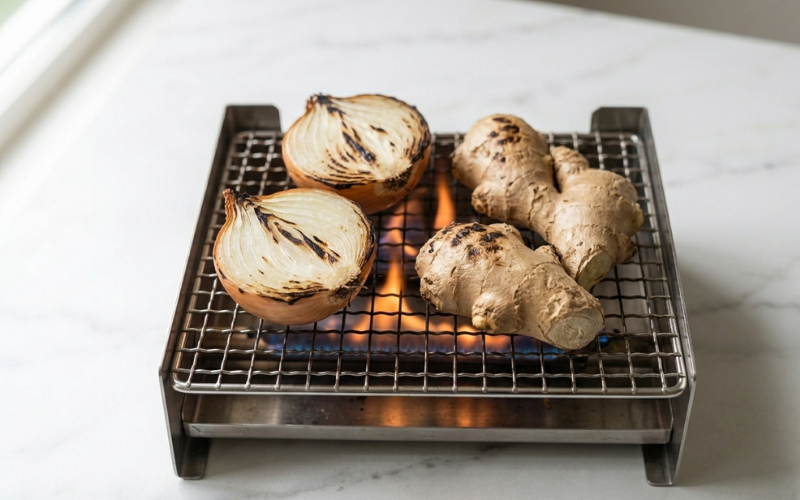
Halve the onions and ginger. Gas flame method: use tongs to hold each piece directly over a medium gas flame, turning for 4–5 minutes until the cut surfaces are visibly blackened and the edges are charred. Oven method: place on a foil-lined baking sheet under the broiler, 15cm from the element, for 15–20 minutes until charred. After charring, rinse briefly and rub off any heavily loose blackened skin — leave some char attached, it is flavour.
💡 Why this mattersCharring creates Maillard browning compounds in both the ginger and onion — the same chemistry as caramel and roasted coffee. These compounds dissolve into the broth and add a caramel-sweet smokiness and golden colour that raw ginger and onion cannot produce no matter how long they simmer. This step is standard in every traditional Vietnamese pho kitchen and absent in most Western home recipe adaptations. -
3
Toast Spices — Black Cardamom First
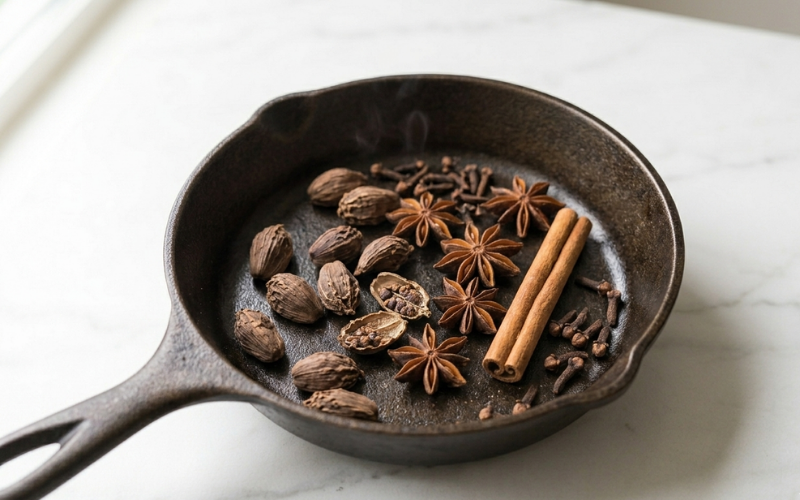
In a dry cast iron or heavy pan on medium-low heat: add the black cardamom pod (lightly crushed to open it slightly) and cinnamon sticks first. Toast 60–90 seconds until you can smell the camphor note releasing. Then add star anise, coriander seeds, fennel seeds, and cloves. Shake the pan and toast for another 90 seconds — all spices should be fragrant and slightly darkened. Remove from heat immediately when fragrant; scorched spices turn bitter.
💡 Why this mattersDry-toasting ruptures the volatile oil cells in each spice, making them dramatically more extractable during the long broth simmer. Black cardamom is added first because its compounds need slightly longer to release and the pod’s thick outer shell slows initial extraction. Toasted spices produce 2–3× the flavour of raw spices added directly to liquid. -
4
Bundle Spices in Cheesecloth Sachet
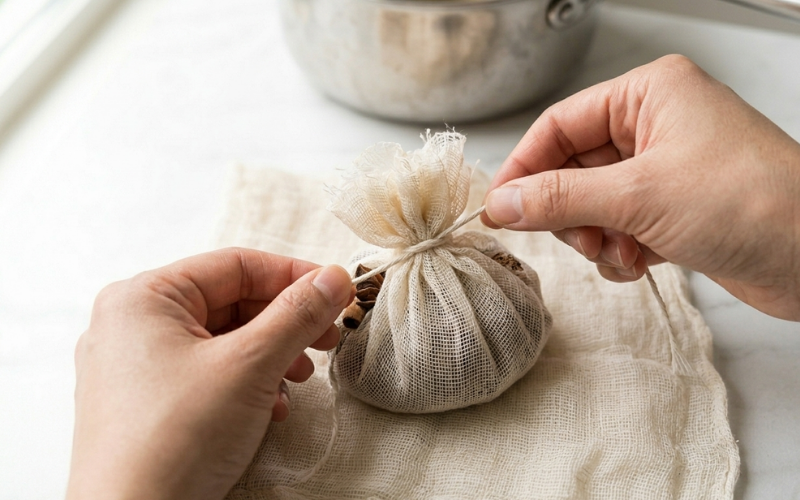
Transfer all toasted spices to the centre of a double-layered 15×15cm piece of cheesecloth (muslin). Pull the corners up and tie tightly with kitchen string to form a compact sachet. The sachet should be snug — loose spices escape and star anise points disintegrate into the broth, making it impossible to strain cleanly. Tie the string long enough to hang over the side of the pot so you can locate and remove it easily.
💡 Why this mattersCheesecloth allows full flavour extraction during the 4-hour simmer while keeping spices contained. Without it, broken star anise and disintegrated coriander seeds pass through all but the finest sieves and create tiny particulates that cloud the finished broth. The sachet also lets you taste and remove spices early if any note becomes too strong before the full simmer time ends. -
5
Simmer for 4 Hours — Bare Heat Only
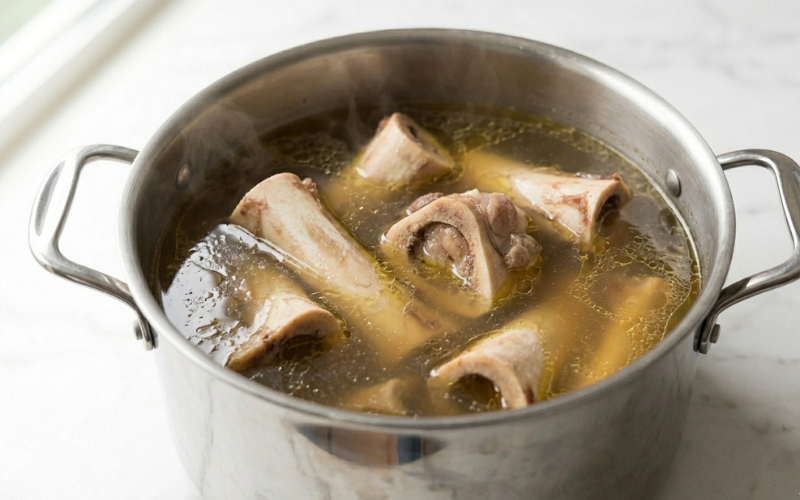
Add 4 litres cold water to the blanched bones. Bring to a boil, then reduce heat to a bare simmer — small bubbles breaking the surface every 2–3 seconds only. Add charred onion and ginger, spice sachet, daikon (if using), and 1 tsp salt. At 40 minutes: remove one piece of brisket, plunge into an ice water bath, then refrigerate — this is your serving meat. Leave the rest in the pot for full flavour extraction. Skim every 30 minutes for the first 2 hours. Simmer 3.5–4 hours total.
💡 Why this mattersA rolling boil emulsifies fat droplets into the water, creating a permanently cloudy broth that cannot be clarified. A bare simmer keeps fat rising to the surface where it can be skimmed. The 4-hour minimum is needed for collagen from the knuckle bones to fully convert to gelatin — this is what gives pho broth its characteristic body and the slightly lip-coating texture that water-based broths lack. -
6
Strain the Finished Broth
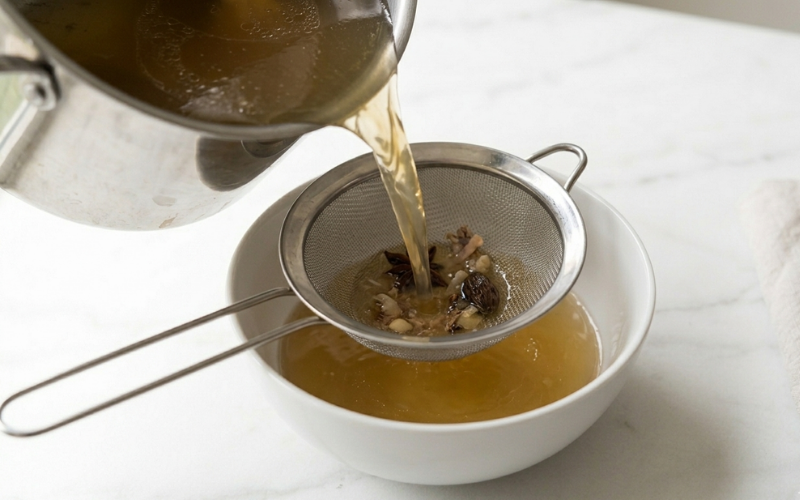
After 4 hours, remove and discard bones, sachet, ginger, onion, and daikon. Remove remaining brisket — slice thinly against the grain for serving. Line a fine mesh sieve with a layer of damp muslin cloth and set over a clean large pot. Ladle the broth through in batches — do not pour all at once as rushing disturbs the sediment at the bottom. Discard the sediment in the muslin. The strained broth should be a clear golden amber.
💡 Why this mattersEven a carefully simmered broth contains fine particulates that settle during cooking. The muslin cloth catches these while allowing the clear, flavoured liquid through. A metal sieve alone is insufficient for restaurant-quality clarity — the muslin layer is what produces the visually beautiful clear broth that signals quality in a bowl of pho. -
7
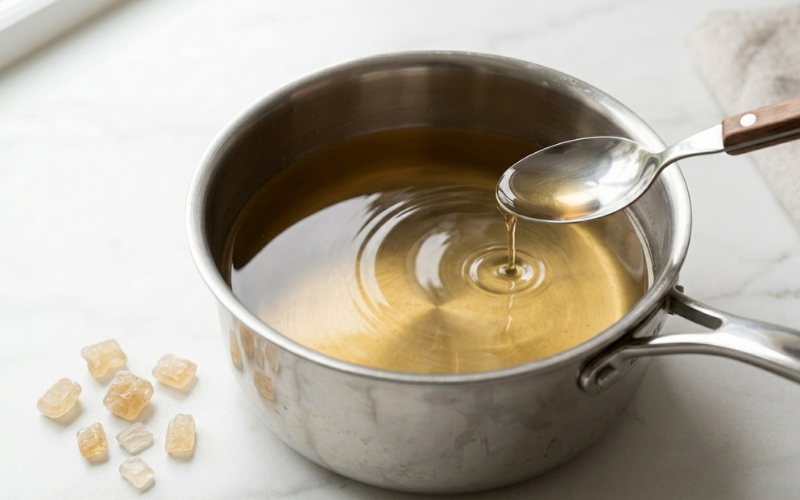
Season: Fish Sauce, Rock Sugar, Salt
Taste the strained broth. It should be beefy and aromatic but underseasoned. Add fish sauce in ½ tbsp increments (start with 2 tbsp total) — fish sauce adds deep umami salinity, not fishy flavour. Crush rock sugar and dissolve in the hot broth (add in small pieces, taste after each). Add salt as needed. The finished broth should taste savoury-sweet, with a background anise note, and that deep camphor-smoke from the black cardamom. Bring to a simmer before ladling into bowls — never boil the seasoned broth.
💡 Why this mattersFish sauce and rock sugar are not optional — they are what make pho broth taste like pho rather than beef stock. Fish sauce contributes glutamate umami that salt alone cannot replicate. Rock sugar (vs white sugar) adds a softer, more rounded sweetness. The balance between the two is a personal preference — start conservative and build. Boiling after seasoning drives off the delicate volatile aromatics from the spices that took 4 hours to extract.
What Makes Restaurant Pho Taste Different
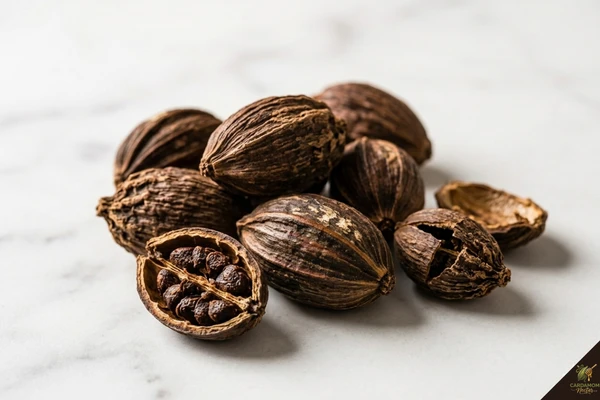
A single black cardamom pod must do significant flavour work in a 4-litre broth. Small, cracked, or stale pods (common in supermarket spice aisles) have lost most of their volatile oils. Buy from a Vietnamese or South Asian grocer with high turnover — the pod should be large (2–3cm), fully intact, and smell distinctly smoky when scratched. See our cardamom buying guide for specific sourcing advice.
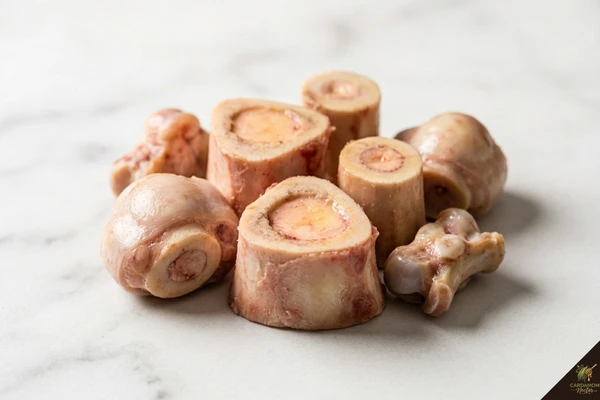
Knuckle (joint) bones are high in collagen which converts to gelatin during the long simmer, giving the broth body and that slightly lip-coating richness. Marrow bones add fat-soluble flavour compounds. Using only marrow bones produces a greasy, thin broth; only knuckle bones produces a thick broth with less flavour complexity. The 60:40 knuckle-to-marrow ratio gives the best of both. Adding oxtail improves the broth further — it contributes both collagen and deep beef flavour.
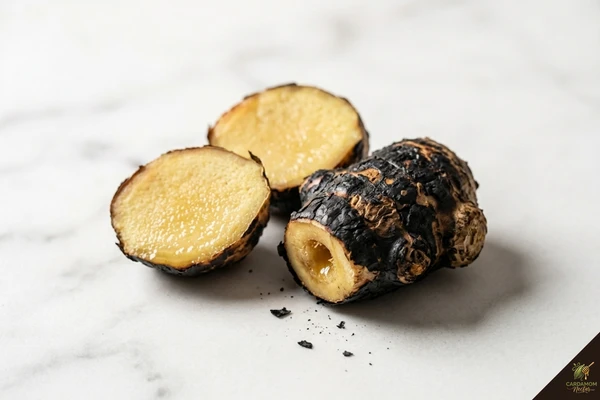
Most home cooks under-char the ginger and onion, producing only mild colour change. The charring should be genuine — blackened and slightly crisp on the cut surfaces, with visible char marks. The deeper the Maillard reaction at the surface, the more caramel and smoke compounds dissolve into the broth. Over-charring to actual burning (completely black, ashy) creates bitter compounds — aim for “darkly charred edges” not “fully carbonised.”
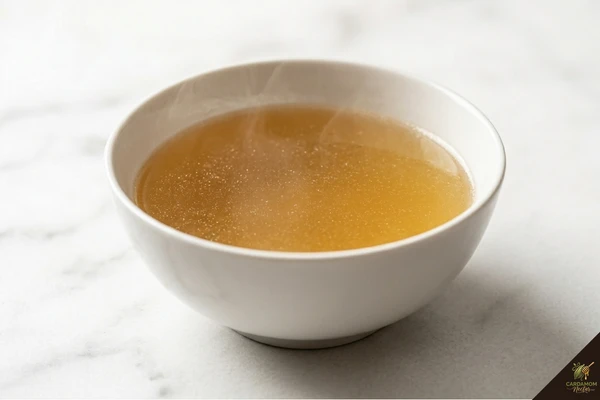
The visual quality of pho broth (clear vs cloudy) is entirely determined by heat management. A rolling boil creates turbulence that breaks fat droplets into tiny emulsified particles — these cannot be removed by skimming or straining and permanently cloud the broth. A bare simmer allows fat to rise cleanly to the surface for skimming. If your broth goes cloudy during cooking: reduce heat immediately, skim vigorously, and it will begin to clarify. It will not fully recover but will improve.
Difficulty Level & Time Breakdown
This is one of the most accessible recipes on this site despite the time commitment — the 4-hour simmer is almost entirely passive. A beginner who has made soup before can make excellent pho broth. The technique is mostly about managing heat and not rushing. Budget a weekend afternoon — start at 1pm, eat by 6pm.
Nutrition Information
Per serving — broth only (approx. 375ml). Does not include noodles, meat toppings, or garnishes which are added at serving.
Note: Gelatin content comes from collagen extracted from knuckle bones during the 4-hour simmer. This contributes to gut-lining support and the characteristic body of the broth.
↑ Back to topFrequently Asked Questions


Emily covers South Asian spice culture, recipe development, and market sourcing. She has visited spice markets in Kerala, Karachi, and Dubai and writes all recipe content on CardamomNectar. Her approach prioritises kitchen science — the why behind technique — and sourcing accuracy grounded in direct market experience.
View Profile →
Dr. Bennett reviews all scientific and technical content on CardamomNectar. His expertise in volatile oil composition and spice phytochemistry ensures all data meets peer-reviewed standards. He verified the claims in this article on camphor and cineole extraction during dry-toasting and the Maillard chemistry of charred aromatics in Vietnamese pho.
View Profile →