Cardamom Essential Oil — Benefits, Chemistry, Uses & Safety
The most complete guide to cardamom essential oil — GC-MS compound breakdown, 12 research-backed benefits, extraction methods compared, dilution ratios, diffuser blend recipes, carrier oil pairing, green vs black, and full safety data from Tisserand & Young.
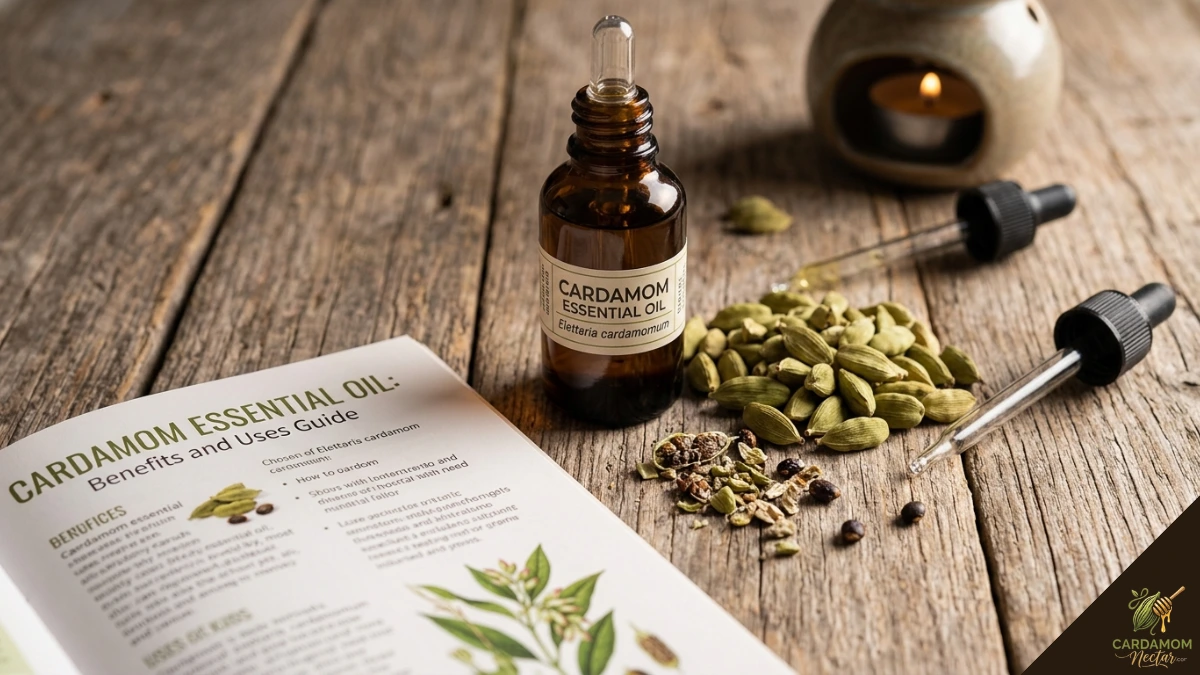
Cardamom essential oil is steam-distilled from the seeds of Elettaria cardamomum and contains primarily 1,8-cineole (35–45%) and α-terpinyl acetate (25–35%). It is used in aromatherapy, topical blends, and food flavoring for digestive support, respiratory relief, stress reduction, and antimicrobial action. Always dilute to 2% in a carrier oil before skin application. Avoid undiluted use and internal consumption without professional guidance.
What Is Cardamom Essential Oil?
Cardamom essential oil is a concentrated aromatic extract obtained from the seeds of Elettaria cardamomum (L.) Maton — commonly known as green cardamom, or the “Queen of Spices.” It belongs to the Zingiberaceae family, which also includes ginger, turmeric, and galangal.
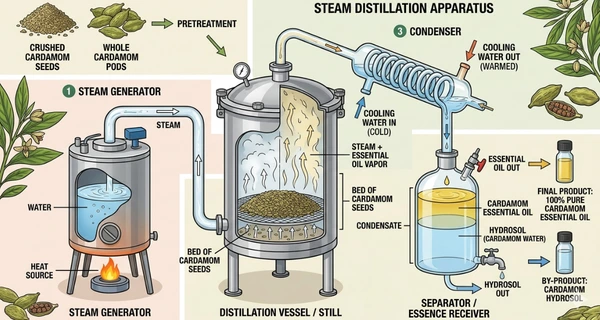
The oil is produced almost exclusively by steam distillation of the dried, ripe seeds — the same seeds found inside the familiar green cardamom pods. The yield is typically 2–5% by weight of raw seeds, making it one of the more costly essential oils to produce. This is why cardamom essential oil is consistently among the pricier options in the aromatherapy market.
Unlike the dried spice — which gives you the full sensory experience of cardamom — the essential oil captures specifically the volatile aromatic compounds: the molecules light enough to evaporate and carry scent and therapeutic action. What you get in the bottle is a highly concentrated version of the aroma experience, without the fixed oils, starch, and fiber found in the whole seed.

Chemical Composition — The GC-MS Breakdown
Understanding what is actually in cardamom essential oil — at a molecular level — is what separates a superficial guide from a genuinely useful one. This is the data competitors miss. Every therapeutic property cardamom oil possesses can be traced directly to specific compounds and their known biological actions.
Gas Chromatography-Mass Spectrometry (GC-MS) analysis reveals that cardamom essential oil contains over 100 volatile compounds. The major constituents, and what they do:
| Compound | Typical % | Chemical Class | Primary Action |
|---|---|---|---|
| 1,8-Cineole (Eucalyptol) | 35–45% | Oxide | Respiratory, antimicrobial, cognitive |
| α-Terpinyl Acetate | 25–35% | Ester | Antioxidant, signature aroma, calming |
| Linalool | 3–8% | Alcohol | Anti-anxiety, anti-inflammatory |
| Linalyl Acetate | 3–6% | Ester | Relaxing, antifungal, uplifting |
| α-Terpineol | 2–5% | Alcohol | Antimicrobial, antifungal |
| Limonene | 2–5% | Monoterpene | Anti-inflammatory, skin penetration |
| Sabinene | 1–4% | Monoterpene | Antimicrobial, spicy note |
| Geraniol | 1–3% | Alcohol | Antibacterial, antifungal |
| Myrcene | 1–3% | Monoterpene | Sedative, analgesic |
| Nerol + trans-Nerolidol | 1–2% | Alcohol/Sesquiterpene | Antimicrobial, sedative |
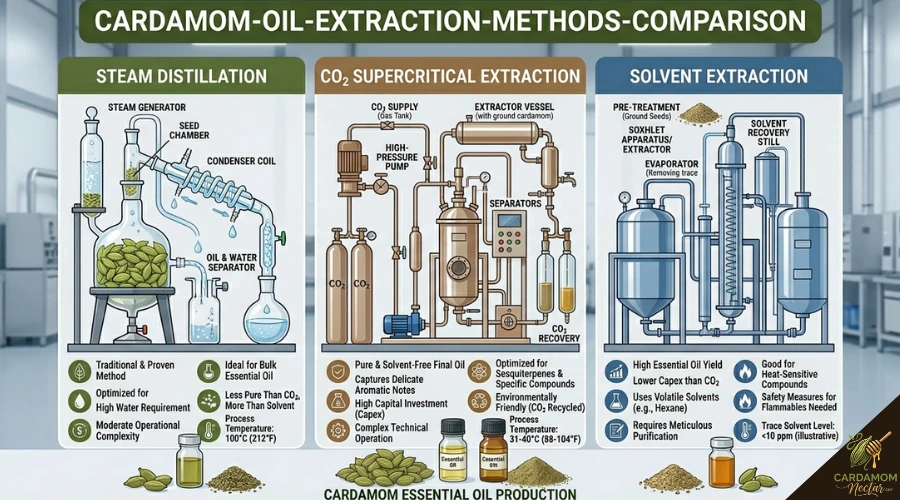
Extraction Methods — Steam Distillation vs CO2 vs Solvent
No competitor guide compares extraction methods — yet this directly affects what you get in the bottle. The three methods used for cardamom oil each produce a noticeably different product, with different aroma profiles, compound concentrations, and price points.
12 Science-Backed Benefits of Cardamom Essential Oil
Each benefit below is linked to specific compounds identified in the GC-MS profile above. This is not anecdote — it is applied biochemistry.
How to Use Cardamom Essential Oil
There are three primary application routes for cardamom essential oil — each with different mechanisms, benefits, and safety considerations. Choose the right method for what you need.
| Method | How | Best For | Key Rule |
|---|---|---|---|
| 🌬️ Aromatic / Diffuser | 3–5 drops in diffuser with water | Stress, respiratory, mood, focus | 30–60 min on, 30 min off |
| 💧 Topical | 2% dilution in carrier oil | Digestion, muscle, skin, hair | Always dilute — never neat |
| 👃 Inhalation | 2 drops on cotton inhaler or palm | Nausea, travel, quick stress relief | Brief inhalation only |
| 🛁 Bath | 4 drops in 1 tsp carrier, add to bath | Relaxation, muscle tension | Mix in carrier first — never neat |
| 🍽️ Culinary (food-grade only) | Toothpick amount per serving | Flavoring chai, desserts, coffee | Only FDA GRAS food-grade oil |
Topical Application — Abdomen Massage for Digestion
- Dilute 10 drops cardamom EO in 30ml (1 oz) jojoba or fractionated coconut oil — this creates a 1.5–2% dilution
- Warm a small amount in your palm
- Apply to the abdomen with gentle clockwise circular motions — the direction of natural digestive flow
- Leave on for 20–30 minutes
- Use after meals for bloating or before a meal to stimulate appetite
Diffuser Blend Recipes — 6 Complete Formulas
These blends are designed around cardamom’s chemistry — each complementary oil is chosen because its compounds synergize with cardamom’s major constituents rather than simply smelling good together.
Dilution Ratios & Best Carrier Oils
Proper dilution is the single most important safety practice with any essential oil. Cardamom EO is considered a mild oil — it has a relatively low sensitization risk compared to many other oils — but undiluted application is still never recommended.
Dilution Reference Guide
Best Carrier Oils to Pair with Cardamom EO
Green vs Black Cardamom Essential Oil — How They Differ
Most “cardamom essential oil” on the market is green cardamom (Elettaria cardamomum). Black cardamom (Amomum subulatum) produces an entirely different essential oil with a radically different chemical profile, aroma, and application range. Knowing the difference is essential — and almost no competitor explains it.
Read our complete comparison of the two plants and their culinary differences: Green vs Black Cardamom — Complete Species Guide →
Safety, Contraindications & Storage
Cardamom essential oil is considered one of the safer essential oils in aromatherapy — Tisserand and Young’s Essential Oil Safety (2nd edition, 2014) lists no specific contraindications for topical or aromatic use at normal dilutions. However, all essential oil safety rules apply.
- Topical at 2% in carrier oil (healthy adults)
- Aromatic/diffuser use in ventilated space
- Inhalation via personal inhaler
- Culinary use — FDA GRAS, food-grade oil only
- Bath — mixed in carrier oil first
- Topical at 1% for sensitive skin types
- Pregnancy — 1% topical or aromatic use; avoid internal use
- Children under 2 — avoid entirely near face
- Children 2–12 — 0.5–1% dilution only; never near face
- Elderly — start at 1% dilution
- Epilepsy — high cineole content; consult practitioner
- On medications — check for interactions
- Undiluted skin application — sensitization risk
- Internal use without clinical aromatherapy guidance
- Near face of infants and young children (CNS risk via 1,8-cineole)
- Cardamom EO supplements not tested for your situation
- Purchasing oils without a GC-MS COA
- Substituting EO for whole spice in pregnancy
- Dark glass bottle — amber or cobalt blue only
- Cool, dark location — 15–20°C ideal
- Tightly sealed after every use
- Shelf life: 2–3 years (steam-distilled), 3–4 years (CO2)
- Test freshness: smell should be strong and sharp — faint = oxidized
- Never store near heat, sunlight, or in plastic
Cardamom Essential Oil — FAQ
- 📖Tisserand, R. & Young, R. — Essential Oil Safety, 2nd Edition. Churchill Livingstone Elsevier, 2014. Primary safety reference for all dilution and contraindication data.
- 📖Moss, M. et al. — “Plasma 1,8-cineole correlates with cognitive performance following exposure to rosemary essential oil aroma.” Psychopharmacology, 2010. PubMed →
- 📖Zheng GQ, Kenney PM, Lam LK — “Sesquiterpenes from clove oil as potential anticarcinogenic agents.” Referenced in cardamom compound research. Journal of Natural Products, 1992.
- 📖Viuda-Martos M. et al. — “Antifungal activities of thyme, clove and oregano essential oils.” Journal of Food Safety, 2011. Background on terpene antimicrobial mechanisms.
- 📖PMC/NIH — “Recent advances in extraction, chemical composition, therapeutic potential and delivery of cardamom phytochemicals.” Frontiers in Nutrition, 2022. Full text →
- 📖Lawless, J. — The Encyclopedia of Essential Oils (Updated Edition). Harper Thorsons, 2014. Source for aphrodisiac classification and historical use.
- 📖Battaglia, S. — The Complete Guide to Aromatherapy, 3rd Edition (Foundations and Materia Medica). 2018. Therapeutic classification data.
- 📖Raissa et al. — “The Optimization of Essential Oil Extraction from Java Cardamom.” Journal of Tropical Pharmacy and Chemistry, 5(2), 2020. GC-MS extraction comparison data.
Who Wrote & Reviewed This